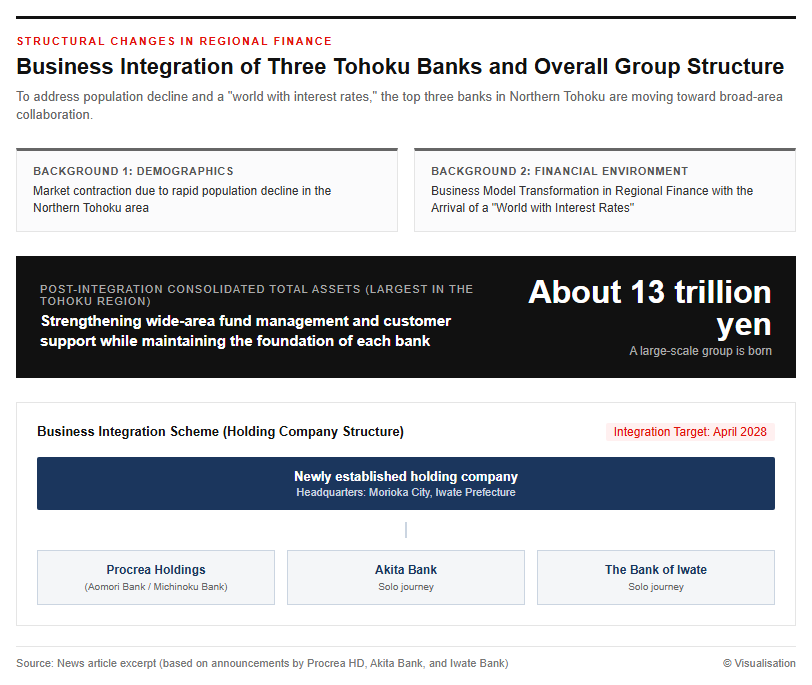
Procrea Holdings, the parent company of Aomori Michinoku Bank, along with Akita Bank and Iwate Bank, have officially announced the start of discussions toward a business integration in April 2028. This move is driven by structural changes in regional finance amid the rapid population decline in the Northern Tohoku region and the arrival of a “world with interest rates.”
- Announcement of Business Integration Discussions Aiming for April 2028 and Details of the Agreement
- A total asset scale of 13 trillion yen and a positioning of 4th nationwide in the number of main bank client companies
- Intensifying Competition Amid Accelerating Population Decline and a “World with Interest Rates”
- From “defensive restructuring” to “offensive restructuring” aimed at solving regional issues
- Backed by the Special Exception Act to the Antimonopoly Act and the government’s regional financial strength enhancement plan
- Market Approval and Future Prospects as a Broad-Area Financial Group
Announcement of Business Integration Discussions Aiming for April 2028 and Details of the Agreement
On October 2, 2026, the top three banking groups in Aomori, Akita, and Iwate prefectures agreed to begin discussions toward a business integration. Specifically, Procrea Holdings—which operates Aomori Michinoku Bank as a subsidiary—along with Akita Bank and Iwate Bank, aim to establish a holding company around April 2028, creating a structure where all three banks fall under its umbrella. Coordination is currently underway to locate the holding company’s headquarters functions in Morioka City, Iwate Prefecture. The heads of the three banks—Toru Iwayama, President of Iwate Bank; Keitaro Ishikawa, President of Procrea Holdings; and Kosuke Ashida, President of Akita Bank—held a joint press conference to announce their intention to integrate. Following the integration, the combined group’s consolidated total assets will reach the scale of 13 trillion yen, resulting in the largest regional banking group in the Tohoku region. This wide-area integration aims to strengthen cross-regional fund management and customer support while maintaining the foundations each bank has independently built thus far. Expectations have also been expressed by the Financial Services Agency and local governments, viewing the move as an initiative that will support the sustainability of the regional economy.
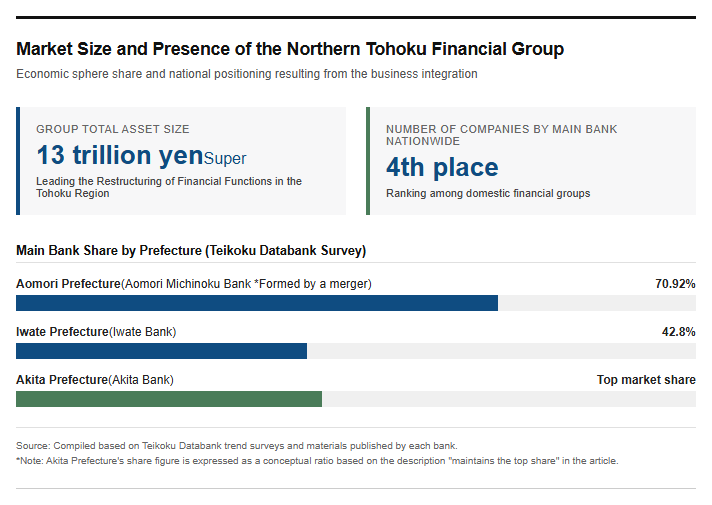
A total asset scale of 13 trillion yen and a positioning of 4th nationwide in the number of main bank client companies
The financial group born from this integration will boast an overwhelming market presence in the Northern Tohoku region. According to a trend survey by Teikoku Databank, the main bank share of Aomori Michinoku Bank—created by the merger of Aomori Bank and Michinoku Bank—reaches 70.92% within Aomori Prefecture. In Iwate Prefecture as well, Bank of Iwate accounts for 42.8% of companies in the prefecture, exceeding 40%, and Akita Bank maintains the top share in Akita Prefecture. Combining the number of client companies of these three banks forms a large-scale financial infrastructure equivalent to the fourth largest in terms of the number of main-bank client companies among financial groups nationwide. The scale of over 13 trillion yen in total assets has the impact of rapidly accelerating the restructuring of financial functions in the Tohoku region. While improving capital efficiency through wide-area business integration, the policy is to maintain each region’s branch networks and sales systems, establishing a framework that can implement extensive financial support while minimizing the impact on existing customers. An increase in the funding capacity for regional core industries and small and medium-sized enterprises is expected.
The background behind steering toward a business integration and structural changes in the industry
Intensifying Competition Amid Accelerating Population Decline and a “World with Interest Rates”
In the Northern Tohoku region, population decline and aging are progressing at a pace exceeding the national average, and the reduction in the number of local business establishments and sluggish lending markets have been long-standing issues. Furthermore, there are concerns about the outflow of household financial assets outside the prefecture due to upcoming inheritances, and individual banks have been facing the limits of their business models of relying solely on lending interest income. Amidst this backdrop, the full-fledged transition to a “world with interest rates” following the Bank of Japan’s policy rate hike has intensified competition for deposit acquisition, raising the risk of rising funding costs. While rising interest rates have positive aspects for bank performance, they also exert management pressure on small and medium-sized enterprises with weak profitability and induce selective behavior among depositors, creating an environment where the soundness and adaptability of financial institutions are strictly tested. Before it becomes difficult to maintain an independent management base, it was essential to steer toward a proactive integration by taking advantage of a period of favorable business performance. These environmental changes have been a major factor pushing the three banks, which have a long history of cooperative relations, toward full-scale business integration negotiations.
From “defensive restructuring” to “offensive restructuring” aimed at solving regional issues
In the past, regional bank restructuring was predominantly a “defensive consolidation” aimed at avoiding crises, such as first-tier regional banks absorbing second-tier regional banks that had fallen into deteriorating financial performance. However, this integration differs significantly in that it is a wide-area “offensive consolidation” that adopts a holding company structure capable of maintaining each bank’s independence and brand. The three banks have built up step-by-step collaboration over more than 20 years, starting with the mutual opening of ATMs in 2000 and the standardization of core banking systems, followed by Akita Bank and Iwate Bank concluding a comprehensive business alliance in October 2021. Rather than solely aiming for cost cuts through branch closures and workforce reductions, this integration places its highest priority on enhancing problem-solving capabilities in non-financial fields—such as digital investments in AI implementation and cybersecurity measures, M&A and business succession support, and the creation of regional revitalization funds. Building a system that consolidates the management resources of the three banks to comprehensively support advanced challenges faced by regional companies, such as labor shortages and decarbonization, is positioned as the growth strategy for the entire group.
Policy Support, Market Assessment, and Future Outlook
Backed by the Special Exception Act to the Antimonopoly Act and the government’s regional financial strength enhancement plan
Supporting the wide-area restructuring of regional banks is the government’s generous policy support framework. Under the Special Act on the Antimonopoly Law enacted in November 2020, mergers aimed at maintaining regional financial services can be exempted from the Antimonopoly Act even if they result in a high market share. Furthermore, in the “Regional Financial Strength Enhancement Plan” formulated by the government in December 2025, the application deadline for the fund-granting system to promote regional bank restructuring was extended by five years until the end of March 2031. Under this system, not only was the maximum grant limit for mergers increased from the conventional 3 billion yen to 5 billion yen, but cancellation penalties associated with terminating existing systems were also newly included as eligible for support. While the integration of core banking systems and cancellation costs had been major barriers in past integrations, the fact that public support has dramatically lowered these hurdles encouraged the decision by the three banks. Minister of State for Financial Services Satsuki Katayama also indicated her intention to welcome initiatives aimed at management reform of regional financial institutions and the strengthening of financial intermediary functions at a post-cabinet press conference, making the policy tailwind clear.
Market Approval and Future Prospects as a Broad-Area Financial Group
Following the news that the integration talks had begun, the stock market reacted favorably right away. In the Tokyo stock market on October 2, 2026, when the announcement was made, Procrea Holdings’ share price surged by over 7%, while the share prices of the Bank of Iwate and the Akita Bank each recorded gains of over 1%. Market observers appear to have welcomed the synergy effects, reduction of investment burdens, and strengthening of the management foundation resulting from the wide-area integration. The future focus will be on materializing the integration benefits toward the establishment of a holding company in April 2028. Under the holding company system, which guarantees the autonomy of each bank, cases where prompt decision-making and the avoidance of friction between organizations become challenges are not uncommon. Furthermore, regarding Aomori Michinoku Bank, which holds a more than 70% share within Aomori Prefecture, moves by financial institutions outside the prefecture to acquire sub-main bank positions are also anticipated. Whether the three banks, centered around their head office functions located in Morioka City, can provide high-value-added services—such as business matching, new industry cultivation, and labor shortage support throughout the entire Northern Tohoku region—will determine the integrated group’s long-term growth and the revitalization of the regional economy.
Reference page
- [Teikoku Databank] https://www.tdb.co.jp
[#TohokuRegionalBanks #ProcreaHD #IwateBank #AkitaBank #MainBankShare #RegionalFinance #RegionalBankRestructuring]


コメント