On July 4, 2026, U.S. President Donald Trump held a roughly 90-minute phone meeting with Russian President Vladimir Putin to discuss an early end to the fighting in Ukraine. However, the situation remains extremely uncertain, as Putin has shown no willingness to agree to an immediate ceasefire and has not withdrawn his stance to take the lead in negotiations backed by military superiority.
- Simultaneous phone call between the US, Russia, and the US-Ukraine and laying the groundwork for the Ankara summit
- Russia’s diplomatic tactics and time margin in refusing an ‘immediate ceasefire’
- The dilemma of the U.S. defense industry: falling stock prices and worsening weapons shortages
- Strong interest in Russian energy and geopolitical risks
- NATO unity and the acceleration of “defense independence” by European countries
- Resumption of Ceasefire Negotiations and Post-Ceasefire Security and Business Outlook
Simultaneous phone call between the US, Russia, and the US-Ukraine and laying the groundwork for the Ankara summit
On July 4, 2026, Russian President Putin and U.S. President Trump held a roughly 90-minute phone call. The main points of this meeting were the early end of the ongoing fighting in Ukraine, the resumption of stalled peace talks, and the conditions for a political and diplomatic solution advocated by the Russian side. Trump has expressed readiness to cooperate in ending the conflict and has indicated his intention to continue mediation by Jared Kushner and others. Interestingly, on the same day, a phone call was also held between Trump and Ukrainian President Zelensky, where opinions were exchanged on the frontline situation and U.S. support. The following diagram conceptually illustrates how these diplomatic moves overlap.
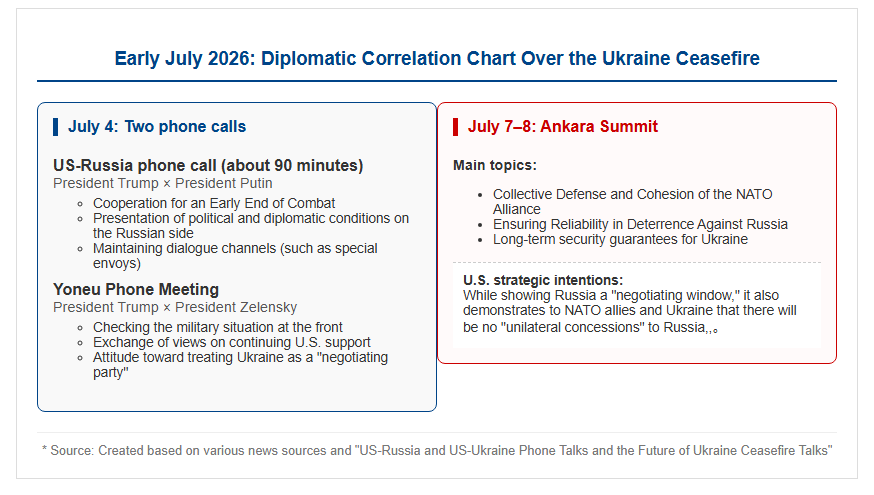
These meetings were scheduled just before the NATO summit scheduled for July 7–8, 2026, in Ankara, Turkey. The fact that Trump held talks with both Putin and Zelensky meant that the U.S. needed to act as a mediator in the ceasefire negotiations while simultaneously demonstrating a deterrent stance against Russia to NATO allies. The Trump administration is trying to dispel concerns that a “head-to-head” deal will be conducted without Ukraine by treating Ukraine not merely as a negotiating party but as a negotiating party. However, Russia is using this dialogue as a stage to justify its own position, and U.S.-Russia relations remain tense.
Russia’s diplomatic tactics and time margin in refusing an ‘immediate ceasefire’
In contrast to Trump’s optimistic remarks in this phone call for swift results, Putin showed no intention of responding to an immediate ceasefire. While Russia does not rule out the possibility of implementing a temporary ceasefire if an appropriate agreement is reached, it reiterates its traditional claim that the most important thing is to “eliminate the root causes of the crisis.” According to experts, Russia is demonstrating “time leeway” against the backdrop of battlefield superiority and is conducting a cognitive war against the Trump administration, which is rushing for early results. Please refer to the diagram below.
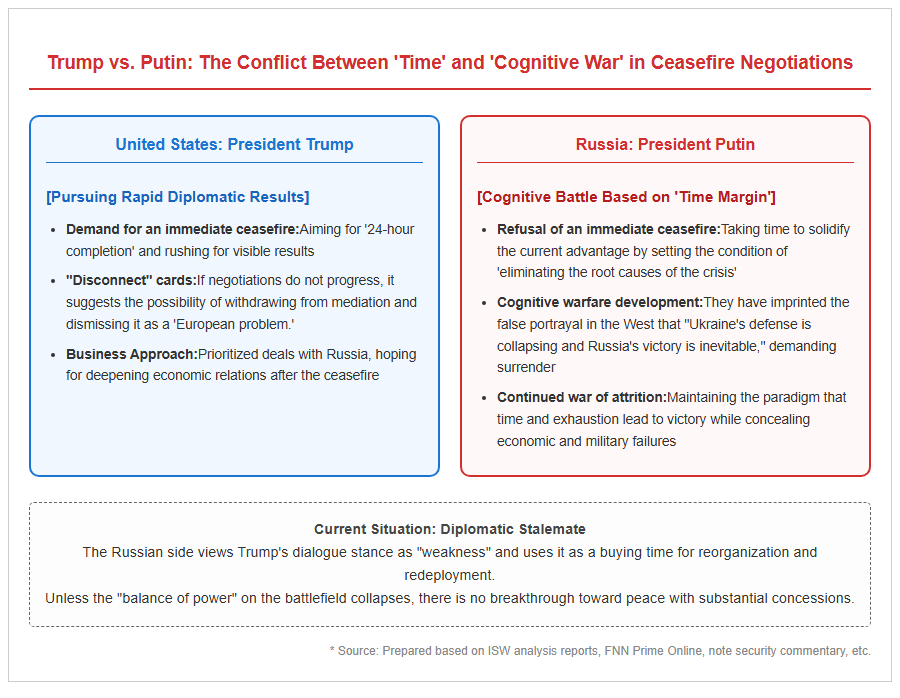
According to a report by the Institute for the Study of War (ISW), Putin continues efforts to pressure Western countries to surrender through false portrayals that Ukraine’s defense is collapsing and Russia’s victory is inevitable. In reality, the Ukrainian military has blocked significant Russian advances on multiple fronts, including Donetsk Oblast, inflicting heavy losses on the Russian side, while the Kremlin continues to conceal its own economic and military failures. For Putin, dialogue with Trump is not a step toward seeking peace, but rather a tool to exploit Trump’s conciliatory tactics, provoke divisions within NATO, and buy time for repositioning on the battlefield.
[Impact on Market and Industry] Shortages of Military Supplies and Transformation of the Energy Market
The dilemma of the U.S. defense industry: falling stock prices and worsening weapons shortages
While U.S.-Russia dialogue is making progress, the U.S. defense industry is facing a severe shortage of military supplies and the resulting market uncertainty. In late June 2026, after reports that President Trump convened senior Pentagon officials and executives from major defense-related companies such as Lockheed Martin, RTX, and Boeing to the White House to discuss measures against the weapons shortage, defense-related stocks fell. For example, as of June 22, 2026, Lockheed Martin (LMT) shares have been sold to $494, marking a significant drop from a 52-week high of $692. Due to the conflict with Iran and support for Ukraine, stockpiles of Patriot interceptor missiles and Tomahawk cruise missiles are declining at a faster pace than expected, and military officials have expressed strong concern.
Defense industry companies are rushing to expand production capacity to meet rising demand. Lockheed Martin is building and modernizing more than 20 facilities with the goal of tripling to quadruple PAC-3 and THAAD production, but formal contract finalization and budget approval have been stalled by Congress.
-
The FY2027 budget request allocates $52.9 billion for 12 types of critical weapons, most of which is included in the $350 billion budget adjustment plan facing opposition in Congress.
-
RTX is performing well, achieving double-digit growth in its existing businesses, with adjusted sales reaching $22.1 billion in Q1 2026, but if defense budget execution is delayed, the outlook remains uncertain.
Investors understand that verbal agreements and meetings do not necessarily lead directly to secured contracts, and this gap is putting downward pressure on stock prices.
Strong interest in Russian energy and geopolitical risks
The worsening situation in the Middle East, occurring alongside the war in Ukraine, especially the attacks on Iran by the United States and Israel and the effective blockade of the Strait of Hormuz, have triggered a global energy crisis. Ironically, this situation has created strong demand for Russian energy, which should be under economic sanctions. In April 2026, Russian presidential spokesperson Peskov revealed that there were “huge numbers” of purchase requests for Russian crude oil and gas from a wide range of regions. The following chart shows how the outflow destinations of Russian energy are changing.
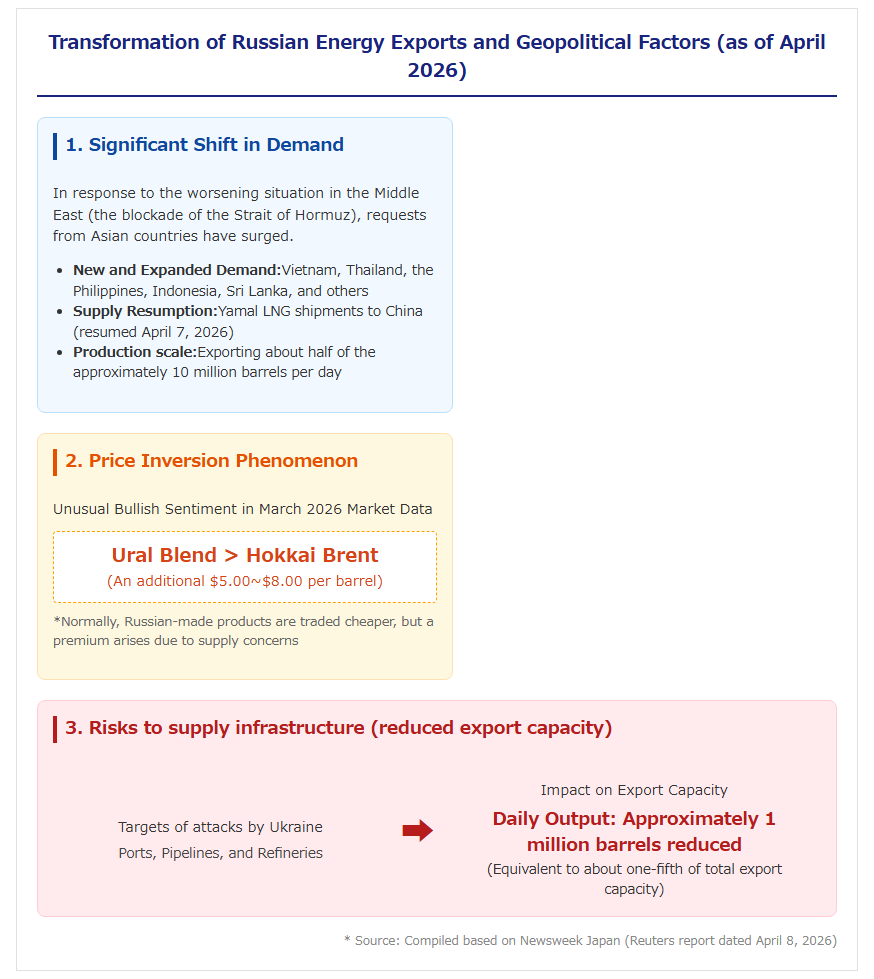
Russia’s influence in the energy market is reflected in the following figures and phenomena.
-
Russia produces about 10 million barrels of oil per day and exports roughly half of it, but disruptions in supply from the Middle East have led Asian countries such as Vietnam, Thailand, the Philippines, Indonesia, and Sri Lanka to voluntarily purchase Russian crude oil.
-
In March 2026, an unusual situation occurred when, contrary to usual circumstances, the price of Ural Blend, Russia’s main oil product, exceeded North Sea Brent crude by $5 to $8 per barrel.
-
Shipments from the Yamal LNG project to China have also resumed in April 2026, and Russia is negotiating to maximize diplomatic benefits through energy supply.
However, there are estimates that Ukraine’s attacks on pipelines and refineries within Russia have reduced Russia’s export capacity by 1 million barrels per day (about one-fifth), and geopolitical risks have always loomed over the stability of production and exports.
[Medium- to Long-Term Outlook] The Future of the New Security Order and Business
NATO unity and the acceleration of “defense independence” by European countries
The Trump administration’s “America First” foreign policy and efforts to reduce Europe’s security burden have encouraged European countries to achieve “defense independence.” In June 2025, NATO member states agreed to raise defense spending to 5% of GDP by 2035. In particular, Poland is already allocated 4.7% of its GDP to defense by 2025, highlighting the heightened sense of crisis among Eastern bloc countries close to Russia. In addition, the EU approved the “European Defence Readiness Roadmap 2030” in October 2025, embarking on strengthening its own security framework.
The key initiatives outlined in the roadmap represent a major business opportunity for Europe’s defense industry and also signify a departure from U.S. influence.
-
European Drone Defense Initiative: Aiming to advance drone technology.
-
Eastern Frank Guard: Strengthening deterrence and rapid response mechanisms along the Russian border.
-
European Air Shield and Space Shield: Strengthening integrated air defense, missile defense, and the protection of satellite assets.
President Trump’s hint at a partial reduction of approximately 85,000 U.S. troops in Europe serves as a powerful “wake-up call” for European countries, shifting toward a structure that prioritizes Europe’s own military infrastructure investment in the long term, while maintaining short-term, transactional relations of purchasing U.S.-made weapons.
Resumption of Ceasefire Negotiations and Post-Ceasefire Security and Business Outlook
The biggest focus going forward is whether the ceasefire will end as merely a “preparation period for the next war” or will become a gateway to sustainable peace. After a phone call on July 4, 2026, Trump stated that Ukraine and Russia would “immediately” begin negotiations, but reaching agreement on those terms is extremely difficult. The Russian side continues to demand international recognition of the four states they declared annexation in 2022, a ban on Ukraine’s NATO membership, and troop restrictions, while Ukraine is seeking security mechanisms (such as NATO membership and bilateral agreements) that prevent Russia from invading again.
The following points are noteworthy in the post-ceasefire world.
-
Trump intends to deepen business relations with Russia if the ceasefire materializes, and the ceasefire could trigger the resumption of economic exchanges between the U.S. and Russia.
-
However, there is strong distrust that Putin is using the negotiations as a mere “time grab,” and there are also suggestions that the U.S. might withdraw from mediation (with the stance that “it’s a European problem”).
-
As a security ‘stick,’ scenarios are being discussed in which the U.S. intensifies the supply of long-range strike weapons such as Tomahawk missiles to Ukraine or proceeds with the confiscation of frozen Russian assets, thereby forcing Russia to compromise.
Ultimately, the success or failure of a ceasefire depends less on the content of diplomatic documents and on the “balance of power” on the battlefield and whether Russia can be convinced that the cost of continuing the war outweighs the benefits of peace.
[#米露電話会談 #ウクライナ情勢 #トランプ大統領 #プーチン大統領 #防衛関連株 #エネルギー市場 #NATO首脳会議 #地政学リスク]

」_en.png)
コメント