Japan’s Ministry of Finance and Financial Services Agency have finalized plans to include tax incentives for Japanese Government Bonds (JGBs) held by individual investors in their FY2027 tax reform requests. The move is aimed at tapping households as a stable new investor base amid rising long-term interest rates and the Bank of Japan’s tapering of bond purchases.
- Synchronized Policy Push for the FY2027 Tax Reform Requests
- The Four Proposed Incentives and the Debates Surrounding NISA and Inheritance Tax
- Structural Shifts: Rising Interest Rates and BOJ Purchase Tapering
- Spreads Exceeding 1%: Deposit-to-Bond Shift Projections vs. Reality
- Deposit Outflow Concerns Threatening Regional Banks
- Policy Inconsistency with “Savings to Investment” and Coalition Skepticism
- Road to December 2026: Upcoming Policy Milestones
Synchronized Policy Push for the FY2027 Tax Reform Requests
In August 2026, the Ministry of Finance (MOF) and the Financial Services Agency (FSA) formulated a joint strategy to request tax incentives for Japanese Government Bonds (JGBs) for individual investors as part of their FY2027 tax reform proposals. This synchronized move by two agencies that have not always aligned on policy underlines the exceptionally high priority assigned to the initiative. Political groundwork had already been laid in July 2026, when the Democratic Party for the People submitted a bill to the House of Councillors advocating for the inclusion of retail JGBs in NISA (Nippon Individual Savings Account) and exempting them from inheritance tax. Shortly thereafter, Finance Minister Satsuki Katayama expressed a receptive stance toward improving the appeal of government bonds.
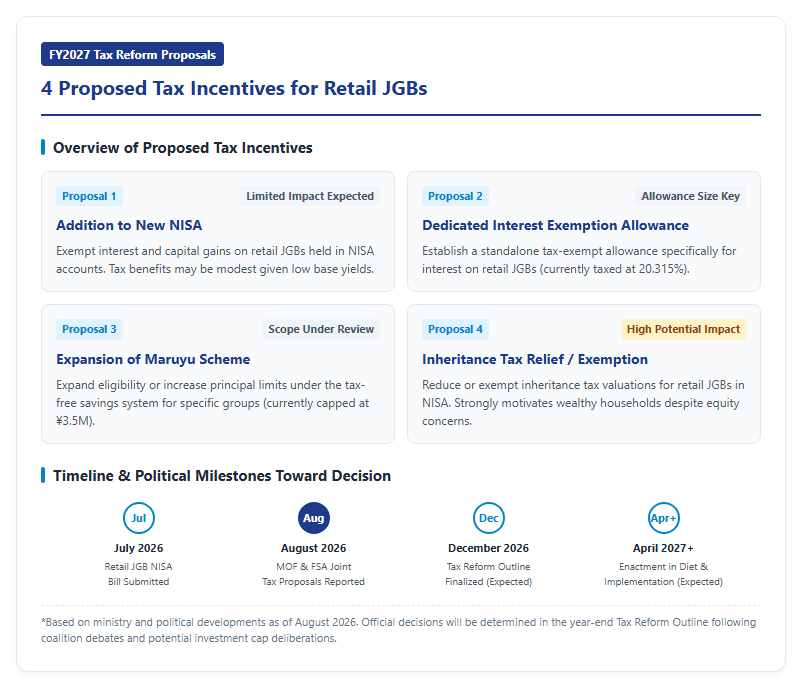
The tax incentives under consideration fall primarily into four categories. The first is adding retail JGBs to the eligible assets under NISA. While NISA currently focuses on equities and investment trusts, incorporating government bonds would render interest payments and capital gains tax-exempt. The second proposal involves establishing a dedicated tax-exempt allowance specifically for JGB interest income. The third entails expanding Maruyu (the tax-free savings scheme for individuals with disabilities and specific demographics). The fourth proposal contemplates inheritance tax reductions or exemptions for retail JGBs held within NISA accounts. The eventual scale of household capital reallocation will depend heavily on which of these measures are ultimately adopted.
The Four Proposed Incentives and the Debates Surrounding NISA and Inheritance Tax
Among the four proposed tax incentives, the expansion of NISA eligibility and inheritance tax exemptions have attracted the most intense scrutiny. However, market practitioners and experts remain sharply divided over the potential efficacy and ramifications of each measure.
Regarding NISA eligibility, critics argue that because NISA exempts investment gains from tax, the actual financial benefit for low-yielding retail JGBs is inherently modest. Consequently, it may offer limited appeal to active investors. Since NISA account holders predominantly seek capital growth through equities and equity funds, skepticism persists as to whether a risk-free asset like government bonds aligns with the core motivations of NISA investors.
In contrast, an inheritance tax reduction or exemption is expected to have a far more significant impact. For wealthy households and older demographics, estate tax planning is a critical priority. If a mechanism is introduced that allows individuals to reduce taxable estate valuations while retaining cash-like liquidity and safety, a substantial influx of wealth into retail JGBs is almost certain. Nevertheless, this proposal faces pushback from critics who warn that it unfairly favors affluent individuals and compromises tax neutrality across competing asset classes, such as real estate.
Structural Shifts: Rising Interest Rates and BOJ Purchase Tapering
The rapid emergence of the tax incentive debate stems from a landmark structural shift in Japan’s financial markets. As the Bank of Japan (BOJ) raises its policy interest rate and tapers its JGB purchases, its share of outstanding government debt dropped to 47.9% as of late March 2026, falling below the 50% threshold according to Flow of Funds statistics. With the dominant buyer that once absorbed nearly half of all outstanding sovereign debt scaling back its presence, the Japanese government faces an urgent need to secure a stable alternative buyer base.
Japanese households, holding over 1,100 trillion yen in currency and bank deposits, have emerged as the primary candidate. Currently, retail JGBs account for only about 2.0% of Japanese household financial assets—a striking contrast to countries like Italy, where retail investors hold 14% to 15% of government debt. Furthermore, retail JGBs are not traded on open markets, shielding them from market price volatility, and investors typically hold them until maturity. For the Ministry of Finance, retail investors represent a highly manageable investor base that minimizes market disruption, making the absorption of household capital vital to mitigating risks associated with rising long-term interest rates and ballooning debt-servicing costs.
Market and Household Impact: The Reality of the “100 Trillion Yen Shift”
Spreads Exceeding 1%: Deposit-to-Bond Shift Projections vs. Reality
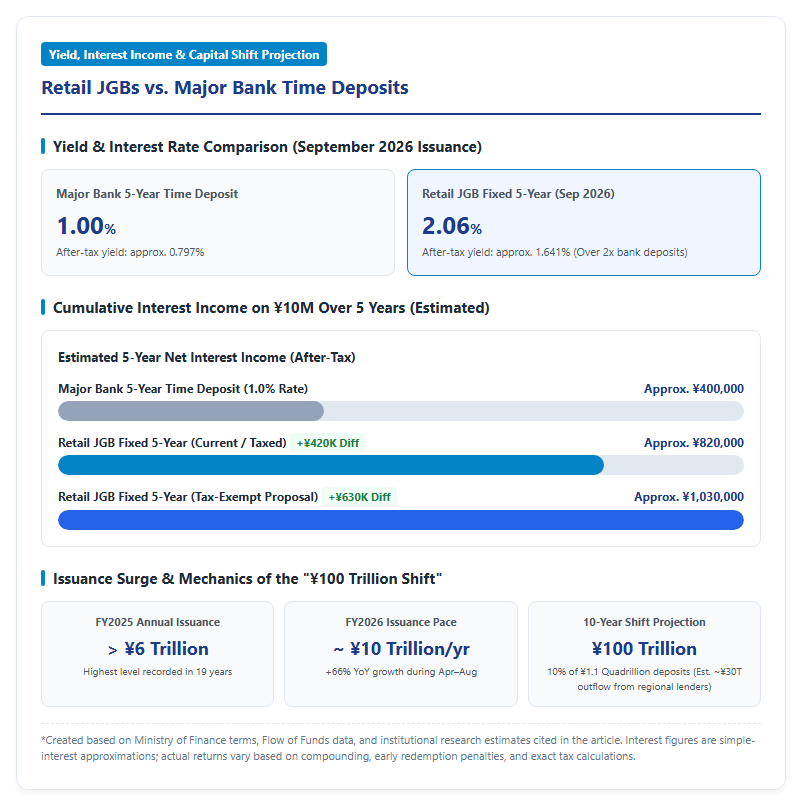
With Japan’s transition back to a positive-interest-rate environment, yields on retail JGBs have climbed sharply. For the September 2026 issuance, the coupon rate on 5-year fixed-rate retail JGBs hit a record high of 2.06%, while 10-year variable-rate bonds reached 1.87% and 3-year fixed-rate bonds stood at 1.71%. Given that the 10-year variable rate yielded roughly 0.46% in early 2024, yields have quadrupled in just over two years.
Conversely, 5-year time deposit rates at major commercial banks hover around 1%. Even after tax, retail JGB yields are more than double those of bank deposits. For instance, allocating 10 million yen over five years yields approximately 400,000 yen in after-tax interest at a major bank, compared to around 820,000 yen with 5-year fixed JGBs—a spread of roughly 420,000 yen. If interest payments become tax-exempt, after-tax earnings on the JGB investment would surge to approximately 1.03 million yen.
Driven by this substantial yield gap and principal guarantees, retail JGB issuance topped 6 trillion yen in FY2025 and is tracking toward nearly 10 trillion yen annualized in FY2026. Projections by research institutions such as NLI Research Institute indicate that if tax incentives are enacted, up to 100 trillion yen—equivalent to 10% of total household cash and bank deposits—could reallocate from bank deposits to government bonds over the next decade.
Deposit Outflow Concerns Threatening Regional Banks
A massive capital migration toward retail JGBs poses a severe headwind to the financial stability of regional banking institutions. While individual retail deposits account for 40% to 50% of total deposits at major national banks, they represent nearly 70% at regional banks. Consequently, any outflow of household deposits into government bonds will disproportionately impact regional banks and credit associations (shinkin banks).
If a 100 trillion yen capital shift occurs proportionally across the banking system, regional financial institutions could lose an estimated 30 trillion yen in deposits. Financial results for FY2025 (ended March 2026) among Regional Banks Association of Japan member banks reveal that lending growth outpaced deposit growth, driving the average loan-to-deposit ratio up by 2 percentage points to 77.3%. Furthermore, FSA surveys indicate that nearly 30% of regional banks have already experienced year-on-year declines in personal deposits.
The erosion of sticky, low-cost retail deposits forces regional lenders to rely more heavily on wholesale funding and volatile large-denomination deposits, thereby driving up funding costs and expanding liquidity risks. Concerns are mounting that a contraction in lending capacity could constrain credit to local businesses and undermine broader regional economies.
Key Challenges and Future Outlook for Policy Implementation
Policy Inconsistency with “Savings to Investment” and Coalition Skepticism
The proposed tax incentives face substantial skepticism among lawmakers within the ruling coalition and policy analysts alike. The central objection centers on the inconsistency with the government’s longstanding policy mandate of shifting household assets “from savings to investment.” NISA was explicitly designed to channel personal funds into risk assets such as equities and equity funds, fostering corporate growth and revitalizing capital markets. Extending heavy tax privileges to risk-free, principal-guaranteed government bonds risks transforming the policy mandate into “from savings to government debt,” potentially choking off the supply of risk capital to private enterprises.
Critics also highlight significant fiscal and tax equity concerns. Granting tax exemptions on JGB interest income and inheritance tax directly reduces government revenues. If additional debt issuance is required to offset these revenue losses, it could paradoxically put upward pressure on long-term interest rates. Furthermore, arguments persist that tax perks would disproportionately benefit wealthy households capable of purchasing large volumes of bonds, while effectively using tax concessions to underwrite fiscal deficits—a practice critics label as stealth debt monetization. Consequently, calls are growing for strict safeguards, such as strict investment caps and eligibility restrictions.
Road to December 2026: Upcoming Policy Milestones
Deliberations over tax incentives for retail JGBs will reach a decisive juncture between autumn and winter 2026. Following the submission of tax reform requests by government ministries in late August, the ruling party’s Tax Commission will initiate detailed debates in the autumn. The final policy outline and scope will be decided in the ruling coalition’s Tax Reform Outline in December 2026. If approved and subsequently enacted during the regular Diet session, implementation would begin in April 2027 at the earliest.
Key issues to monitor in the upcoming policy debates include: (1) scope—whether incentives will cover all three existing retail JGB products or be limited to specific tenors; (2) depth—whether provisions will extend beyond interest tax exemptions to encompass inheritance tax relief; and (3) restrictions—the establishment of annual or lifetime purchase limits to prevent disorderly capital flight. Simultaneously, efforts to enhance product features, such as introducing recurring accumulation plans or super-long maturity bonds, remain critical areas of focus.
In an era defined by positive interest rates and conscious household asset allocation, the decisions finalized in the December 2026 Tax Reform Outline will profoundly shape the destination of Japan’s 1,100 trillion yen in liquid household savings and the future of regional finance.
Reference Pages
- [Ministry of Finance] FY2027 Tax Reform Request (Joint Request by FSA and MOF)

- [Ministry of Finance] Summary of Press Conference by Finance Minister Katayama (August 25, 2026)
- [Bank of Japan] Flow of Funds Accounts
https://www.boj.or.jp/statistics/sj/sjexp.pdf
[#RetailJGBs #TaxIncentives #NISA #MinistryOfFinance #FinancialServicesAgency #RisingInterestRates #RegionalBanks #AssetBuilding]

コメント