
On June 25, 2026, Mozilla released version 152.0.3, a revised version of its desktop browser Firefox. The main purpose of this update is to resolve critical issues such as startup freezes and extreme memory consumption that occurred in certain environments.
- Solving the Memory Overconsumption Problem
- The Track of Concentrated Updates in June
- Mechanisms of resource depletion caused by language packs
- Memory management strategies that go hand in hand with efficiency
- Uncertainty in revenue structure and current market share
- The Path to a Renewed “Nova” and AI Integration
Solving the Memory Overconsumption Problem
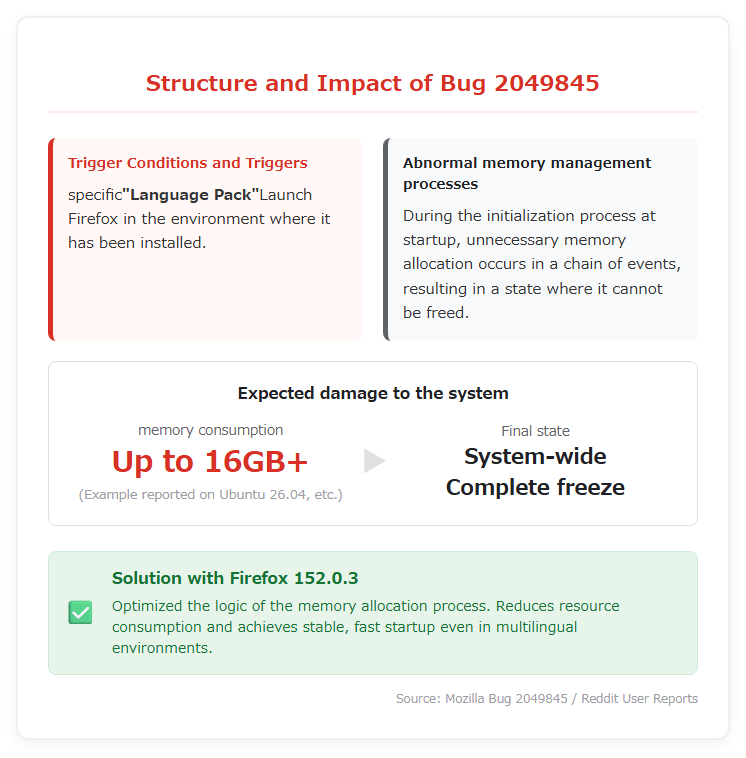
On June 25, 2026 (U.S. time), Mozilla officially released version 152.0.3, the latest update for the desktop version of Firefox. The primary purpose of this release is to fix a critical bug that significantly hindered system operation that occurred at startup in specific user environments. Specifically, in environments with the browser “Language Pack” installed, issues such as a sudden spike in memory usage immediately after startup or the application freezing and becoming unusable have been resolved. This issue is managed as a bug 2049845, which significantly compromises convenience for users worldwide who customize their language environments.
Although this update does not include any security-related fixes, it is positioned as an urgent measure to ensure browser stability. Firefox supports a wide range of platforms including Windows 10/11, macOS, and Linux, and users of these operating systems are encouraged to update to the latest version promptly. Please refer to the diagram below.
The Track of Concentrated Updates in June
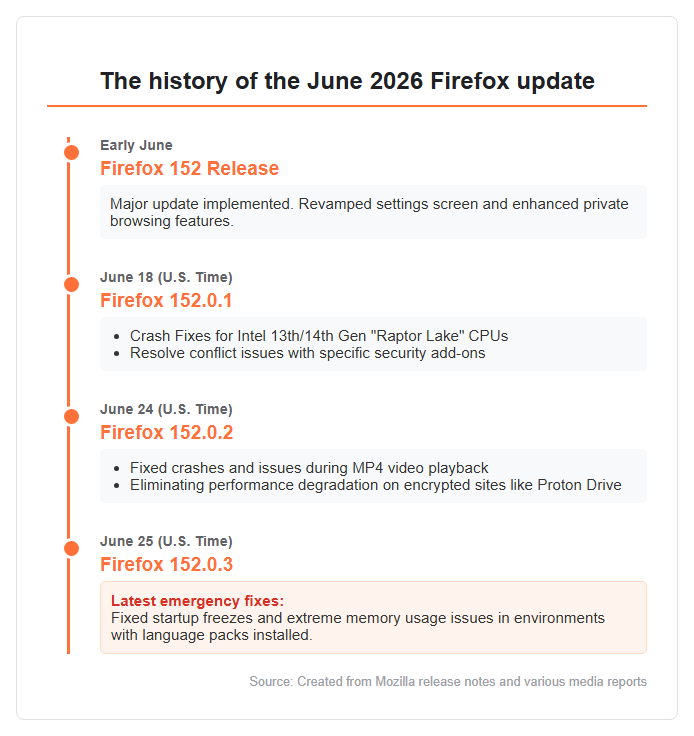
June 2026 has been an extremely busy period for the Firefox development team. This is because unexpected bugs began to surface one after another right after the release of the major update, version 152. First, on June 18, 152.0.1 was hastily released to fix frequent crashes on PCs equipped with Intel’s “Raptor Lake” processors and conflicts with certain extensions.
Then, on June 24, 152.0.2 was released, fixing issues such as poor playback of MP4 videos and significant performance drops on sites such as encrypted cloud storage “Proton Drive.” Then, on the following day, June 25, 152.0.3 was released to resolve memory issues caused by this language pack. The reason for these three minor updates in such a short period is the difficulty of covering all the diverse combinations of hardware and software worldwide through pre-beta testing. However, the rapid development process—which immediately detects issues and delivers patches within days—demonstrates the strength of the open source community.
Firefox’s Operation and Challenges from a Technical Perspective
Mechanisms of resource depletion caused by language packs
The bug fixed in 152.0.3 affected users in the form of “abnormal resource consumption” that went beyond mere delays. On the community site Reddit, users using Firefox on Ubuntu 26.04 have reported that the browser consumed about 16GB of memory upon startup, causing the entire system to crash. Originally, language packs supporting multilingual display were components to enhance user convenience, but it is believed that memory allocation was not properly performed on certain code paths or behaviors attempting to allocate unlimited space.
Such extreme memory consumption exhausts physical memory capacity and causes frequent swaps between the disk and virtual memory. As a result, the overall performance of your PC deteriorates significantly, causing not only your browser but also other applications to stop working. With the application of 152.0.3, these abnormal memory allocation processes have been properly regulated, improving stable startup even in environments with multiple language packs. Please refer to the diagram below.
Memory management strategies that go hand in hand with efficiency
The reason Firefox tends to struggle with memory consumption issues is its unique performance-focused strategy. Modern web browsers use a method to improve perceived speed, rather than frequently demanding memory from the OS, they pre-secure a “certain amount of space” and then divide it internally for use. This is a measure to reduce the overhead associated with accessing memory to the OS, but if a “memory leak” occurs when allocated space is not properly returned, there is a risk that consumption will continue to increase steadily.
Also, the ‘Garbage Collection (GC)’ mechanism, which collects memory lost through programs like JavaScript, is important. If GC runs too frequently, it causes flickering (stuttering), and if execution is delayed, it accumulates memory. Firefox has introduced settings such as efficiently performing GC while the user is away, but if certain bugs like this occur, these controls can fail and lead to memory depletion. Mozilla continuously works to optimize memory management and eliminate issues to maintain high performance while protecting privacy.
Firefox’s Current Position and Future in Market Competition
Uncertainty in revenue structure and current market share
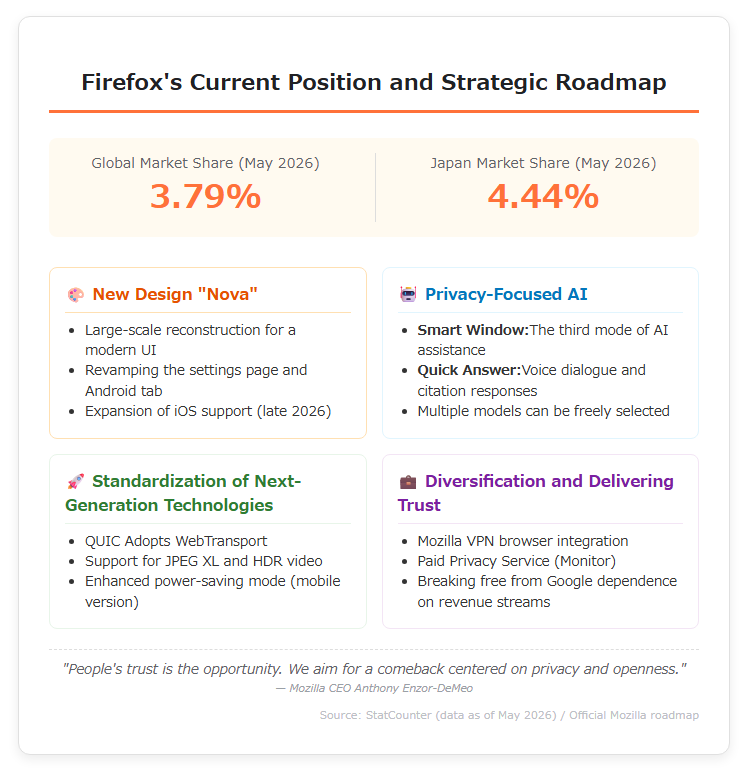
While bug fixes are progressing, Mozilla, the company operating Firefox, is facing a major turning point in its foundation. According to the latest data as of May 2026, Firefox’s global share in the desktop browser market remains at 3.79%, with a significant gap between Google Chrome (75.00%) and Microsoft Edge (9.89%). In the Japanese market, the rate remains at 4.44%, which is above the global average, but compared to the golden era when it once exceeded 30%, the situation is undeniably tough.
Even more serious are financial concerns. About 90% of Mozilla’s revenue comes from contracts to sell default search engine settings, with roughly 85% coming from contracts with Google. Currently, antitrust regulations on Google being implemented in the US and other countries could restrict this contract, and Mozilla’s CFO has warned that losing this revenue could lead to reduced investment in Firefox’s development or even a crisis to its survival. Maintaining its proprietary rendering engine, Gecko, requires enormous resources, and Mozilla is rushing to move away from its dependence on Google and diversify its revenue streams.
The Path to a Renewed “Nova” and AI Integration
Despite these headwinds, Mozilla has released an ambitious roadmap for Firefox’s revival. Planned for the latter half of 2026 is a major design overhaul codenamed “Nova.” This is an attempt to reconstruct the user interface into a more modern one, breathing new life into both visuals and user experience. Furthermore, the integration of AI features with privacy protection as the top priority was announced.
Specifically, a new browsing mode called “Smart Window” is planned. This is a third form, different from traditional regular windows or privacy windows, providing AI to assist in summarizing and comparing web content. Additionally, features such as ‘Quick Answer,’ which provides well-sourced answers when asked by voice, are planned to help users efficiently gather complex information. Although its market share is low, by establishing a unique position of AI that does not compromise privacy, it aims to differentiate itself from other browsers, solidify its core user base, and acquire new users. Please refer to the diagram below.
[#Firefox #Mozilla #ブラウザ #アップデート #メモリ消費 #AI技術 #プライバシー保護]


コメント