
On June 30, 2026, the Ministry of Land, Infrastructure, Transport and Tourism decided on a new “Wide-Area Local Plan” outlining Japan’s future vision and the “Priority Plan for Social Infrastructure Development in Local Blocks,” which sets specific projects over five years to realize it. This serves as a new guideline for building a new land that confronts the severe crises of population decline and aging infrastructure by integrating digital technology with regional resources.
- Ministerial Decision of June 30, 2026 and the Significance of the Plan
- The roles and interconnection of the two plans
- Accelerating population decline and crisis in regional centers
- The risk of ‘homelessness’ and national land degradation by 2050
- Regional industrial specialization and formation of advanced industrial hubs
- Building a ‘Community Living Area’ Connected by Digital and Mutual Assistance
- Strengthening and strengthening measures against aging infrastructure
- Realizing a Green Society and Decarbonized Infrastructure
- Synergy with the Takaichi Cabinet’s ‘Regional Future Strategy’
- Improved Private Predictability and Future Highlights
Ministerial Decision of June 30, 2026 and the Significance of the Plan
On June 30, 2026, the Ministry of Land, Infrastructure, Transport and Tourism decided on the “Wide-area Local Plan,” which sets policies for land formation for each regional block, and the “Priority Plan for Social Capital Development in Local Blocks,” which focuses on promoting social infrastructure development. This aims to realize the “Land that connects regional strength in the new era” outlined in the Third National Land Formation Plan (National Plan), approved by the Cabinet in July 2023. The new wide-area regional plan sets a long-term vision for roughly ten years, while the priority social infrastructure development plan outlines specific developments for rivers, roads, ports, and other areas over five years up to fiscal year 2020.
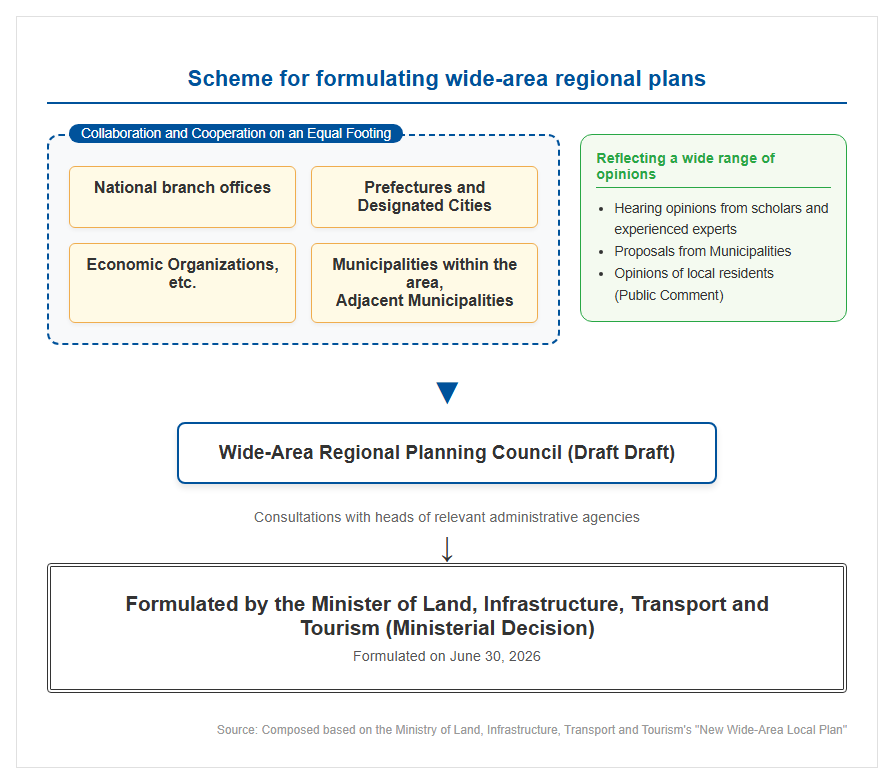
These plans were reviewed not only by national local branch offices but also by local governments and economic organizations, such as the “Wide-Area Regional Planning Council.” This breaks down the traditional silosed administration and establishes a system where the public and private sectors collaborate and cooperate on equal footing. In Japan, which stands at a crossroads such as population decline and the threat of massive disasters, this serves as an extremely important legal guideline for the community to take the lead in rebuilding a sustainable society. The following diagram shows the scheme for formulating wide-area regional plans in collaboration between the national and local governments.
The roles and interconnection of the two plans
The wide-area local plan and the key social infrastructure development plan are, so to speak, a relationship between an “ideal future vision” and a “roadmap for implementation.” The wide-area regional plan envisions each wide-area area beyond the boundaries of prefectures (eight regions: Tohoku, Shutoku, Hokuriku, Chubu,, Chugoku, Shikoku, Kyushu), maximizing the industrial and cultural strengths of each region. On the other hand, the Priority Plan for Social Infrastructure Development is an action plan that clearly states by when and how the necessary social infrastructure (such as roads, railways, airports, water systems, sewage systems, etc.) will be developed to realize the vision.
By formulating and promoting these two plans simultaneously, it is expected that infrastructure development will go beyond mere public works to directly contribute to strengthening regional industrial competitiveness and improving living convenience. In particular, its greatest feature is the ability to integrate the hardware aspects of infrastructure and the soft aspects of policy to address modern challenges such as logistics efficiency, promotion of DX (digital transformation), and decarbonization. Through this, we aim to ensure the sustainability of local communities.
[Background and Sense of Crisis] Responding to a Population Decline Society and ‘No-Resident Population’
Accelerating population decline and crisis in regional centers
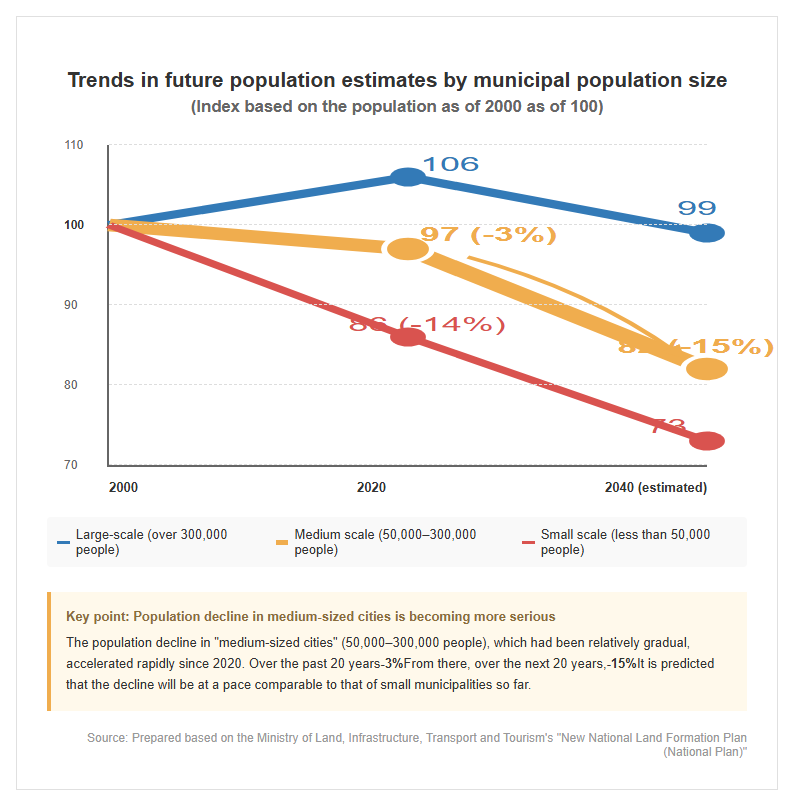
Behind the formulation of this plan lies an unprecedented sense of crisis facing Japan’s national territory. Since 2008, Japan’s total population has entered a phase of decline, with the rate of decline in rural areas reaching a serious stage. Looking at municipalities by municipal size as of 2000, small municipalities with populations under 50,000 have seen an average decrease of about 14% over the past 20 years (2000–2020). Even more serious are medium-sized cities (populations 50,000–300,000) that have played a central role in daily life in rural areas. These medium-sized cities have seen only about a 3% decline over the past 20 years, but over the next 20 years (2020–2040), their populations are expected to drop by an average of about 15%, a rate comparable to that of small cities so far.
This rapid demographic change is not just a decrease in numbers. It threatens the maintenance of public transportation in the region, the provision of medical and welfare services, and the very survival of the local economy itself. If a regional central city becomes dysfunctional, the living infrastructure of surrounding mountainous and small municipalities may collapse in a chain reaction. This plan directly addresses these “local crises,” focusing on how to efficiently reallocate limited resources and maintain and enhance regional strength. Please refer to the following estimate chart.
The risk of ‘homelessness’ and national land degradation by 2050
If the distortions in the national land structure—such as population decline and Tokyo concentration—remain unresolved, a terrifying future is predicted. According to estimates, by 2050, about 20% of residential areas nationwide could become uninhabited. When residents leave a region, it means the authority to manage the land is lost. Neglected land becomes desolate, causing damage to worsen during disasters and becoming a hotbed for illegal dumping, making it extremely difficult to revive a management system once lost.
Furthermore, if the outflow of young people from rural areas continues and the concentration in Tokyo, where the total fertility rate is low, accelerates, the overall declining birthrate in Japan will accelerate, making it impossible to escape the vicious cycle of population decline. To prevent the expansion of uninhabited areas and ensure that management covers every corner of the country, it is essential not just to maintain population but to build new regional management that utilizes location-independent work styles and digital technologies. This plan positions digital utilization to overcome constraints of location and time as a key strategy for national land development, clearly stating the goal of improving the well-being of individuals and society as a whole.
[Regional Strategies] The Future Envisions of Each of the Eight Wide-Area Areas
Regional industrial specialization and formation of advanced industrial hubs
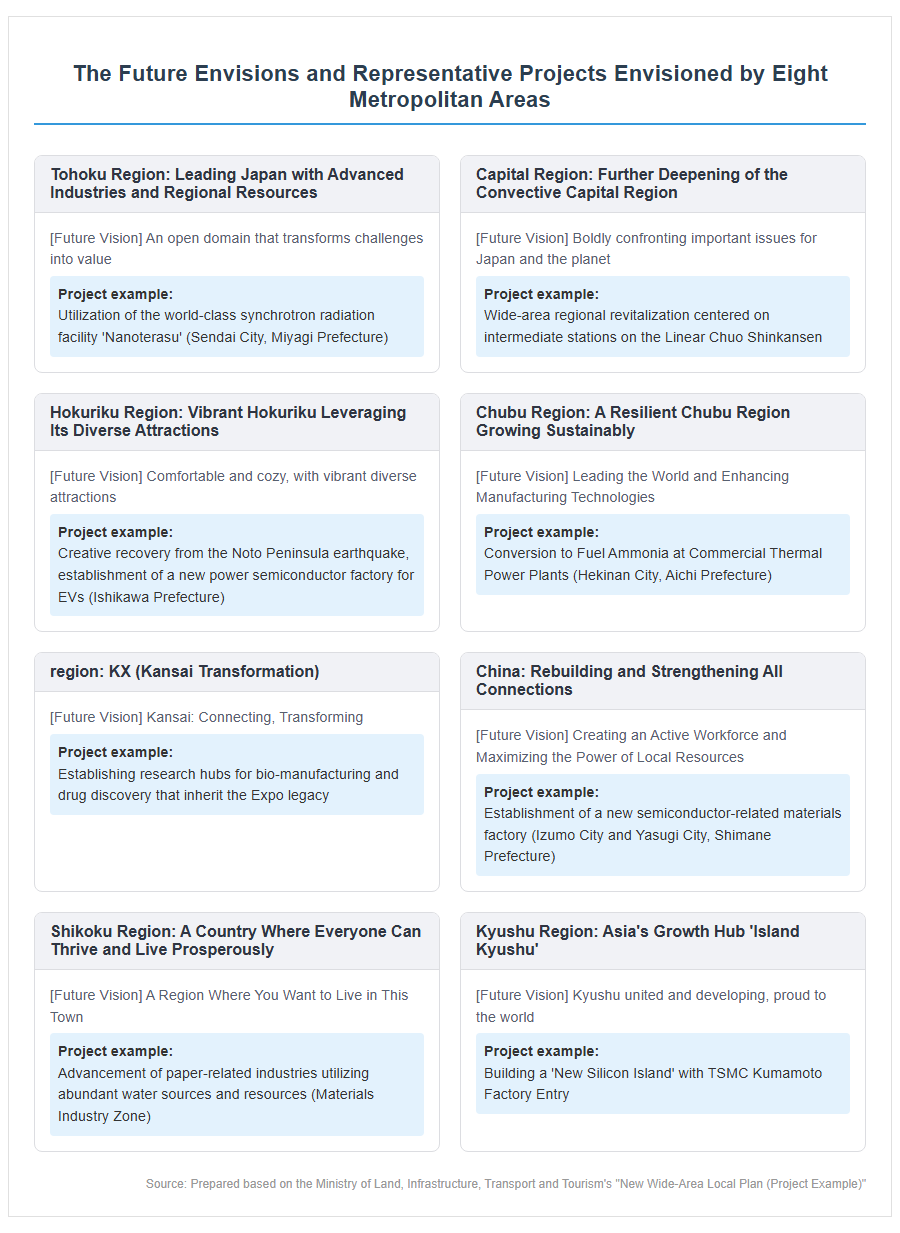
In the finalized wide-area regional plan, the eight regions nationwide are outlining future visions that leverage their respective strengths. For example, in the Kyushu region, we are aiming to build a “New Silicon Island Kyushu” that leverages abundant groundwater, supported by the construction and investment progress of world-class semiconductor factories (such as TSMC). In the Tohoku region, while utilizing vast land and rich natural environments, we are networking research and development hubs for next-generation technologies such as the world-class synchrotron radiation facility “Nano Terrace,” promoting the formation of a leading industrial hub in Japan.
The Chubu region will maintain its strength as a manufacturing hub, where shipment value for “transport machinery” accounts for half of the national market share, while also forming supply chains for hydrogen and ammonia to advance the industrial structure. Meanwhile, the region is leveraging strengths in processing technology, pharmaceuticals, and regenerative medicine to create innovation (KX: Kansai Transformation) that inherits the legacy of the Expo. In this way, each region aims to form unique industrial clusters capable of winning global competition and concentrate infrastructure investments there, thereby revitalizing the local economy and creating quality jobs. The diagram below shows examples of projects that leverage the unique characteristics of each region.
Building a ‘Community Living Area’ Connected by Digital and Mutual Assistance
To ensure convenience in areas experiencing population decline, the current plan strongly emphasizes the formation of ‘regional living zones.’ This is an effort to build a zone that goes beyond the framework of administration to provide the services necessary for daily life sustainably. Specifically, we will thoroughly leverage digital transformation (DX) to rebuild services that were previously difficult due to profitability and location constraints.
Advanced cases that have already begun in various regions are included in the plan. For example, in Asahi Town, Toyama Prefecture, the cooperative public transportation system ‘Nokkal Asahimachi’ using private cars is in operation, providing transportation options for the elderly. In Goto City, Nagasaki Prefecture, drone delivery of pharmaceuticals is carried out, supporting sustainable living in remote island areas. Additionally, in Kawanishi Town, Yamagata Prefecture, a project is underway to solve heavy labor such as snow removal through local mutual assistance systems and digital management. In this way, to improve the quality of real local spaces, digital technology is fully utilized, and new regional management in which the public, private, and local residents collaborate (mutual assistance) is the key to a sustainable national land.
[Priority Investment Direction] A safe and secure land and a green society
Strengthening and strengthening measures against aging infrastructure
One of the most urgent issues in the priority social infrastructure development plan is countermeasures against aging infrastructure. Learning from lessons such as the road subsidence accident in Yashio City, Saitama Prefecture, strengthening and enhancing aging infrastructure measures has been set as a key goal. Roads, bridges, tunnels, dams, and water pipes, which were intensively developed during the period of rapid economic growth, are all reaching the end of their lifespans. However, under budget constraints, it is impossible to maintain all facilities as if they were new. Therefore, there is a need to balance inspections and surveys, and strategically “extend lifespan” in connection with the region’s future vision and urban development plans.
Going forward, we will promote visualization of “infrastructure aging countermeasures, etc.” at the municipal level, making transparency about which areas and which facilities should be prioritized for repair. In addition, as a response to severe natural disasters caused by climate change, investments in national resilience (disaster prevention and mitigation) will continue. In addition to traditional aging measures, civil engineering projects to protect citizens’ lives will be intensively carried out, such as strengthening levees and dredging works to prevent river flooding caused by super typhoons and linear rainbands. Securing and developing human resources to support the construction industry is also positioned as an important foundational strengthening measure integrated with infrastructure development.
Realizing a Green Society and Decarbonized Infrastructure
The new plan aims to achieve carbon neutrality (CN) by 2050, with the realization of a green society led by the infrastructure sector as one of its key goals. This is not just about reducing emissions, but about leveraging infrastructure itself as a decarbonization engine. Specifically, we support the construction of next-generation energy supply chains, such as converting fuel to ammonia at commercial thermal power plants and establishing facilities to produce hydrogen from electricity and water powered by solar power.
There is also a goal to build a resource-circulating economic and social system (circular economy). By promoting the carbon-neutral ports (CNP) of ports and airports, we will enhance our international competitiveness while contributing to the conservation of the global environment. Representative indicators (KPIs) have been set to objectively evaluate the progress of these environmental initiatives, and steady achievement is required. The goal is not only to reduce environmental impact through infrastructure development but also to serve as a “catalyst” for attracting new environmental industries.
[Future Developments] Linking the ‘Regional Future Strategy’ with Private Investment
Synergy with the Takaichi Cabinet’s ‘Regional Future Strategy’
This National Land Plan and Social Infrastructure Development Plan will be closely linked to the government’s “Regional Future Strategy.” This strategy, presented by the Takaichi Cabinet, is characterized by inheriting the traditional trend of ‘regional revitalization’ while placing greater emphasis on revitalizing the economy and industry. To form industrial clusters by block, we have formulated a ‘Strategic Industry Cluster Plan’ and aim to concentrate industries related to the government’s ’17 strategic fields’—such as semiconductors, shipbuilding, space, and AI—in each region.
Supporting this industrial cluster is the newly decided social infrastructure development. In addition to infrastructure development such as roads, railways, and industrial water, the government has announced a policy to secure budgets “separate from the existing budget” for private capital investment in facilities like shipbuilding docks. By demonstrating strong government support, the aim is to enhance the foresight of private companies and attract large-scale private investment to rural areas. For example, the formation of semiconductor clusters in Kyushu and strengthening collaboration with the automotive industry are concrete examples. By clarifying the focus areas for public and private investment, a model for autonomous growth of localities will be established.
Improved Private Predictability and Future Highlights
The focus going forward will be how steadily the long-term vision and action plan decided this time will be budgeted and can draw out the vitality of the private sector. When introducing advanced technologies such as smart cities and MaaS, local government budgets alone have limits to sustainability, so it is essential to build a monetization model that enables the business to run independently. This plan emphasizes the establishment of councils for collaboration among the public, private, academia, and private sectors, as well as the promotion of open innovation.
Addressing the logistics issues of 2024 is also an urgent task. To address challenges such as delays in delivery of construction materials and rising transportation costs, logistics efficiency improvements through infrastructure development (modal shift and establishing the foundation for joint transportation) are anticipated. Additionally, DX and the introduction of construction robots to support the construction industry’s own “work style reform” will be key factors that determine the success or failure of the plan. Based on the new plan, five years will begin in which each region can express its individuality and form a land where people can have hope for the future—this will be the true value of the land.
[#国土形成計画 #広域地方計画 #社会資本整備 #地方創生 #人口減少対策 #デジタルトランスフォーメーション #カーボンニュートラル #インフラ老朽化]

コメント