
On March 12, 2026, NEC announced the world’s first physical AI technology that predicts human movements and psychological states in real time to optimize robot behavior. This technology aims to address labor shortages and improve productivity in logistics and retail settings by providing not only physical safety but also psychological reassurance.
- Innovation in communication through the world’s first ‘human-based world model’
- Two advanced predictive models that anticipate movement and anxiety
- Improved flexibility in layout design by eliminating the need for dedicated plots
- The Industrial Significance of Physical AI Targeting the 20 Trillion Yen Market
- Fierce domestic and international competition and a unique position
- Establishing international regulatory compliance and ethical governance
- Roadmap for Social Implementation Toward Practical Use in FY2027
Innovation in communication through the world’s first ‘human-based world model’
The physical AI technology announced by NEC on March 12, 2026, is characterized by its use of a proprietary “human-like world model.” This is the world’s first attempt to estimate the anxiety people feel when interacting with robots in real time and quantitatively, and to directly reflect that information in the robot’s driving control. Traditional autonomous robots have focused on physical safety by using sensors to detect and avoid obstacles, but NEC’s new technology goes a step further and is designed with ensuring “psychological safety” with humans as the top priority. Specifically, it predicts in advance the degree of anxiety that robots will experience when approaching people, and autonomously selects and controls movement paths and speeds so that humans do not feel intimidated or excessively tense. Such technological approaches are expected to create collaborative environments where people can work with peace of mind, significantly reducing the psychological barriers associated with introducing robots on-site.
Two advanced predictive models that anticipate movement and anxiety
Supporting this groundbreaking technology are two independently combined advanced predictive models. The first is a “motion prediction model” that obtains human 3D skeletal information from camera footage and robot control data, and accurately predicts position and posture several seconds ahead. This allows the robot to anticipate a person’s walking speed and direction in advance, enabling smooth evasion and preemption. The second is the “anxiety estimation model,” which was trained by AI on robot running patterns and survey data from subjects. Based on physical conditions such as relative distance, orientation, and approach speed with the robot, it quantifies in real time how much anxiety a person feels. The following diagram models such interactions between humans and robots at extremely close ranges and illustrates concepts that can be applied to both passive and active control.
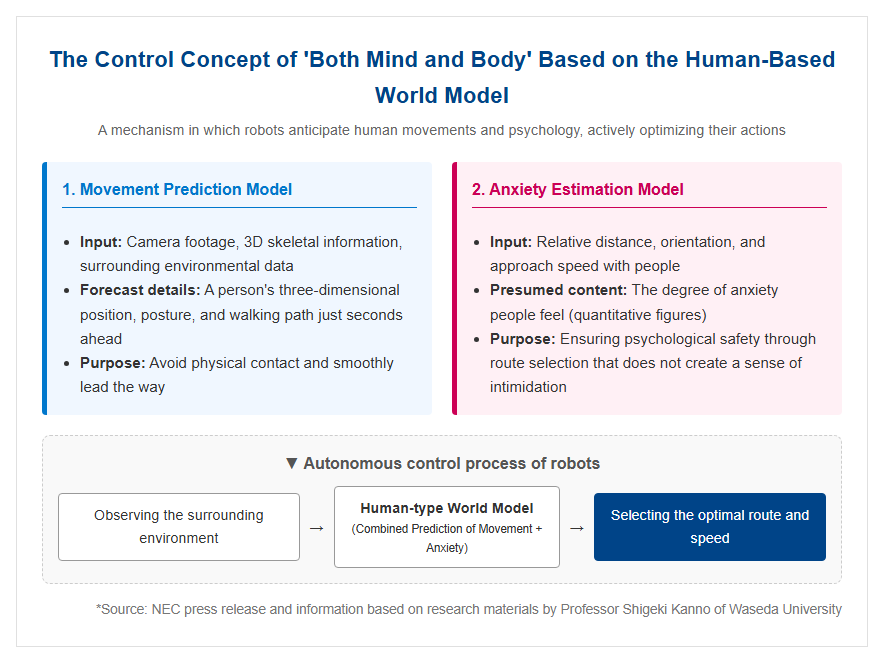
。 By closely integrating these models, robots can achieve driving that minimizes human psychological burden while maintaining unnecessary stops and deceleration, maintaining operational efficiency.
Improved flexibility in layout design by eliminating the need for dedicated plots
A major practical advantage of the social implementation of this technology is the dramatic increase in the degree of freedom in site layout. Conventional robot operations typically involved partitioning dedicated robot-specific compartments with fences or laying running lines fixed to the floor to ensure safety. However, NEC’s technology allows robots themselves to highly predict human movements and psychology, eliminating the need for large-scale facilities that physically separate the activity areas of humans and robots. Thanks to this feature, efficient robot operation becomes possible even in places where it was previously difficult to implement, such as small and medium-sized logistics warehouses and manufacturing plants with narrow aisles and frequent foot traffic, as well as retail store sales floors where general customers can freely walk. With labor shortages due to a declining birthrate and aging population becoming a serious issue, the advantage of being able to flexibly and quickly deploy robots to the site while minimizing renovations to existing facilities offers significant investment value for companies.
The Rapid Growth of the Physical AI Market and NEC’s Strategy
The Industrial Significance of Physical AI Targeting the 20 Trillion Yen Market
Physical AI, which operates autonomously in the real world, is attracting global attention as a huge growth area that will come after traditional generative AI, which specializes in information processing in digital space. The global physical AI-related market is projected to expand from $47.1 billion in 2023 to $124.7 billion (about 20 trillion yen) by 2030. The Japanese government recognizes this importance and announced the “AI Robotics Strategy” in March 2026, aiming to capture a 20 trillion yen domestic market by 2040. Additionally, the FY2026 budget plans to invest a total of 1.2 trillion yen in AI and semiconductor fields, of which about 380 billion yen will be allocated to physical AI-related fields, accelerating public-private development efforts. In 2026, AI is expected to enter an evaluation phase where it is expected not just to be a topic of interest but to demand “measurable results,” and NEC’s announced psychological prediction technology will serve as a crucial touchstone for proving practicality and effectiveness in the field.
Fierce domestic and international competition and a unique position
The battle for dominance in physical AI is intensifying among top domestic and international companies. In the United States, NVIDIA is deploying the robot learning platform “Cosmos,” while Amazon is leading the implementation of physical AI at its logistics centers, leveraging vast amounts of data. Domestically, Hitachi has declared that it aims to become the world’s top user through “HMAX,” which integrates OT (Control and Operation Technology) and IT for railways and manufacturing sites. Additionally, leading manufacturing companies such as FANUC, Yaskawa Electric, and Keyence are also rushing to strengthen physical AI by leveraging their respective strengths. In this competitive environment, NEC is aiming to build its unique advantage by integrating its long-cultivated advanced biometric authentication and AI image analysis technologies into the physical layer of robot control. This psychological prediction approach focuses not only on mechanical efficiency but also on “coexistence with humans,” presenting a value that sets it apart from competitors in the market.
Future Developments and Key Challenges
Establishing international regulatory compliance and ethical governance
Responding to international trends in product safety and legal liability related to AI is an unavoidable challenge in advancing the practical application of technology. In the European Union (EU), the comprehensive “European AI Act” came into effect in 2024, initiating strict regulations tailored to the risks of AI systems. This law imposes strong restrictions from the perspective of human rights protection, such as prohibiting the use of AI to predict human emotions in workplaces and educational settings. When deploying NEC’s psychological prediction technology globally, a major focus will be on how to adapt to these stringent regulations and ensure transparency and fairness. In Japan as well, the Ministry of Economy, Trade and Industry has formulated the “AI Business Guideline,” which proactively requires developers and providers to consider safety, accountability, and privacy. To establish innovative technologies in society, it is essential not only to improve performance but also to build a robust governance system in harmony with domestic and international legal systems.
Roadmap for Social Implementation Toward Practical Use in FY2027
NEC is steadily outlining a roadmap for the physical AI technology announced this time, aiming for practical application within fiscal year 2027. Going forward, they plan to repeatedly conduct field tests at actual logistics warehouses, stores, and manufacturing plants to refine the accuracy of predictive models for a wide variety of human movements and different psychological states. 2026 is also called the “Year of Physical AI,” predicted to be a year where concrete return on investment (ROI) beyond proof-of-concept (PoC) will be tested. NEC’s performance has exceeded analyst expectations in its May 2026 earnings announcement, providing financial backing to continue aggressive investments in new technologies. If commercialization is achieved in fiscal year 2027, it will not only be a powerful solution for industries facing severe labor shortages, but also a crucial turning point for Japan’s robotics industry to regain leadership in the global market.
[#NEC #フィジカルAI #ロボット #心理予測 #物流DX #生産性向上 #世界初 #人工知能]
_en.png)

コメント