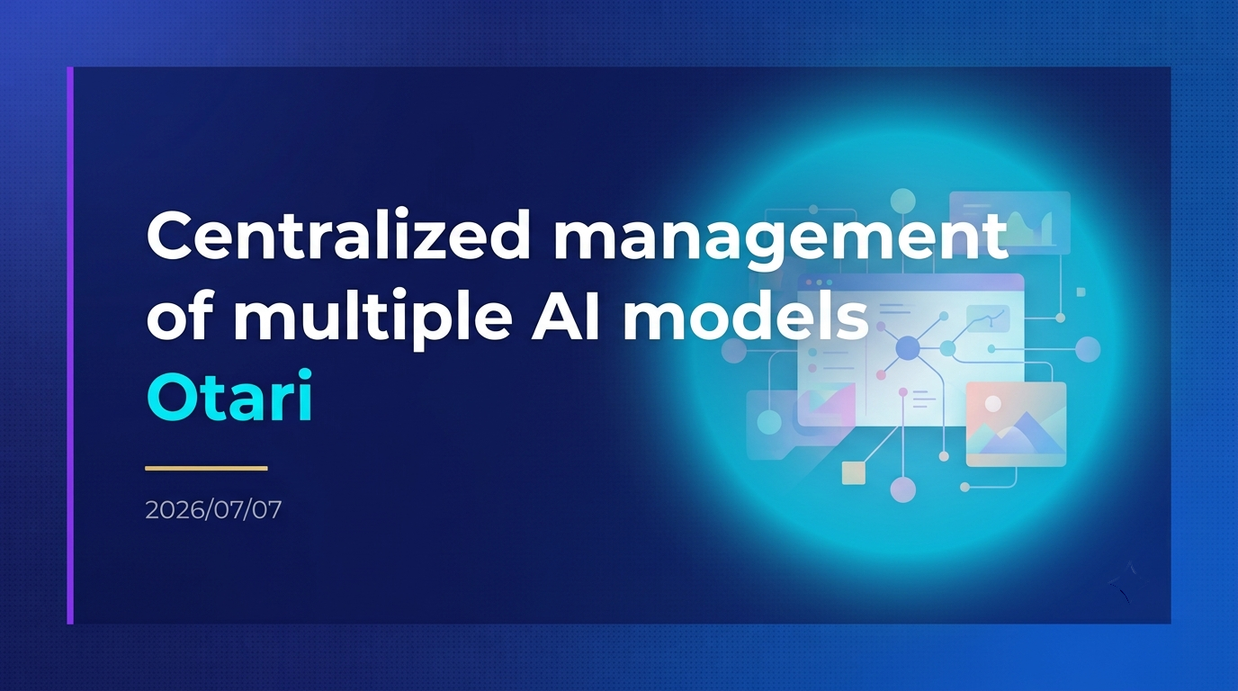
Mozilla.ai has released the open-source control plane “Otari” for centralized management of large language models (LLMs). The background is the shift in the AI market in 2026, as it faces a period of disillusionment, with companies and developers increasingly demanding cost management, transparency, and governance for AI.
- Development Background and Key Points of the Announcement
- Key Implemented Features and Technical Features
- Reassessing Cost and Value in the Era of AI Disillusionment
- The Importance of Data Sovereignty and Privacy Protection
- Integration with the AI Agent Ecosystem
- Future developments and key points to watch
Development Background and Key Points of the Announcement
Mozilla.ai, founded by Mozilla, known for developing Firefox and others, released the open-source control plane “Otari” on July 6, 2026, to effectively operate large language models (LLMs). As AI development companies increasingly move toward keeping their data private, Mozilla.ai aims to be a “company that develops AI while ensuring openness and transparency, and fulfilling accountability.” To help developers build AI systems that can be flexibly controlled, Otari was publicly launched on GitHub as an open-source project.
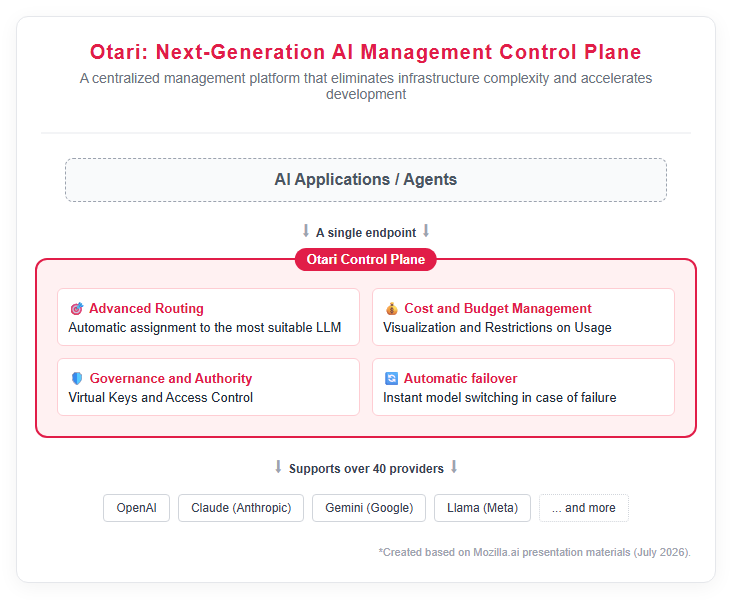
Otari sits between applications and multiple LLM providers, acting as a ‘control plane’ that manages the entire infrastructure. Until now, many organizations have faced complex infrastructure operational challenges such as building proprietary routing logic, individually managing provider keys, tracking usage, and managing budgets, which have strained development resources. Mozilla.ai aims to solve these common challenges on a single platform, providing an environment where developers can focus on developing AI applications themselves. Please refer to the dashboard image below.
Key Implemented Features and Technical Features
Otari offers multiple powerful features that enable developers and engineering teams to centrally manage AI infrastructure. Requests can be routed to over 40 different AI providers, including OpenAI, Claude, and Gemini, through a single endpoint. The main features are as follows:
-
Intelligent routing: The ability to automatically assign requests to the optimal LLM
-
Automatic failover: A feature that instantly switches to another LLM when a specific model fails to maintain reliability.
-
Cost management and visualization: Features that strictly manage LLM usage costs through usage visualization and automatic budget constraint settings.
-
Strengthening Governance: Centralized Management of API Keys, Workspaces, and Access Permissions
Additionally, Otari supports both cloud-hosted and self-hosted models, allowing flexible deployment tailored to corporate security policies. Furthermore, “Agent Harnesses,” which support AI agent development, are integrated, making it easy to build advanced AI applications with tool integration and orchestration capabilities.
Why is “centralized management” in the AI market in 2026?
Reassessing Cost and Value in the Era of AI Disillusionment
The AI market in 2026 is analyzed to be entering the “disillusionment period” of the hype cycle proposed by Gartner. The hype until 2025 has subsided, and investors and business executives have taken a calm yet skeptical perspective on whether massive AI investments can truly be recouped. According to a survey by the National Bureau of Economic Research (NBER), over 80% of surveyed executives said that “AI has yet to contribute to improving employee productivity,” highlighting the reality that the expected results are not being achieved.
In such a market environment, the need for centralized management tools like Otari is due to the growing need to visualize the “cost” and “value” of AI. When multiple AI models are used in a dispersed manner, it is difficult to grasp the total number of consumed tokens and the budget execution status of each department. Otari’s budget management features and usage visualization enable optimization of AI spending based on return on investment (ROI). As AI-related stocks enter a stage where winners and losers are selected, efficient infrastructure management has become a crucial factor that determines a company’s competitiveness.
The Importance of Data Sovereignty and Privacy Protection
While the use of generative AI is advancing, concerns over security and privacy remain major barriers to adoption. In particular, 41.7% of executives at major companies cite “security and privacy concerns” as barriers to AI utilization, making unintended information leaks and risk assessment of models urgent. Otari’s support for self-hosting is extremely important for companies that prioritize data sovereignty.
In models that rely on cloud services, it is difficult for providers to fully control how data is processed and retained, which poses risks to the handling of corporate confidential information. By using Otari, companies can operate AI stacks within their managed infrastructure and strictly control virtual keys and access privileges. It also helps avoid the risk of being locked into a single provider and builds an operational framework that complies with the latest laws, regulations, and ethical standards (such as Japan’s AI Provider Guidelines and the EU’s AI Act). Choosing open infrastructure is becoming the standard approach to transparency and accountability.
Otari’s Role and Future Outlook in the AI Agent Era
Integration with the AI Agent Ecosystem
The evolution of AI is shifting from mere chatbots to “AI agents” that autonomously make decisions and act accordingly. Entering 2026, open-source AI coding agents like OpenCode are expected to integrate with Mozilla’s Otari Gateway. This integration allows developers to fully control API costs and data privacy incurred behind the scenes, while automatically generating and modifying code by AI agents.
Otari’s “Agent Harnesses” serve as the foundation for AI agents to call external tools and orchestrate complex workflows. While over 80% of companies are positive about adopting generative AI, tools are scattered across the field by application, posing a challenge due to lack of governance. Otari integrates these multiple agents and models, centralizing them as the company’s “digital brain.” Through Otari, developers can monitor the behavior of autonomous agents and incorporate human-in-the-loop processes as needed, achieving both automation and safety.
Future developments and key points to watch
The emergence of Otari could accelerate the “commoditization” and “standardization” of AI infrastructure. As of July 7, 2026, Otari supports over 40 providers, but it is expected that support for even more diverse models and specialized hardware (such as NVIDIA’s Vera Rubin platform) will continue in the future. Another notable point is the competition and coexistence with enterprise all-in-one AI platforms like Doraverse. Because Otari is open source, it is expected to be community-driven as the core of an ecosystem independent of any particular vendor, with its features being expanded.
The future focus will be on how advanced AI model risk assessment and governance functions will become. Whether integration with next-generation network infrastructures—such as the spread of “A2A (Agent-to-Agent)” protocols where AI agents communicate with each other and decentralized identity management—will be key to Otari’s roadmap. As the market moves past the “disillusionment phase” toward the “Enlightenment Hill,” Otari will evolve into a subtle yet indispensable infrastructure foundation supporting practical and marketable AI businesses (the foundation of the Enlightenment Slope).
[#Mozilla #Otari #生成AI #オープンソース #ガバナンス #LLM #AIエージェント #技術トレンド]

コメント