In September 2026, AI startup Inception unveiled “Mercury 2.5,” a new AI model capable of ultra-fast text generation at 1,107 tokens per second. The release addresses the severe latency and cost bottlenecks long caused by token-by-token sequential generation in traditional autoregressive models.
- Key Highlights of the Mercury 2.5 Release
- The Limitations of Autoregressive Models and the Diffusion LLM (dLLM) Approach
- The Reality Behind 1,107 Tokens Per Second and Unmatched Cost Efficiency
- Performance Benchmarks: How Mercury 2.5 Compares to Existing Frontier Models
- Production Case Studies: Real-Time Voice Agents and Developer Tools
- Next-Generation Roadmap and the Future of Real-Time AI
Key Highlights of the Mercury 2.5 Release
On September 8, 2026, Inception—an AI company founded by Stanford alumni—announced its flagship model, Mercury 2.5. Mercury 2.5 is now available via major developer platforms, including the Inception API, OpenRouter, and Baseten, drawing widespread attention across the developer community. Its standout feature is an unprecedented generation speed of up to 1,107 tokens per second.
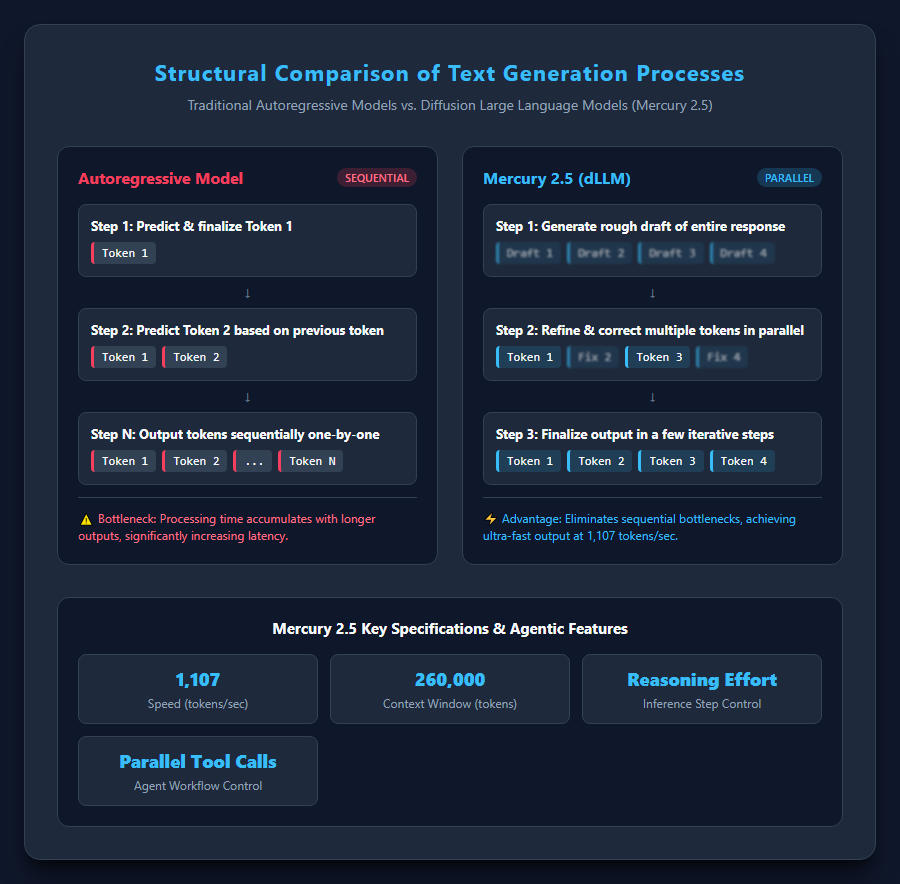
The model boasts an expanded context window of 260,000 tokens, enabling seamless handling of long-context processing tasks. It also comes fully equipped with advanced agentic capabilities required for production workflows, such as adjustable reasoning effort during inference, parallel tool calling, and schema control for formatted JSON output.
The following graphic illustrates the model’s processing workflow.
Inception has also driven down costs significantly. Standard pricing is set at \$0.20 per million input tokens and \$0.75 per million output tokens. During the initial launch promotion, rates drop to an exceptionally low \$0.04 per million input tokens and \$0.15 per million output tokens.
The Limitations of Autoregressive Models and the Diffusion LLM (dLLM) Approach
Most conventional large language models (LLMs) rely on an “autoregressive” architecture, predicting and generating text sequentially—one token at a time—based on previously generated tokens. While this step-by-step approach produces natural language, its sequential nature creates a major structural drawback: processing time accumulates with longer outputs, leading to noticeable user latency.
To break this bottleneck, Inception leveraged Diffusion Large Language Models (dLLMs), adapting the core principles of image generation AI to text generation. Rather than finalizing text sequentially from start to finish, Mercury 2.5 begins with a rough draft of the entire output. It then refines and corrects multiple tokens in parallel over a few iterative steps.
This parallel processing approach eliminates the sequential generation bottleneck inherent to autoregressive models. The performance gains are particularly significant in complex multi-step workflows—such as agentic loops involving repeated web searches, information summarization, and final response synthesis—where accumulated latency typically degrades performance. As a technological paradigm shift, dLLMs represent a compelling alternative for next-generation AI inference infrastructure.
The Reality Behind 1,107 Tokens Per Second and Unmatched Cost Efficiency
Mercury 2.5’s benchmark of 1,107 tokens per second was achieved on NVIDIA Blackwell GPUs. Compared to its predecessor—Mercury 2, released in February 2026 with a speed of 1,009 tokens per second and a 128,000-token context window—Mercury 2.5 delivers notable upgrades in both throughput and context capacity within a span of just seven months.
While model size can be reduced to increase output speed, simply slimming down a model often degrades performance on complex reasoning and coding tasks. Mercury 2.5 maintains high intelligence while optimizing parallel execution efficiency, successfully achieving both high output quality and ultra-fast generation.
The figure below illustrates the relationship between output speed and cost efficiency.
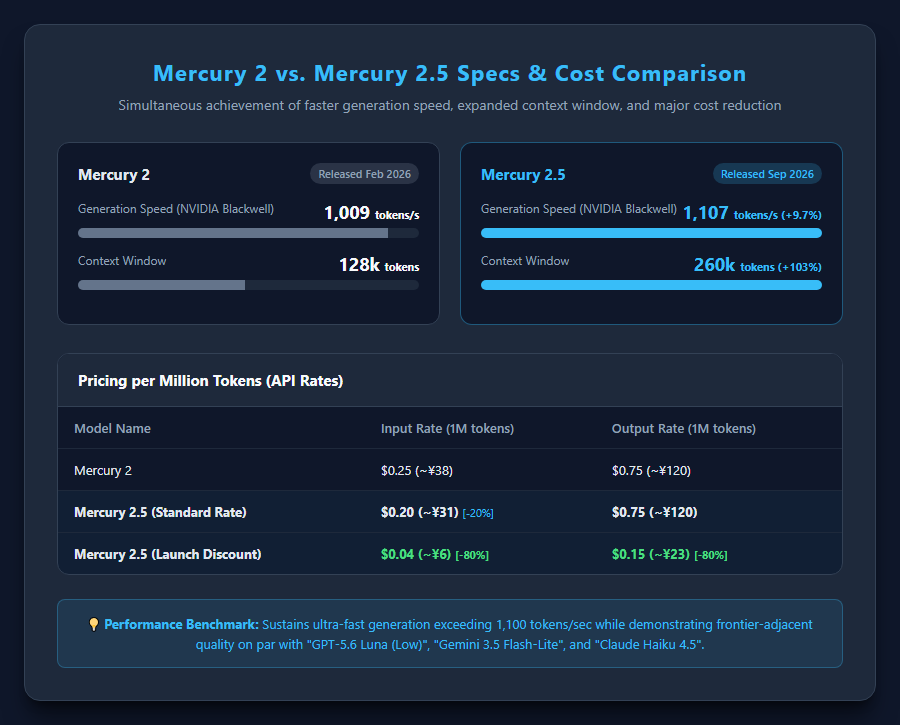
The economic impact is equally compelling. Inception lowered input costs from \$0.25 per million tokens on Mercury 2 down to \$0.20 per million tokens on Mercury 2.5. Output costs remain capped at \$0.75 per million tokens, offering unmatched cost performance compared to competing frontier models. For enterprise organizations managing large data volumes or high-frequency API workloads, this dramatic reduction in operational overhead provides a significant competitive advantage.
Real-World Adoption and Industry Impact
Performance Benchmarks: How Mercury 2.5 Compares to Existing Frontier Models
When evaluating AI models, maintaining accuracy and intelligence is just as critical as raw generation speed. According to Inception, Mercury 2.5 achieved a major leap in overall performance by feeding real-world user feedback and edge-case failure modes directly back into its evaluation and training pipelines.
In benchmark comparisons, Mercury 2.5 achieves quality comparable to top cost-optimized models, including OpenAI’s GPT-5.6 Luna (Low setting), Google’s Gemini 3.5 Flash-Lite, and Anthropic’s Claude Haiku 4.5. Traditionally, developers faced a trade-off: faster models were less intelligent, while smarter models were slower and more expensive. Diffusion LLM technology shatters this assumption.
By delivering frontier-adjacent quality at a fraction of the cost and latency, Mercury 2.5 is ideal for production applications where both speed and precision matter. Businesses can now replace costly top-tier models with Mercury 2.5 for complex sub-tasks, optimizing overall system architecture and reducing API spend.
Production Case Studies: Real-Time Voice Agents and Developer Tools
Mercury 2.5’s ultra-low latency is already yielding tangible results in production. OpenCall, a company developing AI phone agents, reported that switching to Mercury reduced median model response latency to approximately 170 milliseconds. In human conversation, delays of even a fraction of a second can feel awkward; a 170-ms response time is pivotal for creating natural, fluid voice interactions.
Similarly, Augment Code, an AI coding assistant platform, integrated Mercury to handle context compression—summarizing long chat histories and developer logs. The transition reduced context compression time from roughly 150 seconds down to just 27 seconds, while cutting associated costs by 90%.
Furthermore, faster response times accelerate the developer iteration loop. Eliminating the wait time between writing code and receiving AI feedback allows developers to maintain flow state and work continuously, driving substantial productivity gains across engineering teams.
Next-Generation Roadmap and the Future of Real-Time AI
Alongside Mercury 2.5, Inception unveiled preview versions of Mercury Voice, a specialized model for voice AI, and Mercury Router, an intelligent routing layer that automatically directs queries to optimal models based on input characteristics. Rather than relying solely on a single text model, the company is building a comprehensive, real-time AI ecosystem spanning voice and multi-model orchestration.
Inception also revealed that training is already underway for its largest next-generation model to date. The company aims to release this flagship within months, combining the speed and token efficiency of diffusion architectures with even higher reasoning depth and domain expertise.
As diffusion language models gain broader adoption, AI integration will accelerate across fields previously bottlenecked by latency—including conversational voice systems, real-time code generation, and instant search synthesis. The arrival of infrastructure capable of generating over 1,000 tokens per second marks a fundamental shift in human-AI interaction, ushering in the era of real-time AI.
Primary References
- 【Introducing Mercury 2.5 – Inception】https://www.inceptionlabs.ai/blog/introducing-mercury-2-5
- 【Inception: Mercury 2.5 – OpenRouter】https://openrouter.ai/inception/mercury-2.5
【#AI #ArtificialIntelligence #DiffusionModels #Mercury25 #Inception #GenerativeAI #TechNews】

コメント