The Ministry of Education, Culture, Sports, Science and Technology has decided to fundamentally strengthen information literacy education in elementary and junior high schools in the next curriculum guidelines, which will be fully implemented from fiscal year 2030. Behind this is the urgent need to address new social challenges brought by digitalization, such as the rapid spread of generative AI, defamation on social media, and the spread of false and misinformation.
- Establishment of New Domains and New Subjects in Elementary and Junior High Schools
- Consideration of early implementation before fiscal year 2030
- Addressing Risks in the Era of Generative AI and Social Media
- Current Status of Typing Ability as a Basic Skill
- Developing Critical Thinking
- Experiential Learning and Foundation Formation in Elementary Schools
- Specialization in Junior High Schools and Application in Real Environments
- Formalization and Environment Improvement of Digital Textbooks
- The importance of support at home and public-private partnerships
Establishment of New Domains and New Subjects in Elementary and Junior High Schools
As part of its educational reform policy toward the 2030s, the Ministry of Education, Culture, Sports, Science and Technology plans to systematize and significantly expand information education from elementary through junior high school. Specifically, elementary schools will newly establish an “Information Domain” (tentative name) within the current integrated learning period, securing a certain amount of class time annually to provide systematic instruction. In junior high schools, the current “Technology and Home Economics” department is being separated, and the new “Information and Technology Department (tentative name)” specializing in information education is being considered.
Until now, information education has been improved since the 2021 academic year, such as enhancing programming education in junior high schools, but the significant differences in approaches by school and region have been a challenge. The new policy aims to foster the ability to use information technology not merely as a tool but also to understand its mechanisms and make appropriate judgments while utilizing it. In elementary school, experiential activities are emphasized, while in junior high school, students learn more advanced network mechanisms and data utilization, building a consistent curriculum that leads to the compulsory high school subject “Information 1.”
Consideration of early implementation before fiscal year 2030
The full implementation of the next curriculum guidelines will begin in fiscal year 2030, but the Ministry of Education, Culture, Sports, Science and Technology is considering introducing only content related to information education ahead of time, considering the rapid pace of information technology evolution. The Central Council for Education’s working group is working on scheduling for fiscal year 2026 and beyond, and specific implementation measures are being discussed.
The background to this early introduction is the increasing opportunities for children to engage with advanced technologies such as social media and generative AI on a daily basis. According to the Survey on Youth Internet Usage (published in March 2025), the average daily usage time is about 3 hours 44 minutes for elementary school students, about 5 hours 2 minutes for junior high school students, and about 6 hours 19 minutes for high school students, indicating that the health impacts of long usage and online troubles are becoming more serious.
Additionally, the decline in Japan’s digital competitiveness is a major factor. In the “World Digital Competitiveness Rankings 2024” released by the International Institute for Management Development (IMD) in Switzerland, Japan ranked 31st out of 67 countries and regions, with particularly low scores in digital and technical skills. To avoid falling behind international trends, it is necessary to refresh educational content and accelerate the development of digital talent before the full implementation of the next curriculum guidelines.
Why Information Literacy Education Is Important Now?
Addressing Risks in the Era of Generative AI and Social Media
Modern children naturally use technology where they ask generative AI questions when they don’t understand and automatically process photos taken with smartphones. However, on the other hand, negative aspects such as hallucination by generative AI and the spread of malicious misinformation are also becoming apparent.
What the Ministry of Education emphasizes is understanding how these technologies work and the ability to avoid risks that affect cognition and behavior. In particular, the “filter bubble phenomenon,” where people are surrounded only by their preferred information on social media, and the “echo chamber phenomenon,” where similar opinions echo in closed spaces, raise alarms about the risk of biasing values and causing social division. Please refer to the diagram below.
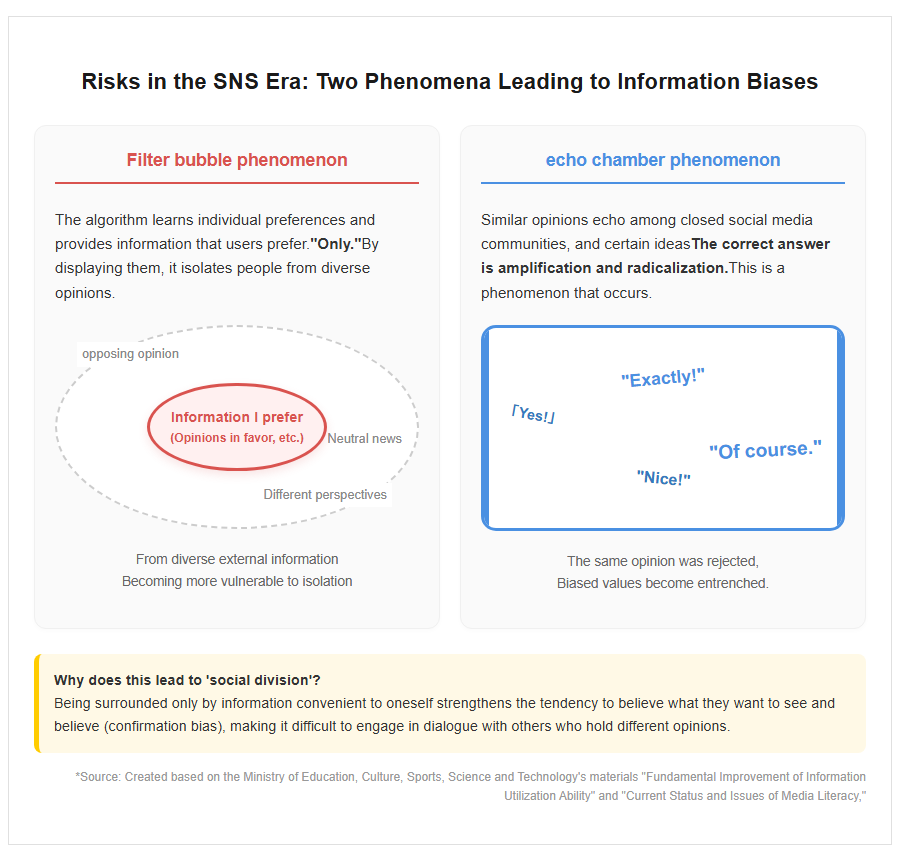
Additionally, incidents of child sexual assault caused by social media and similar platforms remain at high levels, with the number of elementary school victims in 2023 more than tripling compared to 2014. It is more important than ever to simply use equipment, but also to acquire information ethics to protect oneself and media literacy to discern the truth of information.
Current Status of Typing Ability as a Basic Skill
While digitalization is advancing, there are still challenges regarding typing skills, which are fundamental skills for handling computers. According to an information utilization ability survey conducted by the Ministry of Education, Culture, Sports, Science and Technology, the average number of characters input per minute for elementary school students is 15.8, and for junior high school students, it is only 23.0 characters.
The government has set goals for 2026 (Reiwa 8) to allow elementary school students to input 40 characters per minute and junior high school students 60 characters, but there is a significant gap between the current and current levels. About 30% of elementary school students and about 10% of junior high school students can only input 10 characters or less, highlighting the insufficient foundation for effectively using information devices as learning tools.
Future curricula will require securing time for mastering these basic operations. The goal is to develop the basic physical skills to efficiently verbalize and express one’s ideas digitally, combining various methods such as keyboard input on tablets and voice input.
Developing Critical Thinking
One of the core aspects of information education in the next curriculum guidelines is the cultivation of “critical thinking.” Here, critical thinking does not simply mean attacking others, but rather a style of thinking that examines the information obtained from multiple perspectives and logic, aiming for better judgment based on evidence.
The Ministry of Education, Culture, Sports, Science and Technology’s study group regards media literacy as an important component of information utilization ability, and emphasizes fostering the mindset and attitude of evaluating and disseminating information within a social and cultural context. Specifically, the following learning activities are envisioned.
-
Pause and think.
-
Evaluate information from both pros and cons of viewpoints.
-
Compare multiple sources to determine reliability.
-
Do not use false or ambiguous information, or withhold judgment.
Such qualities are not limited to specific “information” classes but are positioned as foundational abilities to be cultivated across all subjects, including Japanese, social studies, arithmetic and mathematics, and science.
Next-generation learning nurtured step by step across elementary, junior high, and high school
Experiential Learning and Foundation Formation in Elementary Schools
New information education in elementary schools focuses not on classroom knowledge acquisition but on hands-on hands-on activities. In the educational settings of the 2030s, each student will have one device used daily like stationery, integrated with inquiry-based learning.
The main content taught at the elementary school level includes the following items:
-
Basic operations: Taking and editing photos and videos, searching online, creating tables and graphs.
-
Programming experience: Using block-based programming and similar methods, you have the computer perform the intended processing.
-
Understanding characteristics: Understanding the possibility that generative AI may produce incorrect information and understanding the characteristics of digital data.
-
Proper handling: Protection of personal information, copyright fundamentals, and online communication etiquette.
For example, in a class researching “local environmental issues,” children gather information on tablets, assess its reliability, and create presentation materials with charts and tables. By repeating this cycle, the design naturally develops not only operational skills but also the ability to identify and solve problems on their own.
Specialization in Junior High Schools and Application in Real Environments
Learning in junior high is based on the experiences in elementary school, and the content becomes more specialized and systematic. The newly established ‘Information and Technology Department (tentative name)’ will deepen scientific understanding of how computers and networks work, while also developing the ability to apply technology to solve real-world issues.
The main topics covered include computer mechanics, network fundamentals (including cloud concepts), text-based programming, data analysis, information security, and more. Please refer to the table below.
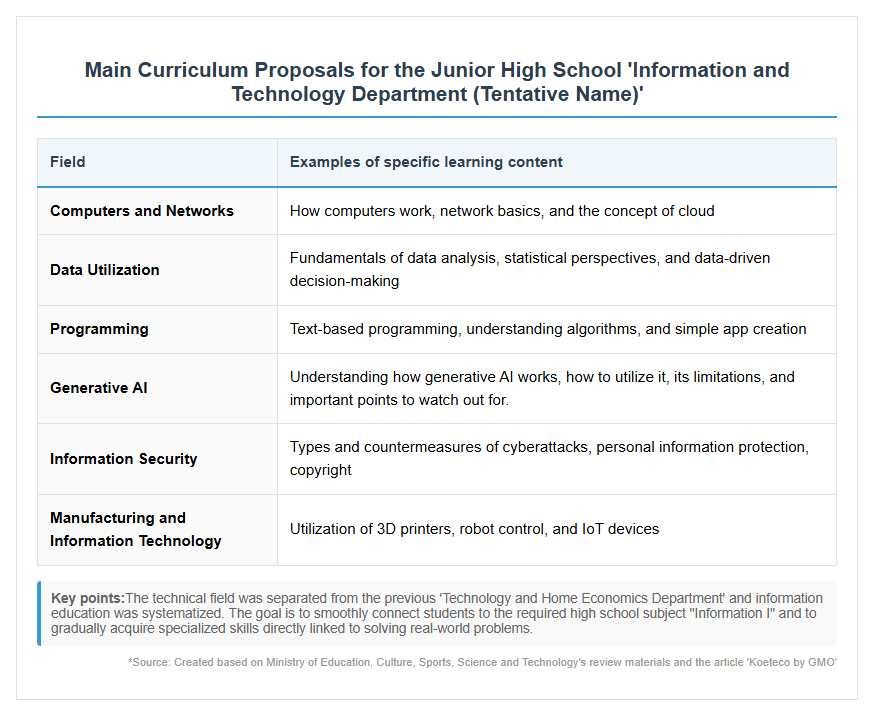
Concrete project examples include creating an app that collects and analyzes data for “creating local disaster prevention maps” to show evacuation routes, and conceiving automatic control mechanisms that combine sensors and programming for “energy-saving home appliances.” Through these experiences, junior high school students are expected to realize that information technology is a crucial element supporting social sustainability and gain opportunities to broaden their career choices.
Future Outlook and Key Points
Formalization and Environment Improvement of Digital Textbooks
With the full implementation of the next curriculum guidelines for the 2030 academic year, the nature of textbooks will also change significantly. In September 2025, a subcommittee of the Central Education Council designated digital textbooks as “official textbooks” and approved the policy to introduce them starting in fiscal year 2030. As a result, digital textbooks, like paper textbooks, will be distributed free of charge at the government’s expense.
Digital textbooks offer features such as magnification, aloud, and text color changes, holding great potential to reduce learning difficulties for students with visual impairments or special needs. Additionally, digital features such as science observation using videos and photos, and English pronunciation practice using audio functions, are expected to enhance learning effectiveness.
To support this transformation, the Ministry of Education, Culture, Sports, Science and Technology has significantly increased the budget related to the GIGA School Initiative in its budget request for fiscal year 2026. In addition to allocated over 12 billion yen to steadily updating devices, we are demanding substantial budgets to accelerate school digital transformation (DX) and improve school network environments, accelerating the development of digital learning infrastructure for the 2030s.
The importance of support at home and public-private partnerships
Strengthening information education is not a problem only within schools. As children regularly use digital devices at home, dialogue with parents and improving literacy throughout the community are essential.
In January 2025, the Ministry of Internal Affairs and Communications launched the public-private partnership project “DIGITAL POSITIVE ACTION,” in collaboration with 19 major IT companies and telecommunications operators. Under the slogan “Is it true? Protecting you,” Google, Microsoft Japan, LINE Yahoo, and others collaborate to provide educational materials and promote ICT literacy across generations.
As a parent, what you should know is not to keep your child away from digital devices, but to nurture the ability to interact appropriately with them together. Watching the time spent digging deeper into topics of interest on digital devices and thinking together about “Is this information real?” simple actions become a powerful force supporting children’s information utilization skills. Education reform toward the 2030s is a major challenge for schools, families, and private companies to collaborate and jointly build a “secure information society.”
[#文部科学省 #情報リテラシー #GIGAスクール構想 #デジタル教科書 #生成AI #メディアリテラシー #教育改革 #2030年代]

コメント