
Mitsubishi Electric is accelerating fundamental structural reforms, including the sale of its automotive equipment subsidiary, Mitsubishi Electric Mobility. Behind this is a management strategy focused on ROIC (Return on Invested Capital), aimed at streamlining long-standing low-profit businesses and concentrating management resources on growth sectors such as defense and power semiconductors.
- Background of the Establishment and Consideration of Sale of Mitsubishi Electric Mobility
- The Three Classifications of ‘Selection and Concentration’ in the Automotive Equipment Business
- Withdrawal from the Car Multimedia Business and Personnel Reallocation
- Review Plan for Low-Profit Businesses Worth 800 Billion Yen
- Growth shift toward defense, space, and power semiconductors
- Market and Stock Evaluation and Investor Perspectives
- Challenges Revealed by Partnerships with External Partners and ‘Broken Deals’
- Breaking away from a comprehensive electronics manufacturer and the path to becoming the ‘Japanese Raytheon’
Background of the Establishment and Consideration of Sale of Mitsubishi Electric Mobility
Mitsubishi Electric spun off its automotive equipment business in April 2024 to establish “Mitsubishi Electric Mobility” by spinning off the automotive equipment business to improve profitability and accelerate decision-making. The automotive equipment business used to be a major division, accounting for about 16% of the company’s sales, but in fiscal 2022, it posted an operating loss of 46.2 billion yen against sales of 816.4 billion yen, indicating a difficult management situation. To respond to the rapidly advancing structural transformation of the automotive industry, known as the “CASE,” Mitsubishi Electric shifted away from self-sufficiency and shifted toward organizational restructuring based on the introduction of external capital and collaboration with other companies. Entering 2026, it has been reported that Mitsubishi Electric is considering the sale of this subsidiary and is considering the bidding process with multiple potential buyers, including domestic and international investment funds and operating companies. Although the sale has not yet been officially decided, by spinning off the business into a separate company, it can be said that an environment has been created where the business value can be easily evaluated by buyers.
The Three Classifications of ‘Selection and Concentration’ in the Automotive Equipment Business
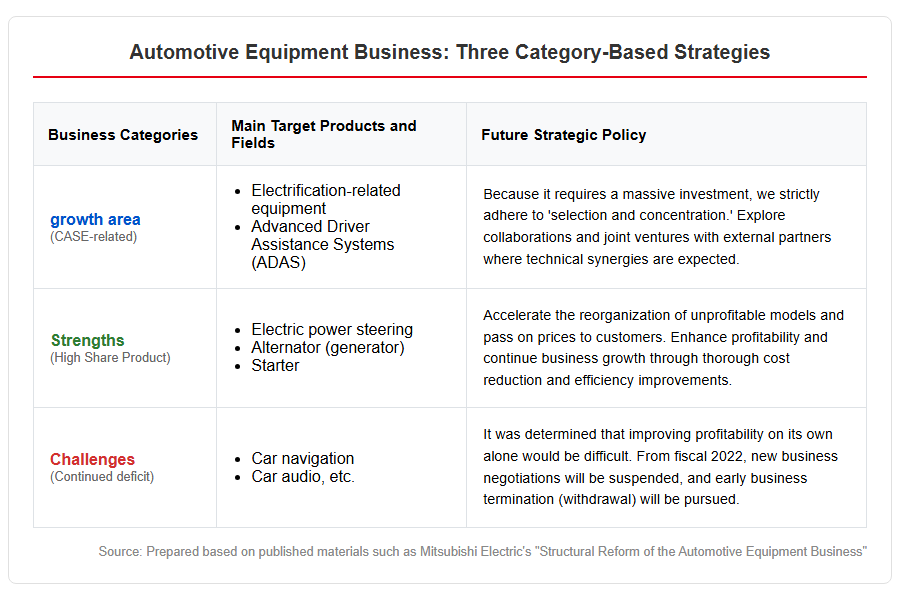
Mitsubishi Electric classifies its automotive equipment business into three categories according to its characteristics, and formulates individual strategies. The first category is growth areas related to electrification and advanced driver assistance systems (ADAS). While this field has significant market potential, it requires massive investment, so rather than developing alone, we are seeking collaboration with partners who can offer technological synergies. The second category includes businesses where Mitsubishi Electric already holds a high market share, such as electric power steering systems and alternators (generators). For these businesses, we aim for growth through thorough cost reduction and efficiency improvements by streamlining unprofitable models, reviewing transaction terms with customers, and accelerating price pass-through. The third category is the challenge business centered on car multimedia, such as car navigation. These businesses have been judged to be extremely difficult to improve profitability, and early closure of operations is being pursued.
Withdrawal from the Car Multimedia Business and Personnel Reallocation
A symbolic move in structural reform is the convergence of the car multimedia business, which had annual sales of about 200 billion yen. This business has been operating at a loss for several years, and from fiscal year 2022, it was decided to suspend new business negotiations. Many engineers and specialized personnel who were involved in this business are scheduled to be gradually reassigned to growth areas such as factory automation (FA) systems and air conditioning businesses, which Mitsubishi Electric will focus on going forward. Mitsubishi Electric expects that the know-how and technical capabilities cultivated in the automotive industry, where strict demands for controlling production costs are extremely strict, can be fully utilized in other industrial sectors as well. Within a massive group organization of approximately 150,000 employees, we are advancing structural reforms that involve not mere restructuring but also workforce relocation (reskilling and reassignment) to high-profit, growth sectors. The diagram below illustrates the framework of the company’s business restructuring.
Management and Strategy Background: Shift to ROIC Management and High Profitability
Review Plan for Low-Profit Businesses Worth 800 Billion Yen
Mitsubishi Electric President Kei Urushima announced at the investor briefing (IR Day 2025) held in May 2025 that a new evaluation of low-profit businesses worth 800 billion yen will be conducted within fiscal 2025. In its medium-term management plan starting in fiscal 2025, the company has set forth “transformation into an innovative company,” promoting ROIC management that emphasizes asset efficiency throughout the company. By fiscal year 2024, we had already finalized a withdrawal and sale policy of about 500 billion yen, and in addition, we plan to further streamline problematic businesses where profitability and asset efficiency are not expected to improve. We are undergoing a large-scale business structure transformation, said to be the first in 20 years, from a business model that covered all industries as a “comprehensive electronics manufacturer” to a model that quickly reallocates resources to “winning areas” that generate profits exceeding capital costs.
Growth shift toward defense, space, and power semiconductors
While advancing business divestitures, Mitsubishi Electric is accelerating its investments in three areas: “Defense & Space,” “Power Semiconductors,” and “FA Systems.” In particular, the infrastructure business, including the defense and space segments, is expected to reach sales of approximately 1.2 trillion yen in the fiscal year ending March 2025, with a significant improvement in profit margin from 3.0% to 7.4%. Against the backdrop of Japan’s expanded defense budget, demand for the company’s specialties in radar, electronic warfare systems, missile guidance devices, and communication satellites is surging. In the power semiconductor sector, we are investing tens of billions of yen in next-generation products using silicon carbide (SiC) to capture demand for electric vehicles (xEVs) and data centers. Although the semiconductor device business, centered on SiC power semiconductors, accounts for only 4.7% of sales, its operating profit margin is 15.6%, making it the most profitable among all segments, positioning it as a “next-generation growth engine.”
Market and Stock Evaluation and Investor Perspectives
Mitsubishi Electric’s consolidated financial results for the fiscal year ending March 2026 show sales of 5.8947 trillion yen, operating profit of 433 billion yen, and net profit of 407.7 billion yen, all of which achieved increased sales and profits, with net profit in particular showing a year-on-year increase of over 25%. Following this strong performance, the market is reevaluating the company not just as a “quiet large-cap” with economic sensitivity but as a “growth stock” with strong growth themes such as defense, AI, and data centers. The stock price surged significantly through the first half of 2026, reaching a year-to-date high of 6,686 yen in May 2026. The management, once called the “model students of the electronics industry” but cautious about structural reforms, has begun concrete efforts to spin off loss-making businesses, increasing investor confidence in governance improvements and capital efficiency. On the other hand, concerns remain over geopolitical and cyclical risks such as overheating from rapid stock price increases and slowing FA demand.
Future Developments and Key Points: Industry Restructuring and Transformation
Challenges Revealed by Partnerships with External Partners and ‘Broken Deals’
Building relationships with external partners is an unavoidable challenge when advancing subsidiary sales or business restructuring. This difficulty was hinted at by the background of partnership discussions with Aisin, a Toyota affiliate, in the automotive business. In May 2026, both companies announced they had agreed to establish a joint venture for electrification business, but just five months later, in October, the agreement was terminated and the tone was downgraded to a “continued discussion” of a business alliance. Behind this is believed to be the intentions of stakeholders such as Toyota and Denso, as well as the struggle for leadership within the industry. When Mitsubishi Electric proceeds with the sale of subsidiaries or capital integration with other companies, complex interest negotiations with existing customers and rival companies are required, which is a major opaque factor affecting the speed of strategy execution.
Breaking away from a comprehensive electronics manufacturer and the path to becoming the ‘Japanese Raytheon’
After ongoing structural reforms, Mitsubishi Electric is making a significant move away from its former image as a “home appliance and heavy electronics manufacturer.” Today, the company has evolved into a cutting-edge technology enterprise that holds information systems that serve as the ‘brain’ of modern warfare, including advanced radar technology, electronic warfare, space surveillance, and AI defense. In the defense industry, it plays a role that supports the core of information warfare—not just simple weapons manufacturing—by ‘finding, connecting, jamming, and guiding.’ In the long term, it has the potential to establish a unique position supporting national security and advanced social infrastructure, much like the ‘Japanese Raytheon.’ Withdrawing from low-profit sectors like the automotive business is an inevitable decision to maintain overwhelming competitiveness in these core areas, and the completion of structural reforms over the coming years will determine the company’s next growth as a “100-Year Company.”
[#三菱電機 #三菱電機モビリティ #事業売却 #構造改革 #ROIC経営 #パワー半導体 #防衛産業 #経済ニュース]
コメント