On July 10, 2026, the Ministry of Internal Affairs and Communications released a report outlining a policy to fundamentally strengthen the protection system for submarine cables, which are the lifeline of Japan’s telecommunications sector. Against the backdrop of explosive growth in communication demand due to the spread of generative AI and the emergence of geopolitical risks, telecommunications infrastructure policy is making a significant shift toward a critical area of economic security.
- Key Points of Report Publication and Strategic Shift
- Why is submarine cable protection important now?
- Exclusion of China and the Role of the Japanese Union
- The Rise of Hyperscalers and Diversification of Ownership
- Strengthening domestic supply chains and legal frameworks
- Upcoming Highlights and Notable Schedule
Key Points of Report Publication and Strategic Shift
On July 10, 2026, the Ministry of Internal Affairs and Communications compiled the report of the “Study Group on the Protection of International Submarine Cables.” In Japan, an island nation, about 99% of international communications are handled by submarine cables, making them the core infrastructure that supports the core of the digital society. However, with the rapid advancement of generative AI and cloud services in recent years, we have entered an era where massive data flows determine a country’s industrial competitiveness. In response, the report goes beyond the traditional framework of simple maintenance of communication equipment and calls for a fundamental strengthening of protective systems with a strong focus on economic security.
Specifically, we are based on the following four directions. First, “multi-route submarine cables and regional dispersion of landing stations,” second, “strengthening protection of cables and landing stations themselves,” third, “securing an autonomous domestic supply system,” and fourth, “establishing an effective supervision system.” Until now, submarine cables have mainly been managed voluntarily by private operators, but going forward, the government is deeply involved, and the policy of strengthening resilience through public-private collaboration has become clear. Please refer to the diagram below.
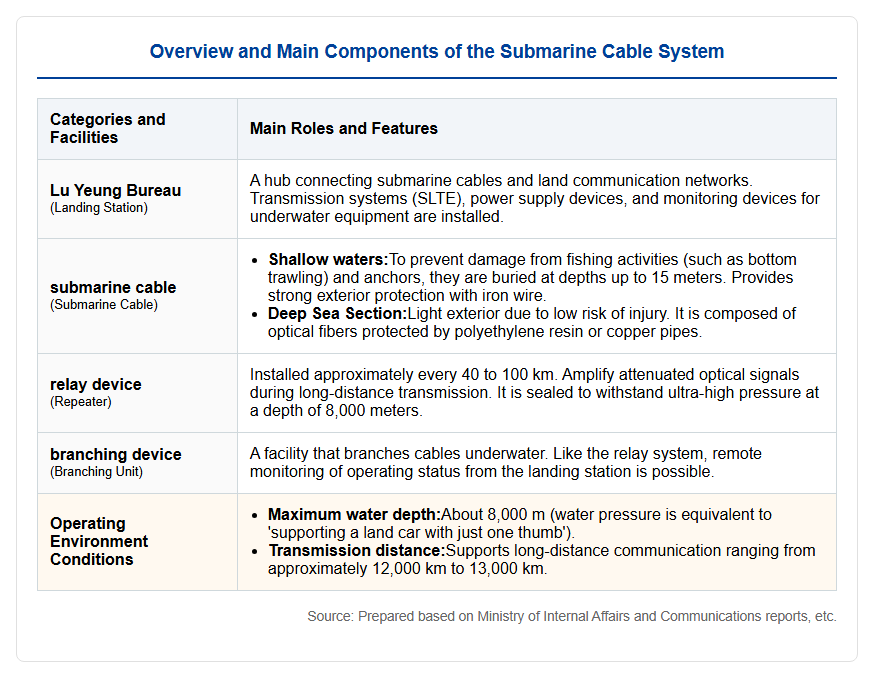
。 This provides a comprehensive picture of the submarine cable system, highlighting the complexity of the equipment operating in harsh environments at depths of up to 8,000 meters.
Why is submarine cable protection important now?
Behind this is a dramatic change in the environment surrounding infrastructure. According to a survey by the International Committee on the Protection of Submarine Cables (ICPC), there are about 100 to 200 failures worldwide each year, with over 60% of these caused by fishing activities or human factors such as anchoring of ships. In particular, the waters around Japan, such as the East China Sea and South China Sea, are regions where damage incidents are concentrated, and their geographic characteristics make repairs exceptionally frequent even among global sources. Furthermore, in recent years, intentional cable severing incidents have occurred one after another in the Baltic Sea and around Taiwan, making physical damage a real threat to national security.
Additionally, with the advent of the AI era and the expansion of data center (DC) demand, the extreme concentration of landing stations in Japan—Boso in Chiba Prefecture and Shima in Mie Prefecture—has been pointed out as a structural vulnerability. In the event of a major disaster such as the Nankai Trough earthquake, Japan’s international communications could be completely shut down or significantly delayed, making dispersed deployment to rural areas an urgent need.
Geopolitical Risks and Changes in Market Structure
Exclusion of China and the Role of the Japanese Union
For a long time, the global submarine cable market has been dominated by three companies: Japan’s NEC, America’s Subcom, and France’s Alcatel Submarine Networks (ASN). However, in recent years, China’s HMN Tech (formerly Huawei Marine Network) has rapidly risen and is seeking to reshape the power landscape. In response, the U.S. government has strengthened regulations to exclude Chinese companies from submarine cable supply networks from security concerns. The report also emphasizes the importance of infrastructure construction by “trusted national companies” from the perspective of economic security.
Among Japanese companies, NEC, KDDI, and NTT-WE Marine are leveraging their strengths as a “Japan Alliance,” capable of completing all layers of manufacturing, installation, monitoring, and maintenance domestically. NEC has the world’s only vertically integrated system from manufacturing to installation, and KDDI has achieved the world’s first demonstration of remote monitoring technology for multicore fiber, leading the world in technology. On the other hand, the Achilles’ heel of Japanese players is the shortage of ‘laying ships.’ Currently, there is a global shortage of vessels to be laid down, and suppliers without their own vessels face risks of being at a disadvantage in securing projects.
The Rise of Hyperscalers and Diversification of Ownership
The market player structure is also changing dramatically. In the past, submarine cables were typically owned by telecom carriers in various countries as consortia (joint ventures), but nowadays, it is becoming mainstream for “hyperscalers” such as Google, Meta, Amazon, and Microsoft to directly order and own their own cables. Forecasts indicate that by 2027, hyperscalers will account for over 70% of new investment deals.
This change also poses challenges to the Japanese government’s supervisory system. Until now, laws such as the Wired Telecommunications Act mainly targeted telecommunications carriers, but as foreign tech companies, which are non-telecommunications carriers, take the lead in infrastructure, the key issue is how to effectively apply Japanese laws to domestic land-unloading stations and cables. The report recommends reviewing the legal system, such as establishing supervisory regulations and requiring prior notification for the introduction of specified critical equipment, to address this diversification of stakeholders. Please refer to the diagram below.
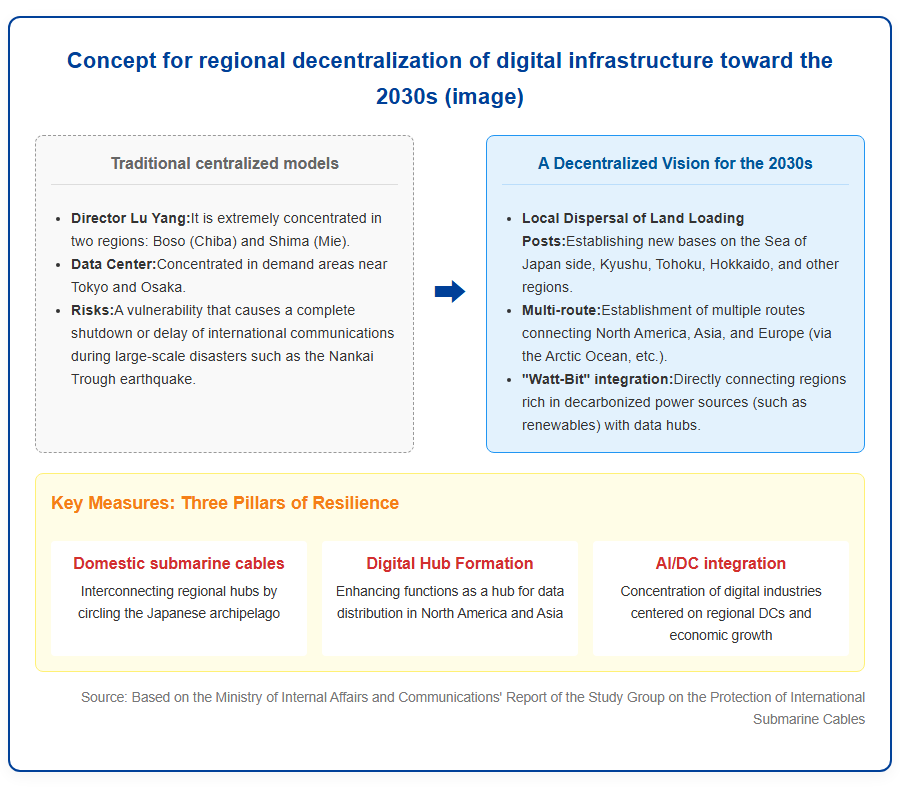
。 This represents a decentralized image of digital infrastructure for the 2030s, showing how to move away from traditional centralization.
Autonomous Supply System and Future Outlook
Strengthening domestic supply chains and legal frameworks
The Japanese government positions submarine cables as critical infrastructure equivalent to specified critical materials under the Economic Security Promotion Act, and is considering financial support to improve domestic suppliers’ production capacity and secure vessels for laying and maintenance. In particular, the renewal of aging anchorage vessels and the development of personnel equipped with Japan’s uniquely advanced fiber restoration technology are unavoidable challenges in maintaining an autonomous supply system.
On the technical side, the practical application of next-generation “multi-core fiber” is a key focus. With transmission capacity several times greater than conventional technology, Japanese companies possess world-class patents and proven track records. Rather than merely maintaining technological superiority, a national goal has been set to increase Japan’s market share in the global submarine cable market (currently about 21%) from 35% to 40% by leading international standardization. The report marks the first step toward concretizing this public-private investment roadmap.
Upcoming Highlights and Notable Schedule
Going forward, the focus will be on the “effectiveness” of the proposals. The Ministry of Internal Affairs and Communications plans to hold follow-up meetings within the year to check the progress of the review. Specific points of interest include: first, the schedule for establishing legal systems, including amendments to the Wired Telecommunications Act; second, the design of incentives such as tax incentives and subsidies to encourage the regional dispersal of land-handling stations; and third, the scale of specific government support measures to secure laydown vessels.
This report, which redefines infrastructure from the perspective of economic security, is the very national strategy for Japan to establish itself as a “digital data hub” and to survive in the AI society beyond the 2030s. The future of Japan’s digital sovereignty is being questioned on how to optimize government intervention while ensuring transparency that does not hinder private investment.
[#海底ケーブル #経済安全保障 #総務省 #NEC #KDDI #NTT #生成AI #インフラ]


コメント