Nationwide corporate bankruptcies in the first half of 2026 reached 5,335, hitting a 13-year high due to the impact of inflation and other factors. Behind this is the overlapping of multiple management risks, including a record-high number of inflation-driven bankruptcies caused by surging raw material and labor costs, delays in passing on price increases, the full-scale repayment of zero-zero loans, and rising interest rates.
- Latest Trends in First-Half Corporate Bankruptcies Reaching 13-Year High
- Record Surge in Inflation-Driven Bankruptcies Hitting Small and Micro Enterprises Hard
- The Price Pass-Through Barrier Created by Rising Raw Material and Labor Costs
- The Blow Inflicted by Full-Scale Zero-Zero Loan Repayments and Rising Interest Rates
- Severe Industry-Specific Impacts Observed in Construction and Long-Established Companies
- Bankruptcy Risks and Economic Concerns Heading into Late 2026
- Management Strategies and Defensive Measures to Overcome Compound Risks
Latest Trends in First-Half Corporate Bankruptcies Reaching 13-Year High
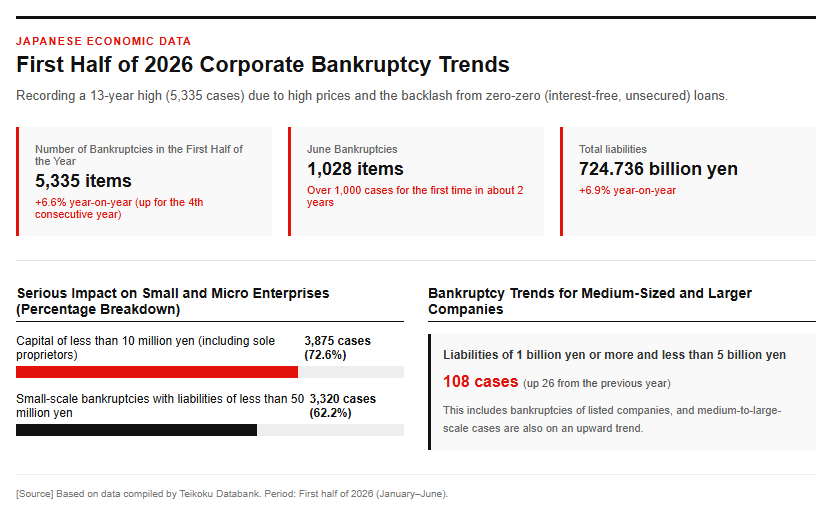
According to Teikoku Databank’s statistics, the number of corporate bankruptcies nationwide in the first half of 2026 (January to June) reached 5,335, a 6.6% increase compared to 5,003 cases in the same period of the previous year. This is the second consecutive year that the number of bankruptcies in the first half has exceeded 5,000, continuing a high-level trend that has surpassed the same period of the previous year for four consecutive years. Looking at the monthly trend, a single month of June 2026 saw 1,028 bankruptcies, breaking the 1,000-case mark for the first time in about two years since May 2024. Total liabilities amounted to 724.736 billion yen, a 6.9% increase year-on-year, marking the first time in four years that the figure for the first half exceeded the previous year’s result. Behind this are factors such as an increase in medium-scale and larger bankruptcies, including 108 bankruptcies with liabilities of 1 billion yen to less than 5 billion yen—an increase of 26 from the previous year—and the inclusion of listed company bankruptcies. On the other hand, looking closely at the structure of bankruptcies, small-scale bankruptcies with liabilities of less than 50 million yen accounted for 3,320 cases, or 62.2% of the total, exceeding 60% for the second consecutive year. Furthermore, bankruptcies with capital of less than 10 million yen, including sole proprietors, reached 3,875 cases, accounting for a record-high 72.6% of the total composition ratio since 2000. The figures clearly highlight how the wave of bankruptcies is rapidly spreading, centered mainly on small and micro enterprises with little leeway in cash flow. Please refer to the following chart summarizing the nationwide bankruptcy trends.
Record Surge in Inflation-Driven Bankruptcies Hitting Small and Micro Enterprises Hard
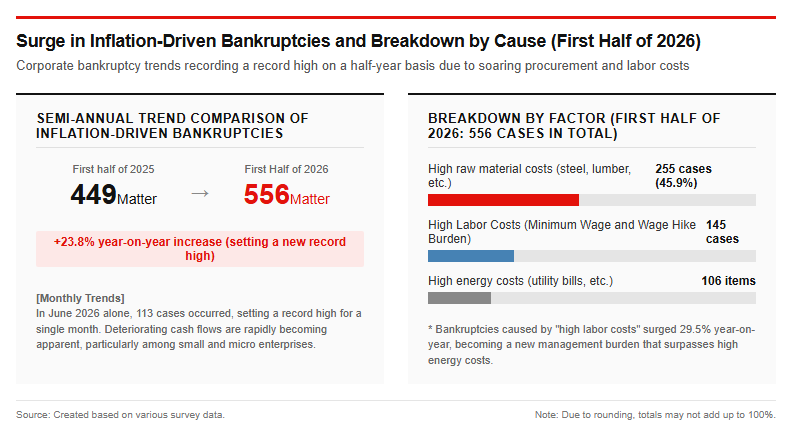
The biggest factor strongly pushing up overall bankruptcy figures is the surge in “inflation-driven bankruptcies,” where corporate earnings deteriorate because companies are unable to sufficiently pass on soaring procurement costs and labor expenses to their selling prices. In the first half of 2026, there were 556 inflation-driven bankruptcies, a 23.8% increase from 449 in the same period last year, significantly surpassing the record for the highest number of bankruptcies in a half-year period since data collection began in 2018. In particular, June 2026 saw 113 cases in a single month, recording the highest-ever number on a monthly basis. Analyzing by factor, “rising raw material costs,” driven by soaring prices of steel, lumber, and other materials, accounted for the largest share at 255 cases (45.9% of the total), setting a new record. Notably, inflation-driven bankruptcies caused by “rising labor costs”—where the burden of minimum wage hikes and wage increases to retain personnel weighs heavily—reached 145 cases, a sharp 29.5% increase year-on-year. Bankruptcies due to labor cost factors surpassed high energy costs (106 cases), emerging as a new heavy pressure on corporate management. According to Tokyo Shoko Research’s fiscal first-half (April to September) survey, inflation-driven bankruptcies also reached 436 cases, with small and micro-enterprises capitalized at less than 10 million yen accounting for 279 cases, or 63.9% of the total. A polarized picture is becoming clear in which small businesses with weak pricing power, unable to absorb cost increases, are being weeded out first under the harsh inflationary environment.
The Multifaceted Structure of “Compound Risks” Driving the Rapid Surge in Bankruptcies
The Price Pass-Through Barrier Created by Rising Raw Material and Labor Costs
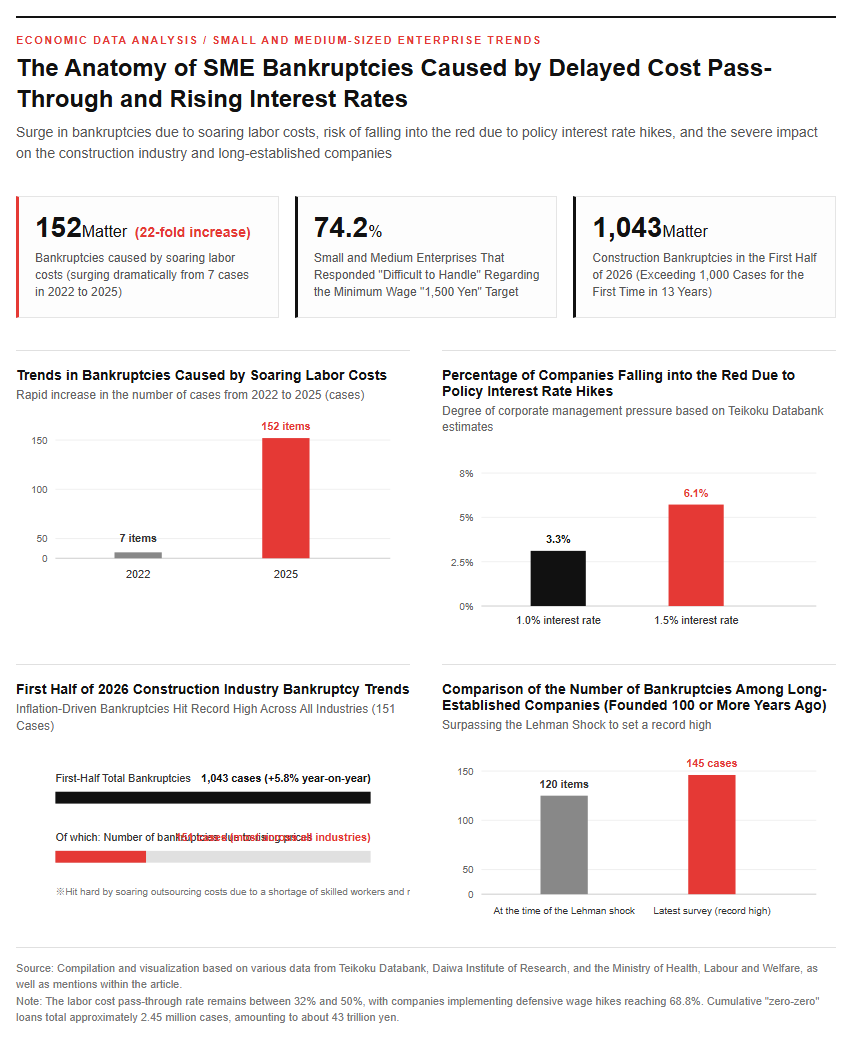
At the root of the successive decisions by companies to give up on business continuity lies a severe, low rate of passing on costs to sales prices, failing to keep pace with stubbornly high cost burdens. According to an October 2025 survey by the Japan Chamber of Commerce and Industry, only 3.8% of small and medium-sized enterprises (SMEs) are able to fully pass on 100% of their increased costs. In particular, the pass-through rate for labor costs is remarkably low at 32% to 50%, revealing the reality that businesses cannot incorporate rising personnel expenses into their selling prices. Structural reasons why SMEs cannot raise wages include refusals of price hikes by subcontractors and business partners, and concerns about customers defecting to competitors. SMEs that have no choice but to implement “defensive wage increases”—raising wages without business improvement in order to prevent employee turnover—have reached 68.8%, and bankruptcies caused by soaring labor costs surged dramatically from 7 cases in 2022 to 152 cases in 2025, an approximately 22-fold increase in just three years. Amid the Ministry of Health, Labour and Welfare raising the national weighted average of the minimum wage to 1,121 yen, 74.2% of SMEs have responded that it is difficult for them to comply with the government’s target of “1,500 yen.” According to an analysis by the Daiwa Institute of Research, the ratios of personnel expenses and interest burdens relative to sales are on an upward trend for SMEs, and companies facing both high procurement costs and high labor costs are rapidly losing their operational buffers. The figure summarizing the data showing the delay in passing on costs is as follows.
The Blow Inflicted by Full-Scale Zero-Zero Loan Repayments and Rising Interest Rates
In addition to rising prices and labor shortages, what is rapidly squeezing corporate cash flow is the changing financial environment and the burden of past debt. The “zero-zero loans” (virtually interest-free, unsecured loans) led by the government during the COVID-19 pandemic were executed for a total of approximately 2.45 million cases, amounting to roughly 43 trillion yen. The grace period for postponing principal repayment (usually 3 to 5 years) has ended, and repayments are reaching their true peak from 2025 to 2026. However, companies whose core business earnings have not recovered are unable to secure the funds needed for repayment, and cases of cash shortages are increasing as debt restructuring (rescheduling) with financial institutions reaches its limit. Furthermore, following the Bank of Japan’s lifting of negative interest rates in 2024, its hike of the policy interest rate to 1% in June 2026 has increased the interest payment burden on small and medium-sized enterprises (SMEs) that have relied on ultra-low interest rates. According to estimates by Teikoku Databank, raising the policy interest rate to 1% will cause 3.3% of companies nationwide to fall into ordinary losses, and if it rises to 1.5%, 6.1% are projected to fall into the red. For companies with a high dependence on interest-bearing debt and an “interest coverage ratio” of less than 1—meaning operating profit cannot cover interest payments—interest rate hikes are becoming a direct trigger forcing them to ultimately abandon their businesses.
Severe Industry-Specific Impacts Observed in Construction and Long-Established Companies
The impact of complex management risks is becoming particularly pronounced in specific industries. Bankruptcies in the “construction industry” for the first half of 2026 reached 1,043 (a 5.8% increase year-on-year), exceeding the 1,000 mark for the first half of the year for the first time in 13 years. Inflation-driven bankruptcies in the construction industry stood at 151, an increase of about 30% from the same period last year, accounting for the highest proportion among all industries. The industry structure of proceeding with construction at predetermined contract amounts, in the face of soaring outsourcing costs due to a shortage of artisans and rising prices for materials such as timber, steel, and concrete, makes it extremely difficult to pass on these costs. Bankruptcies are particularly noticeable in specialized construction work and wooden building construction located within the subcontractor tier. In addition, bankruptcies of “long-established companies” founded 100 or more years ago are surging. According to a survey by Teikoku Databank, bankruptcies of long-established companies totaled 145, significantly surpassing the 120 recorded during the Lehman shock and setting a record high. Retail and manufacturing industries account for approximately 60% of these long-established company bankruptcies, with successive cases of businesses having to close down without being able to overcome the triple hardship of recent rapid inflation, labor shortages, and successor shortages, even despite having built up brand power and accumulated assets over many years. Please refer to the figure below for bankruptcy trends by industry.
The Uncertain Economic Environment and Required Survival Strategies
Bankruptcy Risks and Economic Concerns Heading into Late 2026
Even from the latter half of 2026 onward, the environment surrounding corporate bankruptcies is projected to become even more severe. One of the concerning factors is the fluctuation of crude oil prices due to the escalating tensions in the Middle East, as well as supply shortages and soaring prices of naphtha (crude gasoline), which serves as a raw material for plastics, paints, building materials, and more. Severe cost shocks tend to have a certain time lag from their occurrence until they actually surface as bankruptcies, and similar to the past “wood shock,” there is a risk that “revenue-increase-type bankruptcies” driven by high costs will materialize in earnest from the latter half of 2026. Furthermore, rising import prices caused by the continuation of historically weak yen levels will also squeeze corporate earnings with a time lag. According to an analysis by the Daiwa Institute of Research, in “composite-type” industries where the burden of both procurement costs and labor costs is heavy and price pass-through is not progressing (such as construction, transportation, and fabricated metal product manufacturing), the bankruptcy increase rate has reached 93.1%, and it is seen as certain that high pressure for increasing bankruptcies will continue in the future. In addition, in labor-intensive industries such as accommodation and food services, it has been pointed out that the burden of continuous wage hikes will worsen cash flows with a time lag, creating the risk of triggering a chain reaction of bankruptcies.
Management Strategies and Defensive Measures to Overcome Compound Risks
To overcome the impending wave of compound risks and ensure corporate survival, a rapid shift from traditional management methods is essential. First, what is required is a rigorous diagnosis of the company’s financial health and the strengthening of cash flow management. It is necessary to understand the balance of variable-rate borrowings and the ratio of interest-bearing debt, and to verify the gap with available funds to see if the interest coverage ratio can be maintained at 1.5 times or higher. Second, the promotion of appropriate price pass-throughs and a review of the profit structure are essential. By utilizing legal frameworks such as the revised Construction Business Act enforced in December 2025—which prohibits below-cost contracts and mandates sincere consultations regarding contract changes—it is important to establish a negotiation system to appropriately pass on rising material and labor costs to business partners. Third, companies must break away from reliance on hiring just to increase headcount, and instead promote business automation and DX (digital transformation) to improve productivity. Building a mechanism that increases sales and profit margins without increasing personnel through the automation of routine tasks and the cloud-based management of costs serves as a reliable prescription for securing the financial resources for wage hikes and avoiding bankruptcy.
Reference Page
- [Bankruptcy Statistics: 2026 First Half Report (January–June)] https://www.tdb.co.jp/report/bankruptcy/aggregation/20260708-bankruptcyh12026/
- [“Price Hike” Bankruptcy Trends in the First Half of the Fiscal Year] https://www.tsr-net.co.jp/data/detail/1203319_1527.html
[#CorporateBankruptcies #InflationBankruptcies #2026FirstHalf #SurgingLaborCosts #PricePassThrough #ZeroZeroLoans #RisingInterestRates #JapaneseEconomy]


コメント