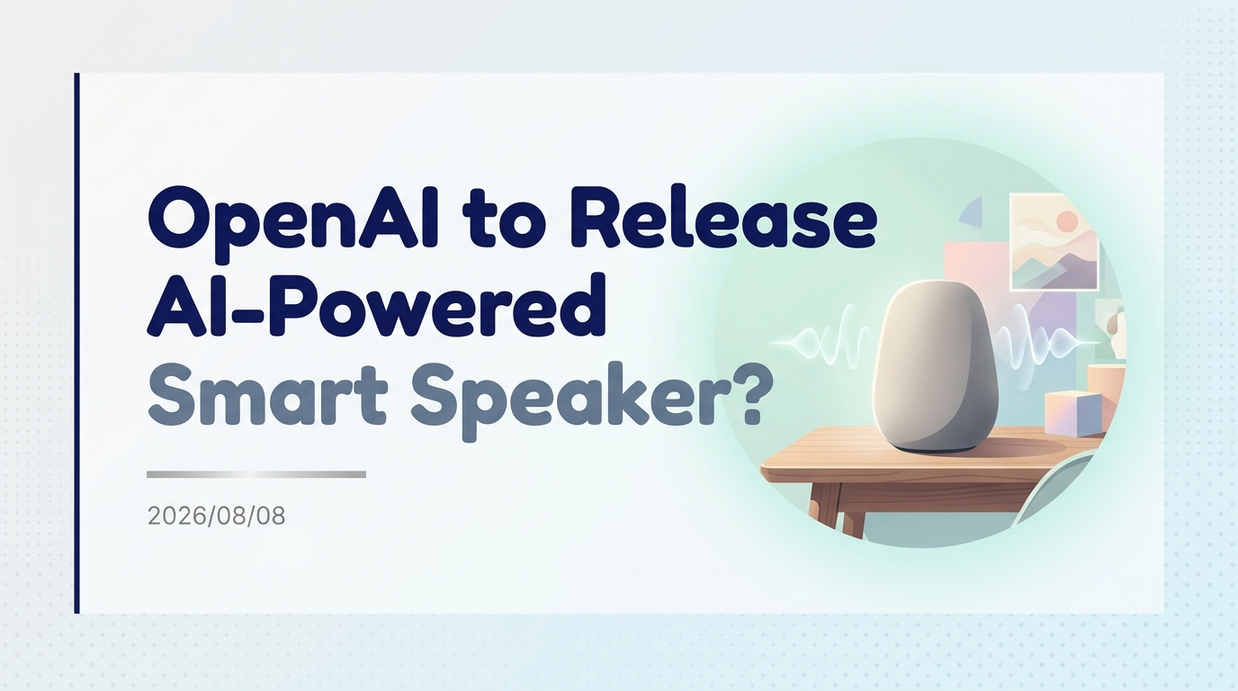
OpenAI is developing its first original hardware, a screenless portable smart speaker, marking a significant shift from software to physical devices. This move is centered on the acquisition of “io,” a hardware startup led by legendary former Apple design chief Jony Ive, as the company seeks to define the “post-iPhone” era.
- The Multi-Billion Dollar Acquisition of Jony Ive’s “io”
- A Screenless Approach to “Ambient Computing”
- Proactive Assistants Powered by Contextual Awareness
- Human-like Companionship through Reasoning Models
- A High-Stakes Legal Battle Over Trade Secrets with Apple
- The Fight for Dominance in Japan and Beyond
- 2027 Launch and the Expansion of the Device Ecosystem
- Financial Challenges and Long-term Sustainability
The Multi-Billion Dollar Acquisition of Jony Ive’s “io”
On May 21, 2025, OpenAI announced its acquisition of io, a hardware startup founded by Jony Ive, for approximately \$6.5 billion (roughly 930 billion Japanese yen). This massive investment signals OpenAI’s serious entry into the hardware sector, moving beyond its roots as a software-only developer. Ive, who famously led design for the iPhone, iPod, and Mac at Apple, has brought together a team of elite former Apple talent, including Scott Cannon, Evans Hankey, and Tang Tan.
The acquisition adds roughly 55 hardware and manufacturing experts to OpenAI’s ranks. OpenAI CEO Sam Altman and Ive have reportedly discussed the concept of a “new type of computer” for two years, aiming to create a device that enhances humanity rather than distracting from it. Ive has expressed concern over the “constant connectivity and distraction” caused by modern smartphones, which has informed the philosophy behind this new project. The following image illustrates the design direction for this next-generation device.
A Screenless Approach to “Ambient Computing”
OpenAI’s inaugural device is reported to be a screenless, portable smart speaker. This design choice is a direct response to the excessive screen time prevalent in modern life, a concept Altman refers to as a step toward “ambient computing”. Key features of the hardware include:
-
A portable, screenless form factor with an internal rechargeable battery, designed to be carried from room to room.
-
A pocket-sized footprint that can also blend seamlessly onto a desk.
-
A user interface centered on voice recognition and environmental awareness via integrated cameras.
Altman has described the device as the “third major device” to sit on a desk alongside the MacBook Pro and the iPhone. By leveraging Ive’s design expertise and the latest AI models, OpenAI hopes to avoid the commercial failures of previous screenless AI gadgets, such as the Humane AI Pin or rabbit r1.
Advanced Features: Proactive AI Agents for the Home
Proactive Assistants Powered by Contextual Awareness
The device is equipped with a camera, allowing it to recognize the user’s surroundings and actions. Unlike traditional smart speakers that only respond when prompted, this hardware is designed to be “proactive,” meaning the AI can take initiative to help users achieve their goals. Potential functionalities include:
-
Facial recognition capabilities similar to Face ID to identify specific users.
-
Observing user behavior to offer timely advice, such as reminding a user to grab their insurance card before a doctor’s appointment or suggesting an earlier bedtime before an early morning meeting.
-
Integrating with smart home accessories (lighting, air conditioning) and offering personalized shopping suggestions.
Because the device constantly monitors its environment, the management of user privacy is expected to be a major point of focus during its development.
Human-like Companionship through Reasoning Models
The “brain” of the device is expected to be OpenAI’s latest models, such as the o1 series, which are capable of logical reasoning. Conversations will be handled by a low-latency system known as “GPT-Live,” facilitating natural, fluid interactions. By 2025, OpenAI plans for these models to evolve into “AI Agents” capable of executing complex tasks autonomously.
Reports suggest the device may even feature moving mechanical parts to give it a sense of being “alive,” fostering a more human-like connection with the user. Ive and Altman have characterized the product as an entirely “new type of computer created for AI,” emphasizing its ability to understand context at an extraordinary level. This integration of high-level awareness and natural dialogue aims to set it apart from any existing smart speaker on the market.
Market Dynamics and Serious Legal Obstacles
A High-Stakes Legal Battle Over Trade Secrets with Apple
OpenAI’s hardware ambitions face a major legal threat from Apple. In July 2026, Apple filed a lawsuit against OpenAI and two former employees for trade secret misappropriation and breach of contract. The lawsuit alleges that former Apple hardware engineers took confidential information—including details on iPhone and Apple Watch development—before joining OpenAI.
Specific allegations made by Apple include:
-
The unauthorized downloading of files related to Main Logic Board (MLB) manufacturing and testing.
-
Accessing proprietary metal finishing techniques and internal project codenames.
-
Allegedly using OpenAI’s interview process as a “trade secret acquisition process” by asking Apple applicants to bring confidential components to their interviews.
Apple has criticized OpenAI’s hardware business as being built on a “corrupt foundation” of stolen secrets and is seeking a court-ordered injunction to prevent the release of the product. OpenAI has denied these allegations, stating that Apple’s claims are “wrong”.
The Fight for Dominance in Japan and Beyond
The competition for the “AI-powered home” is intensifying globally, particularly between Google and Amazon. In the United States, Amazon leads with its “Alexa+” service launched in February 2025. However, the situation is different in the Japanese market, where Google is expected to take the lead.
Google plans to launch the Japanese version of “Gemini for Home” in early 2026, with a new Gemini-centric smart speaker scheduled for a spring 2026 release in Japan. In contrast, Amazon’s rollout of “Alexa+” in Japan is still “under discussion,” with no confirmed start date. Amidst this, Sam Altman has explicitly stated that Apple is OpenAI’s primary rival, indicating a strategy focused on controlling the device ecosystem rather than just competing with Google’s search engine.
Future Outlook: Evolving into a “Lifestyle OS” Company
2027 Launch and the Expansion of the Device Ecosystem
The launch of OpenAI’s first smart speaker is currently projected for February 2027. The device is expected to be priced between \$200 and \$300 (approximately 31,000 to 46,500 Japanese yen). OpenAI does not intend to stop at a single product; a team of over 200 people is reportedly working on a “fleet of AI devices”.
Future products in the roadmap include:
-
“Smart Lamps” integrated with AI functionality.
-
“AI Smart Glasses” targeted for release in 2028 or later.
-
Various wearable sensors and ambient devices that act as a persistent “personal secretary” within the user’s environment.
OpenAI’s ultimate goal is to evolve into a “Lifestyle OS company” where AI is seamlessly integrated into every aspect of daily life.
Financial Challenges and Long-term Sustainability
To succeed, OpenAI must address its significant financial deficit. According to leaked financial statements for fiscal year 2025, while the company’s revenue reached \$13 billion, its net loss ballooned to \$38.5 billion. While much of this loss is attributed to non-cash accounting adjustments, the company’s actual cash burn is estimated at \$8 billion annually.
Hardware business risks include:
-
Massive initial investments in R&D and manufacturing, alongside inventory risks.
-
A dependency on Microsoft, to whom OpenAI paid \$17.2 billion for computing resources in 2025 alone.
-
The necessity of reaching a scale of 100 million units to achieve Altman’s goal of increasing company value by \$1 trillion.
In Japan, OpenAI has partnered with the Japanese multinational SoftBank Group, which is paying \$3 billion annually to implement a customized enterprise AI called “Crystal Intelligence”. Reaching profitability, currently aimed for the 2029–2030 period, will depend on whether this fusion of innovative design and cutting-edge AI can be transformed into a sustainable business model.
References
- 【OpenAI and SoftBank Group Partner to Develop and Sell Cutting-edge AI for Enterprises | Corporate/IR | SoftBank】https://www.softbank.jp/en/corp/news/press/sbkk/2025/20250203_01
【#OpenAI #ChatGPT #JonyIve #SmartSpeaker #AppleLawsuit #GenerativeAI #Hardware #Technology】


コメント