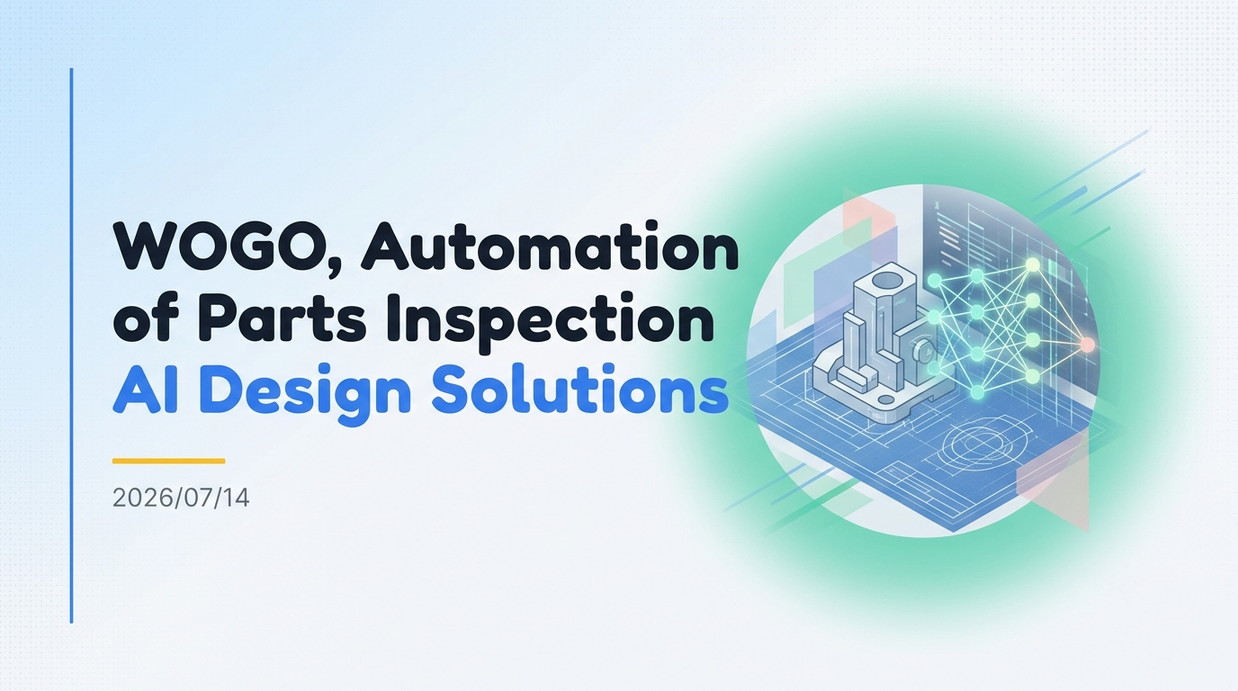
WOGO Inc. has officially launched its “AI Automatic Design Solution,” which dramatically reduces design man-hours in manufacturing. This system presents a groundbreaking approach to the growing shortage of skilled technicians by integrating AI with advanced geometric algorithms to automate the entire process from design to drafting.
- In July 2026, WOGO began full-scale offering of its AI automated design solution.
- Advanced 3D automatic drawing inspection capabilities realized through add-ons to existing CAD
- Advanced design support through the fusion of geometric algorithms and generative AI
- Structural Challenges of Inheriting ‘Tacit Knowledge’ Accompanying the Retirement of Skilled Designers
- Liberation from repetitive design tasks and dramatic productivity gains
- Remarkable implementation results and practical impact at Takahashi Metal and Takeuchi Manufacturing
- Latest Trends in Civil Liability and Governance in AI Era Design
In July 2026, WOGO began full-scale offering of its AI automated design solution.
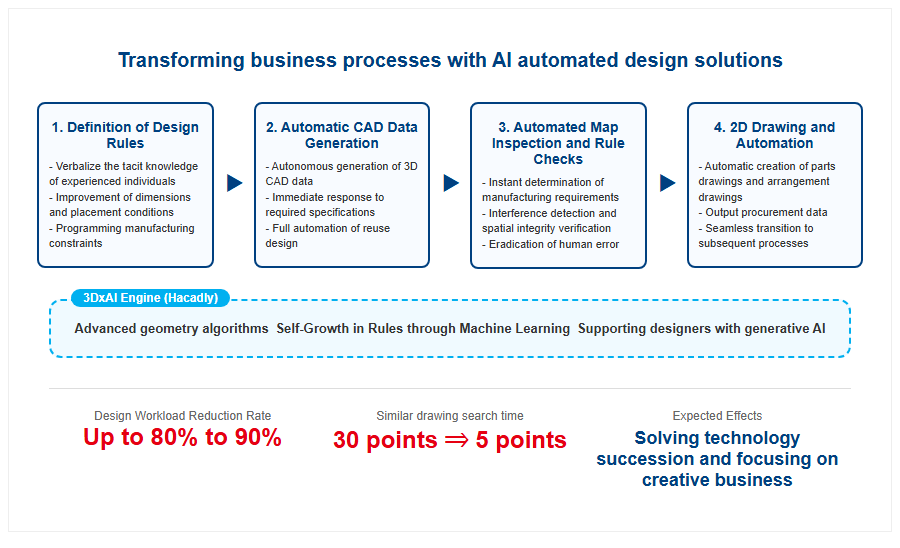
On July 1, 2026, WOGO Inc. began full-scale offering of its “AI Automatic Design Solution” targeting the manufacturing and construction equipment sectors. This solution automatically programs essential design rules in manufacturing practices such as sheet metal, cutting, welding, and profile steel processing, supporting the entire design process seamlessly. Specifically, it offers a wide range of functions such as creating automatic design programs, automatic generation of 3D CAD data and drawings, automatic inspection, and automated 2D drawing.
The greatest feature of this system is that it goes beyond the traditional rule-based automated design framework and incorporates AI to support continuous improvement and expansion of design rules. We aim to create a “self-growth” system that digitizes the vast knowledge designers have accumulated so far, learning each company’s unique design standards the more they use it. Until now, manufacturing sites have produced a vast amount of simple repetitive tasks such as creating new drawings and scheduling drawings based on similar past designs. With the introduction of this solution, most of these tasks are now automated, allowing designers to focus on more advanced and creative work. Please refer to the diagram below.
。
Advanced 3D automatic drawing inspection capabilities realized through add-ons to existing CAD
One of the core features of this solution is “Hacadly 3D Automatic Inspection.” This system allows automatic analysis and inspection of 3D shapes simply by adding add-ins to existing 3D CAD software widely used in design sites, such as iCAD and SolidWorks. We instantly determine specific manufacturing requirements such as hole diameter, end face distance, and bend R in sheet metal processing, based on preset standard rules.
Drawing inspection is an extremely important step to prevent rework caused by design errors or oversights, but until now, it relied heavily on visual checks by skilled technicians, resulting in significant man-hours and mental stress. WOGO’s system automates these checklists, eliminating human error and minimizing rework before drawing. Furthermore, it is possible to flexibly customize items according to each company’s unique processing rules and inspection standards. By systematizing the “tacit knowledge” cultivated by veteran engineers through years of experience within the system, anyone can perform high-quality map inspection, greatly contributing to solving challenges in technology transfer.
Advanced design support through the fusion of geometric algorithms and generative AI
The technical advantage of WOGO’s solutions lies in their fusion of advanced geometric algorithms and cutting-edge generative AI. With the power of this world-first “3DxAI,” it has become possible to bring “meaning” to design data itself. Traditional CAD automation tools relied on static logic and required large-scale program maintenance whenever manufacturing constraints changed, but WOGO’s system leverages machine learning to dynamically adapt to changing machining rules and material constraints.
Additionally, the “Hacadly Design AI Platform,” a companion service, integrates generative AI with CAD to support designers by cross-searching and summarizing internal technical documents and standards. Designers can access necessary information directly via chat from the CAD environment, supporting rapid design decisions. By integrating algorithms that guarantee geometric consistency with generative AI that handles natural language and vast amounts of unstructured data, we realize an advanced engineering ecosystem that digitizes the entire thought process of designers.
Severe labor shortages and accelerated manufacturing DX
Structural Challenges of Inheriting ‘Tacit Knowledge’ Accompanying the Retirement of Skilled Designers
The biggest crisis currently facing Japanese manufacturing is labor shortages due to the declining birthrate and aging population, as well as the retirement of veteran designers who have supported the backbone. The advanced know-how cultivated over many years by skilled technicians often remains as tacit knowledge that is dependent on individuals—such as ‘tips’ and ‘intuition’—that do not appear in drawings, making systematic transmission to the next generation extremely difficult. Many workplaces share a sense of crisis that if things continue as they are, the retirement of veterans could lead to the loss of corporate competitiveness.
Against this backdrop, DX (Digital Transformation), which leverages digital technology to “visualize” expert wisdom and enables anyone to replicate it, has become an urgent task. WOGO’s automated design and mapping solutions truly take over this “knowledge inheritance” through digital power. By converting the judgment criteria of experts into algorithms, we resolve the individualization of technology and enable the utilization of knowledge as an organization. This is not just about efficiency; it is an extremely meaningful initiative to perpetuate the fading strengths of Japan’s manufacturing industry as digital assets.
Liberation from repetitive design tasks and dramatic productivity gains
In manufacturing design sites, a large proportion of work consists of non-creative repetitive tasks, such as searching for and reusing past drawings or repeatedly drawing simple parts with different dimensions. According to one survey, it is not uncommon for designers to spend an average of 30 minutes per part just to find similar past drawings. Such “searching time” and “repetitive work” have put pressure on design work that originally generates added value, leading to longer lead times and increased design costs.
By implementing WOGO’s AI automated design solution, these repetitive CAD drafting tasks can be automated, fundamentally redesigning the design department’s workflow. By autonomously generating 3D models and 2D drawings based on physical design rules, designers are freed from routine dimensional adjustments and can focus on tasks that require human-specific creativity, such as more advanced structural analysis and new product development. This not only significantly shortens design lead times but also supports the establishment of flexible production systems that can promptly meet diverse customer demands in today’s market, where large-scale, small-lot production is mainstream.
The effects of real-world implementation and the responsibility for AI utilization
Remarkable implementation results and practical impact at Takahashi Metal and Takeuchi Manufacturing
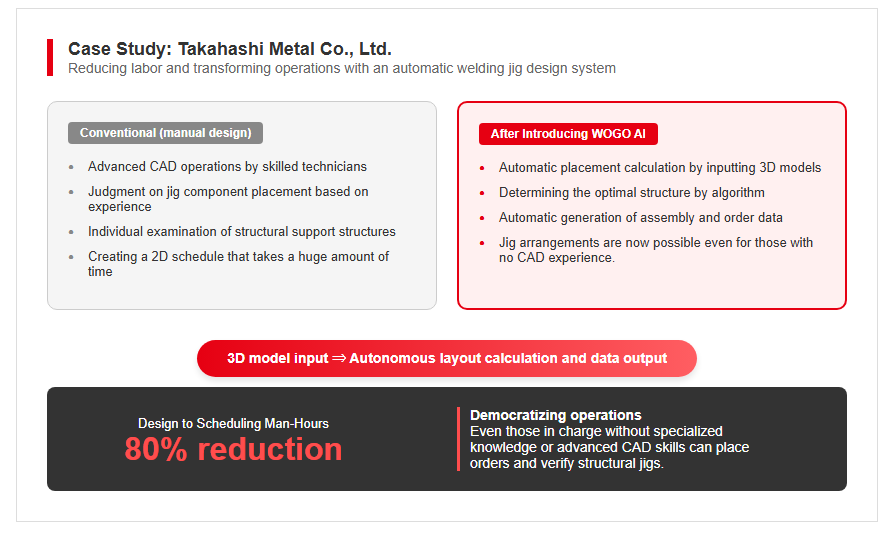
WOGO’s solutions have already delivered tangible results in several advanced companies. At Takahashi Metal Co., Ltd., an initial case study, we achieved an astonishing 80% reduction in labor compared to previous stages from welding jig design to the creation of order drawings. Previously, specialized engineers manually placed parts and spent enormous amounts of time, but now everything is automatically completed simply by importing 3D models, enabling even those unfamiliar with CAD operations to arrange jigs, democratizing business processes. Please refer to the diagram below.
。
Additionally, in a joint project with Takeuchi Manufacturing Co., Ltd., a global manufacturer of construction machinery, we built a similar drawing search system utilizing AI. Simply by uploading the PDF drawings, the AI instantly extracts drawings with similar shapes from the vast internal database. As a result, parts search tasks that previously took 30 minutes have been reduced to about 5 minutes, and efficiency is expected to improve by approximately 83%. These numerical results clearly demonstrate that AI is no longer in the experimental phase but has transitioned into a full-fledged value creation phase in actual manufacturing environments.
Latest Trends in Civil Liability and Governance in AI Era Design
While the social implementation of AI is rapidly advancing, legal responsibility and governance regarding the damages caused by AI-generated outputs have also become important topics of discussion. In April 2026, the Ministry of Economy, Trade and Industry published the “Guidelines on the Interpretation and Application of Civil Liability in AI Utilization,” outlining the fundamental approach to the responsibilities of AI developers, providers, and users. Here, it is organized that the level of duty of care required differs depending on whether AI is treated as an “auxiliary/supportive AI” for humans to make final decisions, or as a “dependent/substitute AI” that entrusts judgment to AI.
In the use of AI in manufacturing design, the process of humans verifying the results produced by AI is emphasized. Public comments on the draft guide also point out that it is difficult for AI users to individually verify the governance framework of providers, and that utilizing certifications based on international standards such as ISO/IEC 42001 is effective. For companies implementing AI solutions like WOGO, not only technical efficiency but also creating mechanisms to ensure transparency in design rules and accountability such as log retention will be key to future competitiveness.
Future Developments and Highlights
WOGO’s efforts are part of a major movement that goes beyond simply providing tools to redesign manufacturing operations themselves as “AI-first.” From 2026 onward, AI is expected to move from being used alone to a phase deeply integrated into overall business processes, evolving into a “self-growth” model where it continuously learns and updates its knowledge.
Going forward, with the advancement of “Physical AI,” which fuses robots and AI, the field will expand into highly autonomous areas where picking, transport, and even precise assembly work within factories will become highly autonomous. WOGO is also expected to expand automation from specific processing rules such as sheet metal and welding to a broader range of manufacturing processes. A future beyond these technological innovations is envisioned, where designers shift from “workers” to “exception handlers and quality managers,” allowing humans to immerse themselves in more essential and purposeful creative activities.
[#製造業DX #AI自動設計 #技術継承 #自動検図 #スマートファクトリー #WOGO #2026年AIトレンド #工数削減]


コメント