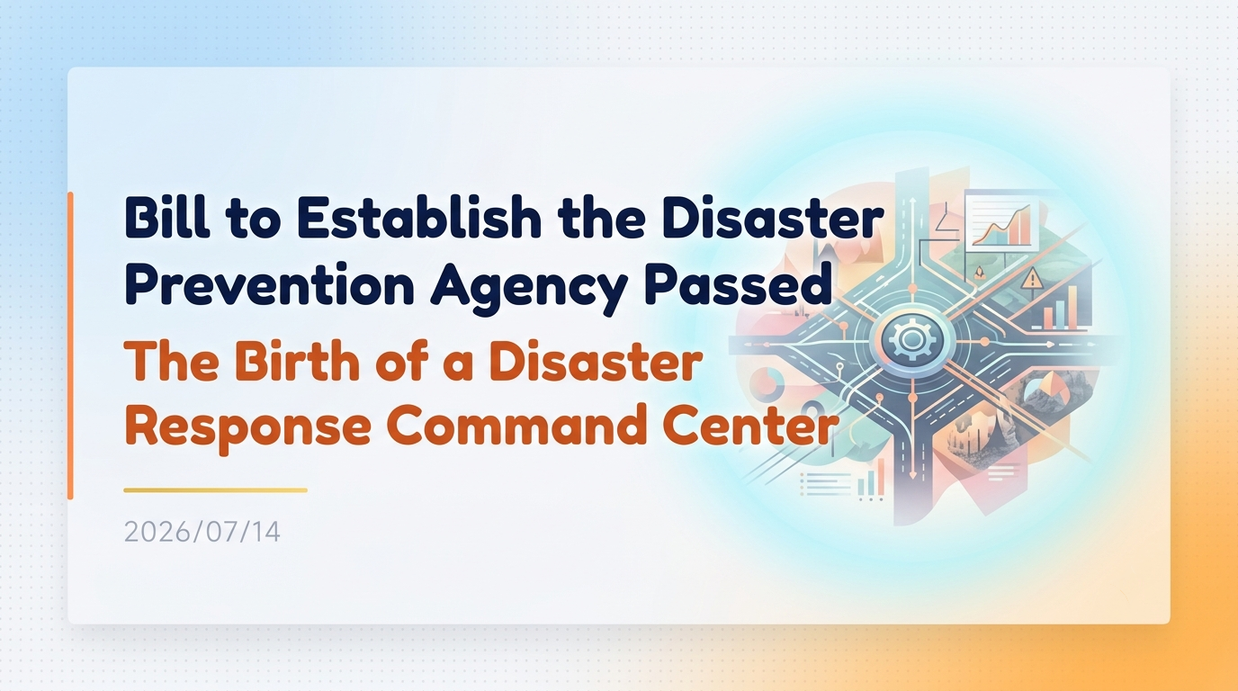
The Act on the Establishment of the Disaster Prevention Agency, which serves as the government’s command center for disaster response, was passed and enacted at the plenary session of the House of Councillors on July 13, 2026. Underlying concerns were about large-scale disasters of national crisis such as the Nankai Trough earthquake and the Tokyo Metropolitan Earthquake, making it urgent to eliminate the traditional siloed administration and establish a system that would centrally handle everything from pre-disaster prevention to recovery.
- Launching in November 2026: A Disaster Response Command Center Emerges
- Significant expansion of organizational structure, personnel, and budget
- Recommendations and a centralized management system that eliminates silos
- Shift to “Disaster Prevention” Based on Scientific Evaluation
- Regional Hub Expansion and Human Resource Development from Fiscal Year 2027 Onward
- Promotion of Disaster Prevention DX and the Effectiveness of Public-Private Partnership
Launching in November 2026: A Disaster Response Command Center Emerges
At the House of Councillors plenary session on July 13, 2026, the Disaster Prevention Agency Establishment Act, which serves as the government’s disaster response command center, was passed and enacted by a majority vote of both ruling and opposition parties. As a result, the functions previously held by the Cabinet Office’s Disaster Prevention Division will be significantly strengthened, and it is expected to be established as an independent organization directly under the Cabinet in November 2026. The newly established Disaster Prevention Agency is positioned as an organization that centrally manages everything from pre-disaster prevention during normal times to emergency response during disasters, and even long-term recovery and reconstruction. Japan is one of the world’s leading disaster countries, and until now, it has repeatedly implemented individual post-disaster measures whenever a large-scale disaster occurred. However, amid concerns over major national disasters such as the Nankai Trough earthquake and the earthquake directly beneath the capital, it has been pointed out that the previous system has limitations in responding to such disasters. The passage of this bill is expected to mark a historic step toward eliminating inter-ministerial silos and realizing a disaster-prevention-oriented nation that prioritizes human life.
Significant expansion of organizational structure, personnel, and budget
Regarding the organizational structure of the Disaster Prevention Agency, the Prime Minister is placed at the top, with a dedicated Minister of Disaster Prevention overseeing operations under him. The personnel structure will be significantly expanded from the current Cabinet Office disaster prevention officer’s approximately 220 personnel to a 352-person team, approximately 1.6 times larger. On the budget side, the FY2026 budget proposal includes approximately 20.2 billion yen for expenses related to the Disaster Prevention Agency, which is an increase of about 38 percent compared to the initial budget of about 14.6 billion yen in FY2025. The establishment of this organization was initiated by former Prime Minister Shigeru Ishiba in autumn 2024, and the bill was passed under the subsequent Sanae Takaichi administration. The establishment of a new agency directly under the Cabinet is the first since the Digital Agency in September 2021, making it clear that the government positions disaster prevention as one of the nation’s top priorities. Please refer to the diagram below.
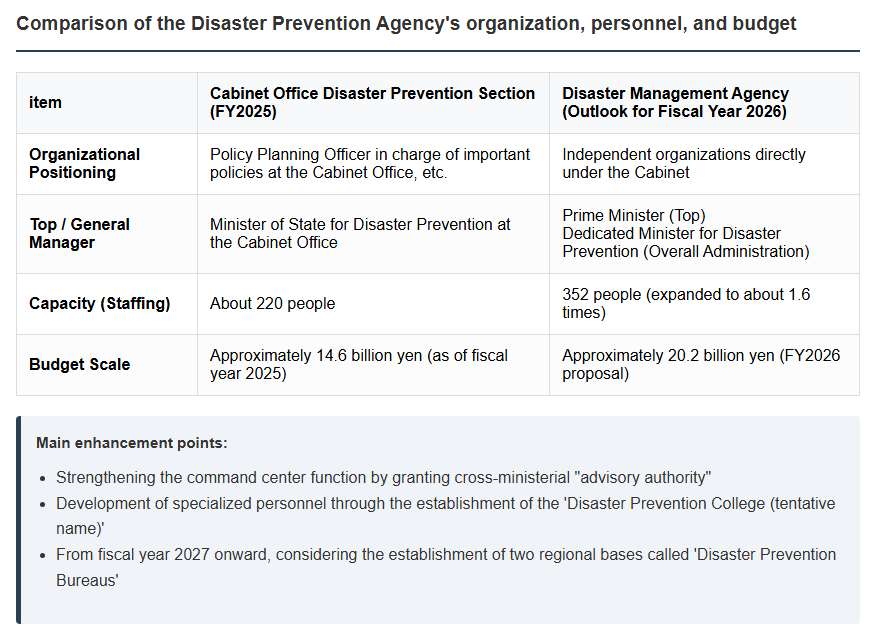
Roles and New Powers of the Disaster Prevention Agency
Recommendations and a centralized management system that eliminates silos
The greatest feature of the Disaster Prevention Agency is its powerful command center function, which coordinates across related ministries and agencies. Of particular interest is the authority granted to the Minister of Disaster Prevention to make recommendations to each ministry and agency. Until now, during large-scale disasters, the authority of various ministries has been dispersed, making it difficult to make rapid decisions and allocate resources optimally. Under the new system, the Disaster Prevention Agency can recommend necessary measures to each ministry, and the ministry receiving the recommendations is obligated to respect them. This enables integrated promotion by eliminating the drawbacks of silos in a wide range of tasks such as improving evacuation shelter environments, transporting supplies, and restoring infrastructure. The government, based on this advisory authority, aims to dramatically accelerate the process from initial response immediately after a disaster to rebuilding living conditions through its coordination functions.
Shift to “Disaster Prevention” Based on Scientific Evaluation
With the establishment of the Disaster Prevention Agency, the focus of Japan’s disaster prevention policy will shift significantly from post-disaster response to scientific pre-disaster prevention during peacetime. The basic principles of disaster response have newly added phrases such as “pre-disaster prevention based on scientific risk assessment” and “ensuring a good living environment for victims.” This indicates a policy that emphasizes not only hard measures to reinforce levees and buildings, but also soft measures such as advanced damage prediction using AI and digital twins, and refined evacuation plans. Specifically, measures include improving living conditions at evacuation centers during disasters by stockpiling beds and partitions during normal times, as well as establishing a registration system for kitchen cars and trailer homes that provide hot meals. Additionally, the school aims to transform the very nature of support from shelter-centered support to individualized support tailored to the needs of each person evacuating home.
Future Outlook and Challenges to Be Addressed
Regional Hub Expansion and Human Resource Development from Fiscal Year 2027 Onward
The Disaster Management Agency plans to develop regional hubs not only at its Tokyo headquarters but also to strengthen on-site response capabilities. Specifically, considering the areas assumed to be affected by the Nankai Trough earthquake and trench-type earthquakes around the Japan Trench and Kuril Trench, the establishment of two local agencies, the “Disaster Prevention Bureau,” is being considered. The establishment of regional bases is expected to take place after fiscal 2027, but through risk assessments during normal times, support for each municipality’s evacuation planning, and large-scale joint drills, they will be responsible for raising the level of regional disaster prevention capabilities. Additionally, the bill includes the establishment of a ‘Disaster Prevention University (tentative name)’ to foster personnel with specialized knowledge in disaster prevention. This program is intended to provide advanced training and education not only for municipal staff but also for private disaster prevention personnel. Deploying specialized personnel nationwide and maintaining a system in which the public and private sectors collaborate to respond to disasters is a key focus over the medium to long term.
Promotion of Disaster Prevention DX and the Effectiveness of Public-Private Partnership
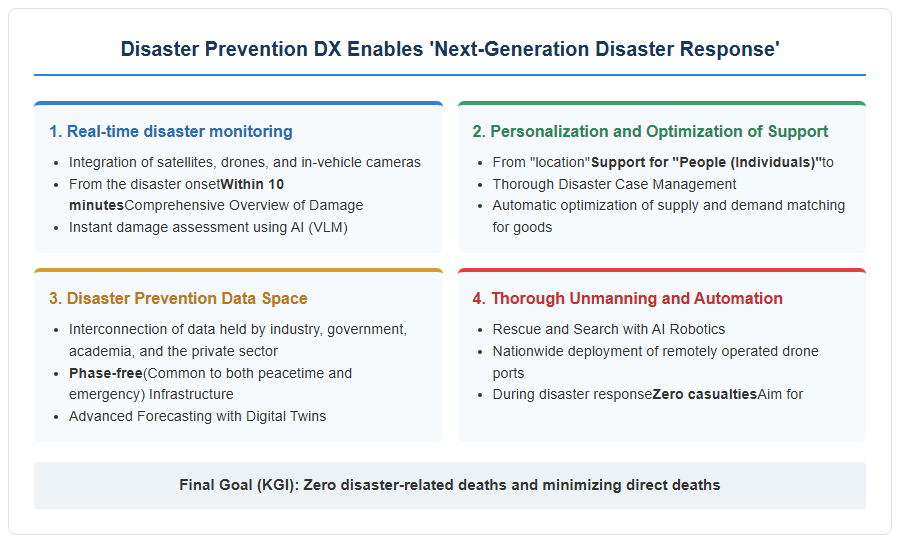
The biggest future focus will be the social implementation of disaster prevention DX (digital transformation) utilizing cutting-edge technologies. The government aims to build a real-time disaster awareness infrastructure that can grasp the overall picture of damage within 10 minutes of a disaster occurring using drones, aircraft, satellites, and other means. Furthermore, by establishing a “Disaster Prevention Data Space” where industry, government, academia, and the private sector collaborate to share data, the creation of mechanisms that visualize disaster victim information and the delivery status of supplies is expected to accelerate in order to provide optimal support. Please refer to the diagram below.
On the other hand, challenges remain to enhance operational effectiveness, such as dividing roles with the Reconstruction Agency and detailed coordination with local governments. In particular, how to control social frictions—such as the impact of precise risk visualization on real estate prices and financial markets—will also be a key issue in future institutional design. Whether the Disaster Prevention Agency can function as a true command center and create a sense of security that the public can feel will be a major focus going forward.
[#防災庁 #防災DX #事前防災 #災害対策 #政治社会 #南海トラフ地震 #司令塔機能 #日本政府]

コメント