On July 17, 2026, Nichirei Co., Ltd., the largest domestic company in frozen foods and refrigerated logistics, announced that it would gradually resume operations suspended due to cyberattacks starting that day, aiming for a full recovery by next week. This situation highlights the structural vulnerability of Japan’s robust supply network that supports its food infrastructure to digital risks.
- Full coverage of cyberattack detection and initial response
- Guidelines for the suspension of physical logistics and full reopening within next week
- Stagnation in supply for residential and commercial products hits consumers’ lives directly
- Temporary closures and disruptions at major food service and retail companies
- The blind spot of digital dependence and the unique recovery challenges of cold chains
- Rapid rebound in stock prices and investor sentiment due to signs of early recovery
- The Decisiveness of Physical Shutdown and the Importance of ‘Analog Regression Capability’
- “Surface Defense” and Supply Chain Redesign by Distribution ISAC
Full coverage of cyberattack detection and initial response
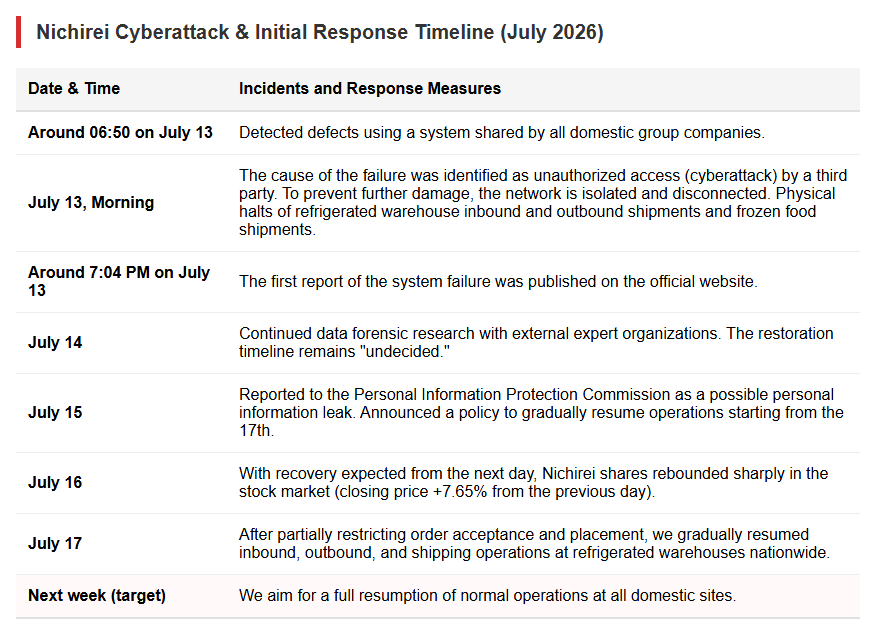
The outbreak began at around 6:50 a.m. on July 13, 2026, when a malfunction was detected in a system shared by Nichirei Group’s domestic companies. The company immediately set up an emergency response headquarters and identified the cause of the outage as a cyberattack caused by unauthorized external access. To prevent further damage from spreading at the water’s edge, measures were taken to isolate the network from the outside, but this system shutdown as a form of “self-defense” ultimately paralyzed physical logistics functions.
Since some of the attacked servers contained personal information, Nichirei reported to the Personal Information Protection Commission on July 15 as a possible leak. Although no external leakage of customer data has been confirmed at this time, data forgibility investigations and safety verifications in collaboration with external security specialists have continued for several days. The decision made by a top logistics leader to “completely shut down the system” was a painful choice to protect data integrity and customer trust. Please refer to the timeline below.
Guidelines for the suspension of physical logistics and full reopening within next week
Due to the system failure, the logistics subsidiary Nichirei Logistics Group’s refrigerated warehouse inbound and outbound operations, as well as Nichirei Foods’ frozen food shipping operations, were physically suspended nationwide. The Nichirei Group boasts an overwhelming domestic refrigerated warehouse capacity of about 1.59 million tons, holding an 8.6% market share, making it the industry leader. Therefore, if the company’s system stopped, it meant that about 5,000 food distribution companies, which were business partners, would be locked at the same time.
With the resumption of operations starting July 17, partial operations have begun in the refrigerated warehouse and food factory, with some restrictions on orders placed on the receiving and receiving orders. According to the company’s announcement, the timing for resuming normal operations at all locations is targeted “within next week.” However, shipping inventory that has been stagnant for several days and rescheduling delivery schedules require enormous effort, and it is expected that it will take some time even after the supply chain fully reopens.
The Ripple Effects of the ‘Nichirei Shock’ and Its Impact on Society
Stagnation in supply for residential and commercial products hits consumers’ lives directly
The Nichirei system outage shook the archipelago as the ‘Nichirei Shock,’ directly affecting consumers’ lives. Especially with the summer vacation season approaching and the demand for frozen foods rising, families raising children voiced their heartbreak. At supermarket stores, not only Nichirei products but also shelves of ice cream and frozen foods from other manufacturers using the company’s warehouse were emptied, resulting in “empty shelves” occurring in various locations. The chart below shows the impact on retail stores.
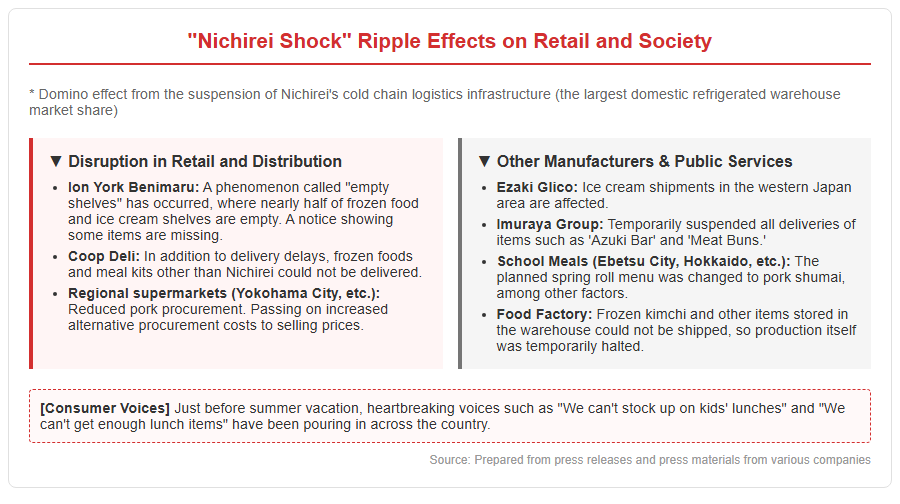
Specifically, Ezaki Glico revealed that its ice cream shipments in western Japan were affected, and the Imuraya Group temporarily suspended all deliveries of items such as “Azuki Bar” and “Nikuman.” Additionally, the impact on public services was unavoidable, and at the school lunch center in Ebetsu City, Hokkaido, the spring rolls scheduled for next week were replaced with other ingredients, among other measures. It has been demonstrated that the impact of a shutdown of food logistics social infrastructure extends beyond a single company to every aspect of citizens’ daily lives.
Temporary closures and disruptions at major food service and retail companies
Food service and retail companies that outsource food delivery to the Nichirei Group have also suffered severe blows. On July 14, KFC Japan announced that, due to difficulties in sourcing ingredients, it may suspend temporary closures, shorten business hours, and suspend orders via its app at all stores nationwide. The company is highly dependent on Nichirei and maintains a cautious stance, maintaining a “fluid” approach regarding the prospects for recovery.
Additionally, at Kura Sushi, a major conveyor belt sushi company, delivery delays occurred for certain sushi toppings such as bonito and pufferfish, as well as frozen ingredients. The company tried to minimize the impact by utilizing multiple logistics routes, but dozens of stores in Kansai experienced menu shortages. As of July 15, some products have been confirmed to be out of stock at AEON-affiliated supermarkets and York Benimaru. These companies are scrambling to secure alternative logistics networks and coordinate deliveries, reaffirming the risks of logistics structures that rely on a single company.
Structural Vulnerabilities and Impact on the Market and Management
The blind spot of digital dependence and the unique recovery challenges of cold chains
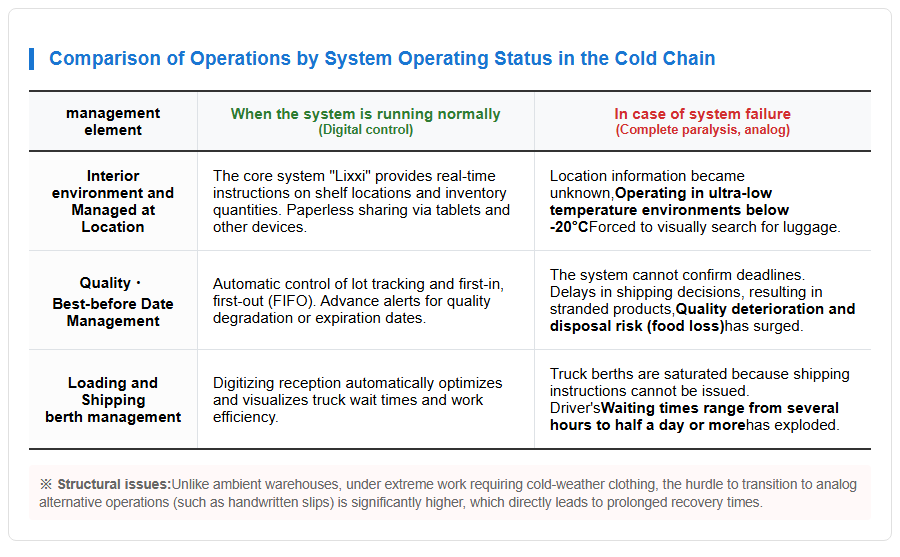
This incident ironically shows that Nichirei’s advanced system, which has been driving logistics digital transformation (DX), has functioned as a “single point of failure (SPOF).” Nichirei’s core systems such as “Lixxi” have been highly regarded as successful examples of logistics DX, such as managing inventory locations, shelf life, and controlling first-in-first-out in real time. However, the moment the system went down, a black box occurred in warehouses with temperatures below minus 20 degrees Celsius, where it was impossible to know which packages were where.
Unlike ambient warehouses, workers in cold storage warehouses perform tasks under extreme conditions, making analog manual picking without systems extremely difficult due to physical strain and safety concerns. Additionally, increased opening and closing of doors leads to higher internal temperatures, directly leading to product quality deterioration and disposal risks. These cold chain-specific constraints prolonged recovery efforts and directly caused site dysfunction. Please refer to the graph below.
Rapid rebound in stock prices and investor sentiment due to signs of early recovery
The stock market was sensitive to Nichirei’s moves toward recovery. After the system failure was discovered, on July 16, 2026, Nichirei announced that it would gradually resume inbound and outbound operations starting the following day, the 17th, causing the company’s stock price to rebound sharply. The closing price was 2,088.50 yen, up 148.50 yen (7.65%) from the previous day, marking the first intraday increase since August 2024. On the following day, the 17th, the stock price continued to rise to 2,135.5 yen, showing some reassurance that recovery was in place earlier than expected.
Analysts at SMBC Nikko Securities say that it is currently difficult to calculate the specific impact of this incident, but they positively evaluate the prospect of a swift resumption. However, in the long term, it is necessary to closely monitor rising cybersecurity costs, opportunity losses due to supply disruptions, and impacts on brand image. In a past case, Asahi Group Holdings, which suffered a cyberattack in 2025, faced a situation where it revised its consolidated net profit downward by about 38%, and management is strongly urged to thoroughly enforce security governance going forward.
Future Outlook and Modern Challenges of Logistics BCP
The Decisiveness of Physical Shutdown and the Importance of ‘Analog Regression Capability’
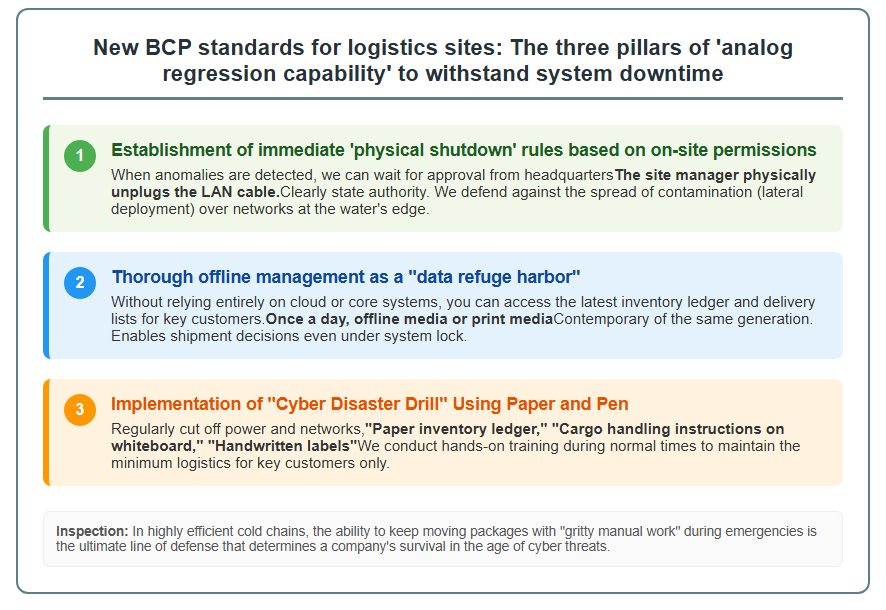
The greatest lesson to be learned from Nichirei’s response and the earlier Asahi Group case is the need for “analog regression capability” when digital services stop functioning. Modern logistics warehouses are designed with 100% system uptime, but in emergencies, conducting training (cyber drills) to maintain minimal logistics using paper inventory ledgers and whiteboards during normal times is essential for a true business continuity plan (BCP).
Additionally, establishing a “site-led physical separation rule” that physically cuts LAN cables on site without waiting for headquarters approval when abnormalities are detected is also attracting attention as an effective defense against total system contamination. Because the logistics industry pursues the extreme of efficiency, maintaining the “ultimate redundancy of analog” is the key to survival strategies in the era of cyber threats. Please refer to the diagram below for on-site countermeasures.
“Surface Defense” and Supply Chain Redesign by Distribution ISAC
It is difficult for individual companies to completely prevent cyberattacks on their own, so going forward, the industry-wide “surface defense” of sharing threat information and jointly protecting against threats will become increasingly important. Established in April 2026, the General Incorporated Association Distribution ISAC is an advanced initiative where manufacturers, wholesalers, retailers, and logistics companies share intelligence such as attack patterns in real time. Major logistics companies like Nichirei are also expected to actively commit to these frameworks and enhance the resilience of the entire supply chain.
Furthermore, this incident may lead retailers and food service chains to increasingly seek decentralization of logistics outsourcing rather than concentrating them in a single company. Discussions will likely focus on redesigning highly fault-resilient distribution networks that can automatically allocate shipments to alternative warehouses in the event of a failure. Positioning cyberattacks as a serious threat to the “last line of society,” a fundamental shift in mindset across the entire industry is now on the verge of begining.
[#ニチレイ #サイバー攻撃 #物流BCP #コールドチェーン #流通ISAC #経済ニュース #情報セキュリティ]


コメント