On July 20, 2026, ByteDance announced a new audio creation model called “Seed Audio 1.0,” which dramatically changes the concept of voice generation. Unlike traditional individual voice synthesis, its biggest feature is that it can generate dialogue, sound effects, and ambient sounds as “scenes” within a single integrated framework.
- Key Points of the Presentation and Implementation of an Integrated Framework
- Technical Foundation: Fusion of Language Models and Diffusion Models
- Support for over 20 languages and advanced control features
- Proof of high practicality and naturalness through evaluation tests
- Dramatic Efficiency and Use Cases of Production Workflows
- Ethical Guardrails and Future Prospects
Key Points of the Presentation and Implementation of an Integrated Framework
On July 20, 2026, ByteDance released “Seed Audio 1.0,” a new standard for voice generation. This model adopts an innovative approach that captures audio in units called “scenes” that make up stories or scenes, rather than generating individual audio files separately. Within a single integrated system, character dialogue, sound effects, and background ambient sounds can be coordinated and generated, greatly reducing the effort of combining and fine-tuning individual materials. As shown in the diagram below, a consistent acoustic space is constructed that aligns with the narrative’s context.
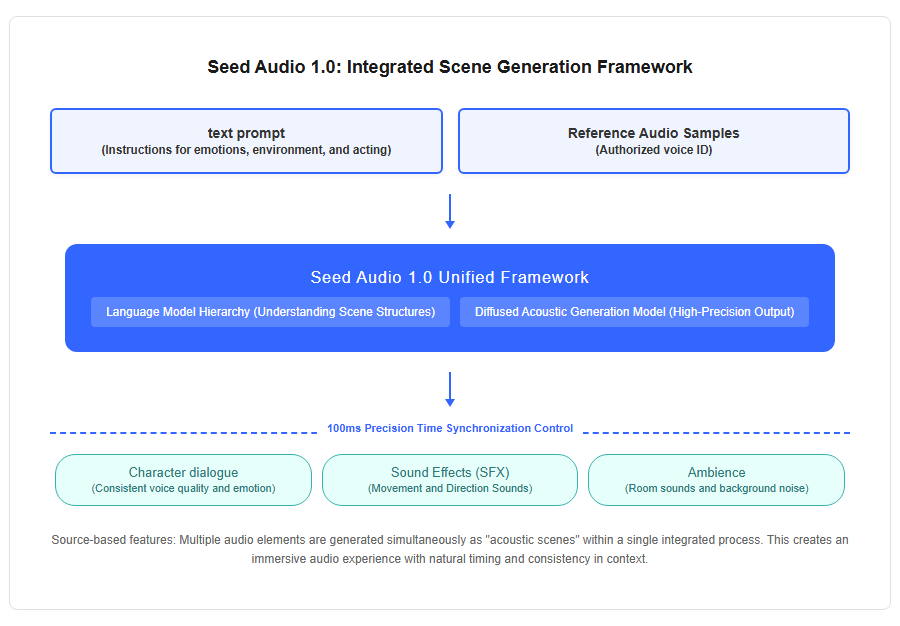
This model is already available through BytePlus, allowing you to intuitively “stage” the entire scene audio by entering text prompts or authorized voice samples.
Technical Foundation: Fusion of Language Models and Diffusion Models
The reason Seed Audio 1.0 can generate complex scenes with high quality is a unique technological architecture that connects two different layers. First, the hierarchy of the language model interprets the creator’s intent and builds a scene-level control structure for “who speaks, with what emotions, and when.” Next, a diffusion-based acoustic generation model outputs the final audio in a highly fidelity latent space. This latent expression is designed to preserve details such as the speaker’s identity, texture, and intonation, while being controlled by semantic instructions like emotion and timing. This simultaneously achieves acoustic continuity and contextual understanding, such as how voices blend into the environment or how sound cues support the emotions of dialogue.
Overwhelming Expressiveness and Responsiveness to Global Expansion
Support for over 20 languages and advanced control features
With a focus on global content creation, Seed Audio 1.0 supports multilingual generation in over 20 languages, including Japanese, Chinese, English, Korean, German, and French. It goes beyond simple translation; by transitioning to different languages while maintaining the speaker’s tone, it becomes easier to expand worldwide while preserving the brand’s identity. It also features highly accurate time control, allowing you to specify the timing of dialogue in millisecond increments. Additionally, it can output up to 2 minutes of audio in a single generation, with support for continuous extended generation thereafter. This makes it highly practical for producing long-form narrative content, games requiring consistent voice characters, podcasts, and more.
Proof of high practicality and naturalness through evaluation tests
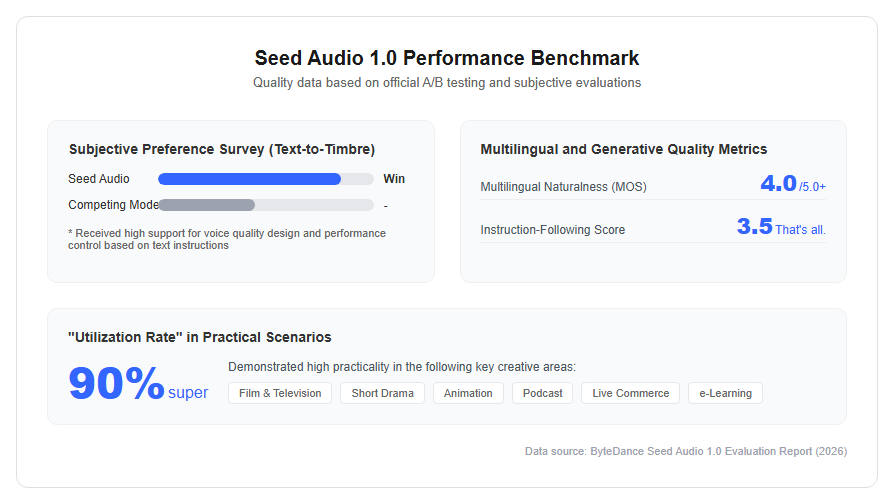
According to ByteDance’s official evaluation, Seed Audio 1.0 delivers extremely high performance across many practical use cases. Testing was conducted across a wide range of scenarios, including movies, TV shows, short dramas, animations, and live commerce, with the availability rate of generated voice exceeding 90% in most cases. Additionally, in human subjective evaluations of multilingual generation, MOS scores of 4.0 or higher, indicating naturalness in many languages, have reached a high level. In particular, when it comes to generating voice from text prompts, it has gained clear support from users compared to competing models, suggesting that the model’s ability to control voice design and performance has been enhanced. The following comparative data also shows the high quality of these products.
Considerations for Social Significance and Safety
Dramatic Efficiency and Use Cases of Production Workflows
The introduction of Seed Audio 1.0 has the potential to significantly reduce the workload required for video marketing and content production. Traditional workflows required recording narration, selecting sound effects, and mixing ambient sounds in separate steps, manually adjusting on the timeline. However, by using this model, these elements are generated harmoniously from a single prompt, which is expected to reduce production time from several days to several hours. Specific use cases include short videos with narration, advertising content, e-learning materials, and game character voices. Especially for small businesses and individual creators, the ability to produce professional-quality audio in-house at low cost is a major business advantage.
Ethical Guardrails and Future Prospects
ByteDance focuses on safety and copyright protection alongside technological advancements. Seed Audio 1.0 imposes restrictions such as using only permitted reference samples when mimicking the voice of a specific individual. This reflects a responsible development approach to prevent misuse, reflecting the fact that the feature that allowed voice cloning from a single photo was temporarily suspended due to privacy concerns. Looking ahead, there are plans to expand timing control beyond dialogue to include sound effects, ambient sounds, and music. Additionally, multimodal features that use video as reference input and multi-track generation capabilities are also planned. As voice generation evolves from mere “speech-aloud” to “expressive production,” the barriers to shaping creators’ imagination will become even lower.
Reference Page
- 【Introducing the Seed Audio 1.0 Audio Creation Model – ByteDance Seed】https://seed.bytedance.com/en/seedaudio1_0
[#SeedAudio #ByteDance #AI音声生成 #人工知能 #マルチモーダル #コンテンツ制作 #DX]

コメント