It has been revealed that US Netflix is implementing generative AI in approximately 300 titles to be released in 2026, achieving a 50% reduction in production costs and shorter production schedules. The backdrop includes a financial crisis driven by soaring global production costs, such as those seen in the South Korean film industry, and declining box office revenues, making cost reduction through AI adoption and subsequent reinvestment an urgent priority.
- Key event highlights: Utilization of AI in 300 distributed titles and streamlining of post-production
- Specific Examples and Cost Reduction: The Frontlines of Doubling Production Speed and Halving Costs
- The Plight of the South Korean Film Industry and AI Adoption: A Breakthrough to Overcome a 45% Drop in Theater Sales
- Revolutionary Changes in Production: Making Low-Budget Films a Reality and Full Government Support
- Protection of Creators’ Rights and Rule-Making: Netflix Guidelines vs. Hollywood Conflict
- Future Developments and Key Focus Areas: The Harmony Between Technological Innovation and Humanity, and the Direction of Reinvestment Strategies
Key event highlights: Utilization of AI in 300 distributed titles and streamlining of post-production
At its second-quarter earnings announcement held on July 16, 2026, US-based Netflix revealed that it is incorporating generative AI technology into the production workflows of approximately 300 titles scheduled to be released that year. The use of this technology is primarily concentrated in post-production processes, which handle post-shoot editing and special effects. Generative AI tools are proving exceptionally effective in tasks such as digital crowd expansion and the rendering of large-scale historical battle scenes—processes that traditionally demanded immense time and expense in conventional VFX (visual effects) work. Co-CEO Ted Sarandos explained that the adoption of AI has made video production possible at twice the speed and half the cost of traditional methods. The company positions generative AI as a groundbreaking tool to boost productivity without sacrificing creative output, pushing forward with cost containment and scale expansion across its entire content supply network. The following image shows a conceptual diagram illustrating the application of AI technology in Netflix streaming titles.
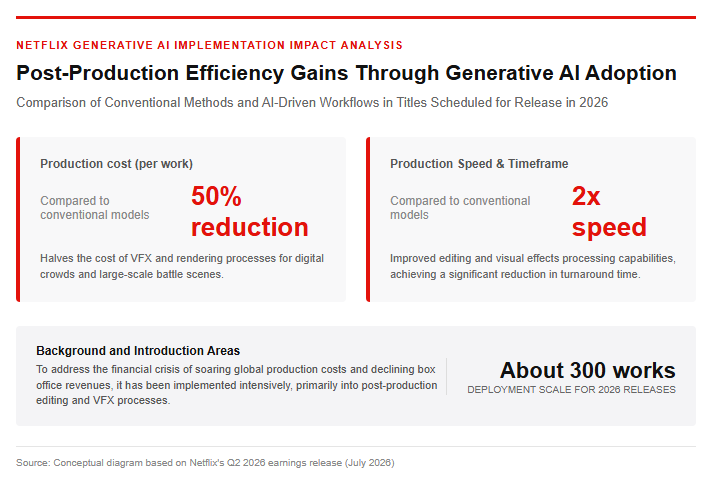
Such technological innovations have made it possible to realize complex sequences that previously would have had to be abandoned due to budget or schedule constraints.
Specific Examples and Cost Reduction: The Frontlines of Doubling Production Speed and Halving Costs
As a specific use case, in the U.S. documentary series The American Experiment, about 17 minutes of footage was enhanced using AI, achieving a 50% reduction in production time compared to traditional methods while cutting the budget in half. Additionally, in the Indian crime thriller Glory, large-scale crowd scenes that were slated to be cut due to budget constraints were preserved through a combination of AI and VFX technologies. Furthermore, generative AI was employed to create building destruction scenes in the sci-fi drama series The Eternaut, successfully achieving significantly lower costs and faster delivery times. Management has indicated that the funds freed up by these efficiencies will not simply be used to compress production costs, but will instead be reinvested into content slots reaching an annual scale of approximately $20 billion. This is a strategy that exemplifies “Jevons’s paradox,” where a decrease in unit cost drives up overall consumption. Meanwhile, in the market, the stock price temporarily fell by 7.7% due to factors such as revenue coming in slightly below expectations at $12.559 billion, as investors look to gauge whether AI-driven efficiencies will contribute to sustainable growth.
The South Korean Film Industry Facing a Financial Crisis and the Rapid Expansion of AI Utilization
The Plight of the South Korean Film Industry and AI Adoption: A Breakthrough to Overcome a 45% Drop in Theater Sales
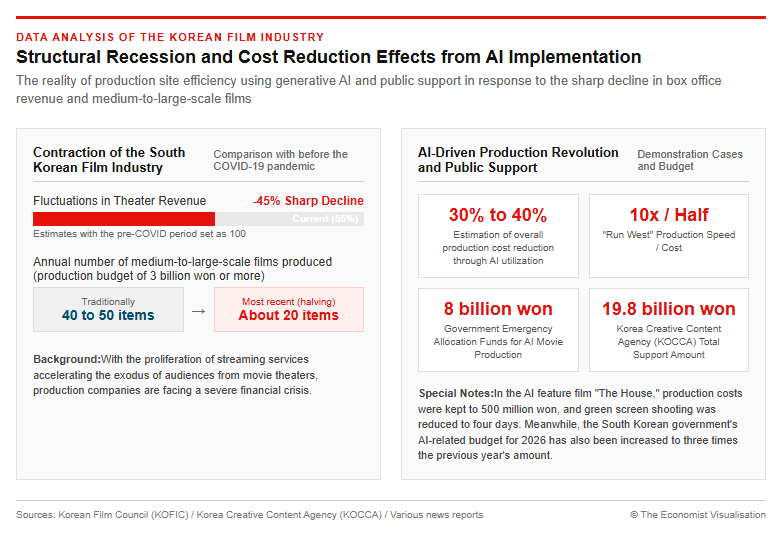
Behind globally acclaimed K-content, South Korea’s film industry is facing a severe financial crisis. Box office revenues have plummeted by about 45% compared to the pre-COVID-19 era, and the spread of streaming services has accelerated audiences turning away from movie theaters. According to data from the Korean Film Council (KOFIC), mid-to-large-scale films with budgets of 3 billion won or more, which were once produced at a rate of 40 to 50 films a year, have been halved to just 20 recently. Amidst this devastating financial crunch, for major domestic production companies like CJ ENM, the adoption of generative AI has become not just an option, but a prerequisite for survival. A May 26, 2026 CNN report also prominently featured the reality of the South Korean film industry actively embracing AI technology as a key to overcoming the crisis. The following image is a conceptual illustration of the application of AI virtual background technology on a South Korean shooting set.
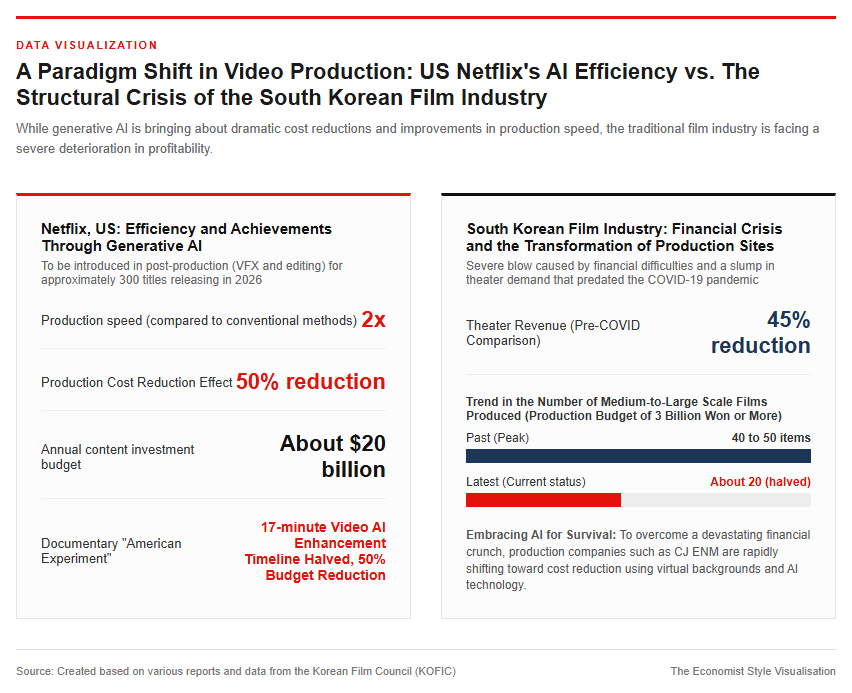
The production team is exploring ways to maintain the work’s quality even within a limited budget by reducing location changes and CGI work.
Revolutionary Changes in Production: Making Low-Budget Films a Reality and Full Government Support
Dramatic changes are occurring in actual production environments. In South Korea’s first AI feature film, “Run to the West,” directed by Kang Yoon-sung (known for “The Outlaws,” etc.) and directed by Kwon Han-seul, AI was applied to monster compositing and special effects, resulting in a 10x increase in production speed and a 50% reduction in costs compared to conventional CGI. Director Kang estimates that AI workflows can reduce overall film production costs by 30% to 40%. Additionally, the 60-minute horror film “The House,” co-produced by CJ ENM and Google Cloud Korea, was completed with a production budget of just 500 million won, keeping actor green-screen shooting down to a mere four days while rendering intricate virtual backgrounds using Google’s AI tools (such as Imagen and Veo). In response to these trends, the South Korean government is also stepping up its support, increasing its AI-related budget for 2026 to three times that of the previous year and allocating 8 billion won in emergency funds for AI film production. The Korea Creative Content Agency (KOCCA) is also investing 19.8 billion won to support technology development, as the public and private sectors unite to secure leadership in the AI content ecosystem.
Industry Concerns, Development of Guidelines, and Future Prospects
Protection of Creators’ Rights and Rule-Making: Netflix Guidelines vs. Hollywood Conflict
While the adoption of AI is rapidly advancing, concerns regarding the infringement of creators’ rights and job displacement are also growing globally. In Hollywood, the Writers Guild of America (WGA) and the Screen Actors Guild-American Federation of Television and Radio Artists (SAG-AFTRA) staged prolonged strikes to establish strict regulations on AI use and the protection of human labor rights. In response, Netflix has become an industry pioneer by formulating and publishing guidelines on the “Use of Generative AI in Content Production.” These rules clearly specify five basic principles, such as the prohibition of copyright infringement, the prohibition of using input and output data for training or storage, usage in a secure corporate environment, and the prohibition of replacing performers’ performances without their consent. The following image is a conceptual diagram illustrating the collaborative production process between humans and AI.
Even in South Korea, master directors such as Park Chan-wook (whose new film is No Other Choice) and Bong Joon-ho (Parasite) are sounding strong alarms against human alienation and the loss of humanity caused by AI. Additionally, concerns have been raised about the ambiguity of copyright attribution for AI-generated content and the risk that algorithm-driven, homogenized aesthetics could undermine the originality of works.
Future Developments and Key Focus Areas: The Harmony Between Technological Innovation and Humanity, and the Direction of Reinvestment Strategies
The primary focus moving forward will be how to balance the production cost reductions brought by generative AI with the quality and emotional resonance of video works. While improvements in technical workflow speed and cost reduction are clear, high-quality video generation does not automatically translate to audience emotion or commercial success, as demonstrated by the poor box office performance of the cited AI feature film “Run West.” As Netflix executives and VFX experts point out, “creative intervention by human hands” is essential to producing content that resonates with audiences, and AI remains merely a tool to assist artists. Additionally, it will be a key evaluation metric whether Netflix’s strategy of “reinvesting AI-reduced costs into new productions and increasing the number of titles with an annual budget of $20 billion” actually contributes to subscriber growth and increased engagement. As the standardization of AI usage in video production advances, how we protect and leverage distinctly human originality while avoiding legal risks will determine the future fortunes of the video industry.
Reference Page
- [Netflix Investor Relations – Financials & Earnings] https://ir.netflix.net/financials/quarterly-earnings/default.aspx
- 【Netflix Studio Partner Help Center – Using Generative AI in Content Production】https://partnerhelp.netflixstudios.com/hc/en-us/articles/43393929218323-Using-Generative-AI-in-Content-Production#h_01K1BTNMC4RTXXMXPKW2TJJ2ZJ
[#GenerativeAI #Netflix #VideoProduction #KoreanMovies #VFX #VideoStreaming #EntertainmentIT]

コメント