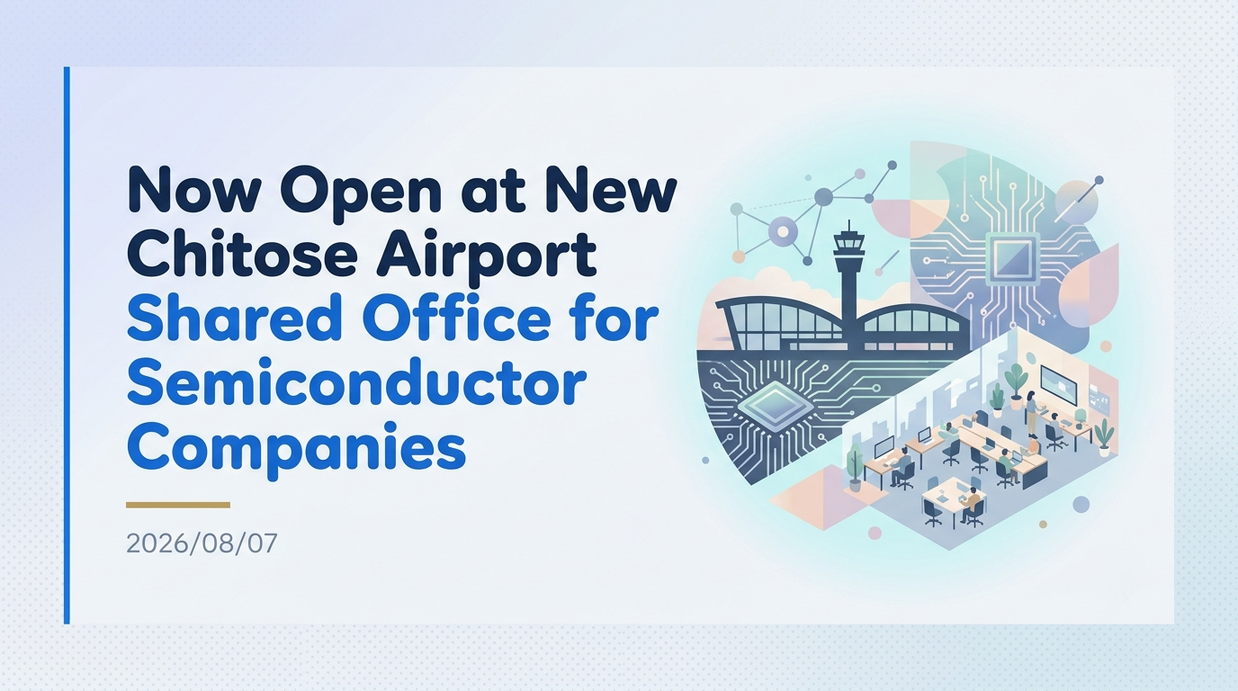
A new co-creation space dedicated to the semiconductor industry, “RISE GATE NEW CHITOSE AIRPORT,” has opened at New Chitose Airport in Hokkaido, Japan. Amidst the regional excitement surrounding the entry of the Japanese next-generation semiconductor manufacturer Rapidus into the neighboring Chitose area, this facility is expected to serve as a vital networking hub and an initial business base for related enterprises.
- Comprehensive Look at the Semiconductor Co-creation Hub at New Chitose Airport
- Integration of Shared Offices and “SHARE LOUNGE” for Diverse Business Needs
- Service Office Functions Supporting Initial Business Entry into Hokkaido
- The Rapidus Project and the Dramatic Transformation of Chitose
- Optimized Supply Chains via Hubs of People and Logistics
- Future Outlook and Challenges for the 2027 Mass Production Goal
Comprehensive Look at the Semiconductor Co-creation Hub at New Chitose Airport
On August 7, 2026, “RISE GATE NEW CHITOSE AIRPORT” officially opened on the third floor of the domestic terminal at New Chitose Airport, the primary gateway to Hokkaido, Japan. This facility is a collaborative project between Mitsui Fudosan Co., Ltd. (a major Japanese real estate developer), the general incorporated association RISE-A, and Culture Convenience Club Co., Ltd. (CCC). Notably, this marks the first time that Mitsui Fudosan’s corporate share office brand, “Work Styling,” has been introduced within a Japanese airport facility. New Chitose Airport is a high-demand transport hub, having handled a record-breaking 26 million passengers in fiscal year 2025. By establishing a base at this intersection of human traffic, the project aims to meet a wide range of needs, from temporary workspace for business travelers to full-scale preparation bases for companies planning to expand into Hokkaido. Furthermore, this is the second location for the RISE GATE brand following its first site in Nihonbashi, Tokyo, and it represents the brand’s first expansion outside the Tokyo metropolitan area. It is expected to play a leading role in forming a new industrial ecosystem that links the region with the semiconductor industry. Please refer to the following diagram for details on the facility.
Integration of Shared Offices and “SHARE LOUNGE” for Diverse Business Needs
A major feature of this hub is the organic coordination of three distinct services with different functions. Specifically, the facility integrates Mitsui Fudosan’s “Work Styling,” CCC’s “SHARE LOUNGE,” and a “Service Office” operated by RISE-A. The SHARE LOUNGE section provides 52 seats in total, 37 of which are designed as individual seats, creating an ideal environment for tasks such as document preparation or meeting previews during short intervals before or after flights. For workers requiring high concentration, three fully private rooms are available, and the facility is equipped with various work amenities such as monitors and PC stands. Additionally, the interior features artwork by Masahiro Kubo, a contract artist with Art Republic based in Sapporo, Hokkaido, creating a calm and professional atmosphere. The food and drink corner offers a variety of snacks like nuts and chocolates, along with coffee, for refreshing between tasks. In the alcohol plan, “Sapporo Classic,” a beer brand deeply loved in Hokkaido, is also provided, realizing a comfortable stay unique to a major Japanese airport. The total floor area of the store is approximately 110 tsubo (approx. 360 square meters), designed to meet diverse demands ranging from business to relaxation.
Service Office Functions Supporting Initial Business Entry into Hokkaido
This facility is positioned as a “First Office” for companies considering new entry into the Chitose area of Hokkaido. The service office provided for RISE-A members offers private office plans that can accommodate from 1 to as many as 11 people, and corporate registration at this address is also permitted. This allows companies to begin their activities in Hokkaido quickly while minimizing large-scale initial investments. Furthermore, an event space is located within the lounge to provide networking opportunities where suppliers, users, universities, and government administrative bodies in Japan can gather. Beyond merely renting out office space, the facility aims to support the formation of an industrial cluster from a “soft” perspective by creating points of contact between member companies and local stakeholders. By providing an airport-based workspace that integrates travel, business, and interaction, the project encourages the smooth regional settlement of companies and speeds up their corporate decision-making processes. Please refer to the following diagram for the community functions.
The Rapidus Project and the Dramatic Transformation of Chitose
The development of this hub at New Chitose Airport is driven by a massive project: the entry into Chitose of Rapidus Corporation, which aims to domesticate the production of next-generation semiconductors in Japan. Rapidus is an “all-Japan” enterprise funded by eight major Japanese companies, including Toyota Motor Corporation, Sony Group, and NTT, with total investments expected to reach approximately 5 trillion yen. The start of this project has turned Chitose into the heart of a “Japanese Silicon Island,” leading to extraordinary spikes in land prices; in March 2026, the area recorded the highest land price increase rate in Japan. According to simulations by the Agency for New Industry Cluster of Hokkaido, the cumulative economic ripple effect on the Hokkaido economy from fiscal year 2023 to 2036 is estimated to reach up to 18.8 trillion yen, with a GDP impact of 11.2 trillion yen. The logistics structure of Hokkaido, which previously focused on the transport of agricultural and marine products, is undergoing a dramatic historic shift toward an advanced industry-compatible model that handles high-precision equipment.
Optimized Supply Chains via Hubs of People and Logistics
The manufacturing of semiconductors requires a stable supply of high-precision manufacturing equipment and specialized chemicals gathered from around the world. Chitose, adjacent to New Chitose Airport, is a multimodal transport hub that combines the strengths of a 24-hour air cargo base with the convenience of maritime transport via the nearby Port of Tomakomai. The opening of this co-creation hub contributes not only to the efficiency of human traffic but also to the optimization of the initial stages of the semiconductor supply chain. As factories begin operations, the development of high-function logistics buffers (temporary storage bases) to deliver components necessary for daily production without delay is progressing rapidly. Major real estate developers and logistics companies from outside Hokkaido are entering the market one after another, leading to a boom in the construction of sophisticated warehouses in Chitose equipped with strict temperature and humidity controls and vibration countermeasures. Utilizing the airport location to minimize the lead time between global suppliers and the Rapidus factory is a key factor for the project’s success.
Future Outlook and Challenges for the 2027 Mass Production Goal
Moving forward, there is a need to build a sustainable ecosystem centered on this hub through collaboration between industry, academia, and government. Rapidus has set an extremely tight schedule, aiming for the operation of a pilot line in 2025 and the start of mass production in 2027. However, global competitors such as Intel and Samsung Electronics are planning mass production with even more advanced miniaturization technology in 2027, making it a critical focus how Rapidus will bridge the potential two-year time lag as it aims for full-scale operation by fiscal year 2029. Furthermore, since semiconductor factories consume enormous amounts of electricity, suppressing electricity rates and securing a stable power supply configuration within Hokkaido are essential for maintaining long-term competitiveness. It is expected that the RISE GATE co-creation hub will function as a comprehensive support platform for human resource development, technological development, and responses to geopolitical risks, going beyond the provision of initial offices for companies.
References
-
[Opening of a Co-creation Hub for the Semiconductor Industry inside an Airport for the First Time in Japan] https://www.mitsuifudosan.co.jp/corporate/news/2026/0427_02/
-
[Simulation of Economic Ripple Effects on Hokkaido Associated with the Location of Rapidus Corporation – Agency for New Industry Cluster of Hokkaido] (internal document reference)

コメント