Ricoh Japan Co., Ltd. announced the integration of the self-improving AI agent “Hermes Agent” into the edge model of its “RICOH On-Premises LLM Starter Kit,” enabling local deployment of generative AI. This move comes as corporate generative AI adoption expands from automating routine tasks to autonomously executing non-routine operations, even as rising API costs and confidential data leak risks pose major barriers to implementation.
- Key Takeaways from Ricoh’s Announcement of “Hermes Agent” Integration
- Background: The Growing Demand for Autonomous AI in Non-Routine Workflows
- Small-Footprint AI Servers and the Self-Improvement Mechanism of “Hermes Agent”
- Integrated Automation of Routine and Non-Routine Tasks via Complementary Roles with “Dify”
- Mitigating Usage-Based Pricing and Establishing Data Sovereignty via Local Execution
- Allocation of Responsibility in Autonomous AI and Future Industry Outlook
Key Takeaways from Ricoh’s Announcement of “Hermes Agent” Integration
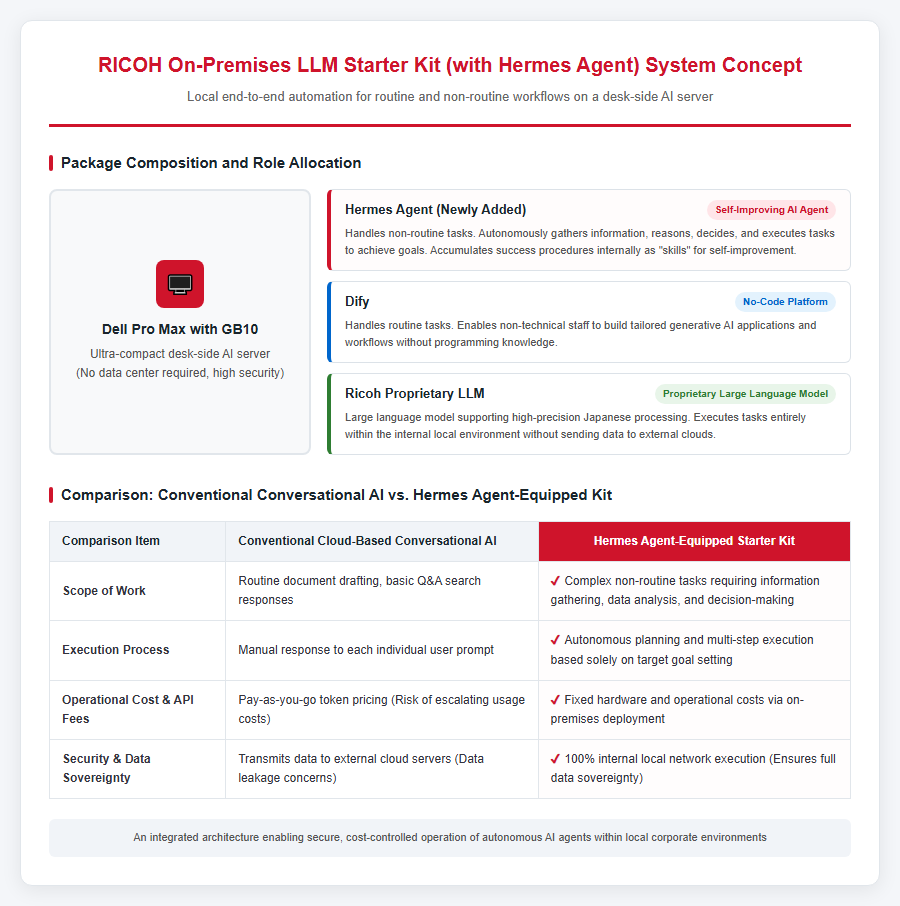
On September 10, 2026, Ricoh Japan Co., Ltd. announced the launch of the edge model of its “RICOH On-Premises LLM Starter Kit,” now equipped with the self-improving AI agent “Hermes Agent.” The solution comes pre-installed on the “Dell Pro Max with GB10,” an ultra-compact desk-side AI server, featuring Ricoh’s proprietary Large Language Model (LLM) and “Dify,” a no-code platform for developing generative AI applications. Its primary advantage is enabling enterprises to instantly access advanced AI capabilities within a highly secure local environment without complex initial setup or infrastructure construction. Moving beyond conventional conversational chat AI focused on basic Q&A, this integration represents a significant step toward practical deployment of autonomous AI agents capable of independently reasoning, planning, and executing multi-step workflows. The following image illustrates the product deployment setup and interface architecture concept.
Background: The Growing Demand for Autonomous AI in Non-Routine Workflows
As generative AI adoption deepens across enterprises, corporate needs are shifting rapidly from initial use cases—such as routine document drafting and basic data retrieval—to automating complex, non-routine tasks including market research, data analytics, and strategic decision support. To drive this operational transformation, expectations are surging for AI agents that can autonomously collect information, reason, make decisions, and execute tasks to achieve designated goals. However, deploying conventional cloud-based AI agent services introduces a major financial burden: because agents invoke LLMs multiple times internally to perform complex reasoning, API usage fees tied to token consumption escalate dramatically. Furthermore, deep-seated concerns regarding security and privacy—specifically the risk of transmitting confidential customer data or proprietary R&D assets to external cloud servers—have continued to hinder full-scale enterprise adoption.
Technical Features and System Architecture of the On-Premises LLM Kit
Small-Footprint AI Servers and the Self-Improvement Mechanism of “Hermes Agent”
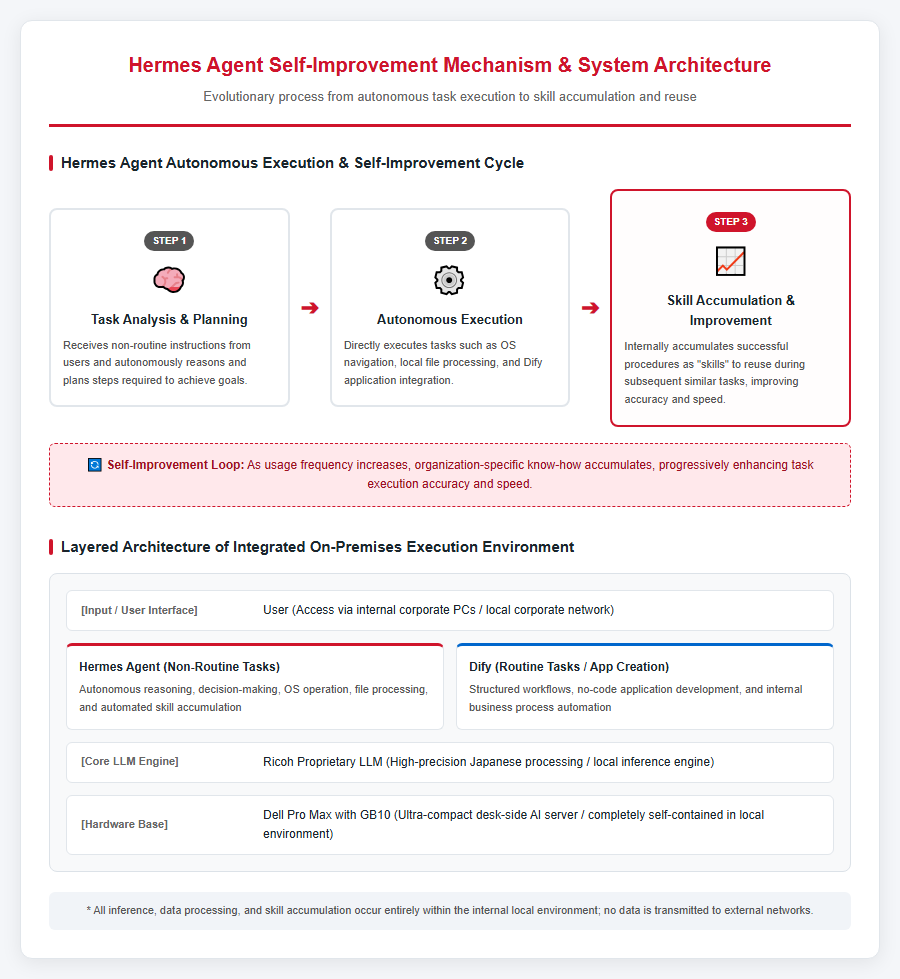
“Hermes Agent,” integrated into this release, is an open-source, self-improving AI agent developed by Nous Research. It analyzes optimal task procedures through user interaction and directly executes operational tasks such as OS navigation and local file processing. Its defining technical innovation lies in its self-improvement mechanism: as it executes tasks, it accumulates successful procedures and operational know-how as skills within its internal memory to reuse during subsequent similar assignments. Consequently, as usage increases, its task execution accuracy and speed progressively improve, tailoring its behavior to the organization’s unique operational workflows. On the hardware front, by leveraging the ultra-compact “Dell Pro Max with GB10” chassis, the solution eliminates the need for large-scale data center infrastructure, enabling seamless, department-level deployment. Please refer to the diagram below for an overview of the system architecture.
Integrated Automation of Routine and Non-Routine Tasks via Complementary Roles with “Dify”
Within this starter kit, the pre-installed no-code generative AI application development platform “Dify” operates in tandem with the newly added “Hermes Agent.” This dual architecture establishes a comprehensive framework for automating diverse enterprise workflows. Specifically, “Dify” handles the automation and application development for structured, routine tasks with clearly defined workflows, while “Hermes Agent” manages unstructured, non-routine tasks that demand situational judgment and exception handling. By enabling non-technical staff to build applications without writing code, the system fosters the democratization of AI while simultaneously supporting end-to-end digital transformation (DX) across offices and operational sites through advanced autonomous reasoning.
Cost Control, Security, and Governance Benefits for Enterprise Adoption
Mitigating Usage-Based Pricing and Establishing Data Sovereignty via Local Execution
Because all data processing occurs entirely within the internal corporate network, the kit completely eliminates the usage-based, token-metered API pricing typical of cloud-based generative AI services. Even when running AI agents that make frequent LLM calls to accomplish complex tasks, enterprises benefit from predictable, fixed equipment and operational costs, leading to substantial reductions in total cost of ownership. In addition, because input prompts, referenced internal documents, and execution logs are never transmitted outside the network, the solution can be safely deployed in sectors with rigorous security requirements, such as finance, healthcare, critical infrastructure, and corporate R&D divisions. It also serves as a robust foundation for establishing corporate data sovereignty (Sovereign AI) and complying with cross-border data transfer regulations.
Allocation of Responsibility in Autonomous AI and Future Industry Outlook
As autonomous AI agents become more prevalent in enterprise environments, defining responsibility boundaries and designing robust governance frameworks for unexpected agent behaviors or misjudgments has become a critical imperative. Unlike traditional software, AI agents act independently upon systems by manipulating tools, making behavioral controls and tamper-proof audit trails essential. Moving forward, the industry is expected to standardize operational frameworks that combine self-improving AI like Hermes Agent with stringent access controls and audit logging aligned with international standards such as ISO/IEC 42001. Furthermore, as demand for Sovereign AI grows alongside convergence with Physical AI—which controls robots and machinery in the physical world—secure, cost-effective on-premises platforms for autonomous agents will play an increasingly pivotal role in driving sustainable corporate growth and competitive advantage.
Reference Pages
- 【”RICOH On-Premises LLM Starter Kit” Edge Model Now Features Self-Improving AI Agent “Hermes Agent”】https://jp.ricoh.com/release/2026/0910_1
- 【Hermes Agent Official Site】https://hermes-agent.nousresearch.com/
- 【New “RICOH On-Premises LLM Starter Kit” Released for Highly Secure Local Generative AI Utilization】https://jp.ricoh.com/release/2025/0407_1
【#Ricoh #AIAgent #OnPremisesLLM #HermesAgent #DataSovereignty #AutonomousAI #Dify】
コメント