On June 29, 2026, Anthropic announced that its cutting-edge AI model, Claude, has been made available to the public (GA) on Microsoft Foundry. This development enables companies to directly procure AI with top-tier inference capabilities and utilize it for agent development under the control of their existing Azure environment.
Key Points of the Presentation and Selection of Target Models
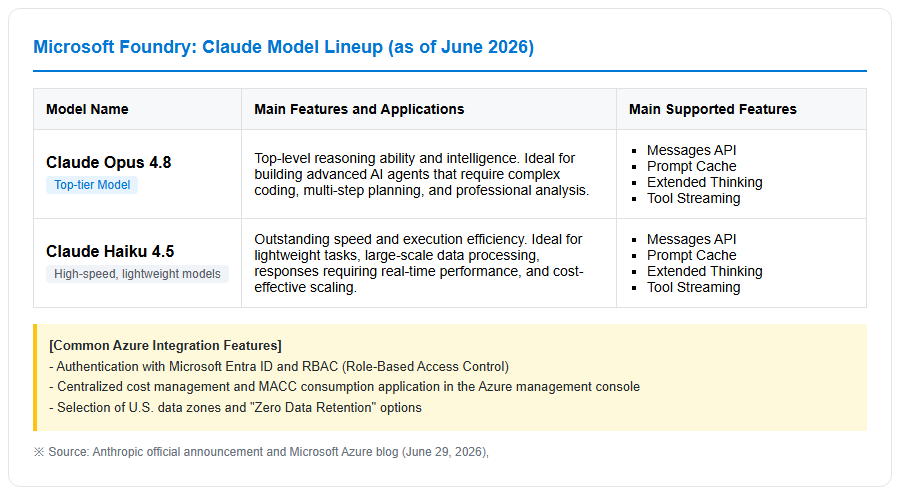
On June 29, 2026, Anthropic and Microsoft announced that the Claude model had moved to the General Availability (GA) phase in Microsoft Foundry. This time, the GA targets are two models: the Claude Opus 4.8, which boasts top-tier reasoning capabilities, and the Claude Haiku 4.5, which is fast and lightweight. Users can access these models through the Messages API, allowing them to directly use Claude’s core features such as prompt caching, extended thinking, and tool streaming within the Azure environment.
The significance of this news lies not simply in the emergence of a new AI model, but in the fact that Claude is fully integrated into the existing Azure, procurement, certification, and governance framework. When building their own AI infrastructure, companies tend to prioritize not only model quality but also compatibility with existing cloud infrastructure and simplified procurement processes. Claude in Microsoft Foundry is positioned as a production path that meets the needs of these companies, aiming to accelerate the transition from the experimental phase of AI to the production phase.
The figure below shows the latest model lineup in Microsoft Foundry.
Technical Foundation and Azure-Native Features
This GA will focus on Claude being hosted on Azure. The infrastructure uses NVIDIA Blackwell Ultra systems and InfiniBand networks, significantly improving inference performance and efficiency. In particular, by leveraging NVIDIA GB300 GPUs, an environment has been established to enable specialized AI agents requiring complex inference to be run at enterprise-scale and with security.
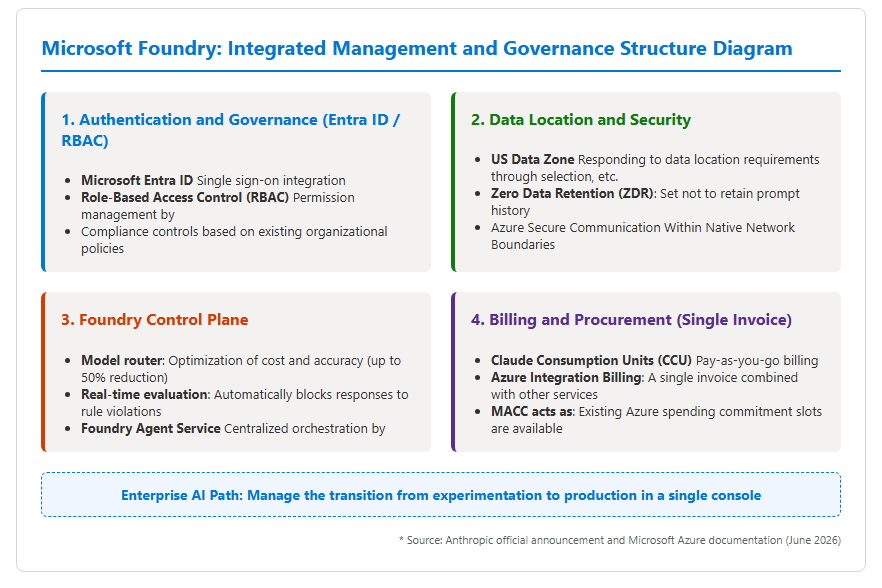
Developers can utilize advanced features such as model routers within the Azure environment. This enables automatic routing to the optimal Claude model based on query content, increasing user satisfaction while reducing costs by up to 50%. Additionally, for companies with data location requirements, options are provided to select specific regions, such as the US Data Zone. For workloads requiring high confidentiality, you can also choose a “zero data retention” setting that prevents prompts and generated results from being held by Anthropic.
Benefits of Implementation and Operational Management for Enterprise Companies
Unified governance and security controls
When enterprise companies adopt new AI models, the biggest barriers are contracts, security audits, and audit log management. By using Claude in Microsoft Foundry, companies can apply their trusted Azure authentication, billing, network, and governance controls directly to Claude. Specifically, by using authentication with Microsoft Entra ID and Azure role-based access control (RBAC), you can manage who and how to use AI within existing systems.
Additionally, through the Foundry Control Plane, advanced governance operations are possible, such as continuously evaluating whether agent responses meet corporate expectations and blocking responses that violate rules before they reach users. This serves as a means to solve the “enterprise AI stagnation problem,” where AI projects stagnate not due to model quality but by security and compliance adjustments. In actual case studies, in fields requiring extremely high reliability, such as safety analysis for nuclear power generation, there have been reports of reducing tasks that used to take 200 days to just one day.
Simplifying procurement and utilizing MACC
A major benefit for finance and purchasing departments is the centralization of billing. Claude usage fees are consolidated into a single invoice as Claude Consumption Units (CCU), along with other Azure service usage fees. This eliminates the hassle of entering new contracts with individual AI vendors and greatly simplifies the internal approval process.
An even more important point is the application of Microsoft Azure Consumption Commitment (MACC). Companies already with annual commitment agreements with Azure can allocate their Claude usage to meet those commitments, potentially allowing them to start projects without securing new budgets. A major feature of this GA is that AI can be efficiently managed not only as a “model capability” but also as a “cloud asset for enterprises.”
The diagram below shows an image of the integrated management console in an Azure environment.
Strategic Background and Future Market Development
Paradigm shift from exclusive alliances to multipolarity
The background to this announcement is the changing relationship among major players Microsoft, OpenAI, and Anthropic. Microsoft and OpenAI once had an exclusive partnership, but now that has been redesigned as a “multipolar alliance.” While OpenAI’s models will be available on other cloud platforms such as AWS, Microsoft has deepened its strategic partnership with Anthropic, steering toward offering Azure customers a wide range of model options.
At the same time, Microsoft is accelerating the development of its own AI models (MAI series) to reduce excessive dependence on external partners. By introducing reasoning-focused models like MAI-Thinking-1, we aim to reduce the margin paid to external vendors in the future and possess “frontier-level intelligence” in-house. In this way, as partnerships and competition become intricately intertwined, enterprise users are creating an environment where they can choose the optimal intelligence for their applications while avoiding the risk of being locked into a single model.
Future Outlook and Challenges to Watch
Going forward, the main battleground for enterprise AI is expected to shift from “the performance of a single model” to “platforms that run agents.” Building agents that autonomously perform tasks by integrating external models like Claude with internal data on a foundation like Microsoft Foundry Agent Service will determine a company’s competitiveness. In the latter half of 2026, even more advanced next-generation models (such as the Fable 5) are also predicted, making how quickly the latest models fit into business a critical challenge.
On the other hand, attention must also be paid to changes in the regulatory environment. With the European AI Act (EU AI Act) set to fully take effect in August 2027, rules regarding AI deployment, adoption, and disclosure are becoming stricter. Additionally, partnerships and acquisitions between AI companies are under strict scrutiny by authorities due to antitrust laws and national security concerns. Companies are required to maintain system configurations that can flexibly adapt to these regulatory and governance changes, while enjoying the latest technologies.
[#Claude #MicrosoftAzure #生成AI #Anthropic #エンタープライズAI #MicrosoftFoundry #AIエージェント]

、エルニーニョ現象の発生を発表_en-1.png)
コメント