Fujieda City in Shizuoka Prefecture and SoftBank Corp. have launched a joint demonstration project to test a domestic generative AI-powered knowledge search system for public service counters. This initiative addresses the challenges of a declining population and shrinking municipal staff while attempting to ensure reliable responses amidst increasingly complex administrative services.
- Overview of the Joint Trial by Fujieda City and SoftBank
- Background and Administrative Challenges Driving the Demonstration Project
- The Three Targeted Municipal Departments and Specific Operational Fields
- Mitigating Hallucinations and Ensuring Answer Accuracy via Retrieval-Augmented Generation (RAG)
- Data Security through Domestic Sovereign Cloud “Cloud PF Type A”
- Balancing Staff Operational Efficiency with Enhanced Resident Services
- Project Schedule and Potential Nationwide Rollout across Municipalities
Overview of the Joint Trial by Fujieda City and SoftBank
On July 1, 2026, Fujieda City, Shizuoka Prefecture, and SoftBank Corp. signed a project agreement to conduct the “Demonstration Project for Developing Reliable AI at Local Government Public Service Counters.” Selected under the Ministry of Internal Affairs and Communications’ (MIC) initiative for promoting the development and adoption of trusted AI in the public sector, the project underwent preparation starting in July 2026, with practical trials scheduled at actual municipal administrative service counters from September 2026 to January 2027. Built upon SoftBank’s “dailyAI” service platform, this demonstration features an interactive, conversational knowledge search system tailored specifically for public service counters. When citizens present diverse inquiries, the AI cross-searches pre-indexed operational manuals, relevant laws, and national government notifications, generating evidence-based draft answers and explanations for city staff. As a pioneering effort in Japan, this project is attracting nationwide attention for testing how effectively generative AI can assist municipal employees in decision-making and administrative workflows.
Background and Administrative Challenges Driving the Demonstration Project
In 2016, Fujieda City and SoftBank concluded a comprehensive partnership agreement—the first of its kind between a Japanese municipality and SoftBank—to advance community development through ICT. This new joint trial marks “Stage 2” of their collaboration, coinciding with its tenth anniversary. Driven by a declining overall population and an aging society with a low birthrate, local governments across Japan face an inevitable reduction in working-age populations and administrative staff. To maintain sustainable public services with limited workforce resources, operational efficiency and digital technology adoption have become essential. In municipal administration, staff must make decisions based on intricate laws and regulatory notices while considering each citizen’s specific circumstances, leading to a structural concentration of workload on experienced staff. Furthermore, routine personnel rotations frequently place inexperienced staff in new roles, where searching for information and verifying legal grounds requires substantial time, resulting in variations in service quality and speed. These challenges underscore the urgent need for a work environment that does not rely solely on individual staff experience.
The Three Targeted Municipal Departments and Specific Operational Fields
This trial targets three specific municipal departments handling highly specialized administrative tasks with diverse inquiries: the Citizen’s Affairs Division, the Regional Integrated Care Promotion Division, and the Welfare Policy Division. Specific operational areas include verifying requirements for family registry applications and counter procedures in the Citizen’s Affairs Division, organizing guidance and verifying legal bases for care facilities in the Regional Integrated Care Promotion Division, and confirming eligibility requirements for public assistance applications while drafting explanations for residents in the Welfare Policy Division. In each area, individual consultations vary widely, requiring staff to accurately assess each applicant’s background and make decisions against relevant laws and administrative notices.
During the trial, AI-assisted workflow support proceeds as follows:
-
Staff enter the core points of a consultation received at the counter or over the phone into the system.
-
The system cross-searches relevant legislation, national government notices, and internal municipal manuals.
-
Based on the search results, the system displays recommended draft responses and citation clauses on a single screen.
-
Staff verify the displayed evidence and deliver the final explanation or decision to the citizen.
Through these steps, the project aims to significantly reduce verification time for complex administrative tasks and ensure consistent, high-quality public service delivery.
Technical Features of Domestic LLM “Sarashina” and Sovereign Cloud Infrastructure
Mitigating Hallucinations and Ensuring Answer Accuracy via Retrieval-Augmented Generation (RAG)
At the core of this system is “Sarashina,” a domestic Large Language Model (LLM) developed by SB Intuitions Corp. (a SoftBank subsidiary), combined with Retrieval-Augmented Generation (RAG) technology. The primary risk of applying generative AI to municipal administrative work is hallucination—the generation of false or ungrounded information. Because public service counters bear legal accountability, presenting incorrect information is unacceptable. To solve this, the demonstration integrates RAG technology to directly search and retrieve reliable primary sources (laws, regulations, administrative notices, and internal manuals) from a structured database based on user queries. Because the AI generates draft responses strictly referenced from these retrieved primary sources, ungrounded generation is strongly suppressed. Furthermore, the system interface displays both the draft answer and specific reference sources side-by-side. Staff can visually verify the exact underlying sources, ensuring human accountability while maintaining a safe and accurate AI support framework.
Data Security through Domestic Sovereign Cloud “Cloud PF Type A”
Data security and data sovereignty are paramount when handling public sector data. This trial utilizes “Cloud PF Type A,” a sovereign cloud infrastructure where data storage and processing are fully completed within Japanese data centers. Relying on overseas public cloud services often raises concerns regarding data transfer across borders, potential jurisdiction under foreign laws, data leaks, or government inspection risks.
The conceptual diagram below illustrates the sovereign cloud and RAG infrastructure configuration used in this system:
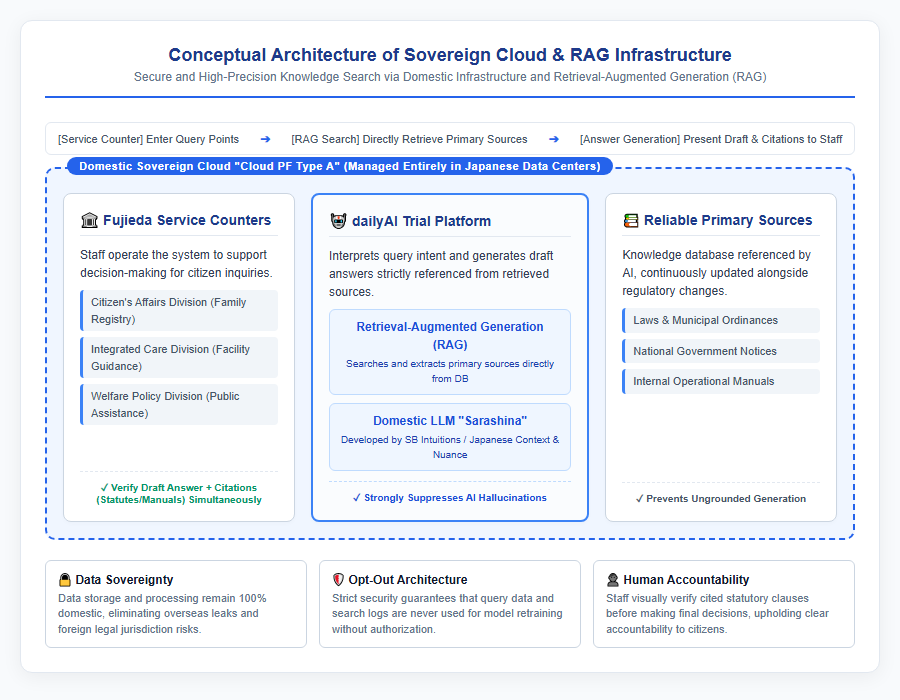
Under this architectural model, input data and query logs remain within a secure domestic environment without leaking overseas, maintaining full compliance with municipal information security policies. In addition, the system enforces an opt-out architecture preventing user data from being repurposed for model retraining, blocking personal or confidential data leaks and establishing a trusted AI environment for public administration.
Advancing Municipal DX: Future Outlook and Key Observations
Balancing Staff Operational Efficiency with Enhanced Resident Services
The ultimate goal of introducing generative AI extends beyond mere time savings to improving the quality of public services through created time. Traditionally, counter staff spent extensive time searching for reference materials and drafting explanations manually. By accelerating legal verification and draft generation through AI assistance, the time required for staff confirmation is dramatically reduced, leading to faster counter interactions.
The diagram below depicts the transformation of counter workflows and time creation structure resulting from AI adoption:
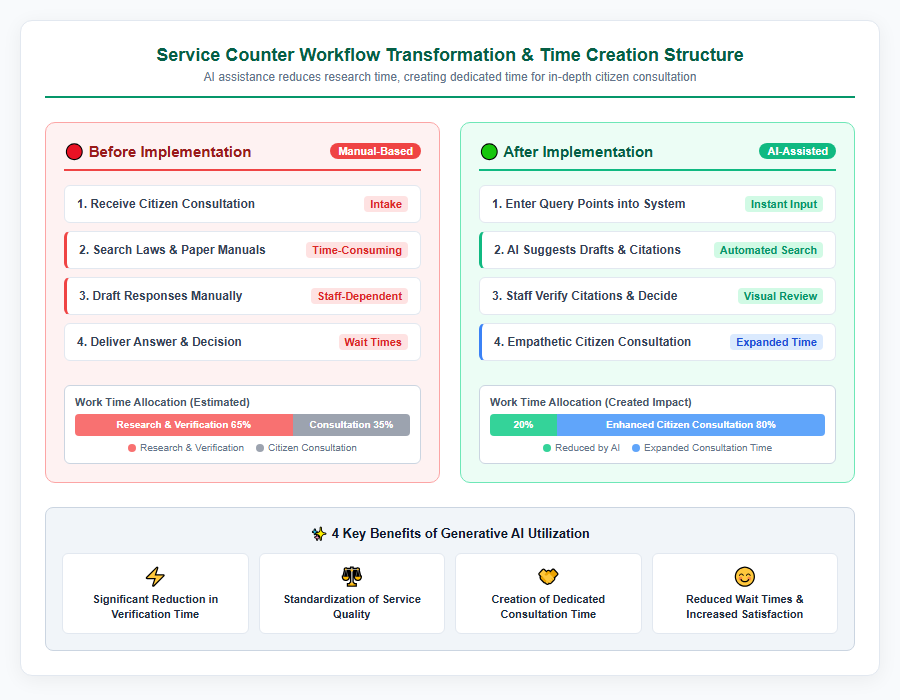
The primary changes and benefits brought by operational efficiency include:
-
Substantial reduction in time spent searching and verifying legal statutes and operational manuals.
-
Inexperienced or newly rotated staff can deliver accurate responses comparable to seasoned personnel.
-
Staff are freed from tedious reference verification, allowing more time for empathetic, attentive citizen consultations.
-
Reduced waiting times at service counters, leading to higher overall resident satisfaction.
By keeping human staff responsible for final decisions and empathetic communication, the AI serves as an advanced support system, contributing to sustainable, human-centric public administration.
Project Schedule and Potential Nationwide Rollout across Municipalities
The demonstration project spans from July 2026 to March 2027. Between July and August 2026, staff generative AI training, detailed operational interviews, and knowledge data preparation were conducted. Practical trials at service counters across Fujieda City’s Citizen’s Affairs Division, Regional Integrated Care Promotion Division, and Welfare Policy Division run from September 2026 to January 2027. Throughout the trial period, continuous user feedback is collected from staff to fine-tune response accuracy, optimize knowledge data indexing, and benchmark performance against foreign AI models. Evaluation and synthesis of results will take place in February and March 2027. If proven effective, Fujieda City plans to explore expanding AI assistance to other service counters and general administrative operations. Concurrently, SoftBank intends to standardize the sovereign cloud-based RAG construction methodologies and knowledge management frameworks developed in this project for future rollout to municipalities nationwide. As an administrative infrastructure model suited for an era of population decline, this domestic generative AI deployment will be closely watched.
Reference Pages
-
[PR TIMES Fujieda City Press Release] https://prtimes.jp/main/html/rd/p/000000282.000109487.html
-
[SoftBank Corp. Press Release] https://www.softbank.jp/business/news/2026/0701-01
-
[Ministry of Internal Affairs and Communications Press Release] https://www.soumu.go.jp/menu_news/s-news/01tsushin03_02000462.html
-
[Fujieda City Official Website] https://www.city.fujieda.shizuoka.jp/
コメント