To advance decarbonization in public works, the Ministry of Land, Infrastructure, Transport and Tourism (MLIT) and the Ministry of Economy, Trade and Industry (METI) have designated four additional public works projects to trial “GX Steel” (green steel) with reduced CO2 emissions, expanding this fiscal year’s total to 10 projects. This initiative aims to leverage government leadership to generate early demand in the steel sector, which accounts for approximately 35% of Japan’s manufacturing CO2 emissions.
- Designation of Four Additional Civil Engineering Projects and the 10-Project Scope for FY2026
- Objectives and Research Scope of Trials Targeting Full Implementation by FY2030
- The Imperative for GX: Steel Industry Accounting for 35% of Manufacturing Emissions
- The Japan Iron and Steel Federation Guidelines and Institutional Framework
- On-Site Implementation Issues and the Digitalization of Mill Sheets
- Market Creation Toward 2030 and Key Points to Watch
Designation of Four Additional Civil Engineering Projects and the 10-Project Scope for FY2026
By the end of August 2026, the Ministry of Land, Infrastructure, Transport and Tourism (MLIT) selected four additional projects in the second phase of its “Green Steel Trial Projects” for FY2026, conducted in collaboration with the Ministry of Economy, Trade and Industry (METI). Combined with the six projects chosen in late July 2026, a total of 10 trial projects have been designated for this fiscal year. These additional projects are expected to utilize structural steel materials such as steel sheet piles and heavy plates for bridges. The specific newly designated projects include the “National Highway Route 5 Niki Town Ginzan Bridge Superstructure Central Project” (Hokkaido Development Bureau, Hokkaido), the “FY2025 Umori-Sango Drainage Channel Improvement Project” (Chubu Regional Development Bureau, Gifu Prefecture), the “FY2025 Route 42 Matsusaka-Taki Bypass Asada Viaduct Steel Superstructure Project” (Chubu Regional Development Bureau, Mie Prefecture), the “FY2025 Fukuyama Road Akasaka-Higashi Footbridge Steel Substructure and Superstructure Project” (Chugoku Regional Development Bureau, Hiroshima Prefecture), and the “FY2025-2027 Aki Road Kurodori Viaduct Superstructure A1-P2 Project” (Shikoku Regional Development Bureau, Kochi Prefecture). Low-carbon steel products will be deployed directly at these civil engineering sites under direct national control to evaluate workability, quality, and performance. A defining feature of this initiative is the gathering of empirical field data across diverse steel product types across infrastructure sites nationwide.
Objectives and Research Scope of Trials Targeting Full Implementation by FY2030
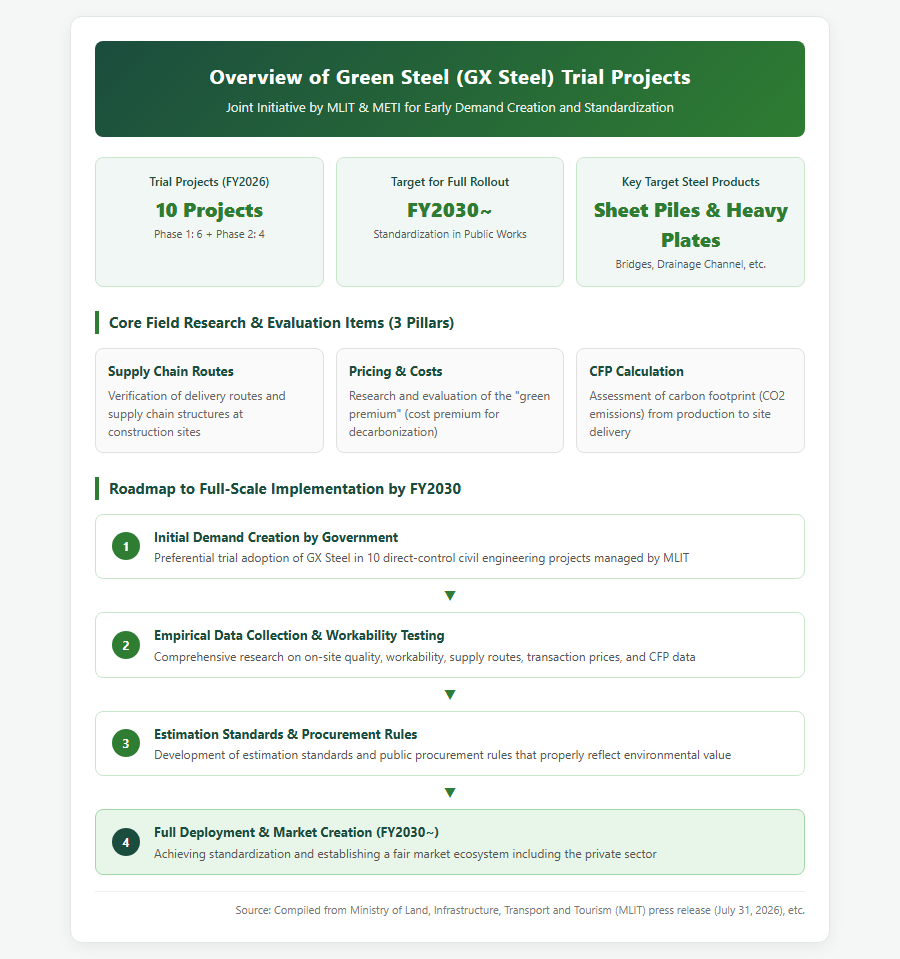
The overarching goal of these trial projects is to collect empirical data necessary for the full-scale deployment and standardization of GX Steel in public works projects directly managed by the government starting in FY2030. Operating as part of METI’s “GX Demand Creation and Carbon Pricing Operation Program,” the initiative comprehensively investigates and evaluates supply chain distribution routes, transaction prices, and calculation methodologies for carbon footprints (CFP), including manufacturing stages. Decarbonizing steel products incurs a price premium (green premium) due to elevated production costs, making it difficult to generate sufficient demand solely through the private market. Therefore, the government aims to jump-start initial demand through public procurement, gradually building a market environment where environmental value is fairly recognized and traded. Data gathered from these trials will directly inform future estimation standards and public procurement rules. The figure below illustrates the overall scope of research items and validation processes in these trial projects.
Decarbonization of the Steel Industry and the Regulatory Framework for GX Steel
The Imperative for GX: Steel Industry Accounting for 35% of Manufacturing Emissions
The steel sector is Japan’s largest industrial source of carbon dioxide, accounting for approximately 35% of CO2 emissions from domestic manufacturing and roughly 10% of Japan’s total greenhouse gas emissions. Consequently, decarbonizing steel through Green Transformation (GX) is classified as a top-priority policy initiative for climate mitigation. However, steelmaking is technically categorized as a “hard-to-abate” sector where direct carbon dioxide reduction is extraordinarily difficult. Achieving net-zero carbon emissions by 2050 requires developing and deploying breakthrough technologies, such as transitioning from blast furnaces to electric arc furnaces and implementing hydrogen-based direct reduction ironmaking. Establishing these technologies demands trillions of yen in capital investments and extensive R&D timelines. As a result, robust support is urgently needed on the demand side to facilitate the adoption of eco-friendly steel products during the transition phase and ensure investment recovery for manufacturers.
The Japan Iron and Steel Federation Guidelines and Institutional Framework
Building a market for GX Steel requires a transparent institutional framework for calculating greenhouse gas reductions and securing third-party certification. In October 2025, the Japan Iron and Steel Federation (JISF) established and updated its “GX Steel Guidelines” and related standards. The guidelines define two primary supply mechanisms: the “Mass Balance Method” (certificate-based), which allocates an organization’s overall CO2 reduction achievements to specific products, and the “Allocation Method,” which directly calculates and attributes emission reductions to individual product carbon footprints. On the regulatory side, the Japanese government updated the “Basic Policy for the Promotion of Procurement of Environmentally Conscious Goods and Services” (Cabinet decision in January 2025), adding items using steel raw materials as a new designated procurement category under the Green Purchasing Law. This explicitly encourages the procurement of steel certified with emission reduction certificates. Steelmakers are bringing compliant products to market—such as Nippon Steel’s “NSCarbolex Neutral”—which are being adopted for these government trial projects. The figure below outlines the certification standards and supply chain structure for GX Steel.
Operational Challenges on Construction Sites and Future Outlook
On-Site Implementation Issues and the Digitalization of Mill Sheets
Achieving widespread adoption of GX Steel in public construction requires addressing operational and practical challenges at job sites, alongside cost hurdles. Key considerations include establishing mechanisms to absorb the green premium for environmental value compared to conventional steel, defining contract modification rules between project owners and general contractors, and implementing measures to prevent the double-counting of environmental attributes. Furthermore, robust systems are required to verify that the steel used is legitimately low-carbon and to prevent fraud or misrepresentation. In this context, digitalizing “mill sheets” (inspection certificates verifying steel quality and compliance with design standards) has gained significant attention. For instance, digital trust infrastructure utilizing technologies like Cybertrust Japan’s “e-Seal” certificates is rapidly being deployed to prevent tampering during procurement and inspection processes while streamlining site management.
Market Creation Toward 2030 and Key Points to Watch
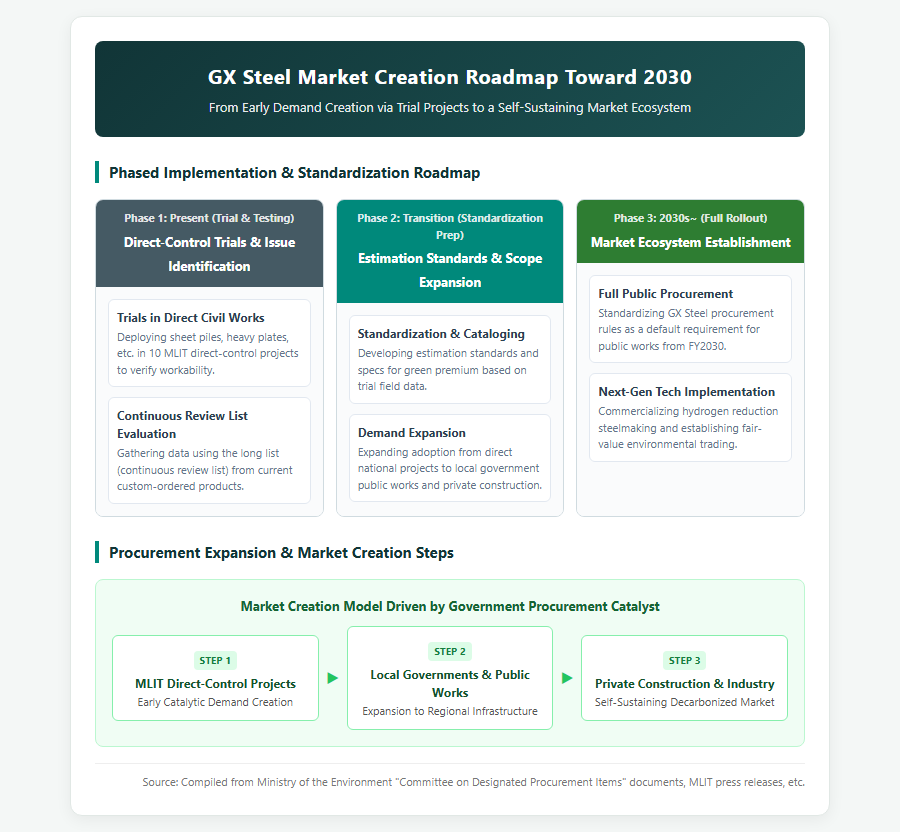
The key focus moving forward is whether the insights gained from MLIT’s direct-control civil engineering trials can drive adoption into municipal public works and private sector construction. Currently, most GX Steel products remain custom-made orders rather than standardized, catalog-procurable items. At the Ministry of the Environment’s Committee on Designated Procurement Items, a roadmap has been outlined to systematically conduct trial construction in public works, evaluate products via a continuous review list (long list), and establish standardized specifications for the future. As next-generation steelmaking technologies like hydrogen reduction are commercialized toward the 2030s, government-led preferential procurement will act as a critical catalyst for early market growth. Establishing a sustainable market ecosystem where both suppliers and buyers reap appropriate value will ultimately determine the global competitiveness of Japan’s steel industry. The figure below depicts the roadmap for procurement expansion toward 2030.
Reference Pages
- 【Press Release: CO2 Emission Reduction Steel Trial Projects Initiated!】https://www.mlit.go.jp/report/press/kanbo08_hh_001354.html
- 【GX Steel Guidelines & Related Guidelines: The Japan Iron and Steel Federation】https://www.jisf.or.jp/business/ondanka/kouken/greensteel/
【#GXSteel #GreenSteel #PublicWorks #MLIT #Decarbonization #CarbonNeutrality #GreenPurchasingLaw】

コメント