- Arrest and Indictment of a City Official and a Local Contractor over Renovation Work
- Kinship and Suspicion of Systematic Pre-arranged Bids
- The Statistical Improbability of Perfect Floor Price Matches
- The Rise of “Low-Price Collusion” in Modern Procurement
- Disciplinary Actions, Apologies, and Niimi City’s Response
- Legislative Objectives of the Bid-Rigging Prevention Act and Systemic Safeguards
Arrest and Indictment of a City Official and a Local Contractor over Renovation Work
On the evening of August 5, 2026, the Okayama Prefectural Police’s Second Investigation Division, along with the Niimi Police Station, arrested a 52-year-old official serving as a senior counselor and deputy division chief in the Niimi City Urban Development Division under charges of violating the Act on Elimination and Prevention of Involvement in Bid Rigging and obstructing public bidding. Simultaneously, the 53-year-old representative director of Nishimura Kogyo Co., Ltd., a local construction firm that won the contract, was arrested under bid-rigging charges (and was 54 by the time of indictment). The focus of the investigation is a designated competitive bid held on May 28, 2025, for the renovation of “Kirameki Hiroba Tessei,” a municipal multi-purpose facility. Out of 13 participating companies, Nishimura Kogyo won the contract for 98.7 million yen (excluding tax) against a non-public target price of 108.5 million yen. The official allegedly leaked this confidential target price to the contractor about two days prior to the bid using phone calls and messaging applications. On August 26, 2026, the Okayama District Public Prosecutors Office formally indicted both individuals, and Niimi City subsequently placed the official on administrative suspension on the same day. This direct flow of restricted public pricing data to a private bidder has severely undermined public trust in municipal administration.
Kinship and Suspicion of Systematic Pre-arranged Bids
The backdrop of this collusion reveals a deeply entrenched, highly insular personal relationship that bypassed professional ethics. The indicted city official and the contractor’s representative are relatives and had a long-standing personal relationship dating back well before the official joined the Niimi City Government in April 2007. Since being appointed as a chief and section head in the Urban Development Division in April 2022, the official was in a position to routinely access draft budget prices and calculations used to establish target prices. This kinship created a highly secure channel for illegal information exchange. More alarmingly, investigations suggest this was not an isolated incident but a systematic practice. Nishimura Kogyo secured a total of seven municipal construction contracts in fiscal year 2025. Unbelievably, in six out of those seven projects, the company’s winning bid matched the city’s pre-calculated minimum limit price down to the single yen. Because such precision is statistically impossible by chance, the Okayama Prefectural Police are conducting a thorough investigation into past bids, suspecting that target prices had been leaked systematically over a multi-year period.
The Mechanism of Minimum Limit Price Matching and Procurement Challenges
The Statistical Improbability of Perfect Floor Price Matches
What caught the public’s attention in this scandal was that the winning bid of 98.7 million yen (excluding tax) was identical to the city’s minimum limit price. In Japanese public bidding, a “minimum limit price” is established as a floor to prevent dumping, contract defaults, and shoddy work resulting from excessively low bids. Bids falling below this line are automatically disqualified. Because this minimum limit price is mechanically calculated by applying a fixed ratio to the non-public target price, anyone who acquires the target price beforehand can calculate the floor with near-absolute precision. In this case, armed with the leaked target price of 108.5 million yen, the contractor successfully reverse-engineered the exact disqualification threshold of 98.7 million yen to submit a winning bid. This perfect match served as undeniable physical evidence of a pre-bid information leak. The pursuit of a guaranteed win using precise leaked data ultimately became the definitive proof that exposed the entire illegal scheme.
The Rise of “Low-Price Collusion” in Modern Procurement
While traditional public bid rigging is associated with inflating contracts near the maximum target price to extract excessive taxpayer funds, the structural dynamics of municipal collusion have changed significantly in recent years. Because high winning ratios are now heavily monitored as indicators of bid rigging, classic high-price cartels are easily detected. In response, modern collusion has shifted to “low-price bid rigging,” where companies compete on paper but secure contracts by targeting the absolute floor, such as the minimum limit price. Statistical data indicates that in municipal bid-rigging cases uncovered between 2010 and 2021, a significant portion of winning bids targeted prices right at or near the minimum limit price. Please refer to the diagram below.
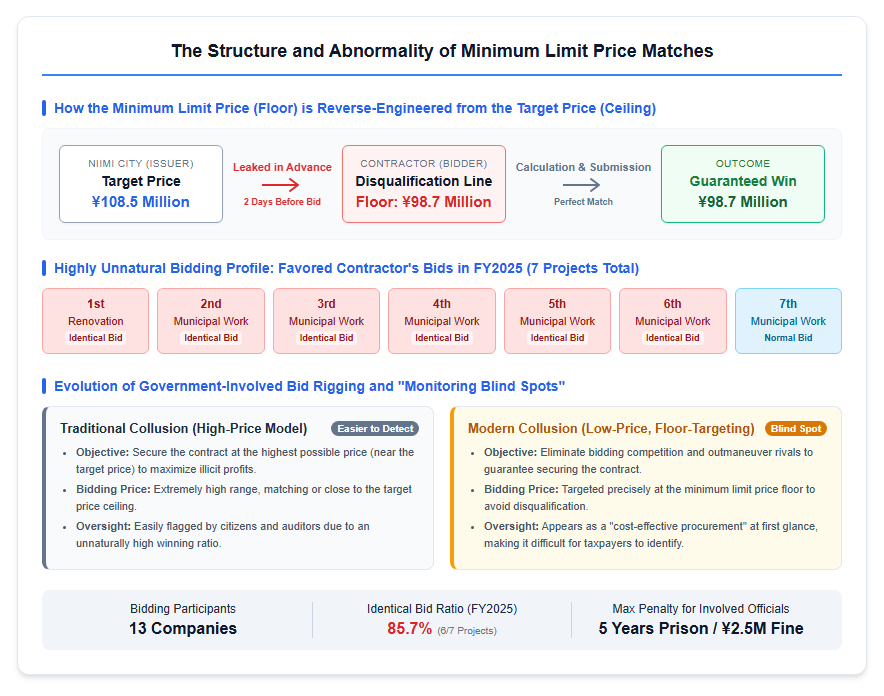
Because these low-price bids appear to save public funds on the surface, they are incredibly difficult for citizens or external auditors to notice, creating a massive blind spot in public monitoring. The monopolization of public works by favored contractors through the exclusion of fair competition still severely damages market integrity and demands systemic reform.
Administrative Impact and the Path to Restoring Public Trust
Disciplinary Actions, Apologies, and Niimi City’s Response
Following the exposure of the scandal, administrative bodies and oversight authorities have moved quickly to implement disciplinary measures and review existing systems. On August 6, 2026, Niimi City Mayor Minoru Ishida held a press conference, offering a deep apology: “The arrest of our official is deeply regrettable, and I sincerely apologize for the immense trouble and concern caused to our citizens and stakeholders.” The mayor announced plans to establish a recurrence prevention committee featuring external experts. Furthermore, on August 25, 2026, the Okayama Prefecture Administrative Division issued a one-year bidding suspension for Nishimura Kogyo Co., Ltd., running from August 25, 2026, to August 24, 2027. Niimi City implemented similar suspension measures. Following the formal indictment on August 26, the city also placed the arrested official on suspension. Moving forward, the city must restructure its governance, including implementing mandatory staff rotations to prevent the centralization of authority and tightening access to confidential bidding data. Restructuring the public procurement process is critical for municipal governments where the proximity between officials and local businesses naturally heightens collusion risks.
Legislative Objectives of the Bid-Rigging Prevention Act and Systemic Safeguards
The Act on Elimination and Prevention of Involvement in Bid Rigging was enacted in 2003 to prevent public officials from facilitating collusion among private bidders. A key amendment in 2006 (effective in 2007) introduced direct criminal penalties for involved officials, including up to five years in prison or confinement, or a fine of up to 2.5 million yen. While these severe penalties act as a strong deterrent, legal threats alone cannot completely eliminate personal misconduct. Local governments must adopt structural systems that make price leaks physically and logistically impossible. For instance, Niigata City restructured its contract administration by completely separating project-managing staff from bidding administration staff, who now manage target price decisions independently. Additionally, by calculating and setting the minimum limit price only at the time of bid opening, it becomes impossible for anyone to estimate or leak the threshold in advance. Rather than relying solely on individual ethics, Niimi City and other municipalities nationwide must adopt robust, system-based procurement safeguards to restore long-term trust.
References
- [Niimi City: “Mayor’s Comment on the Arrest of a City Official”] https://www.city.niimi.okayama.jp/important/important_detail/index/920.html
- [Okayama Prefecture Administrative Division: “List of Suspended and Excluded Contractors for Okayama Prefecture Construction Works”] https://www.pref.okayama.jp/site/321/617473.html
- [Japan Fair Trade Commission: “Act on Elimination and Prevention of Involvement in Bid Rigging”] https://www.jftc.go.jp/dk/kansei/
【#BidRiggingPreventionAct #NiimiCity #IdenticalBid #SuspensionFromBidding #ObstructionOfPublicBidding #RecurrencePrevention #BiddingSystemReform】

コメント