While Japan’s nationwide Consumer Price Index (CPI) growth moderated in August 2026 due to government policy subsidies, underlying inflationary pressure persists, centered on daily household necessities. This trend is driven by multifaceted cost increases, including surging crude oil and naphtha prices alongside rising logistics and labor expenses.
- Overall Picture of the August 2026 CPI and the Suppressive Impact of Policy Factors
- Rapid Price Hikes Spreading to Everyday Items Such as Tissues and Plastic Bags
- Surging Crude Oil and Naphtha Prices and the Pass-Through Lag for Packaging and Logistics Costs
- Rising Labor Costs and Shifting Corporate Stances Under Price Negotiation Guidelines
- Re-Acceleration of Inflation from Autumn Onward and Price Scenarios Heading into 2027
- The Bank of Japan’s Rate Hike Trajectory and Its Impact on Households and Businesses
Overall Picture of the August 2026 CPI and the Suppressive Impact of Policy Factors
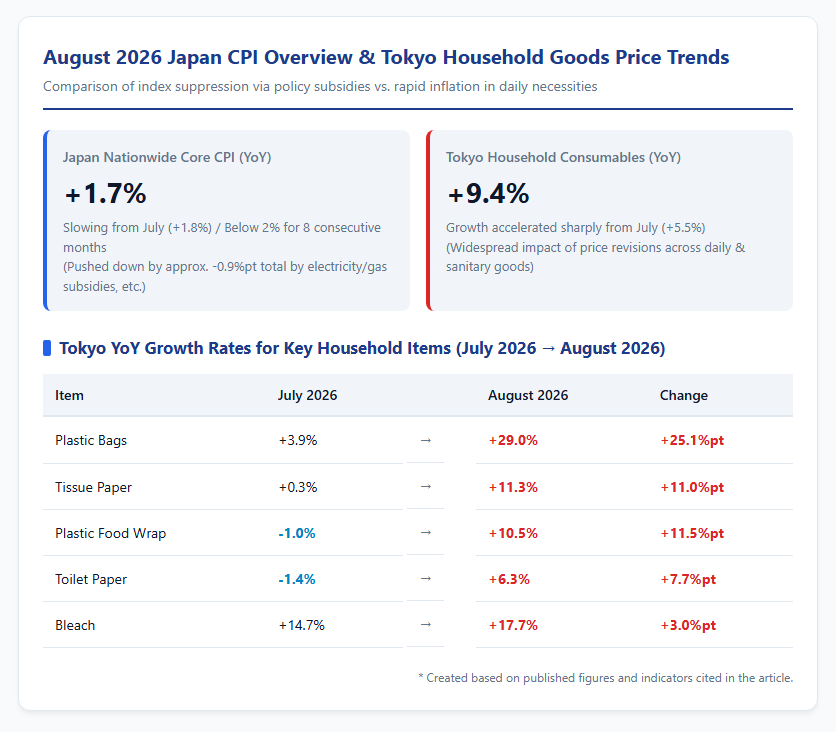
According to data released by the Statistics Bureau of the Ministry of Internal Affairs and Communications, Japan’s nationwide core Consumer Price Index (core CPI, excluding fresh food) rose 1.7% year-on-year in August 2026, slowing slightly from a 1.8% increase in July 2026. This marked the eighth consecutive month that core CPI remained below the 2% threshold. A major contributor to this moderation was the reinstatement of government subsidies for electricity and gas bills during the summer. Combined with free education policies, these government interventions were estimated to have shaved approximately 0.9 percentage points off August’s core CPI. Indeed, energy prices turned downward from a 0.6% increase in July to a 0.7% decrease in August, pushing down the overall figure. However, behind this superficial slowing driven by policy factors, underlying inflation excluding fresh food and energy (the Bank of Japan’s core-core CPI version) accelerated its upward momentum in areas such as the Tokyo metropolitan area preliminary report. This highlights that underlying price pressures are continuing to build steadily.
Rapid Price Hikes Spreading to Everyday Items Such as Tissues and Plastic Bags
The most prominent feature of price movements in August 2026 was a rapid series of price hikes directly affecting everyday household items. According to Tokyo metropolitan area data, the index for household durable and non-durable supplies surged 9.4% year-on-year, accelerating sharply from a 5.5% increase in July. Examining individual items, tissue paper prices jumped from a 0.3% rise in July to an 11.3% increase in August, while toilet paper rebounded from a 1.4% decline to a 6.3% gain. Furthermore, plastic food wrap shifted from a 1.0% drop to a 10.5% surge, and plastic trash bags recorded a staggering 29.0% increase following a 3.9% gain in July. Bleach prices also remained high at a 17.7% increase. Illustrated by major paper product manufacturer Daio Paper revising prices across all consumer and commercial paper products by 15% or more starting with deliveries on August 1, 2026, substantial price pass-throughs took effect all at once across paper products and sanitary goods. These steep price increases on daily necessities are delivering a direct blow to household purchasing power.
Please refer to the figure below.
Multifaceted Cost Pressures and Structural Factors Behind Rising Prices
Surging Crude Oil and Naphtha Prices and the Pass-Through Lag for Packaging and Logistics Costs
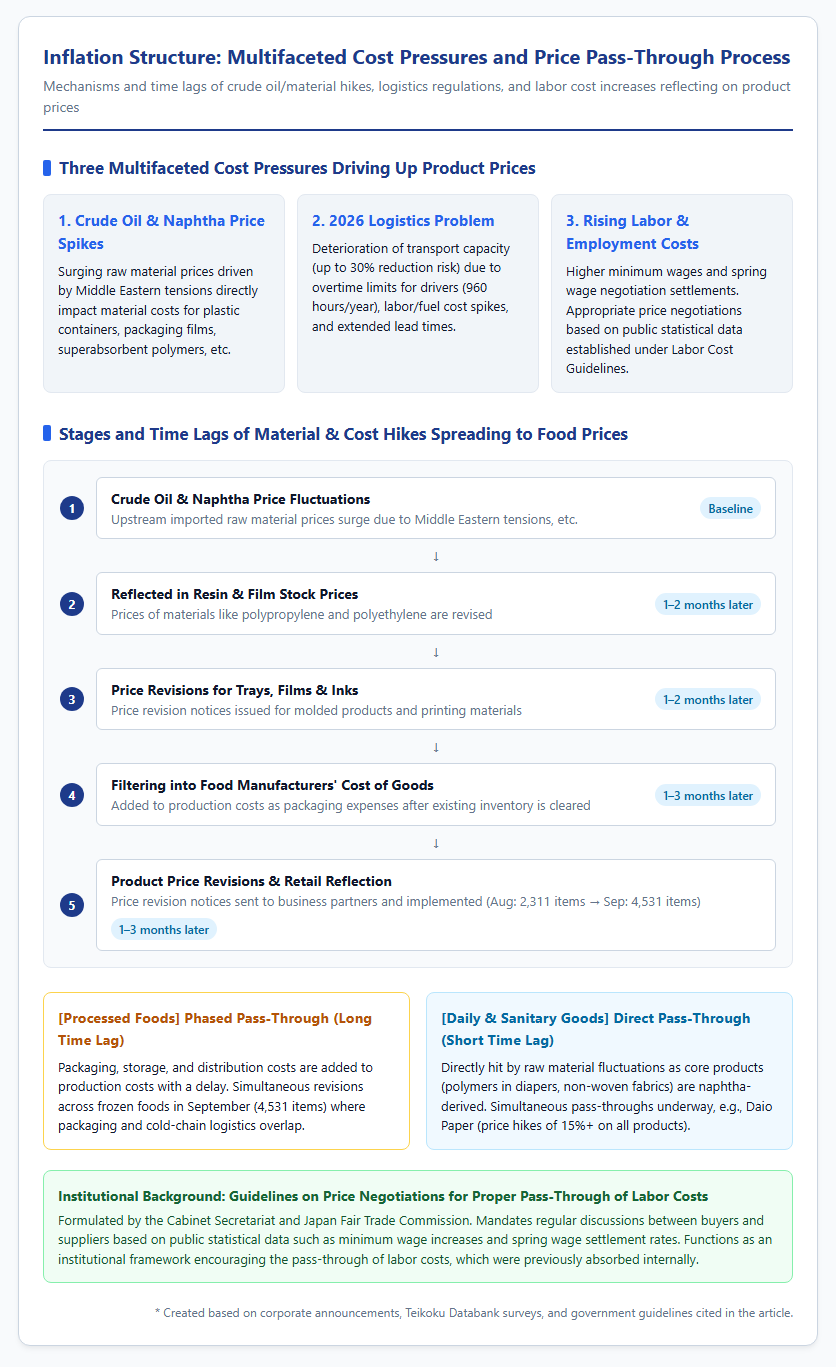
Behind the accelerating price hikes for daily goods and processed foods lie surging crude oil and naphtha prices triggered by escalating Middle Eastern tensions, which have driven up processing material costs. Raw materials such as superabsorbent polymers, polyethylene, and polypropylene—used in plastic products and sanitary items—are derived from naphtha, making product prices highly sensitive to raw material cost spikes. On the other hand, increases in packaging material costs, storage and transport utility fees, and fuel costs filter into manufacturers’ production costs in stages, creating a time lag of several months. In 2026, the complete implementation of overtime limits for truck drivers under the “2026 Logistics Problem” became fully evident, causing severe constraints on transport capacity, extended delivery lead times, and higher logistics labor costs. Companies that could no longer postpone passing on these accumulated cost increases have sequentially implemented price revisions, particularly for cold-chain items like frozen foods, leading to widespread food price hikes affecting 2,311 items in August and 4,531 items in September.
Rising Labor Costs and Shifting Corporate Stances Under Price Negotiation Guidelines
In addition to passing on raw material and energy costs, a growing trend involves passing along labor and employment costs. Amid nationwide wage hikes and persistent labor shortages, companies face an environment where they must reflect rising labor expenses in transaction prices to secure personnel. Encouraging this shift in corporate mindset are the guidelines on price negotiations for proper pass-through of labor costs formulated by the Cabinet Secretariat and the Japan Fair Trade Commission. These guidelines instruct both buyers and suppliers to engage in negotiations using public statistical data—such as minimum wage increase rates and spring wage negotiation results—as a benchmark. Consequently, passing on labor costs, which companies previously felt compelled to absorb through internal efficiency efforts, is now recognized as a legitimate procedure. This institutional framework, combined with a proactive corporate stance toward price setting, is establishing an environment for smoother and more sustained cost pass-through across product and service prices.
Please refer to the figure below.
Future Inflation Outlook and Monetary Policy Implications
Re-Acceleration of Inflation from Autumn Onward and Price Scenarios Heading into 2027
Regarding the future price outlook, a scenario in which inflation re-accelerates from autumn onward as temporary policy effects fade is considered highly probable. Because government electricity and gas subsidies end after September usage (reflected in October bills), the delayed impact of prior fuel price increases will directly affect the consumer price index from November onward, turning energy into a strong upward factor. Compounded by earlier resource price surges, persistent yen weakness, and delayed pass-through pressures from packaging, logistics, and labor costs, core CPI growth could reach approximately 3% year-on-year between late 2026 and early 2027. Although lower rice prices provide some relief in certain food categories, cost pressures on processed foods, dining out, and various services remain robust, suggesting that underlying inflation pressures will stay elevated through 2027.
The Bank of Japan’s Rate Hike Trajectory and Its Impact on Households and Businesses
In response to heightened upside inflation risks, the Bank of Japan (BOJ) is maintaining and advancing its monetary policy normalization path. At its September 2026 Monetary Policy Meeting, the BOJ decided to raise its policy interest rate to 1.25%. Explicitly signaling its intent to continue adjusting the degree of monetary accommodation while searching for the neutral interest rate level, market consensus expects further rate hikes in December 2026 or early 2027, eventually bringing the policy rate to around 1.75% to 2.0%. While rising interest rates raise concerns about increased interest payment burdens for households with mortgage loans, a key risk remains that real wages could falter if a virtuous cycle of sustainable wage increases and business earnings is not maintained, potentially suppressing consumer spending. As high inflation and elevated interest rates progress simultaneously, shifts in household purchasing behavior and corporate financing will serve as pivotal determinants of Japan’s economic recovery momentum.
Reference Pages
- [Statistics Bureau of Japan] https://www.stat.go.jp/data/cpi/1.html
- [Cabinet Secretariat / Japan Fair Trade Commission] https://www.jftc.go.jp/partnership_package/index.html
- [Ministry of Health, Labour and Welfare] https://www.mhlw.go.jp/stf/seisakunitsuite/bunya/koyou_roudou/roudoukijun/chingin/index.html
- [Ministry of Land, Infrastructure, Transport and Tourism] https://www.mlit.go.jp/report/press/tochi_fudousan_kensetsugyo14_hh_000001_00130.html
【#ConsumerPriceIndex #Inflation #DailyNecessities #JapanEconomy #BankOfJapan #InterestRateHike #CostPassThrough】

コメント