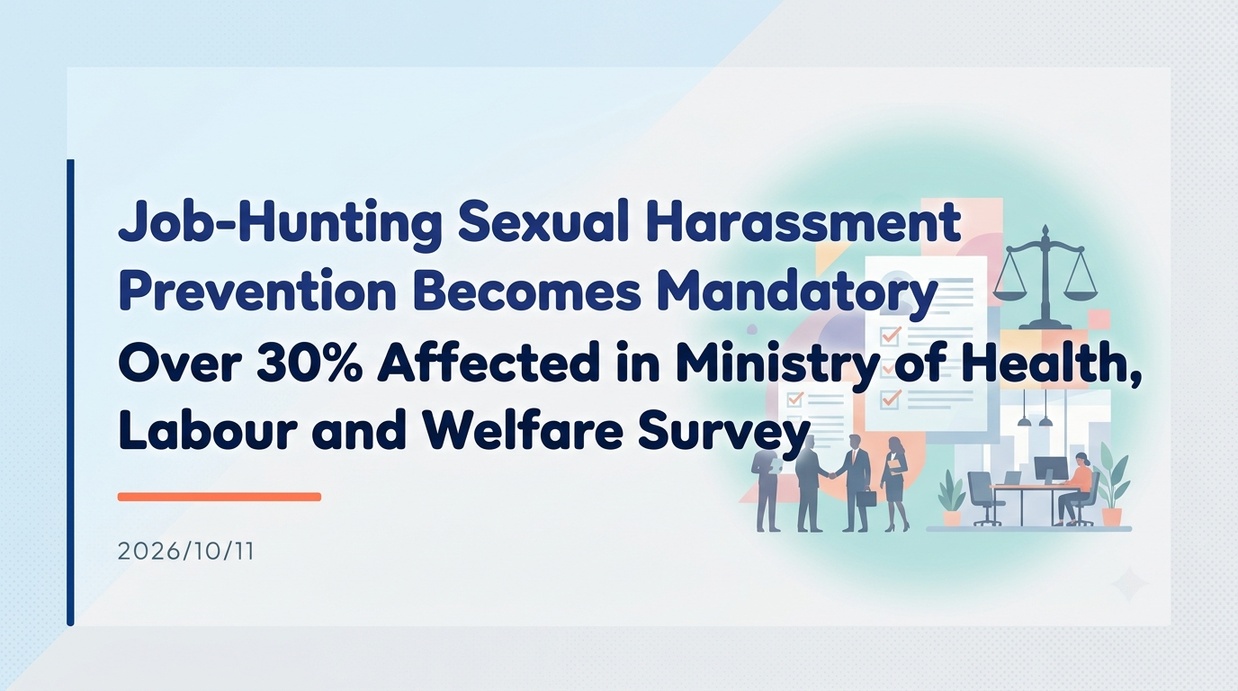
Under the revised Equal Employment Opportunity Act, which takes effect on October 1, 2026, implementing measures to prevent sexual harassment against job-seeking students and interns (“shukatsu” sexual harassment) has been made mandatory for all employers. With a Ministry of Health, Labour and Welfare survey revealing that approximately 30% of students have experienced such abuse, companies are required to improve their recruitment environments in ways that go beyond mere compliance.
- Overview of Mandatory Prevention of Job Hunting Sexual Harassment and Regulatory Changes
- MHLW Survey Reveals Severe Damage Situation Exceeding 30%
- Risks of damages liability, criminal penalties, and corporate brand damage
- Structural Challenges Lurking in Alumni Visits and Internships
- 4 Mandatory Employment Management Measures Required for Companies and Practical Operations
- Future Prospects for Defending Employer Brand and Building Trust
Overview of Mandatory Prevention of Job Hunting Sexual Harassment and Regulatory Changes
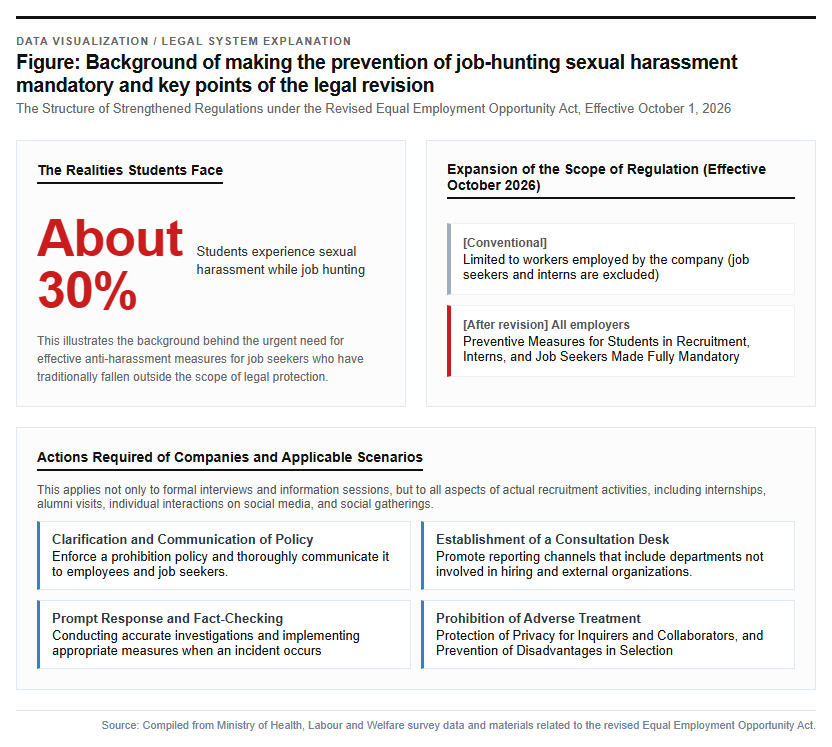
Under the revised Equal Employment Opportunity Act, which will come into effect on October 1, 2026, companies are mandated to take measures to prevent sexual harassment in job hunting and other related activities. Previously, the law’s protection was limited to workers employed by the company itself, leaving job seekers undergoing recruitment screening and internship participants outside the scope of legal protection. With this amendment, all employers, regardless of company size, are now required to implement measures to prevent harassment against “job seekers and others.”
The applicable situations are not limited to formal corporate job interviews or company information sessions. This includes all situations considered to be a de facto extension of recruitment activities, such as internships, teaching practice, alumni visits, individual interactions via social media, and off-site dinners or social gatherings.
As specific measures that companies should take, the Ministry of Health, Labour and Welfare guidelines primarily outline the following responses.
- Clarification of the policy prohibiting sexual harassment during job hunting, and dissemination and awareness-raising among employees and job seekers
- Establishment and promotion of consultation desks that include departments not involved in hiring and external organizations
- Prompt and accurate verification of facts when an incident occurs, and appropriate responses to victims and perpetrators.
- Protection of Privacy for Consultants and Cooperators, and Prohibition of Disadvantageous Treatment in Selection
For companies that fail to fulfill their obligation to take preventive measures, administrative authorities will collect reports, provide guidance, and issue recommendations. If the recommendations are not followed, measures will be taken to publicly disclose the company’s name.
MHLW Survey Reveals Severe Damage Situation Exceeding 30%
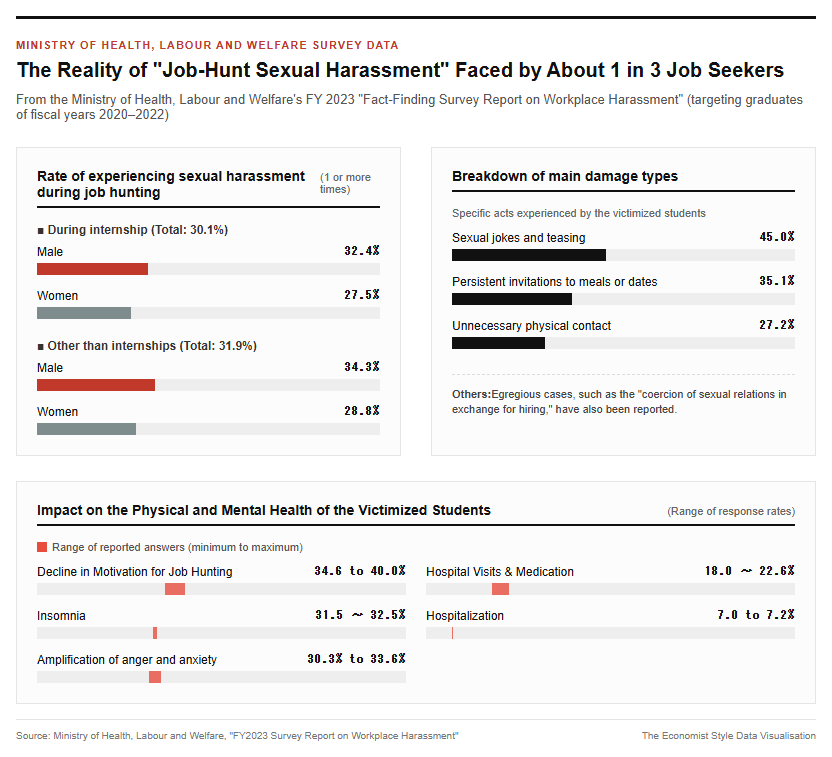
Behind the mandatory implementation of measures against sexual harassment in job hunting lies the reality that sexual victimization is widespread among students looking for jobs. According to the “FY2023 Survey Report on Workplace Harassment” conducted by the Ministry of Health, Labour and Welfare, among people who graduated between fiscal 2020 and fiscal 2022 and experienced job hunting or internships, 30.1% reported experiencing sexual harassment at least once during their internships. Furthermore, 31.9% reported being victimized during job-hunting activities outside of internships, revealing that approximately one in three job-seeking students has experienced sexual harassment.
A breakdown by gender shows that the victimization rate during internships was 32.4% for men and 27.5% for women, while during job hunting outside of internships, it was 34.3% for men and 28.8% for women, indicating that such incidents occur regardless of gender.
The acts most commonly cited as specific damages are as follows.
- Sexual jokes or teasing (45.0%)
- Persistent invitations to meals or dates (35.1%)
- Unnecessary physical contact (27.2%)
- Coercion of sexual relations in exchange for employment
The physical and mental impact on affected students is also severe, with reports including a decline in motivation for job hunting (34.6–40.0%), insomnia (31.5–32.5%), and heightened anger and anxiety (30.3–33.6%), as well as cases requiring hospital visits and medication (18.0–22.6%) or even hospitalization (7.0–7.2%). The structural difficulty of speaking out against conduct from the superior positions of recruiters, interviewers, and alumni (OB/OG), who hold sway over selection advantages and disadvantages, is exacerbating the harm.
Corporate Legal and Management Risks and Their Occurrence Structure
Risks of damages liability, criminal penalties, and corporate brand damage
If job-hunting sexual harassment occurs, companies face multifaceted management risks that extend far beyond simply violating legal employment management measures. Regarding civil liability, if an employee causes damage to a third party in the course of business operations, there is a risk of facing claims for damages and solatium from victimized job seekers and others, based on employer liability under Article 715 of the Civil Code. Furthermore, companies may also be held liable for breach of their duty of care as employers or for tort liability.
Furthermore, for malicious acts, individual perpetrators face criminal liabilities such as charges of forcible indecency and strict legal penalties. In the past, cases have been reported where employees at major general trading companies, major construction firms, and human resources-related companies committed sexual assault during alumni (OB/OG) visits and recruiter activities, leading to their arrest and widespread social condemnation.
The exposure of sexual harassment issues in the job-hunting process has a massive impact on corporate management, with the main risks including the following:
- Decline in corporate brand due to the spread of damaging information on social media and job-hunting review sites
- Decrease in applicants due to the suspension of job referrals from university career centers and Hello Work
- Risk of loss of trust from customers and existing business partners, and the risk of suspension of transactions
- Increase in turnover among existing employees due to declining internal engagement
Especially in today’s era of social media, where reputations among job seekers spread instantly and take root, a decline in the recruiting capability of companies that fail to take countermeasures leads directly to long-term management problems.
Structural Challenges Lurking in Alumni Visits and Internships
The structural factors behind the frequent occurrence of sexual harassment during job hunting lie in the overwhelming asymmetry of status and information between companies and job seekers, as well as in closed-door communication outside the office. In traditional recruitment processes, numerous opportunities have been created for employees and students to interact one-on-one or in small groups, including not only job interviews, but also alumni visits, recruiter meetings, and social gatherings following internships.
Particularly in peer-to-peer alumni networking visits arranged via matching apps and similar platforms, these interactions tended to become a gray zone where corporate recruiting departments could neither monitor nor track whether contact occurred or what was discussed. In closed-room meetings and evening dinners involving alcohol, an environment was easily created where position-based intrusions into personal boundaries were prone to occur.
To mitigate these structural risks, companies need to tighten management rules rather than leaving things up to individual workplaces. Specifically, the following management measures are effective:
- Mandatory advance notification systems for OB/OG visits and consolidation into company-approved systems
- Total ban on after-hours meetings and external contact involving alcohol.
- Restrictions on the Use of Personal Social Media and Private Communication Channels
- Development and Thorough Training of a Code of Conduct Manual for Interviewers and Recruiters
Eliminating closed-door practices and establishing highly transparent contact rules will lead to the resolution of structural issues.
Practical Measures and Future Corporate Outlook
4 Mandatory Employment Management Measures Required for Companies and Practical Operations
Ahead of the mandatory implementation in October 2026, companies must establish concrete operational frameworks in line with the Ministry of Health, Labour and Welfare’s prevention guidelines. The measures required of employers consist of four key elements: policy clarification, establishment of consultation systems, post-incident response, and privacy protection.
First, explicitly state the policy prohibiting sexual harassment against job seekers and the strict disciplinary regulations for offenders in internal regulations such as employment rules and recruitment guidelines, and ensure this is thoroughly communicated to all employees. At the same time, publish the anti-harassment policy on the recruitment website and job postings to make it known to job seekers as well.
When designing a consultation framework, it is important to establish a consultation desk independent from the recruiting department responsible for hiring decisions. By designating a department outside of human resources or an external specialized organization as the contact point, and by clearly stating that consultation will not result in any disadvantages in the selection process, an environment can be created where job seekers can use the service with peace of mind.
The practical response workflow when an incident occurs follows these stages:
- Conducting prompt and accurate fact-finding from a neutral standpoint
- Immediate separation of contact between the victim and the perpetrator, and the immediate removal of the perpetrator from recruitment activities
- Objective investigation by the compliance committee and decisions on disciplinary action
- Protection of Privacy of Complainants and Collaborators and Prohibition of Adverse Treatment
It is required to document these procedures into a manual and verify the operational framework in advance.
Future Prospects for Defending Employer Brand and Building Trust
Making countermeasures against sexual harassment during job hunting mandatory should be viewed not merely as the fulfillment of a legal obligation, but as a crucial strategic investment for a company’s sustainable growth and its competitiveness in talent acquisition. Amid intensifying competition to secure top talent in the new-graduate recruitment market due to the declining birthrate, providing an environment where job seekers can participate in the selection process with peace of mind serves as a powerful differentiating factor.
Companies that establish fair and transparent recruitment selection processes earn high praise from students and university career centers, enabling them to achieve higher job offer acceptance rates and build a high-quality applicant pool. Conversely, companies that are insincere about anti-harassment measures will face soaring recruitment costs due to the spread of scandals on social media and legal disputes, severely damaging their long-term brand value.
The key points to focus on in future corporate operations are as follows.
- Leadership in which management itself clearly communicates a message of harassment prevention
- Visualization of contact status through the implementation of digital management across the entire recruitment process
- A system for early consultation identification and rapid secondary victimization prevention in collaboration with universities and external organizations
- Promotion of Human Capital Management Through the Establishment of a Sound Work Environment
Embedding harassment prevention as part of the corporate culture and building an organization trusted by both job seekers and employees will lead to the enhancement of medium- to long-term corporate value.
Reference page
- [Ministry of Health, Labour and Welfare] FY2023 Fact-Finding Survey Report on Workplace Harassment
[suspicious link removed] - [Ministry of Health, Labour and Welfare] Mandatory Measures against Customer Harassment and Sexual Harassment Targeting Job Seekers, etc. (Pamphlet)
https://www.mhlw.go.jp/content/001662630.pdf - [Ministry of Health, Labour and Welfare] Job-Hunting Harassment Prevention Measures: Corporate Case Studies
https://www.mhlw.go.jp/content/11900000/001060585.pdf - [e-Gov Law Search] Act on Securing, Etc. of Equal Opportunity and Treatment between Men and Women in Employment (Equal Employment Opportunity Act)
e-Gov 法令検索電子政府の総合窓口(e-Gov)。法令(憲法・法律・政令・勅令・府省令・規則)の内容を検索して提供します。laws.e-gov.go.jp

【#JobHuntingSexualHarassment #EqualEmploymentOpportunityAct #LawAmendment #HumanResourcesAndLabor #Compliance #MinistryOfHealthLabourAndWelfare #RiskManagement】
コメント