On September 16, 2026, ExKey Inc. launched “Forgent,” a new service where AI professionals work on-site at client companies to provide end-to-end support—from identifying workflows for AI adoption to implementation and operational integration. The launch comes in response to severe hurdles faced by small and medium-sized enterprises (SMEs), including a lack of talent to drive AI initiatives and difficulty conceptualizing specific business use cases.
- Overview and the Background Behind the Service Launch
- Core Capabilities of “Forgent” and Its Subscription Pricing Model Starting at ¥150,000/Month
- A Clear Implementation Roadmap Starting with a Free AI Diagnostic Assessment
- Government White Papers Reveal the Reality of Failed AI Integration in SMEs
- The Advantage of FDE-Style On-Site Support: Beyond Mere Advice or Custom Development
- Expanding from Defensive Efficiency to Revenue-Generating “Offensive AI”
- Achieving a 68% Reduction in MEO Operational Workload
- Broad Applications Across Digital Marketing, SEO, and Ad Management
- Navigating the Legal Boundaries Between Quasi-Mandate, Contracting, and Dispatch Labor
- Establishing Clear Command Structures and Operational Safeguards
- A Domestic Market Reaching ¥7 Trillion by 2029 and the Surge in AI Agent Demand
- Future Trajectory and the Outlook for AI Integration in SMEs
Overview and the Background Behind the Service Launch
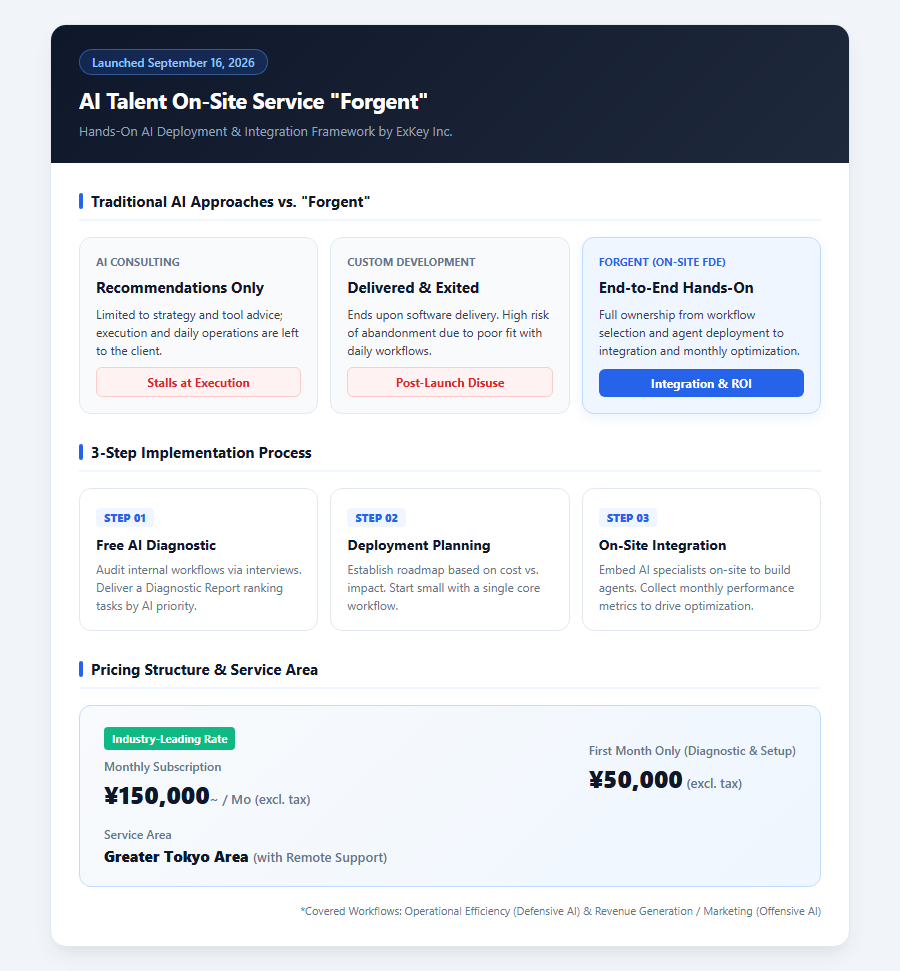
On September 16, 2026, ExKey Inc. officially launched “Forgent,” a new service that dispatches AI professionals directly to client workplaces. The service delivers end-to-end support, encompassing everything from selecting workflows suitable for AI automation and deploying AI agents to establishing daily operational habits and driving continuous improvement. ExKey has a proven track record in digital marketing support—including web advertising management, SEO, and MEO—as well as in-house AI product development. While generative AI adoption has expanded rapidly in recent years, many companies face recurring issues where AI tools are implemented but never truly utilized on the ground. Strategic advice from traditional consulting often remains mere recommendation without execution, while custom-developed software frequently falls into disuse after delivery. Forgent was established as a hands-on, companion-style support model designed to solve these issues by embedding specialists directly in the workplace until AI becomes a fully integrated daily tool. Please refer to the diagram below.
Core Capabilities of “Forgent” and Its Subscription Pricing Model Starting at ¥150,000/Month
A key feature of Forgent is that it allows enterprises to leverage specialized AI talent on a flexible monthly subscription model without incurring the internal risks and overhead of hiring, training, or losing staff. The service pricing is set at an industry-leading low rate starting at ¥150,000 per month (excluding tax), with an initial diagnostic and strategy design fee of ¥50,000 (excluding tax) charged only in the first month. Operating primarily in the Greater Tokyo Area (Tokyo and three surrounding prefectures) combined with remote support, the service enables businesses to start small by testing AI adoption on a single workflow. A dedicated project manager collaborates alongside executive leadership to organize AI adoption themes, map out implementation roadmaps, and quantify measurable outcomes. This structure enables SMEs without dedicated internal IT personnel to smoothly advance their digital transformation while keeping labor costs low.
A Clear Implementation Roadmap Starting with a Free AI Diagnostic Assessment
To initiate the service, ExKey offers a “Free AI Utilization Diagnostic.” Companies can request an assessment in roughly one minute via a dedicated online form, followed by an online interview to conduct a thorough audit of internal workflows. Based on this audit, ExKey delivers a customized “Diagnostic Report” that visualizes which tasks can be automated with AI and ranks them by priority, proposing an implementation plan that carefully balances cost and ROI. Following contract execution, AI specialists deploy on-site to build and integrate AI agents, ensuring frontline employees become proficient in using them in their daily tasks. Post-implementation, the team continues to collect monthly performance data and iterate on improvements, preventing the AI solution from becoming obsolete.
The “Three Barriers” to AI Adoption in SMEs and the Solution
Government White Papers Reveal the Reality of Failed AI Integration in SMEs
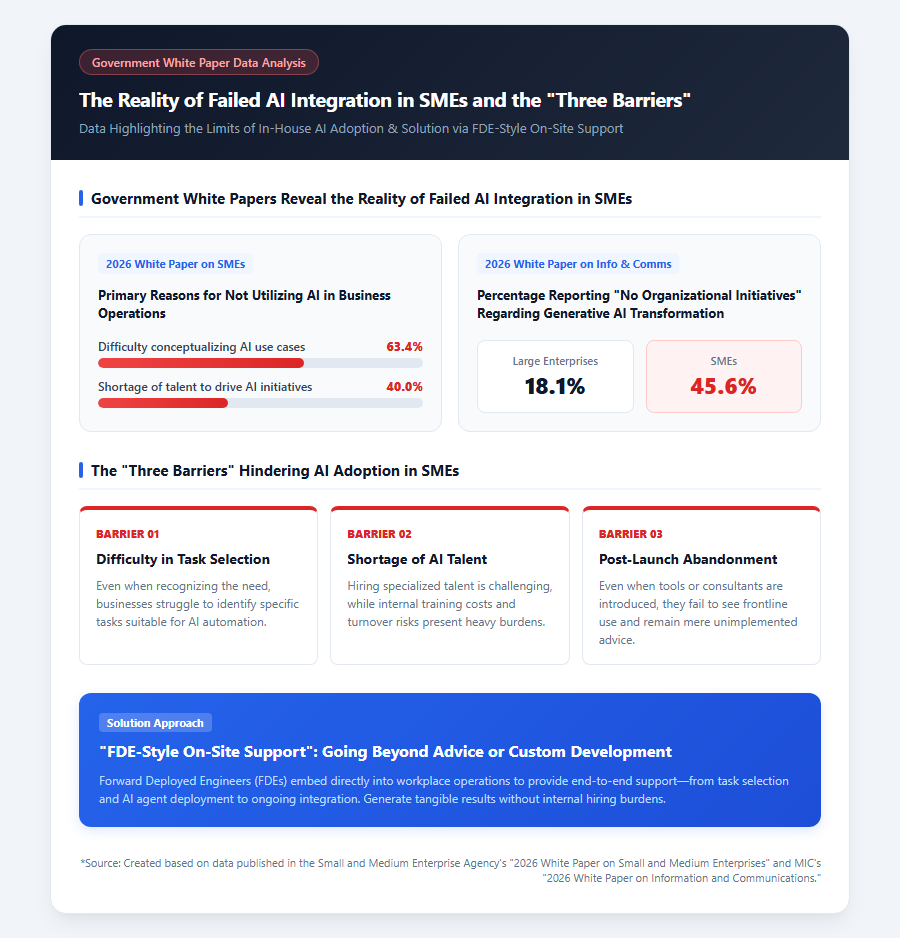
According to the “2026 White Paper on Small and Medium Enterprises” published by the Small and Medium Enterprise Agency, the most common reason cited by companies for not utilizing AI in their operations was “difficulty conceptualizing which tasks can be AI-enabled” at 63.4%, followed by “a shortage of personnel to lead AI initiatives” at 40.0%. Furthermore, the Ministry of Internal Affairs and Communications’ “2026 White Paper on Information and Communications” revealed that while only 18.1% of large enterprises reported having “no organizational initiatives” regarding generative AI-driven operational transformation, that figure surged to 45.6% among SMEs. These statistics highlight a stark reality: even as AI technology advances, SMEs struggle to identify where to apply it and lack the internal talent required to drive implementation. Single-handed internal deployment has clearly reached its limit. Please refer to the diagram below.
The Advantage of FDE-Style On-Site Support: Beyond Mere Advice or Custom Development
ExKey analyzes the primary obstacles to corporate AI adoption as three core barriers: “difficulty in task selection,” “talent shortages,” and “post-launch abandonment.” Traditional AI consulting often stops at high-level strategy and recommendations, leaving actual execution to the client. On the other hand, traditional system development contracts end once the specified tool is built and delivered, making it prone to disuse if it fails to align with real-world workflows. To overcome this, Forgent adopts a Forward Deployed Engineer (FDE) support model. By embedding engineers directly into customer operations, specialists physically integrate AI tools into existing workflows and remain accountable alongside the client until measurable business results are achieved.
Expanding from Defensive Efficiency to Revenue-Generating “Offensive AI”
Another key strength of Forgent is its broad scope of support, which extends beyond “Defensive AI” aimed at cost reduction to “Offensive AI” designed to directly generate revenue. In addition to administrative efficiency gains—such as automating customer support inquiries and generating meeting minutes—Forgent covers the end-to-end AI transformation of digital marketing. This includes web ad management, keyword optimization, SEO content creation, MEO for local store traffic, social media management, and CRM-based customer retention. Leveraging ExKey’s extensive track record of supporting over 300 companies in user acquisition and ad management, the service aligns marketing tactics with corporate KPIs to clearly visualize return on investment (ROI).
Real-World Impact Demonstrated by Internal Benchmark Data
Achieving a 68% Reduction in MEO Operational Workload
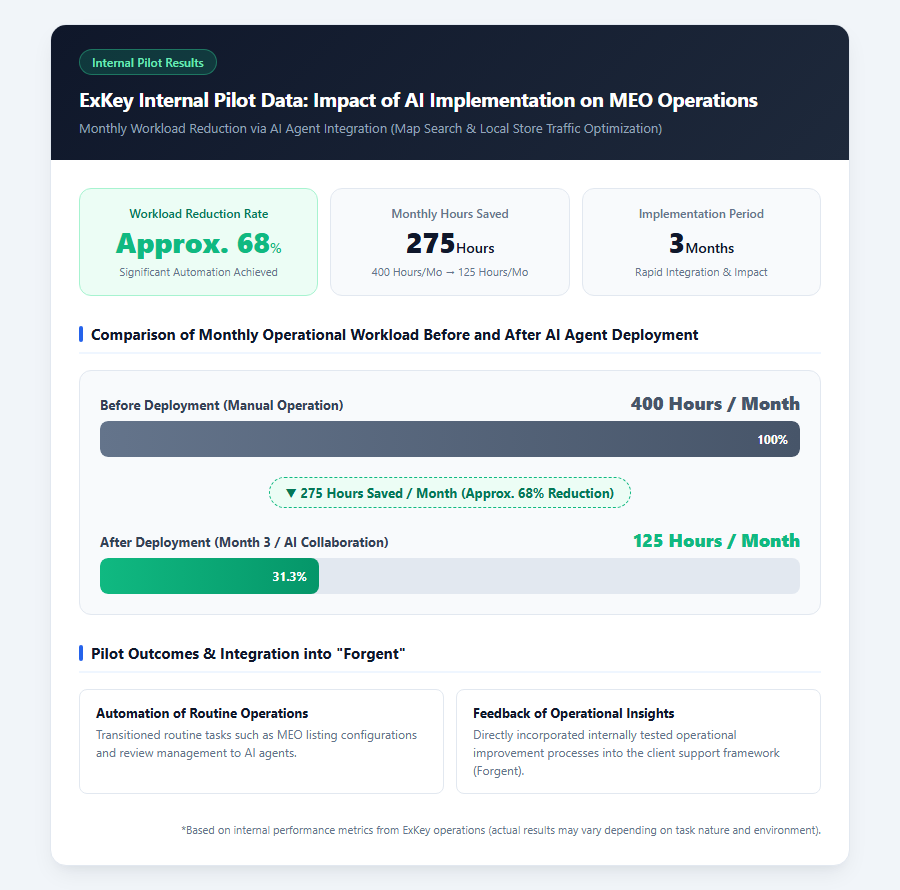
Prior to launching Forgent, ExKey conducted an internal pilot project by implementing AI agents into its own MEO (Map Engine Optimization) management workflows. Prior to deployment, manual management tasks—such as updating local listing settings and managing customer reviews—consumed 400 hours per month. Following a three-month implementation phase, ExKey successfully reduced monthly workload to 125 hours, representing a staggering 68% reduction in labor hours. By testing and validating automated workflows internally, ExKey proved the dramatic efficiency gains of AI while embedding these battle-tested, repeatable operational insights directly into the Forgent program structure. Client companies can thus expect rapid time-to-value backed by proven execution methodologies. Please refer to the diagram below.
Broad Applications Across Digital Marketing, SEO, and Ad Management
The operational gains demonstrated in MEO workflows are directly applicable across a wide range of digital marketing domains. For example, in web advertising management, integrating AI agents into campaign performance analysis and asset optimization reduces employee workload while enhancing targeting precision. In SEO initiatives, AI agents assist in analyzing search trends and drafting content outlines, significantly shortening production cycles while maintaining quality consistency. Client companies can selectively automate the specific bottlenecks in their marketing funnel, maximizing customer acquisition with minimal internal resources and strengthening their overall market competitiveness.
Mitigating Misclassified Employment Risks in On-Site Engagements
Navigating the Legal Boundaries Between Quasi-Mandate, Contracting, and Dispatch Labor
When AI talent works on-site at a client office, a critical legal consideration is avoiding “misclassified employment” (disguised contracting/subcontracting). Under quasi-mandate or service agreements, legal liability is determined by whether effective operational direction and command rest with the client or the contractor. If a client company directly issues work instructions, manages attendance, or dictates daily task orders to an on-site engineer under a service contract, the arrangement violates Article 59, Item 2 of the Worker Dispatch Act, exposing both parties to criminal penalties of up to one year imprisonment or fines up to 1 million yen. Rigorous operational compliance is essential to prevent regulatory non-compliance.
Establishing Clear Command Structures and Operational Safeguards
To prevent misclassification risks while maintaining effective on-site support, companies must establish a clear separation of operational command lines. Clients must refrain from directly delegating tasks to individual on-site workers; instead, all work requests, specification clarifications, and project updates must pass through the contractor’s designated project manager or leader. Labor management, attendance tracking, and performance evaluations must also remain strictly under the contractor’s authority. Defining specific deliverables, service boundaries, and performance metrics in a formal Statement of Work (SOW) safeguards both organizations against legal disputes while maintaining a clear focus on achieving business results.
Expansion of the Domestic AI Market and Future Outlook
A Domestic Market Reaching ¥7 Trillion by 2029 and the Surge in AI Agent Demand
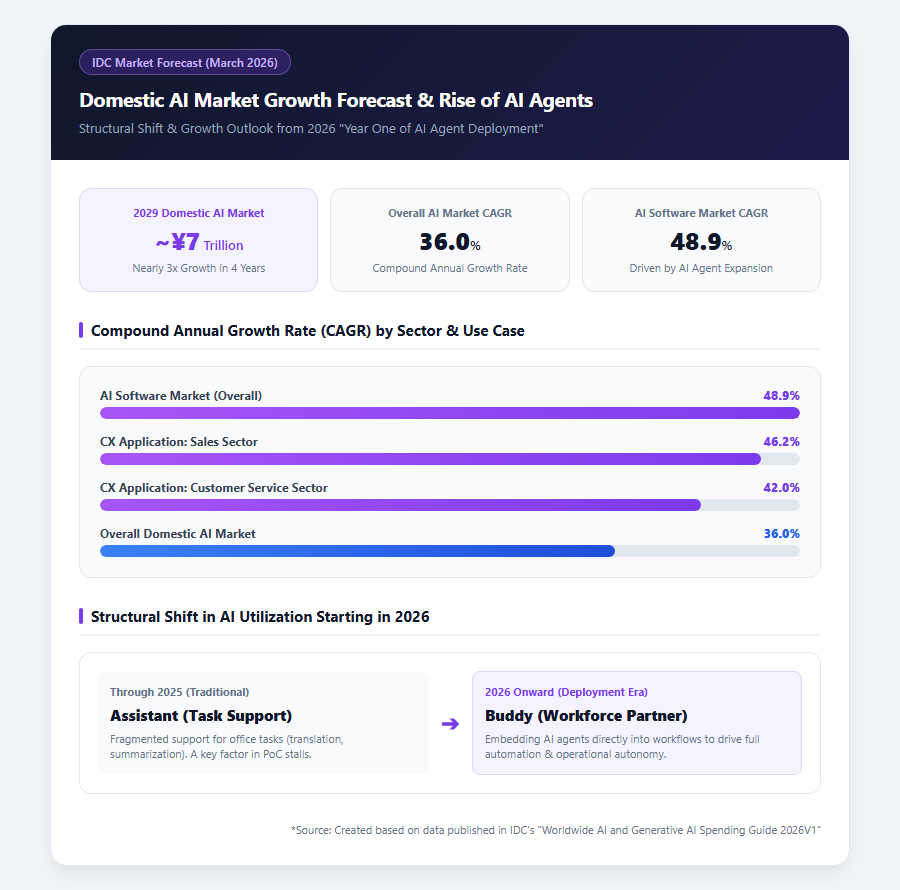
According to forecasts published by research firm IDC in March 2026, the domestic Japanese AI market is projected to expand nearly threefold over the next four years, approaching ¥7 trillion in enterprise expenditure by 2029. IDC highlights 2026 as “Year One of Enterprise AI Agent Deployment,” marking a structural transition from using AI as a simple “office assistant” (for basic translation or text summarization) to embedding autonomous AI agents directly into operational workflows as “workplace buddies.” The AI software market is projected to grow at a Compound Annual Growth Rate (CAGR) of 48.9%, driven heavily by Customer Experience (CX) applications in sales (46.2% CAGR) and customer service (42.0% CAGR). Please refer to the diagram below.
Future Trajectory and the Outlook for AI Integration in SMEs
Along with rapid market growth, the role of AI within enterprises is shifting from a passive assistant to an active partner working alongside human staff. In this evolving landscape, demand for external services like Forgent—which provide hands-on, on-site support through implementation and long-term operational integration—is expected to surge among SMEs that cannot afford to recruit full-time AI specialists internally. Beyond simply installing the latest tools, an enterprise’s long-term competitiveness will depend on its ability to audit workflows and foster a culture where employees collaborate seamlessly with AI. With accessible solutions starting at ¥150,000 per month lowering the barrier to entry, the sustainable adoption of AI across Japanese SMEs is poised to accelerate.
Reference Pages
- [ExKey Inc. Press Release (PR TIMES)] https://prtimes.jp/main/html/rd/p/000000004.000133070.html
- [ExKey Inc. Official Website] https://exkey.jp/
【#ExKey #Forgent #AITalentOnSite #AIAgents #SME_DX #DigitalMarketing #BusinessEfficiency #GenerativeAI】
コメント