Yoshihisa Kainuma, Chairman and CEO of MinebeaMitsumi, has announced a freeze on new M&A ventures into unfamiliar business areas—a strategy that previously served as a primary driver of the company’s growth. This strategic pivot aims to prioritize capital allocation and production capacity expansion within existing business lines to reliably capture surging AI-related demand.
- Freezing New Acquisitions to Concentrate on Surging AI Demand
- Growth Trajectory Driven by M&A and the Fruit of Diversification
- Product Demand in Data Centers and Liquid Cooling Systems
- Future Growth Horizons Unlocked by Humanoid Robotics
- Scaling Bearing Production to 500 Million Monthly Units with Disciplined Capital Deployment
- Organic Growth Scenario and Long-Term Strategic Outlook
Freezing New Acquisitions to Concentrate on Surging AI Demand
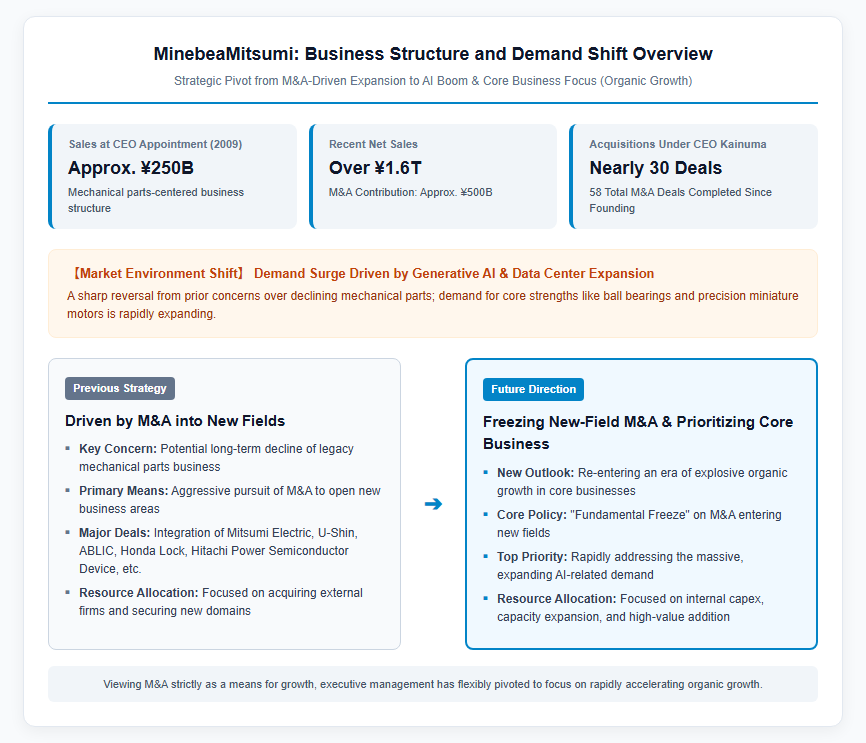
In September 2026, Yoshihisa Kainuma, Chairman and CEO of MinebeaMitsumi Inc., revealed that the company will fundamentally freeze mergers and acquisitions aimed at entering new business fields. Previously, driven by concerns over the potential long-term decline of its legacy mechanical components business, MinebeaMitsumi aggressively pursued acquisitions to expand into new technological domains, such as electronic devices and semiconductors. However, the rapid proliferation of generative AI and the explosion of data centers have ignited an unprecedented surge in demand for the company’s core strengths: high-precision ball bearings and compact motors.
In response to this changing operating environment, executive management concluded that meeting the massive, immediate surge in demand across existing product lines takes precedence over allocating capital and resources toward acquiring external businesses. Viewing M&A strictly as a means to achieve growth rather than an end in itself, Kainuma has demonstrated strategic agility by shifting focus back toward organic growth as core business lines experience rapid expansion. Moving forward, MinebeaMitsumi will concentrate financial resources and talent on enhancing value addition and scaling up its existing core business segments.
The diagram below illustrates the overall shift in the company’s business structure and demand focus.
Growth Trajectory Driven by M&A and the Fruit of Diversification
MinebeaMitsumi has a long history of utilizing aggressive M&A as a primary engine for corporate expansion. Since its founding in 1951, the company has completed 58 acquisitions in total. During the 15 years following Kainuma’s appointment as president in 2009 alone, MinebeaMitsumi executed nearly 30 deals, dramatically scaling its operational footprint. Net sales expanded from approximately ¥250 billion when Kainuma took office to over ¥1.6 trillion in recent fiscal years, with M&A contributions accounting for roughly ¥500 billion of that revenue growth.
Key major consolidation milestones executed by the company include:
– January 2017: Acquired Mitsumi Electric as a wholly owned subsidiary and rebranded as MinebeaMitsumi Inc.
– 2019: Acquired automotive components giant U-Shin Ltd.
– 2020: Acquired analog semiconductor maker ABLIC Inc.
– 2023: Acquired Honda Lock Co., Ltd. (now Minebea AccessSolutions Inc.)
– 2024: Integrated Hitachi Power Semiconductor Device, Ltd. (now Minebea Power Devices Inc.)
Through these strategic deals, MinebeaMitsumi successfully transformed itself from a specialized mechanical components manufacturer into a diversified component powerhouse encompassing semiconductors, sensors, and access control solutions. Crucially, this expanded operational foundation enables the company today to supply comprehensive, multi-technological solutions tailored to the booming AI market.
AI Boom Triggers Surge in Mechanical Component Demand
Product Demand in Data Centers and Liquid Cooling Systems
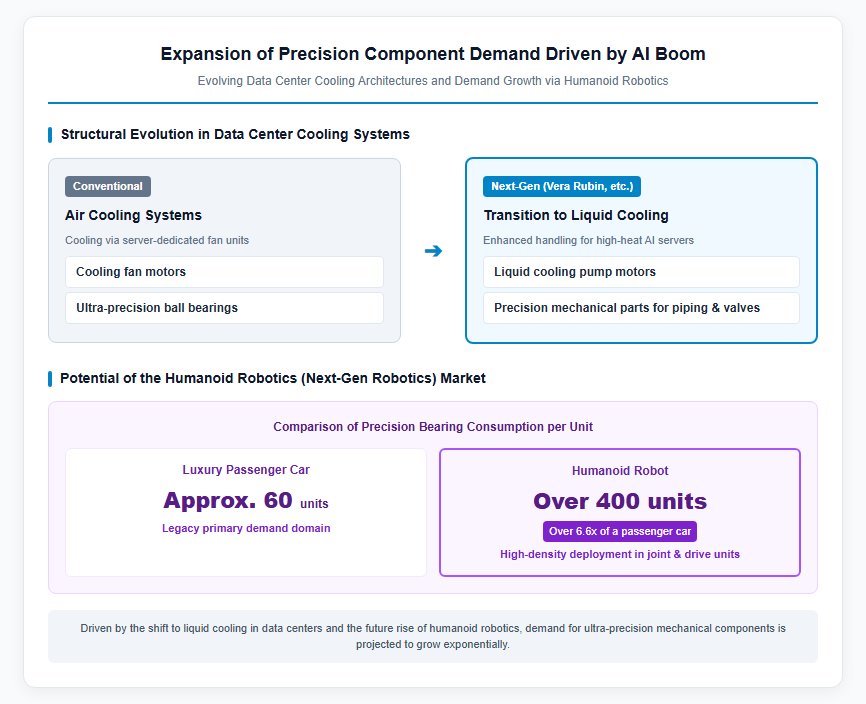
The exponential advancement of AI technology is yielding widespread benefits beyond the semiconductor industry, reaching precision mechanical component manufacturers. In data center servers, thermal management driven by rising processing workloads has become a paramount challenge, spurring massive demand for cooling fan motors and ultra-precision ball bearings. MinebeaMitsumi’s miniature ball bearings and stepping motors are widely deployed in data center infrastructure globally, highly regarded for their extreme precision and long-term durability.
Furthermore, with the introduction of next-generation AI platforms such as NVIDIA’s “Vera Rubin,” the industry transition from traditional air cooling to advanced liquid cooling systems is expected to accelerate rapidly. As cooling architectures evolve, the addressable market for MinebeaMitsumi’s high-precision machining technologies—including motors for liquid cooling pumps and precision components for valves and piping—is expanding substantially. Backed by the resurgence of data center investments across China, North America, and Europe since FY3/25, product shipments remain at historically elevated levels.
The diagram below provides a schematic view of the component deployment across server cooling architectures.
Future Growth Horizons Unlocked by Humanoid Robotics
Over the medium-to-long term, the adoption of humanoid robotics—capable of executing smooth, human-like movements—represents a transformative growth opportunity. Because humanoid robots incorporate vast numbers of bearings and precision motors across their joint actuators and drive units, their widespread commercialization could reshape industrial demand.
A comparison of bearing consumption per unit highlights this market potential:
– Luxury passenger vehicle: approx. 60 bearings per unit
– Humanoid robot: over 400 bearings per unit
Consequently, a single humanoid robot requires more than 6.6 times the number of bearings used in a luxury automobile. As the commercial humanoid robotics market materializes over the next 10 to 15 years, demand for high-precision bearings is projected to scale exponentially. MinebeaMitsumi’s management emphasizes that the long-term technological and market roadmap has become exceedingly clear, justifying a concentrated allocation of internal resources toward these high-growth sectors.
Capital Expenditure Plans and Long-Term Corporate Outlook
Scaling Bearing Production to 500 Million Monthly Units with Disciplined Capital Deployment
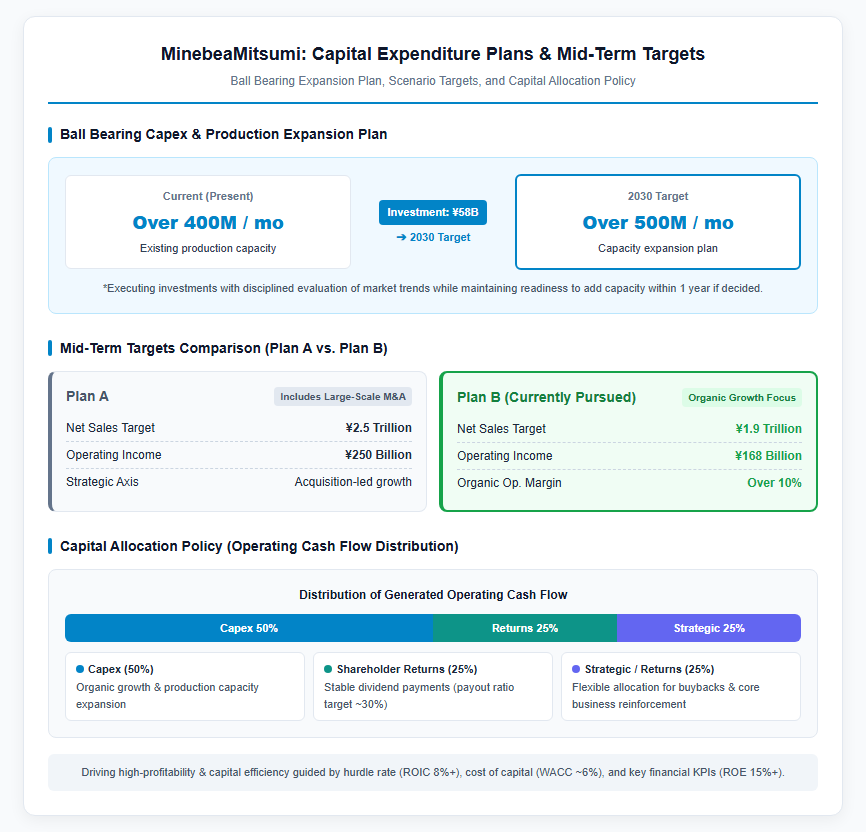
To satisfy surging market demand, MinebeaMitsumi is planning a major capital expenditure initiative to expand its ball bearing production capacity. By investing approximately ¥58 billion, the company aims to raise its monthly production capacity from the current level of just over 400 million units to more than 500 million units by 2030. Given the explosive growth of AI-driven demand, some market analysts and investors have expressed hopes for an accelerated expansion timeline.
However, management maintains a deliberate and prudent approach toward capacity expansion. While the company possesses the agility to execute facility additions within a single year once a decision is made, management recognizes that the AI server ecosystem carries long-term demand volatility risks. Over-committing capital without carefully evaluating market trajectories poses strategic risks. Consequently, MinebeaMitsumi intends to build a flexible and responsive production footprint while exercising rigorous selectivity in capex and optimizing its Cash Conversion Cycle (CCC).
The timeline and structural allocation of the expansion plan are illustrated below.
Organic Growth Scenario and Long-Term Strategic Outlook
Within its mid-term management targets, alongside “Plan A” (¥2.5 trillion in net sales and ¥250 billion in operating income), which incorporates large-scale M&A, MinebeaMitsumi has established “Plan B” (¥1.9 trillion in net sales, ¥168 billion in operating income, and an organic operating margin exceeding 10%). Following the decision to freeze new M&A in unfamiliar domains, the company will accelerate its pivot toward Plan B, focusing strictly on high-margin, capital-efficient organic growth.
The company’s capital allocation policy establishes clear investment priorities:
– 50% of generated operating cash flow: Allocated toward capital expenditures for organic growth
– 25% (half of the remaining 50%): Allocated toward stable shareholder returns (targeting a consolidated payout ratio of around 30%)
– 25% (half of the remaining 50%): Flexible allocation toward share buybacks and opportunistic investments to reinforce core operations
Setting a hurdle rate of Return on Invested Capital (ROIC) at 8% or higher—comfortably above its Weighted Average Cost of Capital (WACC) of approximately 6%—MinebeaMitsumi aims to achieve its long-term financial target of Return on Equity (ROE) of 15% or higher through structural reform and product high-value addition. Market participants are closely watching as MinebeaMitsumi transitions from M&A-driven volume growth toward a business model anchored in profitability, capital efficiency, and core operational execution.
Reference Pages
- [CFO Message – MinebeaMitsumi Inc.] https://www.minebeamitsumi.com/corp/investors/management/cfomessage/index.html
【#MinebeaMitsumi #MAFreeze #AIDemand #DataCenter #Semiconductor #CapitalExpenditure】
コメント