
Chiba Prefecture Governor Toshihito Kumagai conducted an aerial inspection by helicopter and on-site assessments to gauge the full extent of widespread flooding caused by Typhoon No. 25 in 2026 and to facilitate rapid recovery. The move comes as the region faces unprecedented water disasters that exceed previous forecasts, including repeated flooding within short intervals and a dike breach at Lake Kita-Inba.
- Traces of Record-Breaking Torrential Rain and Dike Breaches at Lake Kita-Inba
- Repeated Flooding and Urban-Style Water Disasters Exposed at Affected Sites
- On-Site Assessment and Full Scope Evaluation of Dike Breaches at Lake Kita-Inba via Helicopter
- Emergency Vehicle Removal and Inter-Agency Regional Support Programs
- Policy Statements at the Prefectural Assembly and Accelerated “River Basin Disaster Management” Projects
- Auditing Lessons Learned for “Disaster-Resilient Chiba” and Key Future Outlooks
Traces of Record-Breaking Torrential Rain and Dike Breaches at Lake Kita-Inba
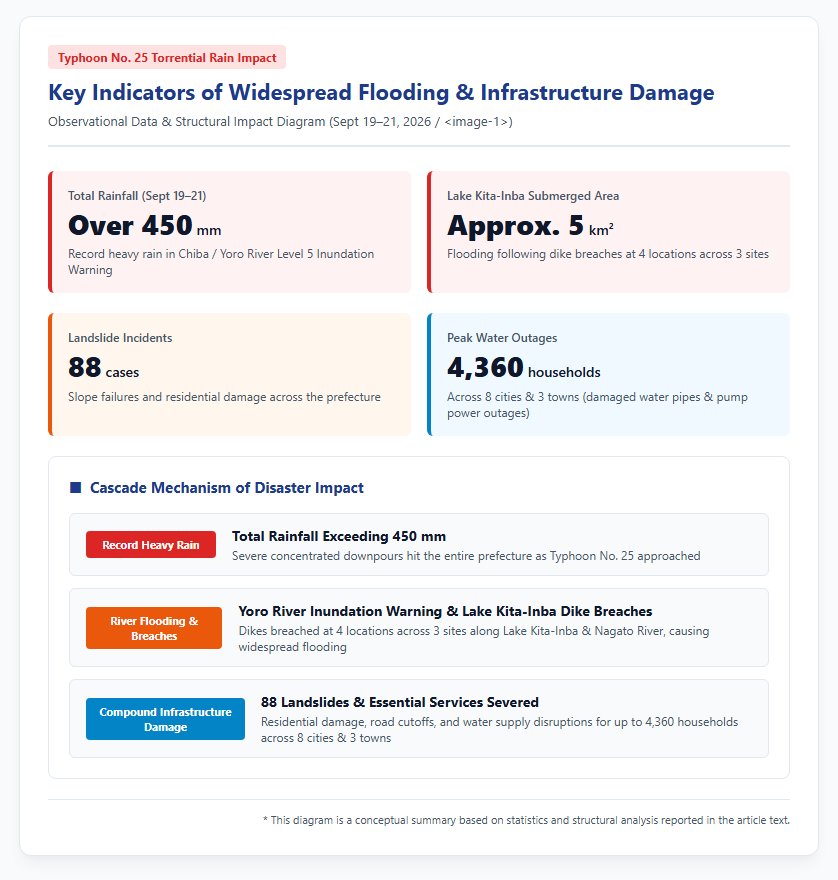
Typhoon No. 25, which formed on September 16, 2026, approached the Kanto-Koshin region on September 21 while maintaining its large size and strong intensity. From September 19 through 21, Chiba Prefecture experienced record-breaking rainfall exceeding 450 millimeters, prompting the Japan Meteorological Agency and local governments to issue strict disaster warnings. The intense rain caused rivers managed by the prefecture to swell rapidly; Level 5 Inundation Warnings were issued for the Yoro River, and dike breaches occurred at four locations across three sites along Lake Kita-Inba and the Nagato River. As a result, an extensive area of approximately five square kilometers surrounding Lake Kita-Inba was submerged, causing severe flooding.
Across the prefecture, 88 landslide incidents were reported, alongside widespread residential damage, including destroyed, partially collapsed, and damaged homes, as well as casualties and missing persons. In terms of infrastructure, damaged water pipes and power outages that disabled pumping stations led to water supply disruptions affecting up to 4,360 households across eight cities and three towns, heavily impacting local residents’ daily lives. The diagram below illustrates the inundation and sediment movement across the affected areas.
Repeated Flooding and Urban-Style Water Disasters Exposed at Affected Sites
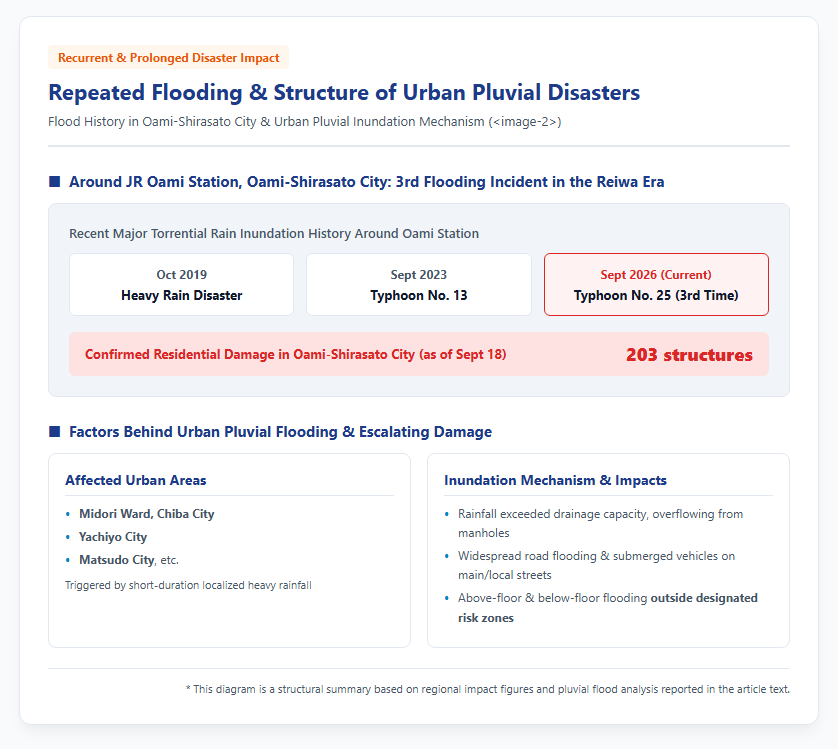
The heavy rainfall brought by Typhoon No. 25 caused recurrent flooding in areas that had previously suffered similar disasters. Around JR Oami Station in Oami-Shirasato City, flooding occurred for the third time in the Reiwa era—following heavy rains in October 2019 and Typhoon No. 13 in September 2023—submerging homes and commercial properties across a wide area. As of September 18, confirmed residential damage in the city reached 203 structures, prompting local residents to urgently demand enhanced flood control measures.
Urban areas such as Midori Ward in Chiba City, Yachiyo City, and Matsudo City also experienced urban pluvial flooding as short-duration concentrated rainfall exceeded the processing capacity of drainage systems, causing water to overflow from manholes and gutters. Submerged roads stranded numerous vehicles, severely disrupting transit on major thoroughfares and local streets. Inundation occurred not only within designated flood-risk zones but also outside these areas, causing above-floor and below-floor flooding and highlighting the limits of conventional hazard maps in predicting urban flood risks. The diagram below illustrates road submergence and urban pluvial flooding.
Governor Kumagai’s Aerial Inspection and Initial Response Measures
On-Site Assessment and Full Scope Evaluation of Dike Breaches at Lake Kita-Inba via Helicopter
On September 22, Chiba Prefecture Governor Toshihito Kumagai boarded a disaster-prevention helicopter to perform an aerial inspection of affected areas to assess the full scope of the damage and expedite recovery efforts. During the flyover, Governor Kumagai surveyed flooded farmland around the dike breach at Lake Kita-Inba as well as slope collapses across the region. Guided by his core administrative philosophy to “make facts and processes transparent to show citizens the future outlook,” the governor prioritized accurate data collection and swift public communication in the initial emergency response.
In parallel with the aerial survey, ground forces—including the Japan Self-Defense Forces, police, the Ministry of Land, Infrastructure, Transport and Tourism’s TEC-FORCE (Technical Emergency Assistance Team), and the JMA’s JETT (Japan Meteorological Agency Disaster Support Team)—were deployed immediately. To address widespread submergence, over 15 drainage pump vehicles were dispatched to Shirako Town, Mobara City, Sakae Town, and Sakura City, operating around the clock for emergency water removal. The governor’s direct visual confirmation of the damage enabled close inter-agency coordination and rapid prioritization of urgent recovery tasks.
Emergency Vehicle Removal and Inter-Agency Regional Support Programs
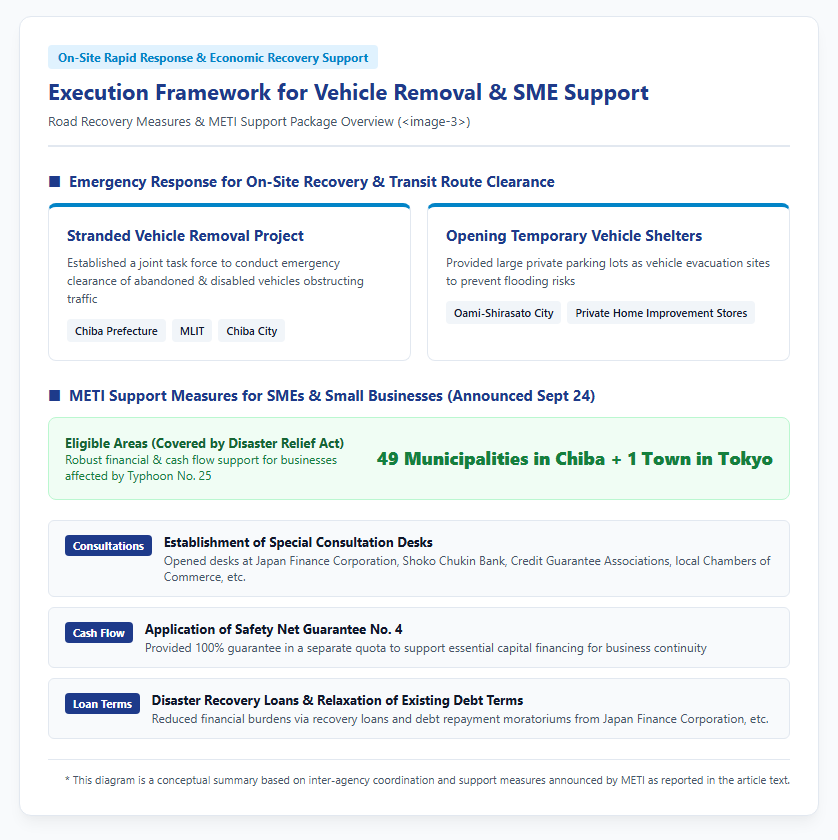
On the ground, cleanup efforts focused on the prompt removal of abandoned and disabled vehicles stranded on flooded roads. Because stranded vehicles obstruct emergency responders and evacuation efforts, Chiba Prefecture, MLIT, and Chiba City established a dedicated task force to complete vehicle clearance rapidly. Additionally, local initiatives were implemented, such as Oami-Shirasato City partnering with a private home improvement store to open its parking lot as a temporary vehicle shelter.
On the economic front, the Ministry of Economy, Trade and Industry (METI) announced comprehensive support measures on September 24 for small and medium-sized enterprises (SMEs) across 49 municipalities in Chiba Prefecture and Oshima Town in Tokyo covered by the Disaster Relief Act. Special consultation desks were established at the Japan Finance Corporation, Shoko Chukin Bank, and local chambers of commerce. A full suite of financial support was activated, including the application of Safety Net Guarantee No. 4, disaster recovery loans, and the relaxation of repayment terms for existing loans. The diagram below shows the framework for emergency vehicle removal and business recovery support.
Strengthening Flood Control Infrastructure and Overhauling Disaster Prevention Frameworks
Policy Statements at the Prefectural Assembly and Accelerated “River Basin Disaster Management” Projects
During the regular September 2026 session of the Chiba Prefectural Assembly, Governor Toshihito Kumagai delivered his opening address with a report on the storm damage, offering condolences and sympathy to those affected. Acknowledging the severity of unprecedented urban water disasters and intense short-term rainfall, Governor Kumagai announced plans for a comprehensive review and audit of the prefecture’s disaster response, defense mechanisms, and evacuation procedures.
Regarding river management, the governor emphasized that channel expansion and dredging works to increase river discharge capacity “must be significantly accelerated.” While noting that “River Basin Disaster Management Projects” along the Ichinomiya River system had successfully mitigated damage in certain areas, he stressed the urgency of accelerating flood control improvements along vulnerable rivers such as the Komaka River and major drainage canals. Furthermore, he committed to launching studies under the revised Flood Control Act to establish new “Inundation Warning Water Levels” that serve as practical benchmarks for timely resident evacuations.
Auditing Lessons Learned for “Disaster-Resilient Chiba” and Key Future Outlooks
Chiba Prefecture previously compiled detailed review reports following the 2019 Boso Peninsula Typhoon and October heavy rains to improve power outage, water supply, and shelter management protocols. Building on these lessons, the prefecture is currently executing a government-wide recovery operation alongside multi-faceted investigations into the causes of the recent damage. In particular, shifting from traditional river-centric hardware infrastructure to holistic “River Basin Disaster Management”—engaging all stakeholders across whole watersheds—is recognized as increasingly imperative.
Key areas to watch moving forward include the prompt formulation and execution of supplementary budgets to support residential recovery, agricultural operations, and business continuity for local enterprises. Furthermore, in light of increasingly frequent and severe localized downpours due to climate change, joint efforts among government agencies, businesses, and local communities to share hazard information and strengthen evacuation protocols will be essential. By leveraging past experience, all of Chiba Prefecture aims to rebuild both structural and non-structural disaster prevention infrastructure to realize a genuinely “Disaster-Resilient Chiba.”
Reference Pages
- 【Ministry of Land, Infrastructure, Transport and Tourism】Report on Damage Status Caused by Typhoon No. 25 of 2026 (Report No. 8)
- 【Chiba Prefecture】Governor’s Address at the Regular September 2026 Session of the Chiba Prefectural Assembly
 令和8年9月定例千葉県議会の知事あいさつwww.pref.chiba.lg.jp
 - 【Ministry of Economy, Trade and Industry】Support Measures for Affected SMEs and Small Businesses Regarding Typhoon No. 25 of 2026
指定されたページまたはファイルは存在しません (METI/経済産業省)www.meti.go.jp

【#Typhoon25 #ChibaFlooding #ChibaPrefecture #GovernorKumagai #DisasterRecovery #RiverBasinDisasterManagement #DisasterResilientChiba #OnSiteInspection】


コメント