On June 2, 2026, the Ministry of Land, Infrastructure, Transport and Tourism revised its guidelines for a single pilot operating multiple drones simultaneously, removing the previously set cap on the number of drones. Behind this is the severe labor shortage in the logistics industry and the government’s strong policy to improve business profitability in infrastructure inspections.
- Requirements and Significance of Guideline Revision
- Applicable flight categories and ensuring safety
- The “2024 Problem” Facing the Logistics and Inspection Industry
- A ‘one-to-many’ operation model supporting productivity improvement
- Collaboration with the 2026 “Drone Route System”
- Demonstration of simultaneous 10-aircraft operations by JAL and KDDI
- Operational management strategies reflecting on-site expertise
- Toward realizing ‘one-to-many’ operations in populated areas
- The Evolution of the Operational Concept into “m:Area”
Requirements and Significance of Guideline Revision
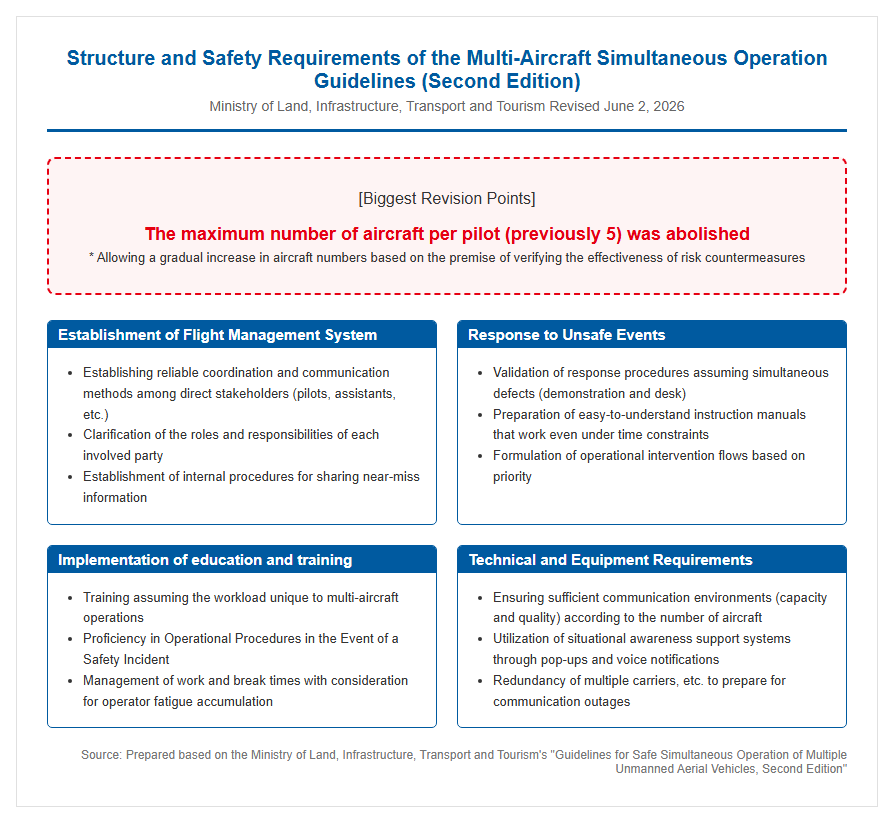
On June 2, 2026, the Civil Aviation Bureau of the Ministry of Land, Infrastructure, Transport and Tourism announced that it had revised its guidelines to ensure the safe simultaneous operation of multiple drones. The biggest point of this revision is the removal of the maximum number of aircraft a single pilot can operate simultaneously.
Under the previous first edition guidelines (formulated in March 2025), each pilot was limited to a maximum of five aircraft. This figure was set to account for the workload when the pilot monitors the condition of each aircraft with human eyes and intervenes as needed. However, with this revision, the “1-to-5” barrier has been removed, based on the premise of verifying the effectiveness of risk countermeasures when gradually increasing the number of aircraft operating simultaneously.
This marks a major turning point for Japan’s drone industry, moving from the demonstration stage to a full-scale social implementation phase. By enabling a single pilot to manage more aircraft, it is expected to dramatically improve operational efficiency and reduce costs. For details on the structure of the revised guidelines, please refer to the diagram below.
Applicable flight categories and ensuring safety
The main focus of this guideline revision is Category II flights under the Aviation Act, where each aircraft is independently controlled. Specifically, this includes “Level 3,” which refers to unassisted visual line of sight flights in unmanned areas, and “Level 3.5” flights, which were institutionalized in December 2023.
Level 3.5 flights simplify entry control measures through onboard camera checks, but when operating multiple aircraft simultaneously, the pilot must monitor camera footage for the number of aircraft on each plane. Since there is a limit to the amount of information humans can process simultaneously, the guidelines state that utilizing autopilot functions is essential.
Additionally, this second edition incorporates insights gained from the demonstration experiment of simultaneous multi-aircraft operations conducted in fiscal year 2025. Specifically, requirements such as establishing procedures for responding to unsafe incidents and conducting training on organized coordination between pilot and assistant have been refined. As a result, operators are required to build systems that can ensure safety even as the number of aircraft increases.
[Background of the System] Worsening labor shortages and expectations for drones
The “2024 Problem” Facing the Logistics and Inspection Industry
The reason for this regulatory relaxation is the severe labor shortage facing the logistics industry. Since April 2024, the so-called ‘2024 problem,’ where restrictions on truck drivers’ overtime have been subject to limits, making the decline in delivery capacity a social concern. Maintaining last-mile delivery, especially in depopulated areas such as mountainous regions and remote islands, is an urgent issue.
Drone delivery is expected to be a next-generation logistics solution to these challenges, but until now, operations have mainly been operated with “one aircraft per pilot,” which incurs high labor costs and makes it difficult to ensure business profitability. If simultaneous operation of multiple aircraft can significantly reduce operating costs, drone delivery services will become independent as a business and pave the way for sustainable social infrastructure.
The labor shortage problem is not limited to logistics. In fields such as large-scale infrastructure inspections such as bridges and dams, and security of solar power facilities with vast sites, simultaneous operation of numerous drones, which can cover wide areas with a small crew, is regarded as an extremely important means to improve productivity.
A ‘one-to-many’ operation model supporting productivity improvement
Simultaneous operation of many drones is not simply a technology for “flying many aircraft with a small crew.” This is a new operational model designed to maximize operational productivity in response to social issues such as labor shortages and long-distance delivery.
With this guideline revision, logistics operators will be able to control multiple drones scattered across different areas simultaneously from remote flight hubs. This enables efficient routing of delivery routes with fewer personnel, making small parcel deliveries and emergency cargo transport—previously cost-effective with traditional transport methods—becoming more realistic.
In its “Roadmap for the Industrial Revolution of the Air,” the government has set a policy to aim for full-scale use of drones in logistics from 2025 onward. Institutionalizing simultaneous multi-aircraft operations is a key milestone in realizing this roadmap, and it will also provide a strong tailwind for local governments and small and medium-sized enterprises struggling with labor shortages to promote DX (digital transformation).
Collaboration with the 2026 “Drone Route System”
Fiscal year 2026 is being called a “historic turning point” for Japan’s drone industry. The biggest reason for this is the full-scale launch of the government-led “Drone Route System.” This is a system that registers “air routes” that have undergone risk assessments and coordination with local residents, greatly simplifying flight permit and approval procedures when using registered routes.
This revision of the multi-aircraft simultaneous operation guidelines is closely linked to this route system. Operators can operate multiple drones simultaneously on well-maintained routes, enabling safer and more on-demand operations.
Additionally, through collaboration with the Ministry of Land, Infrastructure, Transport and Tourism’s “Drone Information Infrastructure System (DIPS2.0),” the practical application process for multi-aircraft operations will be digitized, reducing the administrative burden on operators. With the three pillars of infrastructure (air routes), systems (permission for multi-aircraft operations), and systems (DIPS 2.0) coming together in 2026, the barriers to entry for the drone business are expected to drop dramatically.
[Examples and Results] The Possibility of Breaking the Upper Limit Demonstrated by the Demonstration Experiment
Demonstration of simultaneous 10-aircraft operations by JAL and KDDI
The lifting of the aircraft cap was driven by the successful pilot experiments conducted by private companies. As part of NEDO’s “ReAMo Project,” operators such as Japan Airlines (JAL) and KDDI Smart Drones have repeatedly verified advanced multi-aircraft simultaneous operations.
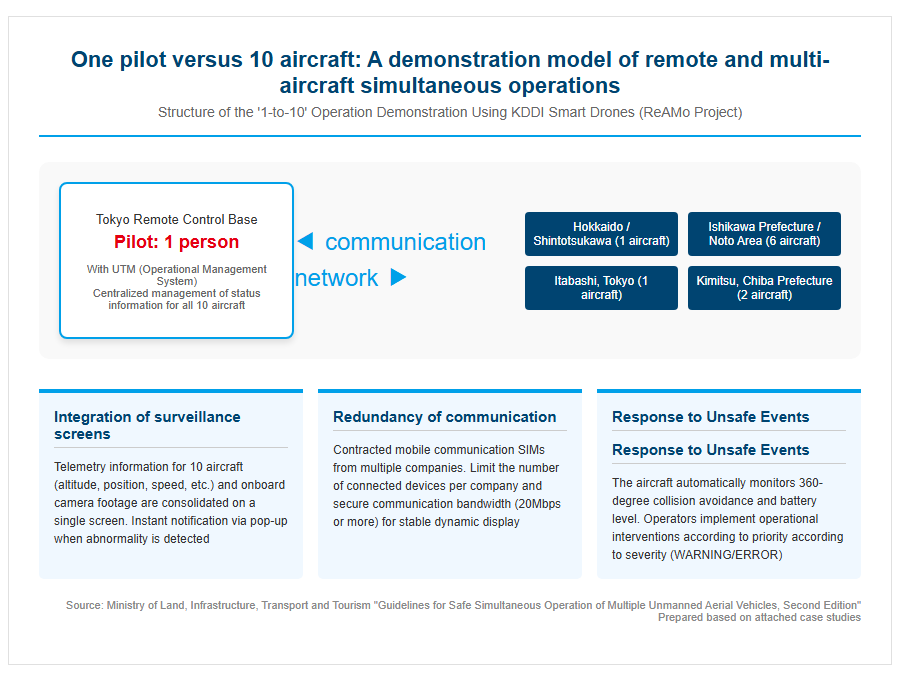
In particular, in fiscal year 2025, tests were conducted where a single pilot operated 8 or even 10 drones simultaneously. In KDDI’s case, four different flight bases—Hokkaido, Ishikawa, Tokyo, and Chiba—were managed centrally from the remote control base in Tokyo, successfully achieving a one-to-ten flight schedule. During this process, a method was validated to aggregate telemetry information and camera footage from aircraft operating in different areas onto a single screen, enabling real-time monitoring and control. For details on the demonstration experiment, please refer to the image below.
JAL is similarly advancing demonstrations of simultaneous multi-aircraft operations at Level 3.5 and Level 4, designed for logistics purposes. Through these demonstration experiments, data proved that with appropriate system support, a single pilot can safely manage more than five aircraft, which became a major basis for this guideline revision.
Operational management strategies reflecting on-site expertise
The demonstration experiment also revealed the unique risks associated with increasing the number of aircraft, as well as their solutions. For example, to reduce the operator’s monitoring burden, a system has been introduced where the aircraft automatically detects low battery levels or approaches from other aircraft, issuing phased alerts of “WARNING” or “ERROR” according to their importance.
Additionally, ensuring stable communication environments has emerged as a critical issue. When flying many aircraft in the same area, practical safety requirements were derived, such as ensuring redundancy by contracting multiple carriers to prevent SIM interference, and setting baseline values for stable dynamic display (such as communication speeds of 20Mbps or higher).
The second edition of the guidelines incorporates insights gained from the hardships faced on the ground. Specifically, it is recommended to prioritize responses when abnormalities occur simultaneously and to introduce methods such as NASA TLX to quantitatively evaluate pilot workloads. This has once again highlighted the importance of an “Operations Management System” that not only increases the number of aircraft but also manages safety as an organization.
[Future Outlook] Level 4 Implementation and Transition to Next-Generation Models
Toward realizing ‘one-to-many’ operations in populated areas
This guideline revision focuses mainly on Category II flights (unmanned areas), but beyond that focus is the simultaneous operation of multiple aircraft in “Level 4 flights (unassisted out-of-visual line of sight flights in manned areas).” Organizations like JAL have already indicated plans for multi-aircraft simultaneous delivery at future Level 4 systems.
Operation in inhabited areas requires more advanced aircraft certification and piloting licenses, but the systematization of safety requirements for multi-aircraft operations in this revision marks a significant step toward Level 4 implementation. If multi-aircraft operations by small crews become possible in inhabited areas, the use cases for drones will explode, such as delivering parcels in urban areas and quickly transporting supplies to densely populated residential areas during disasters.
The government also plans to continue considering the handling of simultaneous multi-aircraft operations based on the aircraft certification system from fiscal year 2026 onward. With regulations and technological development aligned, the everyday life where drones fly across the sky is just around the corner.
The Evolution of the Operational Concept into “m:Area”
In the future, the concept of drone operation is expected to shift from the current ‘pilot-to-aircraft’ ratio to a model called ‘m:Area,’ which automatically manages entire specific areas. This is a direction already seen in advanced cases in the United States.
In this model, highly automated aircraft autonomously set flight paths via the Operation Management System (UTM), automatically avoiding collisions with other aircraft or manned aircraft. The role of humans (operators) is shifting to a “Human-on-the-loop” system that monitors the entire system and intervenes only when critical alerts occur.
In the United States, companies like Amazon Prime Air have obtained exemption from the FAA (Federal Aviation Administration) and are implementing high-ratio flights such as 1:20 and delivery coverage across entire areas. In Japan as well, starting with this guideline revision, the establishment of world-class drone operating environments will accelerate by incorporating new technologies related to automatic and autonomous aircraft development.
🏛️ Politics and Society


コメント