The Finance Minister pointed out that there is a “misunderstanding” in the financial markets regarding the sharp depreciation of the yen, issuing a strong warning to curb speculative yen-selling moves. Behind this situation lies a complex interplay of market anxiety over the Takaichi administration’s expansionary fiscal stance and speculation surrounding the U.S.-Japan interest rate gap.
- Key Points of the Event and Market Warnings by the Finance Minister
- Speculation Over the “Basic Policy” and Fiscal Management
- Execution of Joint U.S.-Japan Intervention and Immediate Market Impact
- Monetary Policy Distortion and Cost-Push Inflation
- Surge in SME Bankruptcies Driven by Soaring Import Costs
- Currency Outlook and Key Economic Indicators to Watch
Key Points of the Event and Market Warnings by the Finance Minister
In September 2026, as the dollar-yen exchange rate swung sharply toward yen weakness in foreign exchange markets, the Finance Minister stated, “Looking at the market, I felt there was somewhat of a misunderstanding. I believe the trend will revert.” Expressing confidence that the overshooting yen-selling trajectory would self-correct, the minister strongly cautioned against market overheating. Prior to this, at a regular press conference, he expressed deep concern that “one-sided and rapid movements have recently been observed in foreign exchange markets,” repeatedly emphasizing the importance of exchange rates moving stably in line with economic fundamentals. Government and monetary authorities have clearly signaled their intention to strictly monitor excessive volatility and disorderly market movements, reflecting a firm desire to curb excessive yen selling driven by speculative sentiment. This situation underscores policymakers’ heightened alarm over the severe impact of currency weakness on domestic prices and household livelihoods through rising import costs.
Speculation Over the “Basic Policy” and Fiscal Management
Behind the accelerated momentum of yen selling were complex interpretations and speculation among market participants regarding government policy direction and fiscal discipline. Following the late June 2026 draft release of the “Basic Policy on Economic and Fiscal Management and Reform 2026” (the “Basic Policy”), market concerns over fiscal deterioration stemming from expansionary government policy, alongside expectations that the Bank of Japan would hold off on interest rate hikes, rapidly mounted across financial markets. This triggered a sharp wave of yen selling known as the “Basic Policy Shock,” causing the dollar-yen rate to drop to near 162.84 yen per dollar—its weakest level since 1986—while newly issued 10-year Japanese Government Bond (JGB) yields briefly surged to the 2.90% range. In response, the government and ruling coalition moved to adjust the draft “Basic Policy” to explicitly respect the autonomy of the Bank of Japan’s monetary policy in an attempt to contain market alarm. Nevertheless, market wariness toward the administration’s fiscal expansion stance remains deeply rooted, making premature speculation and policy “misunderstandings” the main drivers of persistent exchange rate instability.
The Reality of FX Intervention and the Structure of the U.S.-Japan Rate Gap
Execution of Joint U.S.-Japan Intervention and Immediate Market Impact
To counter disorderly currency movements, the Japanese government and monetary authorities have taken intervention measures on a historic scale. In late July 2026, Japanese and U.S. monetary authorities executed joint yen-buying and dollar-selling intervention for the first time in 28 years since 1998. Total intervention volume, including solo operations, reached 15.4 trillion yen, sending a powerful signaling effect to the market reminiscent of the Asian Financial Crisis era. Comparative empirical analyses using counterfactual rate models indicate that across numerous yen-buying interventions executed since 2022, immediate effects pushed exchange rate levels back toward yen strength by approximately 5 yen right after implementation. Please refer to the diagram below.
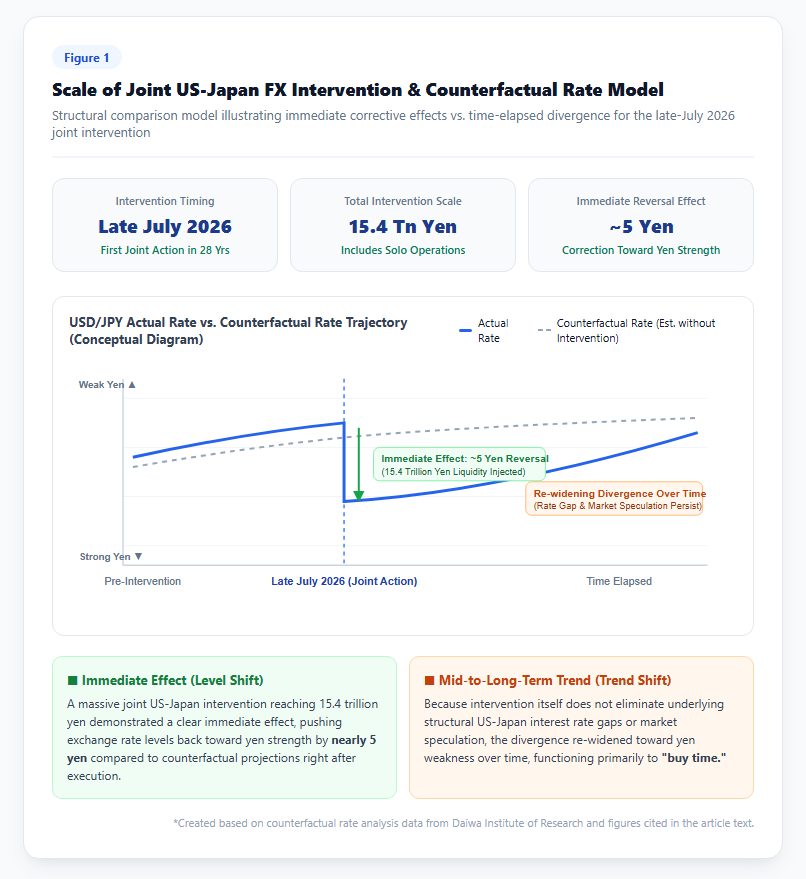
However, intervention alone cannot fundamentally alter long-term market trends; over time, structural interest rate gaps and market speculation frequently caused the divergence toward yen weakness to re-widen. This joint intervention was widely evaluated as a policy effort aimed primarily at buying time and restraining extreme market volatility.
Monetary Policy Distortion and Cost-Push Inflation
Following its policy rate hike to 1.0% in June 2026, the Bank of Japan raised the policy rate further to 1.25% on September 18. While the Bank of Japan cited the need to address the risk of underlying inflation overshooting its 2% target, the Tokyo foreign exchange market witnessed a paradoxical reaction: the yen actually weakened from the upper 157 range to briefly touch the 158 level immediately after the rate hike announcement. This occurred because market participants interpreted the Governor’s remarks as dovish while pricing in prolonged monetary tightening by the U.S. Federal Reserve (FRB). Current price increases in Japan are not driven by demand overheating, but rather strongly exhibit the characteristics of cost-push inflation caused primarily by elevated crude oil prices amid Middle East tensions and a weak currency. Analysts point out that raising interest rates under supply-shock conditions increases corporate borrowing costs (such as short-term prime rates), risking distortions in the real economy by discouraging private and capital investment.
Impact on the Real Economy and Future Challenges
Surge in SME Bankruptcies Driven by Soaring Import Costs
The prolonged and sharp depreciation of the yen is dealing a direct and severe blow to Japan’s real economy, particularly domestic small and medium-sized enterprises (SMEs). According to a survey by Tokyo Shoko Research, a private credit research firm, “yen-weakness-related bankruptcies” reached 45 cases between January and June 2026, representing an approximately 30% increase year-on-year and marking the highest first-half figure since tracking began in 2022. While major exporters in the automotive and electronics industries posted strong performance boosted by foreign exchange gains, SMEs procuring raw materials, energy, and food from overseas faced devastating import cost increases. Wholesalers, retailers, and food manufacturers unable to adequately pass increased import costs onto selling prices saw profit margins plunge, with an increasing number of firms forced into insolvency due to deteriorating cash flows. As the performance gap between large corporations and SMEs widens further, pressing regional employment and local community foundations, strengthening government productivity support and direct assistance for SMEs has become an urgent necessity.
Currency Outlook and Key Economic Indicators to Watch
In gauging future exchange rate trends, it is essential to monitor not only simple U.S.-Japan interest rate differentials, but also shifts in official statements and the broader policy directions of both countries. In early September 2026, media reports regarding the U.S. Treasury Secretary’s comments on reflationary policies, coupled with market speculation over additional Bank of Japan policy shifts, caused the exchange rate to temporarily swing sharply toward yen strength. Please refer to the diagram below.
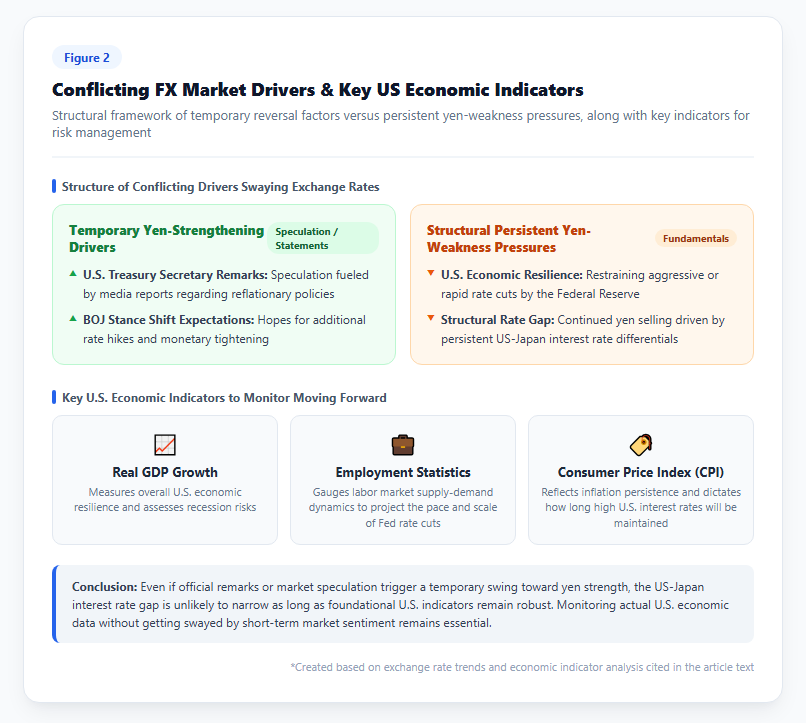
However, if the Federal Reserve refrains from aggressive rate cuts due to the underlying resilience of the U.S. economy, the structural U.S.-Japan interest rate gap will be difficult to close, meaning fundamental yen-selling pressures will not disappear overnight. To prepare for future economic risks, market participants must consistently track foundational indicators such as U.S. real GDP growth, payroll employment statistics, and the Consumer Price Index (CPI). Discerning the progress of government intervention and corporate cost pass-through without getting distracted by short-term market sentiment will be a major focus moving forward.
References
- [Status of Foreign Exchange Intervention Operations – Ministry of Finance Japan] https://www.mof.go.jp/
- [Daiwa Institute of Research – How Effective Was the Joint U.S.-Japan Intervention in Correcting Yen Weakness?] https://www.dir.co.jp/
- [Japan Economic Research Institute – Causes and Effects of Yen Depreciation] https://www.jeri.or.jp/
【#YenDepreciation #FinancialMarkets #FinanceMinister #InterestRateGap #FXIntervention #JapaneseEconomy】


コメント