
On July 22, 2026, SoftBank launched the beta version of “GaranAI,” a data ecosystem platform that balances rights protection for Japan’s content industry with data utilization in AI development. Behind this initiative lies the shortage of high-quality Japanese data essential for generative AI development and strong concerns from rights holders about unauthorized use of copyrighted works.
- The birth of a new platform that balances rights protection and utilization
- Eight media outlets nationwide, including Kyodo News, participated.
- Advanced multi-stage processing technology to prevent original data recovery
- Distribution of compensation to rights holders and provision of management tools
- Cost reduction and quality improvement benefits enjoyed by AI developers
- The AI Society Envisioned by the Medium-Term Management Plan ‘Activate AI for Society’
- Expansion of functions and expansion of participating organizations for official launch
The birth of a new platform that balances rights protection and utilization
On July 22, 2026, SoftBank released the beta version of its platform “GaranAI,” which enables generative AI developers to safely and effectively utilize the vast copyrighted works held by content holders such as newspapers and publishers, and began accepting applications for its use on the same day. This foundation is designed as a bridge to support the sustainable development of Japan’s content industry and the development of high-quality AI specialized in Japanese.
A major motivation behind development is the severe shortage of high-quality Japanese text data, which is essential for improving the performance of large language models (LLMs). Currently, many generative AIs are being developed mainly around English and Chinese data, which presents challenges in not fully understanding Japanese customs, culture, and region-specific nuances. On the other hand, highly reliable data held by news organizations and others has been cautiously provided to AI training due to the risk of copyright infringement due to unauthorized use. Instead of directly providing data, GaranAI provides a mechanism to distribute the value of data to the market while reducing the risk of such rights infringement by applying advanced processing. Please refer to the diagram below.
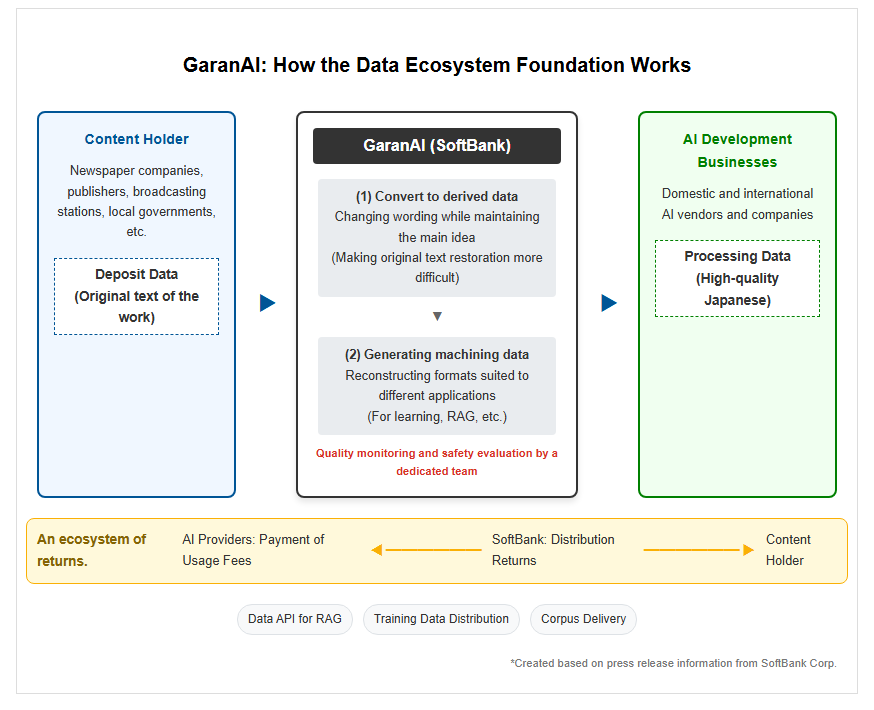
Eight media outlets nationwide, including Kyodo News, participated.
For this beta release, major media supporting Japanese discourse—from national newspapers to local newspapers and news agencies—have established a cooperative framework. SoftBank entered into a business partnership with Kyodo News in May 2025 to develop datasets for AI models, and this GaranAI is an important step in realizing that partnership.
Currently, the following eight companies and organizations are scheduled to provide data.
-
General Incorporated Association Kyodo News
-
Sankei Shimbun Co., Ltd.
-
Mainichi Newspapers Co., Ltd.
-
Shinano Mainichi Shimbun Co., Ltd.
-
Sports Nippon Newspaper Co., Ltd.
-
Daily Tohoku Shimbun Co., Ltd.
-
Nara Shimbun Co., Ltd.
-
Muroran Minpo Co., Ltd.
These news organizations contribute to improving AI response accuracy by providing highly accurate, timely, and comprehensive article data. In particular, the local information rooted in the region held by local newspapers is a valuable source of information that cannot be fully covered by existing publicly available data on the internet alone. SoftBank has been conducting a beta operation for about six months to verify features and quality, aiming for official release after January 2027.
Innovative technology and profit returns to the content industry
Advanced multi-stage processing technology to prevent original data recovery
The biggest technical feature of GaranAI is its “multi-stage processing,” where data entrusted by content holders is not directly handed over to the user operators. This process made it possible to generate data suitable for AI training while protecting copyrights.
The processing process mainly takes place in the following three stages.
-
Receipt of entrusted data: SoftBank’s dedicated team will hold the original text of the copyrighted work from newspapers and similar organizations.
-
Conversion to derived data: While preserving the main idea and facts of the original text, it transforms expressions and phrases, making restoration to the original data difficult.
-
Generation of processed data: Derived data is reconstructed and provided in formats suited to AI development applications (such as training or search).
This process is consistently managed by SoftBank’s internal Quality Operations and Improvement Team. Beyond mere automatic conversion, we monitor the risk of malicious data contamination such as prompt injection and continuously improve processing logic to ensure data transparency and security. This allows operators to reduce the enormous infrastructure investments and labor costs associated with data cleansing and pre-validation.
Distribution of compensation to rights holders and provision of management tools
At the core of its business model is a “reward mechanism,” where rights holders are paid based on the amount of data used. Until now, there have been concerns that data on the internet could be unilaterally crawled by AI developers and used for training without permission. On this platform, usage fees are appropriately distributed to content holders based on the usage performance of data users.
Additionally, for content holders, a “Deposit Data Management Tool” is provided. By using this tool, you can gain detailed insights into which businesses are using your data and to what extent. Additionally, it includes features that limit data provision to specific operators, such as competitors, enabling strategic data management. This has opened up the possibility for news organizations and publishers to build new pillars of digital revenue while controlling the rights to their own works.
Cost reduction and quality improvement benefits enjoyed by AI developers
For businesses developing AI, GaranAI is also an extremely attractive platform. In traditional AI development, it was not uncommon for nearly 80% of the entire process to spend nearly 80% of the time collecting high-quality data that determines model performance and refining and processing it. By using GaranAI, businesses can quickly obtain verified, reliable Japanese data in a development-appropriate format, dramatically reducing lead times.
In particular, it is expected to help break through the ‘Japanese language barrier’ currently facing AI development in Japan by 2026. Access not only to open internet data but also to high-quality closed data that is usually private is a decisive strength in preventing AI hallucination and creating services that deeply understand Japanese business customs and cultural backgrounds. In terms of offerings, in addition to the “RAG Data API” that can be used as a search endpoint, a beta version of “Training Data Delivery” specialized for specific tasks is scheduled to begin in October.
Strategic Background and Future Roadmap for Social Implementation
The AI Society Envisioned by the Medium-Term Management Plan ‘Activate AI for Society’
The announcement of GaranAI is a key component of SoftBank’s new medium-term management plan for fiscal 2026 through 2030, called “Activate AI for Society.” The company has declared its evolution from a traditional “telecommunications infrastructure company” to a “social infrastructure company in the AI era,” with AI implementation as a common theme across all its businesses.
SoftBank has set an ambitious goal of 1.7 trillion yen in consolidated operating profit by fiscal 2030, positioning AI-related businesses within its enterprise business as the driving force behind this goal. Please refer to the diagram below.
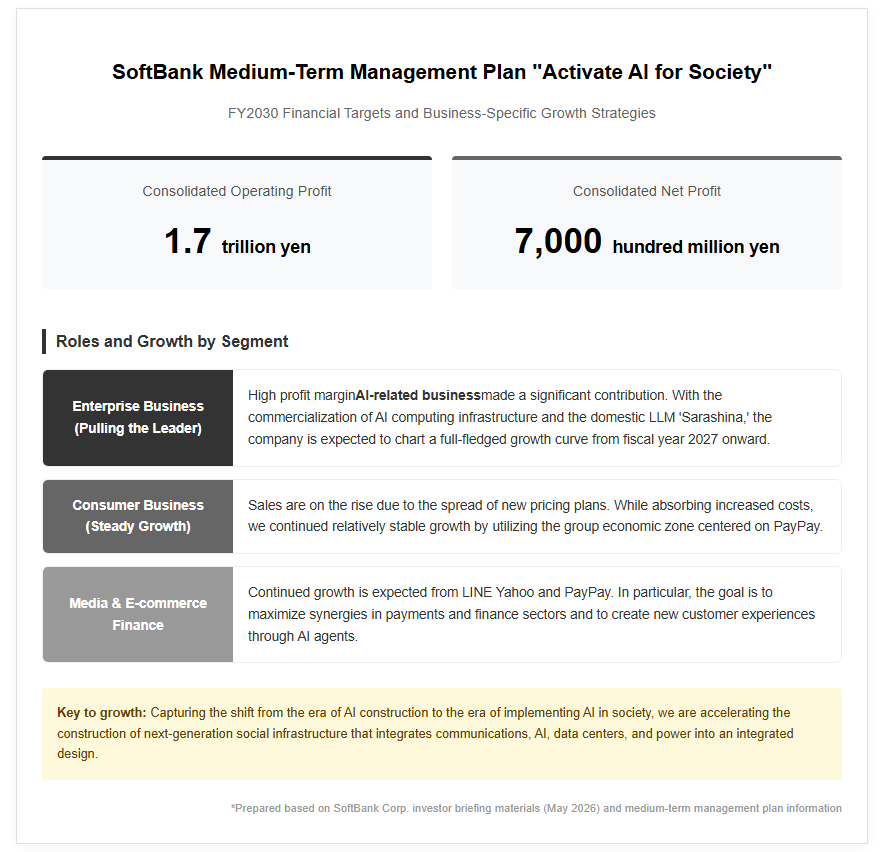
GaranAI will work closely with one of the largest AI computing platforms in Japan that the company is building, as well as with the domestic LLM “Sarashina” developed by its subsidiary SB Intuitions. By having its own computing infrastructure, developing Japanese models, and providing the “data distribution market” as its own platform, we have clarified a strategy to seamlessly cover all layers of AI utilization.
Expansion of functions and expansion of participating organizations for official launch
Aiming for official release in January 2027, GaranAI plans to further expand its features in the future. One notable feature is the introduction of the “Hallucination Prevention Logic.” By automatically analyzing text dependencies during data storage and processing while highly preserving context, the risk of AI generating misinformation is minimized at the system level. Additionally, a feature to provide trend information based on proprietary analysis via API is also planned.
The expansion of participating organizations is also progressing rapidly. Currently, the focus is on news organizations, but in the future, we aim to expand into the following areas.
-
Other mass media such as publishers, TV stations, and radio stations
-
Academic and educational institutions such as museums and libraries
-
Data holders in specific fields such as manufacturing, retail, and local governments
Furthermore, with the full implementation of the EU AI Act approaching in August 2026, the importance of compliant data governance is increasing worldwide. By technically curbing the risks of copyright infringement and misuse, GaranAI should become a strong choice for companies aiming to comply with domestic and international AI regulations. Through this platform, SoftBank aims to establish a data ecosystem originating in Japan and enhance Japan’s presence in the global AI development competition.
Reference Page
-
[Beta Version Launched for GaranAI, a Data Ecosystem Platform Supporting the Sustainable Development of Japan’s Content Industry and Generative AI Development | Corporate & IR | SoftBank] https://www.softbank.jp/corp/news/press/sbkk/2026/20260722_01/
-
[Main Q&A at the Investor Briefing for the Fiscal Year Ending March 2026 | Corporate & IR | SoftBank] https://www.softbank.jp/corp/ir/documents/presentations/fy2025/q4_investors_qa/
[#ソフトバンク #生成AI #GaranAI #データエコシステム #著作権 #DX #経済ニュース #ビジネス]


コメント