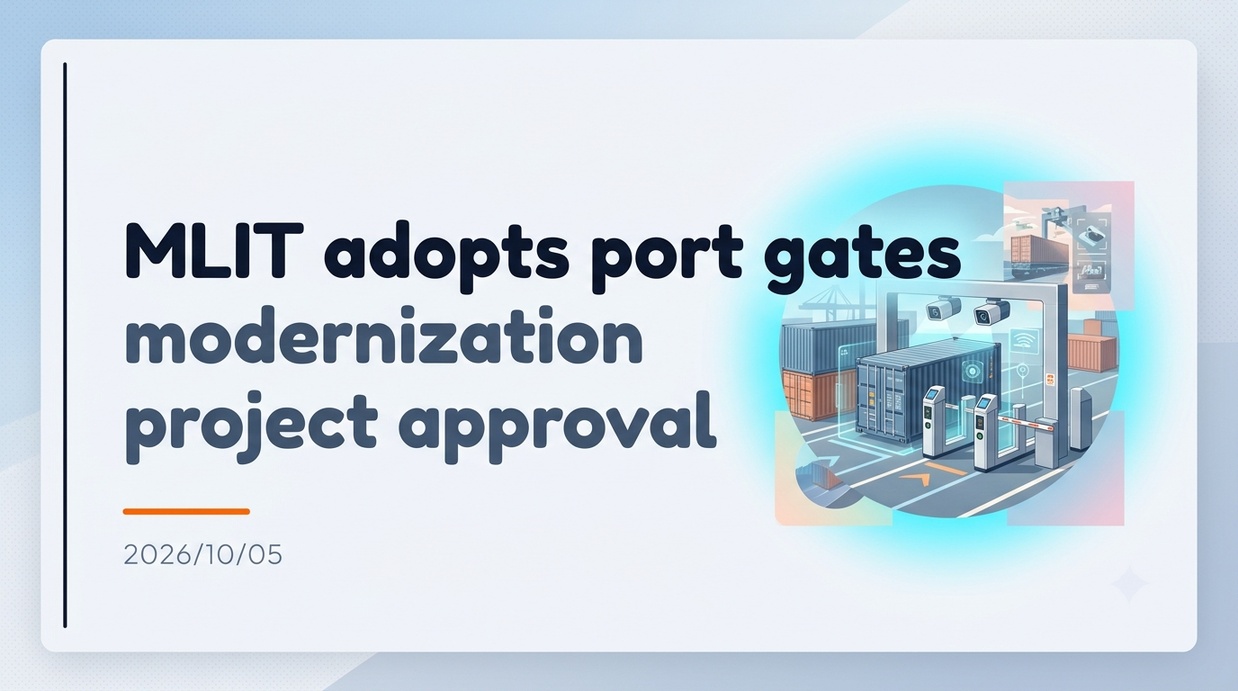
The Ministry of Land, Infrastructure, Transport and Tourism (MLIT) has selected subsidy projects aimed at upgrading container terminal gates to expedite container entry and exit at Strategic International Container Ports. This is driven by worsening trailer congestion due to the increasing size of container ships and a severe labor shortage stemming from the “2024 problem” in the logistics sector.
- Selection Results for 3 Newly Adopted Projects in FY 2026
- Challenges and Bottleneck Structures in Conventional Gate Operations
- Subsidy Program Requirements and One-Third Subsidy Rate Support Structure
- Streamlining Cargo Handling and Verification Work Using AI and OCR Cameras
- The Necessity of DX to Address Driver Shortages and Alleviate Port Congestion
- Security and Future Outlook Based on the Port of Nagoya Incident
Selection Results for 3 Newly Adopted Projects in FY 2026
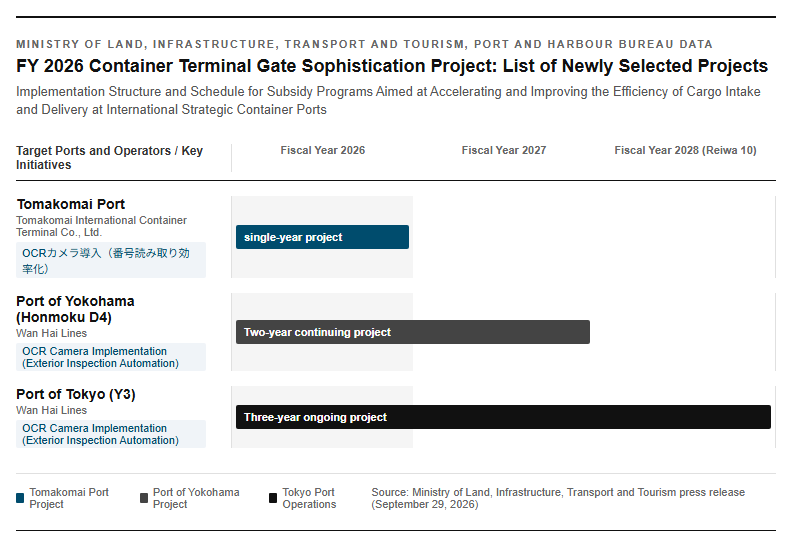
On September 29, 2026, the Ministry of Land, Infrastructure, Transport and Tourism announced the newly selected projects for the Container Terminal Gate Sophistication Subsidy Program, aimed at enhancing the competitiveness of international strategic container ports and accelerating and streamlining container entry and exit. Public applications for this subsidy program were accepted from January 5 to February 3, 2026, and following a rigorous evaluation by academic experts and others, a total of three projects—at the Port of Tomakomai, the Port of Tokyo, and the Port of Yokohama—were newly selected. Specifically, under the Tomakomai Port Container Terminal Gate Sophistication Project, the operator Tomakomai International Container Terminal Co., Ltd. will introduce OCR cameras in fiscal 2026 to improve the efficiency of reading container numbers. In the Tokyo Port Y3 Terminal Gate Sophistication Project, Wan Hai Lines aims to automate exterior inspections using OCR cameras over a project period from fiscal 2026 to fiscal 2028. Furthermore, in the Yokohama Port Honmoku D4 Terminal Gate Sophistication Project, the same company plans to introduce similar OCR cameras from fiscal 2026 to fiscal 2027. The introduction of these digital technologies is intended to dramatically alleviate congestion around the gates. The operational imagery and equipment configuration are as follows.
Challenges and Bottleneck Structures in Conventional Gate Operations
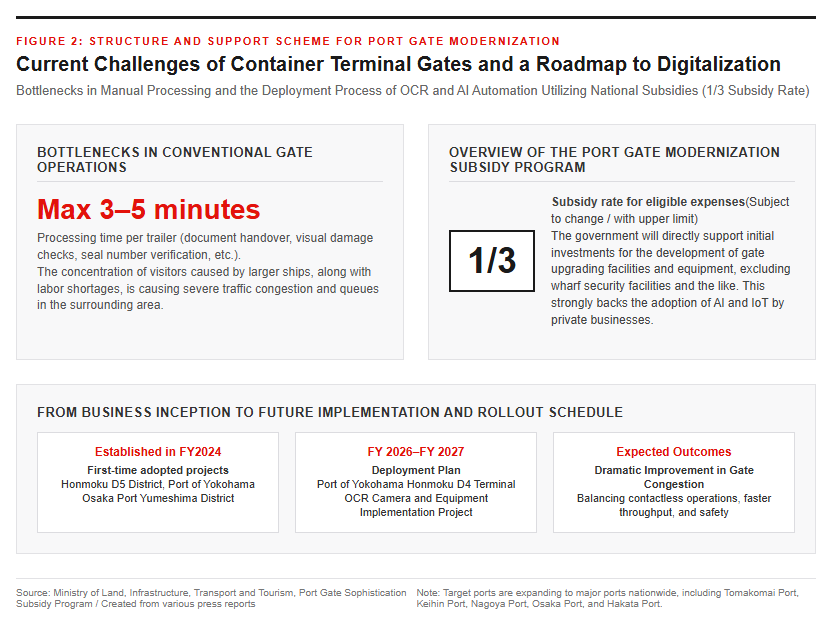
Traditional gate operations at container terminals have long been a major bottleneck in port logistics as a whole. On-site, manual processing is conducted for each arriving trailer—such as the hand-off of documents, visual checks for container damage, and confirmation of seal numbers—taking approximately 3 to 5 minutes per vehicle. In recent years, the global trend toward larger container ships has led to massive volumes of containers being loaded and unloaded at once, resulting in external trailers concentrating their arrivals at specific dates and times, which causes severe traffic congestion and long waiting lines around terminals. In addition, due to the declining labor population and aging demographics in Japan, the shortage of port workers and truck drivers is becoming increasingly severe year by year, making it extremely difficult to maintain operations that rely on conventional, grueling manual labor. Without digitizing documents and automating exterior inspections, the industry has fallen into a situation where stagnation in international logistics and the deterioration of the working environment for trucking companies cannot be avoided.
Mechanisms and Technical Approaches of the Port Gate Upgrading Subsidy Program
Subsidy Program Requirements and One-Third Subsidy Rate Support Structure
The subsidy program established by the Ministry of Land, Infrastructure, Transport and Tourism for the sophistication of container terminal gates is a national support measure aimed at dramatically improving logistics functions in international strategic container ports and other ports. The subsidy rate for this program is set at up to one-third of eligible expenses, and facilities and equipment maintenance necessary for gate sophistication—excluding certain wharf security facilities—are eligible for the subsidy. Eligible ports span major ports nationwide, including Tomakomai Port, Sendai Bay Port, Keihin Port, Niigata Port, Shimizu Port, Nagoya Port, Yokkaichi Port, Osaka Port, Kobe Port, Mizushima Port, Hiroshima Port, Kanmon Port, and Hakata Port. Under this mechanism, private terminal operators and transport businesses take the lead in formulating business plans and applying through the national public offering process. Established in fiscal 2024, the program’s initial selection chose two projects: the Honmoku D5 district in Yokohama Port (CMA CGM JAPAN and Sumitomo Warehouse) and the Yumeshima district in Osaka Port (Yumeshima Container Terminal). By directly supporting a portion of the costs, the government is strongly backing the initial investments made by private operators in cutting-edge DX technologies such as AI and IoT.
Streamlining Cargo Handling and Verification Work Using AI and OCR Cameras
At the core of the gate modernization project is an automation system for various operations utilizing optical character recognition (OCR) cameras and artificial intelligence (AI). By combining high-resolution cameras and AI image analysis technology, the system automatically and in real-time processes visual inspections of container damage such as scratches and dents, reads container and seal numbers, and identifies hazardous material codes as trailers pass through the gate. Furthermore, through integration with arrival reservation systems (such as CONPAS), it cross-references pre-reservation information for trailers to fully digitalize destination instructions within the terminal and the issuance of Equipment Interchange Receipts (EIR). This allows drivers to enter and exit smoothly and contact-free without getting out of their vehicles, simultaneously improving gate passage speed and ensuring worker safety. Such gate systems link directly with Terminal Operating Systems (TOS), contributing to more efficient cargo handling within the yard. The overall picture and operational status of the system are as follows.
The Broader Background Behind the 2024 Logistics Problem and Ensuring Cybersecurity
The Necessity of DX to Address Driver Shortages and Alleviate Port Congestion
The “2024 Logistics Problem,” brought on by the introduction of caps on overtime work for truck drivers, is forcing major structural changes on the front lines of port logistics as well. As truck drivers’ operating hours become restricted, hours of waiting time in front of port gates have significantly hindered the productivity of loading and unloading operations. The Ministry of Land, Infrastructure, Transport and Tourism (MLIT) has set forth the creation of “human-supporting AI terminals,” and—along with supporting the introduction of remotely operated RTGs (rubber-tyred gantry cranes) and digitizing trade procedures through Cyber Port—is positioning gate modernization as a top-priority digital transformation (DX) measure. By alleviating gate congestion and achieving the complete automation of procedures, the time external trailers spend at terminals is expected to be significantly reduced, leading to shorter working hours for drivers and improved driving efficiency. Furthermore, accumulated environmental benefits, such as contributions to reducing carbon dioxide (CO2) emissions and advancing decarbonization (GX), are also receiving high praise.
Security and Future Outlook Based on the Port of Nagoya Incident
While promoting port digitalization, strengthening cybersecurity measures has become a critical concern. On July 4, 2023, the Nagoya Port Unified Terminal System (NUTS)—boasting the largest cargo handling volume in Japan—was hit by a ransomware attack, causing major disruption that completely halted the loading and unloading of foreign trade containers for about three days. In response to this incident, the government implemented regulatory revisions to add “ports” to the critical infrastructure sectors under the Basic Act on Cybersecurity and to designate general port transport businesses under the core infrastructure system of the Economic Security Promotion Act. Moving forward, advanced security certification and vulnerability assessments will be mandatory for the introduction of systems such as sophisticated gates and TOS, with expectations of building a resilient supply chain robust against system failures and attacks. The sophistication of port gates is not merely a matter of operational efficiency; its future developments will be closely monitored as a foundational element supporting Japan’s international competitiveness and national security.
Reference Page
- [Press Release: Promoting Smooth Container Logistics ~Subsidy Projects Selected for Upgrading Container Terminal Gates~ – Ministry of Land, Infrastructure, Transport and Tourism] https://www.mlit.go.jp/report/press/port02_hh_000229.html
- 【Subsidy Program for Container Terminal Gate Modernization – Ministry of Land, Infrastructure, Transport and Tourism】https://www.mlit.go.jp/kowan/kowan_tk5_000056.html
- [Press Release: Accelerating the Enhancement of Competitiveness of Strategic International Container Ports ~ First-Time Adoption of Subsidy Projects for Container Terminal Gate Sophistication ~ – Ministry of Land, Infrastructure, Transport and Tourism] https://www.mlit.go.jp/report/press/port05_hh_000323.html
【#MinistryOfLandInfrastructureTransportAndTourism #PortLogistics #ContainerTerminal #GateModernization #LogisticsDX #2024Problem #SupplyChain】

コメント