On October 5, 2026, Goldman Sachs Japan Co., Ltd. announced the appointment of Hideyuki Ariizumi, former Vice Minister for International Affairs at the Financial Services Agency, as the company’s first International Advisor in Japan. The appointment is aimed at incorporating global regulatory expertise and macroeconomic perspectives into the firm’s business strategy amid rising global geopolitical risks and the ongoing fragmentation of financial regulations in various countries.
- Goldman Sachs’ First-Ever Japan Appointment
- The Career and Achievements of Shu Ariizumi in International Administration
- Changes in Global Regulations for Fiscal Year 2026
- Insights and Strategies Demanded by Major U.S. Investment Banks
- Enhancing the Presence of the Japanese Market and the Direction of Public-Private Partnerships
- Future Focus and Key Points in Cross-Border Finance
Goldman Sachs’ First-Ever Japan Appointment
Goldman Sachs Japan Co., Ltd. officially announced on October 5, 2026, that Hide Ariizumi, former Vice Commissioner for International Affairs at Japan’s Financial Services Agency (FSA), assumed the role of International Advisor to the firm, effective October 1, 2026. The International Advisor position is a key role in which the firm appoints external experts in various regions to gain specialized insights into political, economic, regulatory, and industry trends within global markets. This marks the first time the firm has appointed an International Advisor at its Japan operations.
Hidehiro Imatsu, Representative Director and President of the company, highly evaluated Mr. Ariizumi’s long-standing track record of contributing to the development of domestic and international financial and capital market systems and international cooperation amid increasing global geopolitical tensions and regulatory uncertainty. He expressed confidence that, as capital market structural reforms and corporate governance reforms progress in Japan, Mr. Ariizumi’s expertise will serve as an extremely valuable asset in delivering the highest standard of service to clients.
Upon taking office, Mr. Ariizumi himself expressed his intention to provide high-value-added advice to the company, a leader in global finance, amid significant fluctuations in the global economy and international financial markets, by leveraging his past administrative experience and the knowledge cultivated at the forefront of international financial regulation.
The Career and Achievements of Shu Ariizumi in International Administration
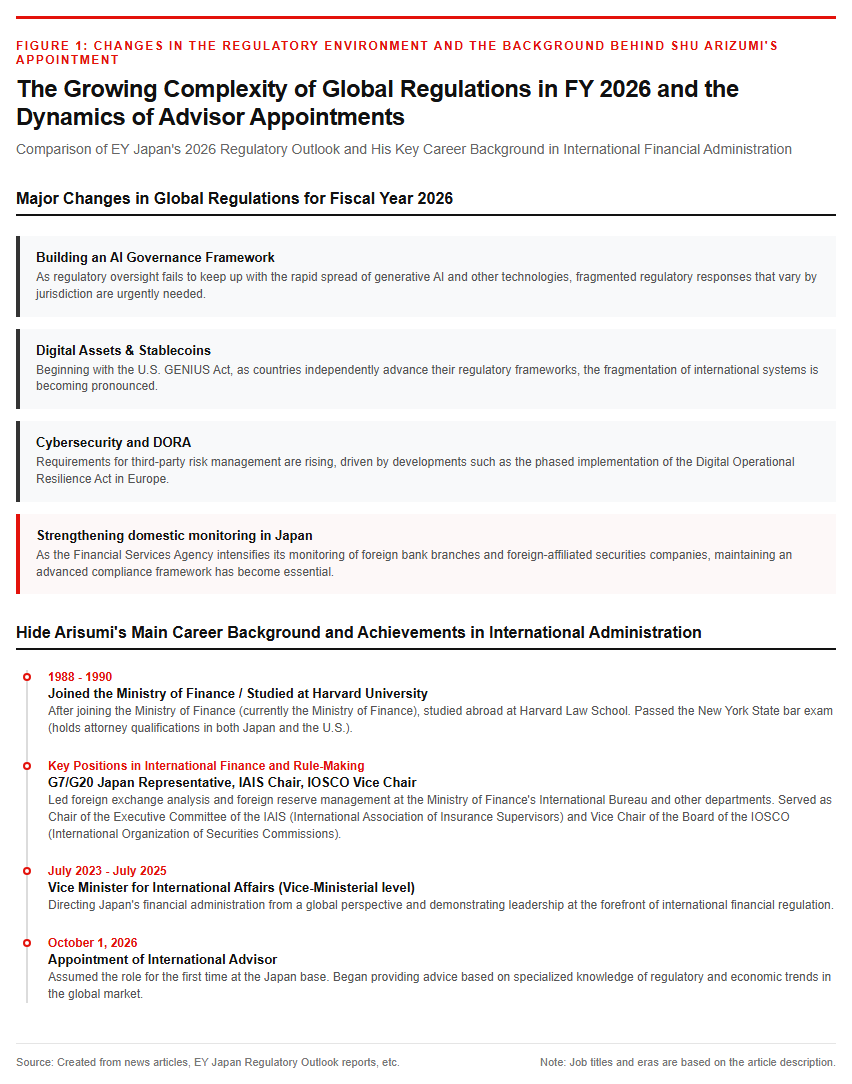
Hidehisa Ariizumi, who recently assumed the position of International Advisor, is a financial and fiscal expert who has held key positions in the Ministry of Finance, the Financial Services Agency, the Fair Trade Commission, the Organisation for Economic Co-operation and Development (OECD), and other organizations since joining the Ministry of Finance (now the Ministry of Finance) in 1988. In 1990, he studied abroad at Harvard Law School, and he passed the New York State bar exam while enrolled. He holds attorney qualifications in both Japan and New York State, USA, and has been serving as a visiting attorney at Mori Hamada & Matsumoto since February 2026.
After serving in the Budget Bureau and the International Bureau, he acted as Japan’s representative at G7 and G20 Vice-Finance-Minister-level meetings, leading foreign exchange market analysis and the management of foreign reserves. Furthermore, he played a central role in international financial regulatory rulemaking, having held positions such as Chair of the Executive Committee of the International Association of Insurance Supervisors (IAIS) and Vice Chair of the Board of the International Organization of Securities Commissions (IOSCO).
From July 2023 until his retirement in July 2025, he served as the Vice Minister for International Affairs at the Financial Services Agency (FSA)—a position considered to be at the vice-ministerial level—and directed Japan’s financial administration from a global perspective. He is an individual with unparalleled expertise in both key roles within international organizations and domestic administration.
The Regulatory Environment Facing Financial Markets and the Objectives of the Appointment
Changes in Global Regulations for Fiscal Year 2026
The global financial services market in 2026 is facing significant complexity as regulatory localization advances due to differing policy priorities across countries and regions. According to the 2026 regulatory outlook report published by EY Japan, regulators’ oversight systems in the global financial industry are struggling to keep pace with the rapid adoption of artificial intelligence (AI), making the establishment of distinct AI governance frameworks across various jurisdictions an urgent necessity. Furthermore, led by the enactment of the GENIUS Act in the United States, legislative frameworks concerning stablecoins and digital assets are being developed independently across nations, resulting in prominent regulatory fragmentation.
Furthermore, as typified by the phased implementation of the Digital Operational Resilience Act (DORA) in Europe, required standards for cybersecurity and third-party risk management are also rising. Within Japan, the Financial Services Agency (FSA) is stepping up its monitoring of foreign bank branches and foreign-affiliated securities companies, making the maintenance of advanced risk management and compliance frameworks an essential challenge. Please refer to the diagram below illustrating these structural changes.
Insights and Strategies Demanded by Major U.S. Investment Banks
Amid this complex regulatory environment, the decision by major U.S. investment bank Goldman Sachs to bring in Mr. Ariizumi reflects a sophisticated strategic judgment to navigate the changing international order. Founded in 1869, Goldman Sachs has expanded its operations in the Japanese market since opening its Tokyo representative office in 1974, serving as its second overseas base outside the United States and its first in Asia. Today, amid mounting geopolitical risks and advancing corporate governance reforms in Japan, responding to changing environments in cross-border M&A, fundraising, and asset management operations has become an urgent priority.
Financial institutions are required not merely to comply with domestic laws, but also to possess a high degree of coordination skills to ensure alignment between the global policies of their U.S. headquarters and Japan’s financial regulatory administration. Mr. Ariizumi’s deep insight into the global macroeconomy, alongside his knowledge regarding the formulation history of international financial regulations and the practical aspects of domestic regulatory administration, will serve as a powerful weapon in solving the complex challenges faced by the company’s management and clients. He is expected to enhance the precision of business strategies through multifaceted advice.
The International Financial Community and the Outlook for the Japanese Market
Enhancing the Presence of the Japanese Market and the Direction of Public-Private Partnerships
Mr. Ariizumi’s appointment as an international advisor is not merely a personnel decision by a single financial institution, but holds great significance in elevating the presence of Japan’s financial market as a whole. To achieve the realization of an “asset management nation,” the Japanese government is actively promoting the attraction of investment from both domestic and international sources and enhancing the appeal of its financial and capital markets. The appointment of an individual who has served in key positions at the Financial Services Agency (FSA) and international roles such as Vice Chair of IOSCO as an advisor to a major foreign financial institution will serve as a vital conduit to accurately communicate Japan’s policy objectives and current market conditions to global investors.
In his comments upon assuming the position, Mr. Ariizumi himself stated that he aims to leverage his experience to add value to Goldman Sachs while enhancing the international presence of Japan’s financial sector and further strengthening its ties with the international financial community. The integration of the policy expertise cultivated in the public sector with the financial business of the private sector will enable sophisticated information dissemination and strategy formulation that incorporate perspectives from both the public and private sectors, which is expected to contribute to the maturation of Japan’s capital markets.
Future Focus and Key Points in Cross-Border Finance
The focus moving forward is on how global financial institutions can establish sustainable business models as regulatory localization progresses across major countries. With the U.S. advancing growth-prioritized deregulation, Europe emphasizing operational resilience, and the Asia-Pacific region promoting fintech and innovation, there is a need for systems capable of swiftly adapting to these varying regional regulatory approaches.
Particularly in areas such as AI governance, the handling of digital assets, and anti-money laundering and counter-terrorist financing (AML/CFT) measures, an approach that goes beyond mere rule compliance to balance practical business promotion with advanced risk management is valued. By leveraging advice from advisors like Mr. Ariizumi, who know the front lines of international administration, Goldman Sachs is expected to strengthen its client advisory capabilities in a rapidly changing market environment. As a bridge connecting the Japanese and global financial communities, significant attention is focused on his future activities and their impact.
Reference Page
- [Goldman Sachs Press Release] https://www.goldmansachs.com/japan/media-relations/press-releases/goldman-sachs-announces-shigeru-ariizumi-as-intl-advisor
- [Financial Services Agency Press Release] https://www.fsa.go.jp/inter/ios/20240528/20240528.html
- [Mori Hamada & Matsumoto Notice] https://www.morihamada.com/ja/notices/146876
- [EY Japan Insights]https://www.ey.com/ja_jp/insights/financial-services/four-regulatory-shifts-financial-firms-must-watch-in-2026
【#GoldmanSachs #ShuAriizumi #FinancialServicesAgency #FinancialRegulation #InternationalFinance】

コメント