On October 6, 2026, the Ministry of Land, Infrastructure, Transport and Tourism released the results of its internal investigation surrounding remarks by Minister of Agriculture, Forestry and Fisheries Kazuo Yana regarding a budget cut for local municipal roads. While it was revealed that Yana made inquiries regarding the allocation prior to the budget’s enactment, the ministry denied any undue political influence or pressure on the allocation decisions.
- Key Points of the Incident and the Fact of Contact Disclosed by the Ministry of Land, Infrastructure, Transport and Tourism
- Basis for Budget Allocation Calculation and Discrepancies in Figures
- Daily Explanations Leading to Retraction and Prime Minister Takaichi’s Response
- Doubts about the involvement of bureaucrats and politicians
- Lack of Openness and Transparency and Stagnation of Diet Deliberations
- Future Outlook and Key Points
Key Points of the Incident and the Fact of Contact Disclosed by the Ministry of Land, Infrastructure, Transport and Tourism
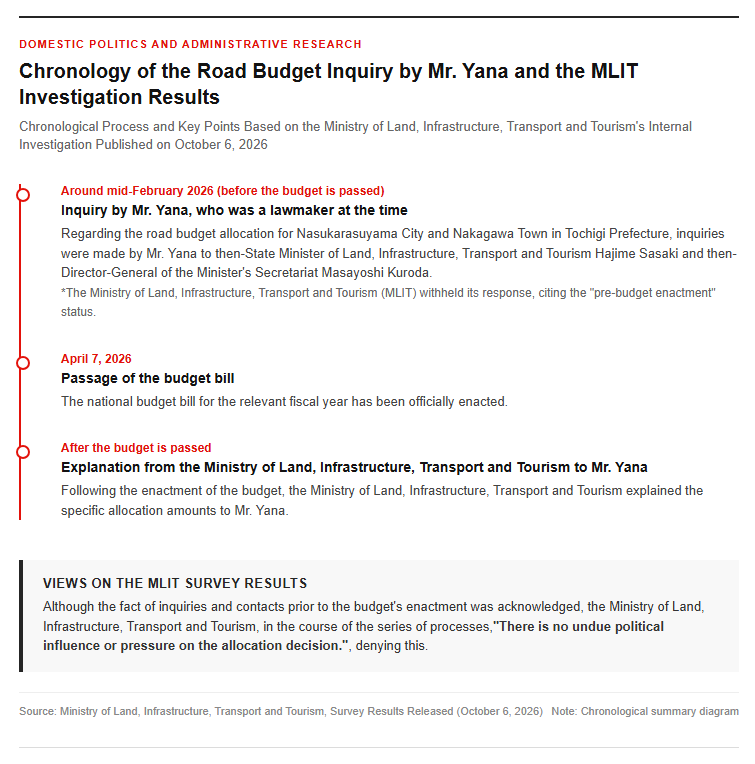
On October 6, 2026, the Ministry of Land, Infrastructure, Transport and Tourism (MLIT) released the results of its internal fact-finding investigation regarding remarks made by Minister of Agriculture, Forestry and Fisheries Kazuo Yana at a Liberal Democratic Party (LDP) branch meeting, in which he claimed to have cut the road budget for local municipalities. According to the disclosed timeline, around mid-February before the passage of the fiscal 2026 budget bill, Yana—who was a lawmaker at the time—made inquiries to then-State Minister of Land, Infrastructure, Transport and Tourism Norisuke Sasaki and then-Director-General of the Minister’s Secretariat Masayoshi Kuroda regarding the road budget allocation for Nasukarasuyama City and Nakagawa Town in Tochigi Prefecture. The ministry stated that it withheld its response at the time on the grounds that the budget had not yet been enacted, and later explained the specific allocation amounts to Yana after the budget passed on April 7. The summary diagram below illustrates this sequence of events.
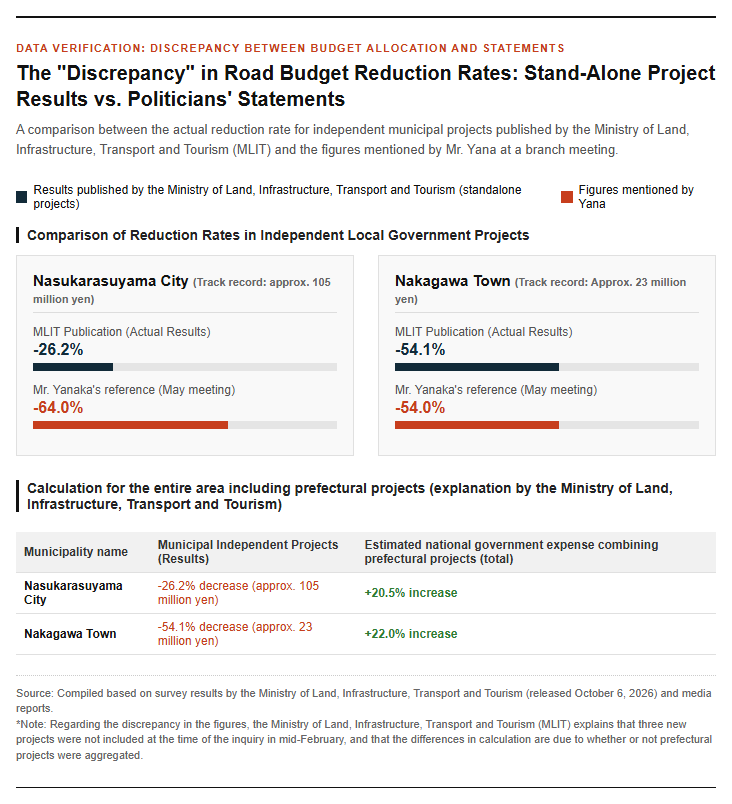
Looking at the actual budget allocation amounts, for independent projects implemented by municipalities, Nasukarasuyama City decreased by 26.2 percent from the previous year to approximately 105 million yen, and Nakagawa Town decreased by 54.1 percent from the previous year to approximately 23 million yen. The Ministry of Land, Infrastructure, Transport and Tourism has denied the existence of any lobbying or undue pressure from Mr. Yana’s side, explaining that the allocation amounts were fairly calculated based on local requests and project progress.
- Revelation that an allocation inquiry was made by Mr. Yana to senior Ministry of Land, Infrastructure, Transport and Tourism officials in mid-February
- Following the passage of the budget in April, the Ministry of Land, Infrastructure, Transport and Tourism (MLIT) presented the actual figures to Mr. Yana.
- the actual allocation figures of a 26.2 percent decrease for Nasukarasuyama City and a 54.1 percent decrease for Nakagawa Town
Basis for Budget Allocation Calculation and Discrepancies in Figures
According to the allocation policy presented by the Ministry of Land, Infrastructure, Transport and Tourism (MLIT), it is explained that the allocation of grants for comprehensive social infrastructure development is calculated by comprehensively adjusting requests from each local government, the progress of construction work, and the presence or absence of priority allocation targets within limited financial resources. The survey results have revealed that a discrepancy exists between the reduction rates mentioned by Mr. Yana at the Liberal Democratic Party branch general meeting on May 24 (a 64% reduction for Nasukarasuyama City and a 54% reduction for Nakagawa Town) and the figures presented by the MLIT (a 26.2% reduction for Nasukarasuyama City).
As the background behind this discrepancy, the Ministry has explained the difference in calculations by citing the following two points.
- the fact that, at the time of the inquiry in mid-February, the information was organized based on the previous fiscal year’s results, and therefore did not include the three newly listed businesses
- the calculation results varying depending on whether only standalone municipal projects are extracted or if prefectural projects implemented by Tochigi Prefecture within the same area are included
When calculated based on the estimated national funding for the entire area, including prefectural projects, it represents a 20.5 percent increase in Nasukarasuyama City and a 22.0 percent increase in Nakagawa Town, showing an upward trend overall. Even among municipalities nationwide, cases where funding was reduced to less than 50 percent of the previous year’s level account for about 10 percent of the total, and the ministry is emphasizing the legitimacy of the allocation process.
Agriculture Minister Yana’s Explanation and the Unnaturalness Seen in the Timeline
Daily Explanations Leading to Retraction and Prime Minister Takaichi’s Response
At a Liberal Democratic Party (LDP) branch meeting on May 24, 2026, Agriculture Minister Yana remarked—with local municipal heads who did not support him in the February House of Representatives election in mind—that honest people do not get ahead, and stated that he had drastically cut the road budget. When the issue surfaced in a weekly magazine report at the end of September, he repeatedly refrained from answering at post-Cabinet press conferences on October 1 and on the morning of October 2, but at a press conference on the evening of the same day, he acknowledged that he had made inquiries to the Ministry of Land, Infrastructure, Transport and Tourism (MLIT). Later, on October 5, he retracted and apologized for the remarks, saying they were inappropriate; however, he has consistently denied lobbying for budget cuts. The following diagram illustrates the process of contact between politicians and the administration.
In response to this situation, Prime Minister Sanae Takaichi stated in the plenary sessions of both houses of the Diet on October 8 that Agriculture Minister Yana’s remarks were inappropriate and that she had issued a severe reprimand. However, she refused to dismiss the minister, asking him instead to fulfill his duty to explain the matter thoroughly, straighten up his act, and fully discharge his responsibilities, thereby rejecting calls for his dismissal by urging him to make amends through his work. Amidst the minister’s remarks implying that budget allocations might be influenced by the presence or absence of political support, growing calls from both the ruling and opposition parties are demanding that he be held morally responsible.
- The day-by-day process of shifting explanations, from the remarks on May 24 to the retraction and apology on October 5
- The consistent stance of denying pressure or undue lobbying on the Ministry of Land, Infrastructure, Transport and Tourism
- Prime Minister Takaichi’s Warning and Announcement of Intention to Remain in Office
Doubts about the involvement of bureaucrats and politicians
Although the investigation report by the Ministry of Land, Infrastructure, Transport and Tourism concluded that no evidence of pressure or lobbying was found, questions have been raised regarding its investigative methods and rationale. In response to interviews by the ministry, Masayoshi Kuroda, who served as Director-General of the Minister’s Secretariat at the time and handled the matter, stated that he could not remember clearly because no detailed notes remained, but because his recollection was vague to that extent, he believed there had been no strong pressure or lobbying. Criticism has been leveled against the current state of administrative operations—where official documents and records of meetings are neither created nor preserved when budget inquiries are received from influential lawmakers or executives of the ruling party—pointing to a remarkably low level of verifiability.
Furthermore, skepticism has been raised over the fact that senior ministry officials, such as the State Minister and the Director-General of the Secretariat, visited the Diet members’ office buildings to respond to individual inquiries before the budget’s passage in mid-February, as well as the point that while Agriculture Minister Yana explained the reason for these inquiries was to accommodate local requests, he claimed he did not remember the specific exchanges. Public distrust in politics is deepening regarding the attitude of attempting to bring the matter to a close without objective evidence as to how political influence operated in the public budget decision-making process.
- The Reality of Administrative Document Management Lacking Detailed Notes and Interview Records
- Lack of Objectivity in Denying Pressure Based on Testimony of “Not Remembering”
- The nature of political contacts in which senior ministry officials responded to inquiries at the Diet Members’ Office buildings before the budget was enacted
The Impact of Alleged Profiteering and Future Points of Discussion
Lack of Openness and Transparency and Stagnation of Diet Deliberations
Regarding this issue, the opposition parties have strongly protested, suspecting that public funds were misappropriated as tools for political grudges and election campaigning. In meetings such as the House of Councillors Diet Affairs Committee Chairpersons’ meeting, the opposition parties have adopted a stance of refusing to participate in parliamentary deliberations, including the Committee on Agriculture, Forestry and Fisheries, unless Agriculture Minister Yana fulfills his accountability with a satisfactory explanation. In the House of Councillors, the submission of a censure resolution is also being considered, and the confrontation between the ruling and opposition parties has escalated into a situation where parliamentary deliberations are stalling.
Furthermore, regarding Agriculture Minister Yana, controversy has arisen not only over his remarks about budget cuts, but also over the issue of providing free shuttle bus transportation for attendees at his campaign kickoff rally on the official announcement day of the House of Representatives election, with critics pointing out that it may constitute illegal vote-buying or the provision of benefits prohibited by the Public Offices Election Act. In Diet debates, thorough scrutiny is being applied not merely to a personal slip of the tongue, but to the structural pathology of politicians exerting undue influence over bureaucratic organizations to secure benefits for their home districts, as well as the precarious nature of the political-bureaucratic relationship in which bureaucrats, with personnel authority firmly in the hands of politicians, cannot stand up to them.
- Moves by opposition parties to boycott deliberations in the Committee on Agriculture, Forestry and Fisheries and submit a censure resolution
- Spreading suspicions of Public Offices Election Act violations, such as free bus transportation for the rally kick-off event
- Intensifying criticism of politician-bureaucrat collusion and pork-barrel structures resulting from political leadership
Future Outlook and Key Points
This issue has reached a critical juncture where the transparency and fairness of Japan’s budget-making process are being called into question. The biggest point of focus moving forward will be how the ruling government and coalition parties respond to the opposition’s demands for an all-ministry investigation into budget allocations, and to what extent the reality of opaque political-bureaucratic contacts will be clarified through parliamentary deliberations. Prime Minister Takaichi has indicated a policy of not conducting individual investigations, but third-party verification and strict record management are essential to restore public trust in fair budget execution free from political bias.
Furthermore, whether institutional reforms will be implemented—such as revisions to the administrative document management guidelines set by the Cabinet Office and the mandatory creation and publication of records concerning interventions by politicians in ministries and agencies—will also be a focal point. To prevent political-led governance from leaning toward mere personal appropriation or electoral retaliation, whether a system for allocating infrastructure budgets based on fair criteria can be rebuilt will be a critically important issue in future Japanese politics.
- Clarification of Political-Bureaucratic Contacts in the Diet and Responses to Opposition Demands for Investigation
- Institutional reforms such as the obligation to create and publish records of lobbying efforts by politicians
- Restructuring of Fair and Transparent Budget Allocation Rules and Restoration of Public Trust
Reference page
- [Summary of Minister Ibayashi’s Press Conference – Ministry of Land, Infrastructure, Transport and Tourism] https://www.mlit.go.jp/report/interview/daijin261002.html
【#MLIT #KazuoYana #RoadBudget #PoliticsAndBureaucrats #BudgetAllocation #PorkBarrel】


コメント