A survey has revealed that the number of individual applications for the “10-Billion-Yen Declaration Companies” promoted by the Ministry of Economy, Trade and Industry and the Small and Medium Enterprise Agency has reached 3,050, with 35 companies already achieving sales of 10 billion yen. Behind this lies a strong trend among the government and companies—amid rising prices and labor shortages—to shift away from conventional SME policies and aim for dramatic business expansion through large-scale capital investment and wage increases.
- Key points of the event: Surpassing 3,050 standalone applications and the current status of companies reaching 10 billion yen in sales
- Attribute Analysis of Declaring Companies: The Rise of Young Executives in Their 30s and Regional Expansion
- Structure of the Subsidy Program: Up to 500 Million Yen in Support and Rigorous Selection Criteria
- Growth Rate and Investment Appetite: Growth Plans Averaging Over 30% Among Selected Companies
- Management Risks and Governance: Subsidy Repayment for Non-Achievement and Countermeasures Against Unscrupulous Consultants
- Future Developments and Key Points: Open Innovation and Soaring into the Global Market
Key points of the event: Surpassing 3,050 standalone applications and the current status of companies reaching 10 billion yen in sales
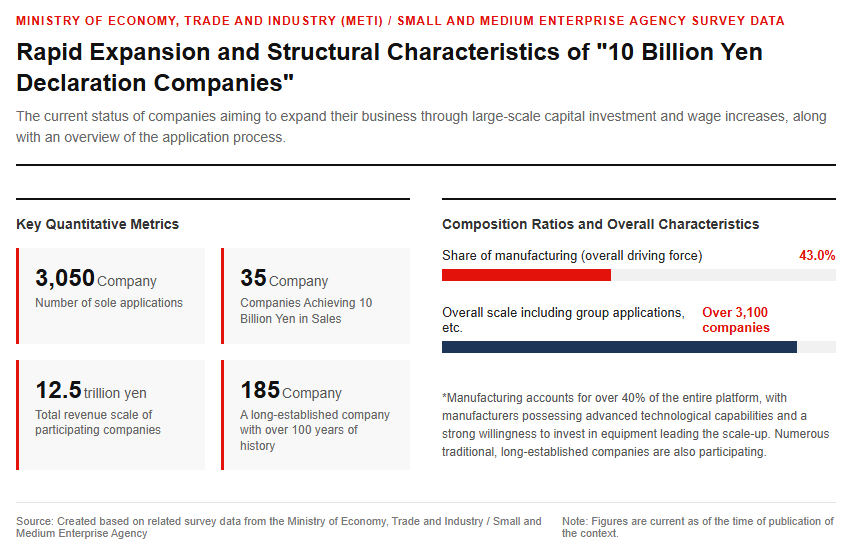
According to a trend survey on the “Companies Declaring 10 Billion Yen in Sales” promoted by the Ministry of Economy, Trade and Industry (METI), it has been revealed that the number of companies applying individually has reached 3,050, of which 35 have already surpassed the 10-billion-yen sales milestone. The number of declared companies, which stood at around 300 when the program was first launched, has grown rapidly alongside a rise in nationwide recognition. Totaling over 3,100 companies when including group applications and other categories, the combined sales of participating companies have expanded to a scale of 12.5 trillion yen.
A breakdown of the committed companies by industry shows that manufacturing companies account for 43.0% of the total, highlighting the reality that makers with high technological capabilities and a strong appetite for capital investment are leading the trend. Furthermore, the list includes 185 long-standing companies with a history of over 100 years, suggesting that traditional small and medium-sized enterprises (SMEs) are not resting on the scale of their existing businesses, but are tackling large-scale scale-ups in pursuit of a higher level of renewed growth. The figure below illustrates the expansion trends of committed companies and the breakdown of major industries.
If these declaring companies achieve steady growth, estimates suggest that new demand rippling through regional economies and the entire supply chain will exceed 10 trillion yen, and expectations are growing that they will serve as a powerful driving force to create a virtuous cycle in the Japanese economy.
Attribute Analysis of Declaring Companies: The Rise of Young Executives in Their 30s and Regional Expansion
According to an analytical survey by Teikoku Databank, notable characteristics can be seen in the attributes of companies that have issued the “10-billion-yen declaration” in terms of industry, region, and the age of top executives. By industry composition, manufacturing is the most common at 40.2%, followed by wholesale at 16.7%, services at 13.1%, and construction at 11.4%. Looking at the number of companies by prefecture, major metropolitan areas occupy the top spots with 186 companies in Tokyo, 134 in Osaka Prefecture, and 117 in Aichi Prefecture. However, in terms of the declaration rate relative to the number of eligible companies within each region, Tottori Prefecture ranks highest nationwide at 3.12%, followed by Kumamoto Prefecture at 2.62% and Nara Prefecture at 2.60%, highlighting the high level of ambition in regional areas.
Focusing on the age distribution of business owners, those in their 50s account for 32.9% and those in their 40s for 27.3%, forming the core of the working-age generation. However, the highest declaration rate was seen among those aged 30 and under at 2.94%. This is more than double the overall average of 1.40%, indicating that young CEOs are taking on the challenge of scaling their companies into 10-billion-yen enterprises at a high rate of 1 in 34 companies.
By number of employees, companies with 50 to under 300 employees account for approximately 65% of the total, making it clear that businesses with a solid organizational base and financial capacity are mapping out a path for rapid growth. Additionally, an increasing number of cases are led by successor executives following business succession, who are working to renew management structures and expand into new businesses.
How the Growth Acceleration Subsidy Works and Growth Scenarios for Selected Companies
Structure of the Subsidy Program: Up to 500 Million Yen in Support and Rigorous Selection Criteria
A powerful catalyst strongly supporting companies aiming for the 10-billion-yen mark is the national government’s “SME Growth Acceleration Subsidy.” Targeting small and medium-sized enterprises with sales of 1 billion yen or more and less than 10 billion yen, this subsidy provides robust support—with a maximum subsidy of 500 million yen (at a 1/2 subsidization rate)—for large-scale capital investments such as the new construction or expansion of factories and logistics facilities, and the introduction of automated equipment. Applications require an investment plan of 100 million yen or more, as well as the setting of a target to increase the total wage payment per employee by an annual average of 4.5% or more over the three years following the completion of the subsidized project.
The screening process for the public offering is extremely rigorous; in addition to an initial document-based screening, a presentation review conducted by the representative director in person is also required. The evaluation assesses multiple facets, going beyond mere equipment installation to include the management’s clear scenario for reaching 10 billion yen in future sales, a precise analysis of the external and internal environments, and the ripple effect on the regional economy.
Acceptance rates in past open calls have been highly competitive, ranging from approximately 3.9 to 6 times, making thorough preliminary preparation and the logical consistency of growth scenarios critical factors in determining success or failure. Proposals heavily reliant on consultants are excluded, and the system is structured to put the business owners’ own commitment and vision to the test.
Growth Rate and Investment Appetite: Growth Plans Averaging Over 30% Among Selected Companies
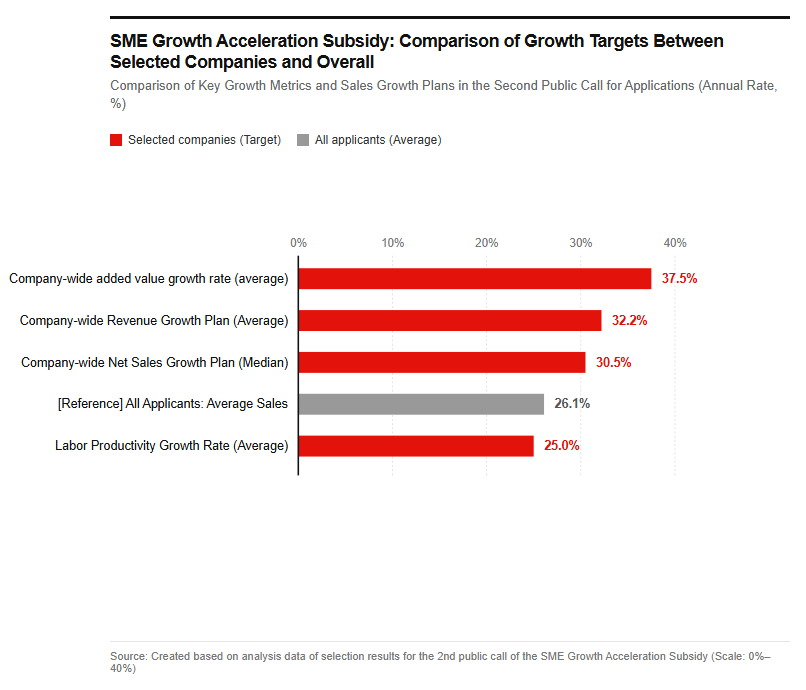
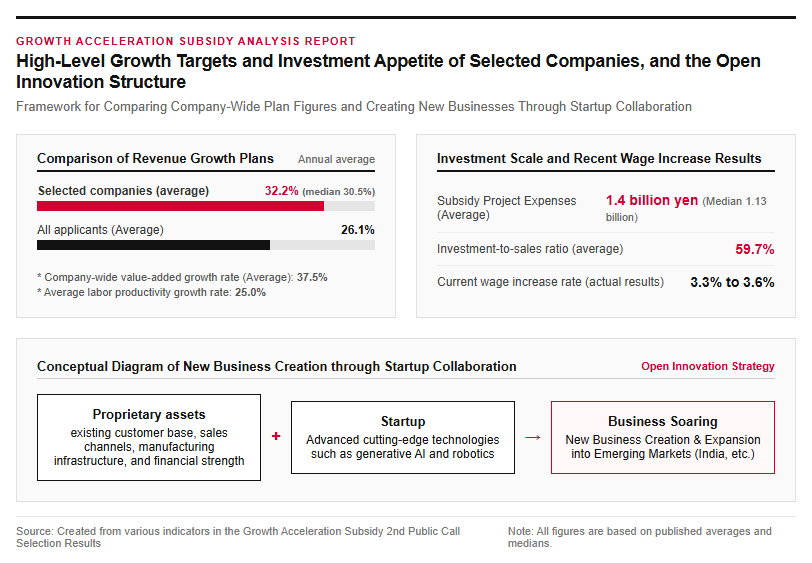
Various indicators from the selection results of the second public call for applications for the Growth Acceleration Subsidy numerically demonstrate the selected companies’ overwhelming drive for growth and aggressive investment stance. The average company-wide sales growth plan among the selected companies reaches an annual 32.2% (with a median of 30.5%), significantly exceeding the overall applicant average of 26.1% per year. The average company-wide value-added increase rate also stands at an annual 37.5%, and the labor productivity growth rate is an annual 25.0%, setting ambitious targets that anticipate a dramatic improvement in earning capacity. The following figure shows the correlation between the sales growth rate and the investment scale of the selected companies.
In terms of investment scale, the average cost required for the subsidized projects as a whole is 1.4 billion yen (with a median of 1.13 billion yen), and the investment ratio relative to company-wide net sales in the latest fiscal period reaches an average of 59.7%. This indicates that they are taking risks commensurate with their revenue scale and embarking on capital investments aimed at discontinuous growth.
Furthermore, wage increases implemented promptly without waiting for the completion of subsidized projects are also highly evaluated in the review process, with selected companies achieving an average current wage increase rate of 3.3% to 3.6%. A virtuous cycle of productivity improvement through investment and sustainable wage increases is at the core of the growth strategy.
Hidden Risks in System Utilization and Medium-to-Long-Term Outlook
Management Risks and Governance: Subsidy Repayment for Non-Achievement and Countermeasures Against Unscrupulous Consultants
While subsidies of up to 500 million yen serve as a powerful means for growth, they also entail significant management risks stemming from the failure to achieve business plans or an insufficient understanding of the system. The granting of subsidies is subject to strict laws such as the Subsidy Optimization Act. If wage-increase requirements or investment plans are not met, there is a risk that the subsidy grant decision may be revoked and the full amount ordered to be returned along with surcharges. If business performance slumps after making substantial capital investments, the increased fixed costs and repayment demands will weigh heavily simultaneously, raising concerns of rapidly deteriorating cash flow.
Furthermore, with the expansion of large-scale subsidies, the involvement of fraudulent subsidy consultants and support providers advertising “virtually zero out-of-pocket costs” or “kickbacks” has become a growing concern. Even if they follow the guidance of such providers, the applicant businesses themselves will bear full legal responsibility. If fraud is identified, they will face severe sanctions—not only orders to return the funds, but also public disclosure of their company names and criminal prosecution.
As companies advance their scale-up efforts, it is essential to build an organizational structure that is not surrounded by yes-men, introduce sound governance from financial institutions and others, and ensure that executives themselves maintain a thorough awareness of compliance.
Future Developments and Key Points: Open Innovation and Soaring into the Global Market
Whether companies that have pledged 10 billion yen can transform into sustainable 10-billion-yen enterprises rather than merely ending up as temporary subsidy users depends on the continuous updating of their growth strategies in response to changes in the external environment. This is because, as population decline and a severe labor shortage continue in the domestic market, there is a limit to maintaining high growth merely as an extension of conventional business operations. Strengthening overseas expansion and open innovation is attracting attention as the key to future breakthroughs.
In particular, expanding exports and entering emerging markets such as India, which are experiencing remarkable population growth and economic growth, serve as an effective means to capture new external demand. Furthermore, in order to keep pace with rapid technological innovations such as generative AI and robotics, there is a growing trend to actively promote partnerships and M&As with startups and research institutions possessing advanced cutting-edge technologies. The following figure is a conceptual diagram of new business creation through startup collaboration.
Governments and regional financial institutions are also moving beyond merely providing subsidies, strengthening hands-on support aimed at expanding executive networks, matching with overseas markets, and embedding human capital management. Future developments will be closely watched to see whether SMEs that have issued the 10-billion-yen declaration can evolve from traditional family-run management into modern organizational management and grow into large enterprises that drive the regional economy.
Reference page
- [“100 Billion Yen Enterprise Growth Portal” Public Call Overview & Briefing Session Materials] https://growth-100-oku.smrj.go.jp/
- [Analysis Survey on “10 Billion Yen Declaration” Companies | Teikoku Databank, Ltd.] https://www.tdb.co.jp/
- 【”10-Billion-Yen Declaration” Companies Exceed 3,000; Continuous Updating of Growth Strategies is Crucial | The Japan Research Institute】https://www.jri.co.jp/
[#100BillionYenDeclaration #SMEGrowthAccelerationSubsidy #TeikokuDatabank #JapanResearchInstitute #GrowthStrategy #SubsidyOptimizationAct #ManagementReform]


コメント