
The Japanese government held the inaugural meeting of an expert panel to review national intelligence functions, taking the first steps toward drafting a national intelligence strategy and fundamentally bolstering its command structure. The move is driven by heightened alarm over an increasingly severe national security landscape and the risk of technology leaks in critical economic sectors.
- Key Developments: Launch of the Advisory Panel on Intelligence Capabilities
- Panel Composition and Key Deliberation Agendas
- The Security Clearance Framework and Economic Security Legislation
- Practical Effects on Supply Chains and Small-to-Medium Enterprises
- The Creation of the NIB and NIC: Strengthening Intelligence Command
- Future Outlook: Anti-Espionage Legislation and Foreign Intelligence Capabilities
Key Developments: Launch of the Advisory Panel on Intelligence Capabilities
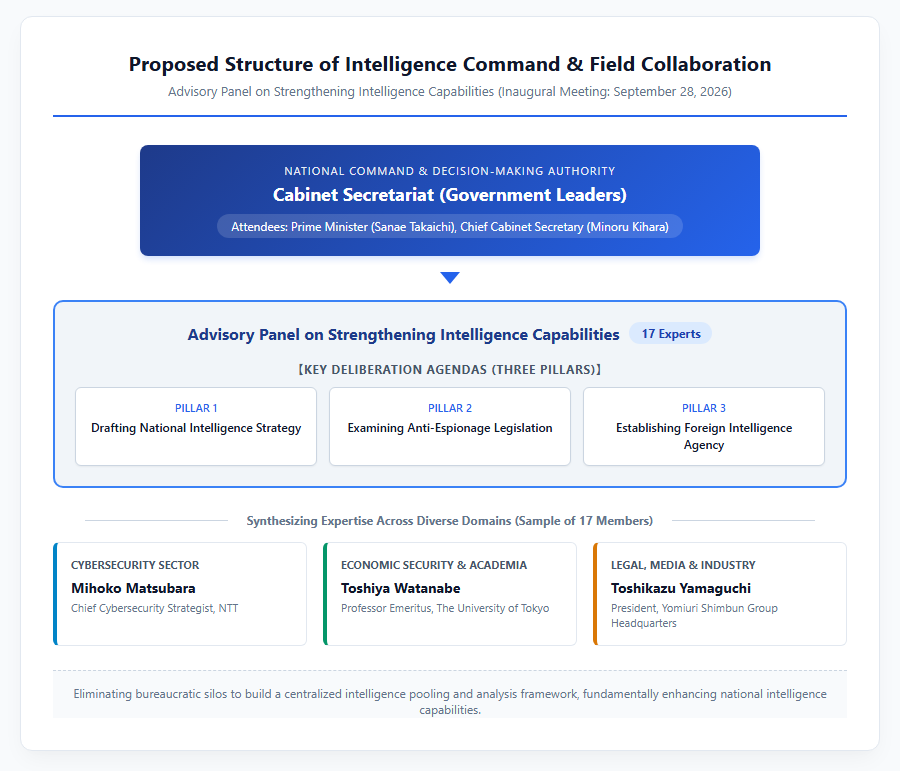
On September 25, 2026, the Japanese government announced the establishment of the “Advisory Panel on Strengthening Intelligence Capabilities” to fundamentally overhaul how the nation collects and analyzes information, holding its first meeting on September 28. The panel comprises 17 experts spanning diverse fields, including cybersecurity, judicial affairs, and economic security. High-level officials, including Prime Minister Sanae Takaichi and Chief Cabinet Secretary Minoru Kihara, attended the session, signaling a strong commitment led by the Prime Minister’s Office to fortify national intelligence functions. Today’s national security environment extends far beyond conventional military threats, encompassing rapidly escalating risks such as cyberattacks on critical infrastructure and the illicit outflow of advanced technology. Addressing these complex challenges rapidly and comprehensively requires a unified intelligence framework that breaks down traditional bureaucratic silos. The panel is slated to hold concrete deliberations on drafting the “National Intelligence Strategy (provisional name),” which will serve as the government’s first comprehensive guideline for state intelligence activities. Discussions will also cover new anti-espionage legislation to counter foreign influence and illicit interference, as well as the potential creation of a dedicated foreign intelligence agency. The diagram below illustrates the proposed structure uniting central command and specialized fields.
This inaugural session represents a potential historic turning point for Japan’s national security posture.
Panel Composition and Key Deliberation Agendas
The newly formed expert panel brings together distinguished figures from academia, industry, and the media. Notable members among the 17 experts include Professor Emeritus Toshiya Watanabe of the University of Tokyo, NTT Chief Cybersecurity Strategist Mihoko Matsubara, and Yomiuri Shimbun Group Headquarters President Toshikazu Yamaguchi. By involving practitioners and scholars on the front lines of cyber defense and economic security, the government aims to generate highly actionable recommendations rather than theoretical proposals. The panel’s agenda rests on three primary pillars. The first is defining the core direction for the “National Intelligence Strategy,” laying out foundational principles and strategic priorities for state intelligence. The second is a thorough examination of anti-espionage legislation designed to thwart unauthorized information acquisition and influence operations by foreign intelligence entities. The third is detailing the organizational structure and operational scope of a prospective “Foreign Intelligence Agency (provisional name)” tasked with human intelligence (HUMINT) gathering abroad. Japan’s intelligence community has historically been fragmented across the Cabinet Intelligence and Research Office, the Ministry of Foreign Affairs, the Ministry of Defense, the National Police Agency, and the Public Security Intelligence Agency, creating chronic hurdles to centralized data pooling and real-time sharing. The panel will focus on dismantling these departmental barriers to elevate Japan’s overall intelligence capabilities to a level on par with other major G7 nations.
Economic Security and Structural Impact on Private Industry
The Security Clearance Framework and Economic Security Legislation
Running parallel to discussions on intelligence reforms, the implementation of a security clearance system under the “Act on the Protection and Utilization of Significant Economic Security Information” is having a direct impact on the private sector. Enacted in May 2024, the law officially took effect on May 16, 2025. While Japan’s secret protection frameworks were previously confined to traditional defense and diplomatic realms under the Act on the Protection of Specially Designated Secrets, the new legal framework expands coverage to core commercial activities, including supply chains, essential infrastructure, and cutting-edge technologies. “Significant Economic Security Information” refers to sensitive data whose leakage could impair national security, encompassing cyber threat metrics, vulnerability reports, critical infrastructure protections, supply chain bottlenecks, and advanced R&D data. Under the system, the government conducts background evaluations to grant security clearances, preventing leaks of confidential information while enabling secure information sharing with vetted enterprises and personnel. This framework allows Japanese firms to participate seamlessly in international joint research and procurement projects with G7 and like-minded partner nations, mitigating the risk of exclusion from global industrial competition.
Practical Effects on Supply Chains and Small-to-Medium Enterprises
The rollout of the security clearance system represents a strategic turning point not only for prime contractors but also for small- and medium-sized enterprises (SMEs) supporting lower tiers of the supply chain. Companies operating in 15 designated critical infrastructure industries—such as electricity, telecommunications, finance, and transportation—as well as those handling specified critical materials like semiconductors, storage batteries, and machine tools, face strict information security mandates as procurement preconditions. SMEs lacking the capacity to establish compliant security protocols face the risk of being phased out of supply chains, regardless of long-standing commercial relationships. Conversely, firms that upgrade physical access controls, enhance cybersecurity measures, and secure government vetting can gain a competitive passport to public sector procurement, defense contracts, and international co-development ventures. The diagram below details the required information management protocols and their role within supply chain relationships.
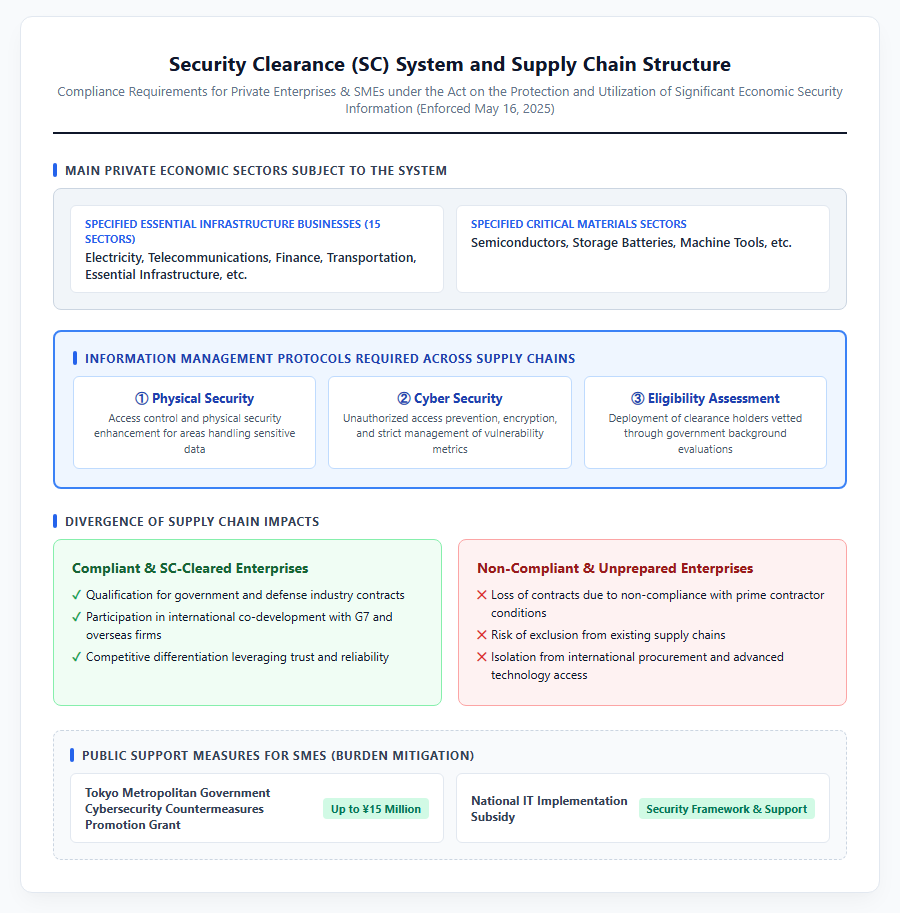
To alleviate compliance costs for smaller firms, public support programs are available, including the Tokyo Metropolitan Government’s “Cybersecurity Countermeasures Promotion Grant” (up to 15 million yen) and national “IT Implementation Subsidies.” Business leaders are encouraged to view these measures not merely as compliance burdens, but as a strategic growth opportunity to build trust and expand market reach.
Establishing Central Command and Future Outlook
The Creation of the NIB and NIC: Strengthening Intelligence Command
The Japanese government is accelerating organizational reforms to centralize information flows and enable swift strategic decision-making. On May 27, 2026, the “Act Establishing the National Intelligence Council” passed the House of Councillors, leading to the official launch of the National Intelligence Bureau (NIB) on July 31, 2026, as the central command hub. Formed by upgrading and restructuring the former Cabinet Intelligence and Research Office, the NIB is a 730-person organization headed by Kazuya Hara, a veteran from the National Police Agency, as its inaugural Director. Holding parliamentary vice-ministerial rank, the Director of the NIB stands on equal footing with the Director-General of the National Security Secretariat (NSS), operating directly under the Prime Minister and Chief Cabinet Secretary. On the same day, the National Intelligence Council (NIC), chaired by the Prime Minister and composed of key cabinet ministers, held its inaugural meeting. The NIB holds comprehensive coordination authority over the information collection activities of individual ministries, serving as the central executive secretariat to pool and analyze intelligence on counter-espionage and national security. This structure is expected to significantly overcome long-standing bureaucratic tendencies where individual ministries hoarded information, delaying critical reporting to the Prime Minister’s Office.
Future Outlook: Anti-Espionage Legislation and Foreign Intelligence Capabilities
Moving forward, attention will shift to the legislative and organizational building blocks emerging from the expert panel’s deliberations. By autumn 2026, the government aims to accelerate the drafting of anti-espionage legislation, including a Foreign Agents Registration Act and a Lobbying Disclosure Act to regulate covert influence, public manipulation, and technology theft by foreign actors. Concurrently, policymakers will work on defining the architecture for a “Foreign Intelligence Agency (provisional name)” dedicated to overseas intelligence gathering, alongside specialized training institutes to cultivate cross-agency intelligence analysts. The diagram below illustrates the roadmap for intelligence reform and key areas of deliberation.
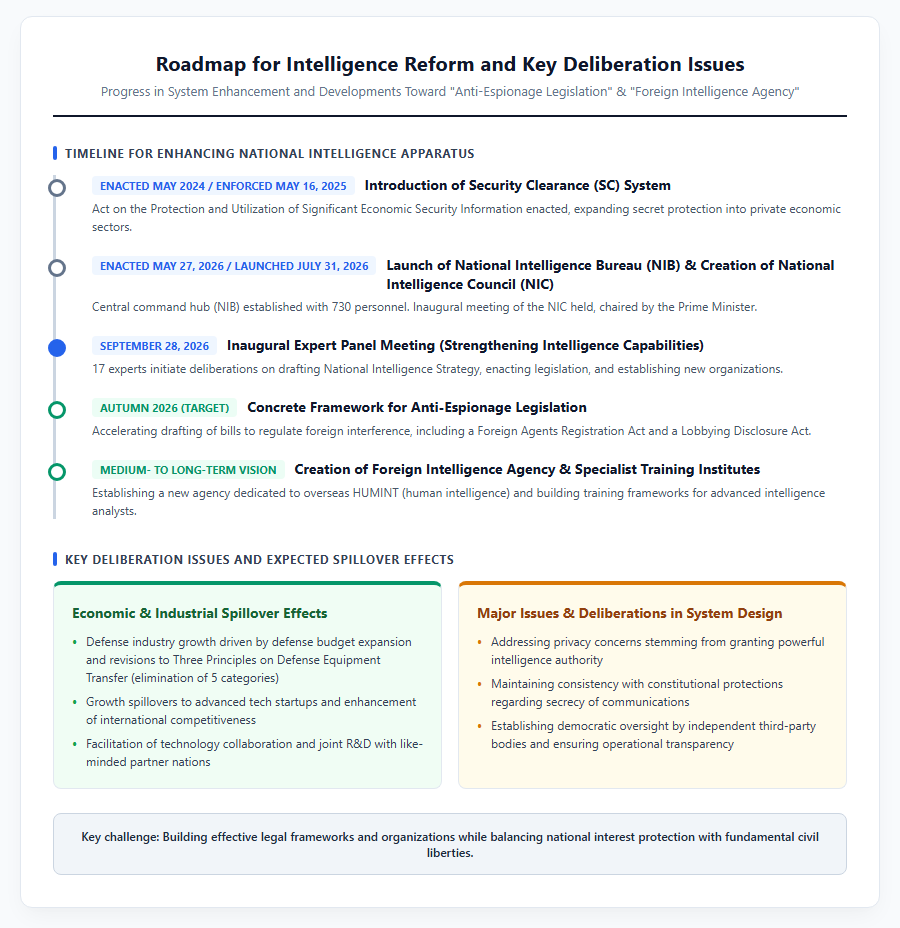
On the economic front, following defense budget expansion and revisions to the operational guidelines of the Three Principles on Transfer of Defense Equipment and Technology (which eliminated the five restricted categories), domestic defense contractors and advanced tech startups are expecting positive spillover growth. Nevertheless, significant policy hurdles remain, including addressing privacy concerns stemming from expanded intelligence powers, safeguarding the constitutional secrecy of communications, and establishing independent democratic oversight mechanisms. Balancing national interest protection with fundamental civil liberties will be crucial to sustaining long-term economic resilience and state security.
Reference Pages
- 【Cabinet Office】Act on the Protection and Utilization of Significant Economic Security Information (Overview & Helpdesk) https://www.cao.go.jp/keizai_anzen_hosho/hogokatsuyou/hogokatsuyou.html
- 【e-Gov Law Search】Act on the Protection and Utilization of Significant Economic Security Information https://laws.e-gov.go.jp/law/506AC0000000027
- 【House of Councillors Research Office】Current Status and Future Trends of the Cabinet Intelligence Apparatus https://www.sangiin.go.jp/japanese/annai/chousa/keizai_prism/backnumber/r08pdf/202625201.pdf
【#Intelligence #NationalIntelligenceCouncil #NationalIntelligenceBureau #SecurityClearance #EconomicSecurity #AntiEspionage #SupplyChain #DefenseIndustry】

コメント