European junk-rated companies are rushing to refinance roughly €3.7 billion in debt ahead of schedule. The movement is driven by growing caution over potential future rate hikes fueled by European Central Bank rate increases and resurgent inflation risks.
- The Scope of the Refinancing Wave and Rapid Shift in Market Sentiment
- Case Studies: Major Issuers and Escalating Borrowing Costs
- Central Bank Tightening and Resurgent Inflation Pressures
- Supply Concentration from M&A Debt and Squeezed Investor Liquidity
- The “90/10 Rule” and Growing Market Bifurcation
- Long-Term Capital Costs and Corporate Strategic Outlook
The Scope of the Refinancing Wave and Rapid Shift in Market Sentiment
In European high-yield (junk-rated) debt markets, companies are accelerating debt refinancing ahead of schedule to lock in terms before borrowing costs rise further. During the week of September 14, 2026, refinancing deals totaling approximately €3.7 billion (around ¥660 billion) were announced in rapid succession. At least seven transactions launched on a single day, making it the most active week for European high-yield issuance since June 2026. While corporations typically begin refinancing 12 to 18 months before debt maturity, companies are now actively retiring and replacing obligations that do not mature for several years. Driving this behavior is intense anxiety over potential Central Bank rate hikes and expanding credit spreads. Companies are actively foregoing the lower coupon payments on existing debt to secure liquidity before yields climb higher. High-profile issuers across diverse sectors—such as auto parts giant ZF Friedrichshafen and gambling software provider Playtech—are participating in this preemptive refinancing rush.
Case Studies: Major Issuers and Escalating Borrowing Costs
Specific issuance details illustrate the dramatic rise in borrowing costs that companies are willing to accept. Lottery and gaming terminal maker Brightstar Lottery kicked off the refinancing wave by replacing 2.375% coupon bonds maturing in April 2028 with new bonds yielding 5.000% maturing in 2032. Similarly, automotive supplier ZF Friedrichshafen issued new 4.5-year notes at a yield of approximately 6.250% to refinance existing debt maturing between mid-2027 and 2028 that carried minimum coupons of just 2.000%. While this nearly triples interest expenses, management deemed it necessary to hedge against further rate increases. Meanwhile, German pharmaceutical manufacturer Grünenthal is evaluating refinancing options for debt maturing as late as 2030. Please refer to the diagram below.
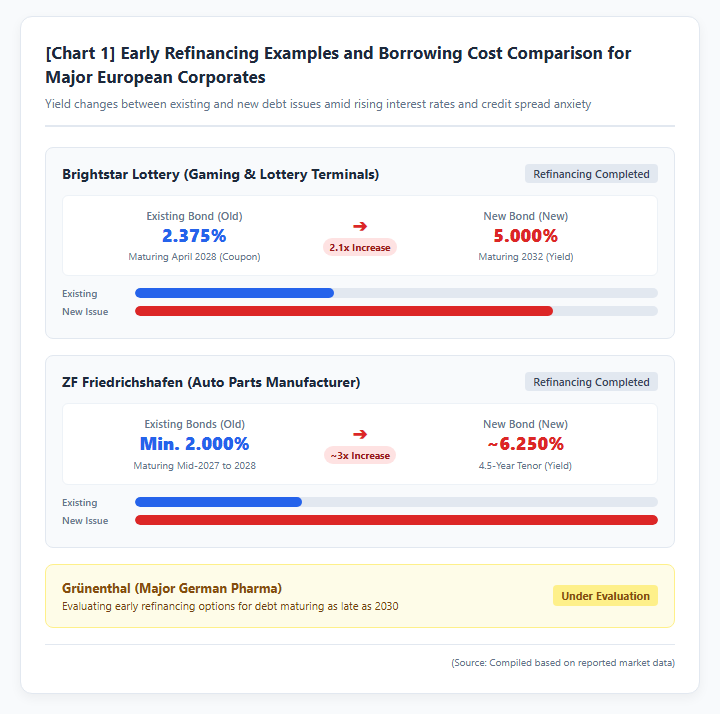
As these examples demonstrate, European corporates are accepting structural, long-term increases in interest expenses to prioritize securing liquidity and extending debt maturities.
Rising Rate Expectations and Macroeconomic Drivers
Central Bank Tightening and Resurgent Inflation Pressures
The primary driver behind corporate willingness to absorb higher borrowing costs is the tightening stance of central banks alongside renewed inflationary pressures. In early September 2026, the European Central Bank (ECB) raised its key deposit facility rate by 25 basis points to 2.500%. This marked the ECB’s second rate hike of 2026, pushing policy rates to the upper bound of the estimated neutral range. Compounding inflation fears, crude oil prices (Brent crude) surged past \$108 per barrel following supply disruptions linked to the closure of a major Saudi pipeline. European natural gas benchmark TTF also jumped above €80 per megawatt-hour. Money markets are now pricing in three additional ECB rate hikes by October 2027, while the US Federal Reserve is widely anticipated to implement its first rate increase in three years. These expectations of persistent high inflation and prolonged upward pressure on interest rates served as the immediate catalyst for the refinancing scramble.
Supply Concentration from M&A Debt and Squeezed Investor Liquidity
Another key structural driver is fear of worsening supply-demand dynamics in the bond market. Heading into late September 2026, a massive wave of new debt linked to major M&A and leveraged buyout (LBO) transactions is scheduled to hit the market. A sudden influx of large-scale new supply threatens to absorb investor liquidity and available capital reserves, leaving less capacity for standard refinancing deals. From an issuer’s perspective, this supply imbalance risks widening credit spreads—the yield premium over government benchmark bonds—and driving required yields even higher. Please refer to the diagram below.
Consequently, companies are scrambling to complete refinancing transactions before M&A-related debt issuance drains market liquidity, creating a competitive race against time.
Structural Shifts and Impacts on Leveraged Finance
The “90/10 Rule” and Growing Market Bifurcation
A distinct bifurcation is opening up within the high-yield bond market based on corporate credit quality and resilience. According to analysis by asset manager PineBridge Investments, the 2026 leveraged finance market is defined by a “90/10 rule.” This framework describes a market divided between approximately 90% of stable, performing issuers and the remaining 10% of highly leveraged credits facing severe restructuring risks and legal complications, such as liability management exercises (LMEs). Credit rating agency Fitch Ratings projects 2026 European default rates at 3.75%–4.25% for high-yield bonds and 3.00%–3.50% for leveraged loans. Sectors like automotive and chemicals face severe headwinds from softening global demand and overcapacity, whereas stable sectors like healthcare and services continue to refinance successfully. While healthy issuers secure capital despite higher rates, the bottom 10% face heightened risk of aggressive restructurings and formal insolvency proceedings.
Long-Term Capital Costs and Corporate Strategic Outlook
This wave of early refinancing is set to leave a lasting mark on corporate financial strategies across Europe. Massive volumes of debt issued at ultra-low coupons during the 2020–2021 pandemic-era monetary stimulus are scheduled to mature between 2027 and 2028. By refinancing early, companies are swapping ~2% coupons for 5%–6% yields, locking in structurally higher interest expenses for years to come. Increased debt service costs will directly erode free cash flow, curtailing capital expenditure (CapEx), research and development (R&D), wage increases, and new M&A activity. For highly leveraged firms, declining interest coverage ratios (ICR) risk triggering credit rating downgrades, creating a vicious cycle of elevated borrowing costs. Operating in a sustained high-rate environment will require European businesses to move beyond simple liquidity management toward comprehensive business portfolio realignments and aggressive cost structure reforms.
Reference Pages
- 【European Leveraged Finance Outlook 2026 – Fitch Ratings】https://www.fitchratings.com/site/re/10329737
- 【Eurostat Government Debt Statistics – Eurostat】https://ec.europa.eu/eurostat/web/products-euro-indicators/w/2-21072026-ap
【#EuropeanEconomy #JunkBonds #DebtRefinancing #ECB #InterestRateHikes #HighYield #CorporateDebt】


コメント