A publisher has announced that it will take a book out of print and recall it after it was found to contain non-existent judicial precedents, having been written using AI search. Behind this lies the generation of false information caused by generative AI hallucinations and inadequate fact-checking protocols for specialized literature.
- The background leading to out-of-print status and recall due to erroneous information
- Lack of Verification Processes in Publishing and Legal Practice
- The Mechanism by Which Generative AI Fabricates Fictitious Legal Precedents
- Domestic and International Dispute Cases in the Judicial and Legal Fields
- Quality Assurance and Fact-Checking in Specialized Document and Book Publishing
- Establishing a Primary Information Verification System and Future Points to Watch
The background leading to out-of-print status and recall due to erroneous information
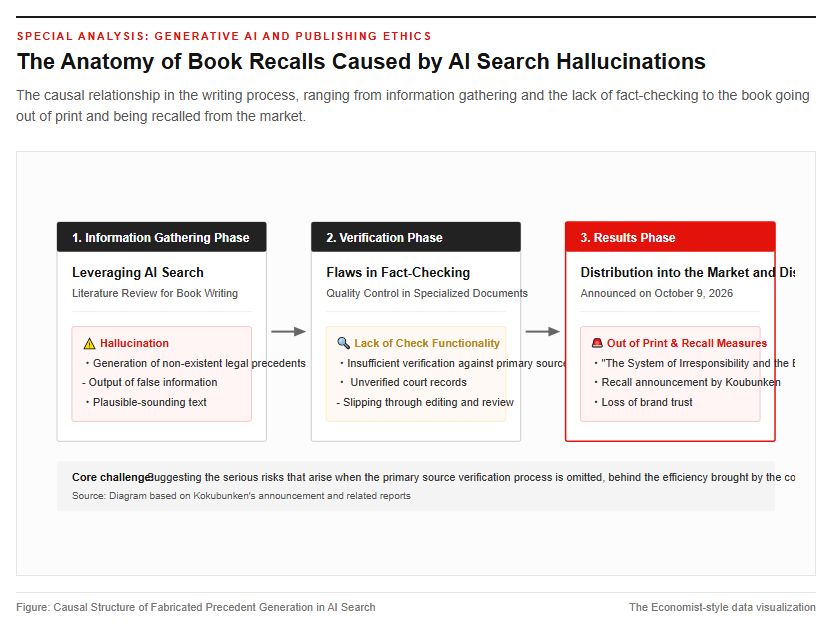
On October 9, 2026, Koubunken, the publisher of the book “The System of Irresponsibility and the Battle of Okinawa” by Professor Jun Shimabukuro of the University of the Ryukyus, announced that it would discontinue publication and recall the book due to significant content errors. This decision was made after it was discovered that a court case cited in the book—which the author searched for using artificial intelligence (AI) during the writing process—was actually a fictitious case that did not exist. Although the use of generative AI for information gathering and literature research has surged in recent years, the direct cause was that the information was reflected in the publication without verifying the authenticity of the presented judicial precedents and cited literature against primary sources. Because once a publication is distributed in the market, revisions and recalls involve massive costs and a loss of brand trust, this incident has become a symbolic example substantiating the concerns surrounding the integration of AI-generated information into specialized books. Please refer to the diagram below for the workflow of information gathering using AI and its risk structure.
Lack of Verification Processes in Publishing and Legal Practice
Behind this recent issue is a lack of fact-checking capabilities in the publishing field and within the editorial process for academic and specialized books. Because generative AI produces text using extremely fluent, natural Japanese and specialized terminology, it has the characteristic of being easily mistaken at first glance for highly reliable literature or legal precedents. Especially in specialized fields like law and history, specific court dates, case numbers, and names of parties are intricately fabricated, meaning that even individuals with professional expertise face a high risk of missing them through visual screening alone. While traditional proofreading has centered on checking for typos, missing characters, and inconsistencies in notation, the introduction of AI makes a primary source cross-referencing mechanism essential to guarantee that “the presented facts themselves actually exist.” It can be said that the editorial department and authors relied on the convenience of AI and failed to check the originals against case law databases or primary sources from public institutions, ultimately causing the serious situation of books being taken out of print and recalled.
The Hallucination Problem and Legal Risks of Generative AI
The Mechanism by Which Generative AI Fabricates Fictitious Legal Precedents
The phenomenon in which generative AI outputs non-existent judicial precedents and literature as if they were the truth is called “hallucination.” Large Language Models (LLMs) are systems that construct text by predicting word occurrence probabilities and statistical connections from vast amounts of text data, and they are not databases that inherently judge the “accuracy of facts.” In particular, AI that has been trained on standardized formats like court rulings and academic papers excels at probabilistically synthesizing “plausible case names” and “statute article numbers” to fit the context. As a result, the AI presents fabricated, non-existent precedents in a confident tone, making it difficult for users to see through the falsehoods. Using AI simply as an advanced search engine without understanding these characteristics of probabilistic generation is the fundamental factor that gives rise to hallucination-related issues.
Domestic and International Dispute Cases in the Judicial and Legal Fields
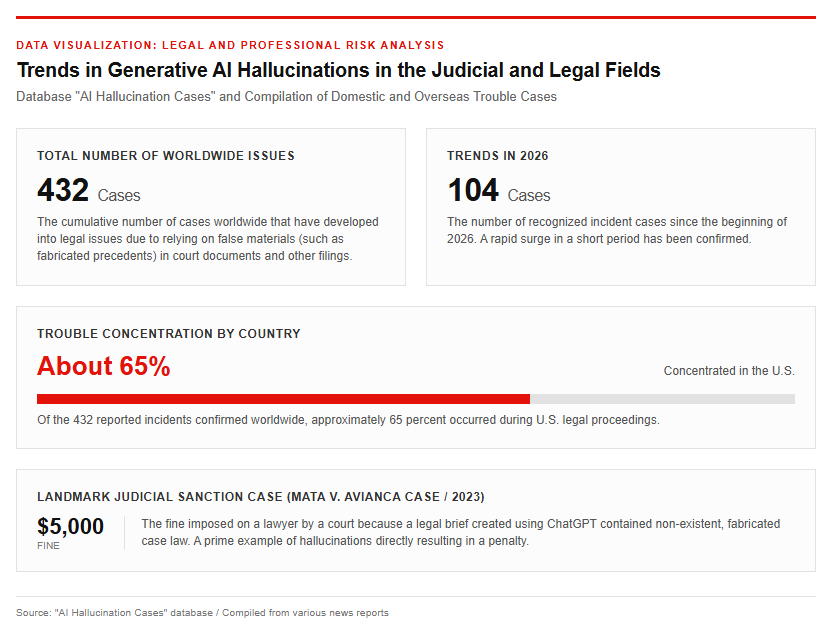
Incidents involving the citation of fabricated judicial precedents by AI are being reported continuously not only in Japan but around the world. In the United States, a 2023 case (Mata v. Avianca) generated significant buzz when a lawyer was fined $5,000 because a court brief prepared using ChatGPT included non-existent, fabricated precedents. According to “AI Hallucination Cases,” a database that compiles instances of parties relying on false materials in court judgments and similar documents, legal cases involving problematic AI use have reached 432 worldwide. Of these, approximately 65 percent are concentrated in the U.S., with 104 such incidents confirmed in 2026 alone. Hallucinations in the judicial sector are more than mere clerical errors; they undermine the fairness of judicial proceedings and directly lead to severe penalties, including the suspension of law licenses, disciplinary actions, and the recall of publications.
Challenges of AI Adoption in the Publishing Industry and Ensuring Reliability
Quality Assurance and Fact-Checking in Specialized Document and Book Publishing
While the publishing industry is increasingly adopting generative AI for planning, writing, proofreading, and other tasks, the difficulty of quality assurance remains the biggest barrier. Compared to industries like newspapers and advertising, book publications entail extremely large physical and financial losses once printed and distributed, such as recalls from storefronts and going out of print. When utilizing AI in editorial departments, it is essential to establish a clear division of labor: using AI during the drafting stages—such as for text summarization and standardizing notations—while humans take responsibility for fact-checking. Please refer to the figure below regarding the arrangement of verification processes in publishing and legal operations.
. Guidelines by the Agency for Cultural Affairs and related organizations also emphasize “Human-in-the-Loop” (human intervention), where editors or authors review and make corrections with human eyes rather than using AI-generated content as-is.
Establishing a Primary Information Verification System and Future Points to Watch
In the future of the publishing industry and specialized document production, formulating operational rules and building an organizational verification system to leverage the benefits of generative AI while controlling its risks will be the most critical challenge. Specifically, this requires the introduction of Retrieval-Augmented Generation (RAG) that links AI with primary information sources such as judicial precedent databases and public document libraries, as well as the standardization of fact-checking procedures during prompt input. Professional organizations such as the Japan Federation of Bar Associations have also published guidelines on AI usage, strongly recommending strict confidentiality when entering information and thorough double-checking of output results. Authors and editors must position AI not as an “all-purpose search tool” but as a “prototype creation tool for work assistance,” and cultivate the literacy to ensure they never neglect access to primary sources. Whether we can build an ecosystem that incorporates double or triple strict human fact-checking while enjoying the convenience of artificial intelligence will be a key point to watch moving forward in maintaining the reliability of published content.
Reference Page
- 【Agency for Cultural Affairs】https://www.bunka.go.jp/seisaku/bunkashingikai/chosakuken/hoseido/r05_03/pdf/93954701_03.pdf
- [Japan Federation of Bar Associations] [suspicious link removed]
【#AI #Hallucination #GenerativeAI #Publishing #FactChecking #CorporateLegalAffairs #LegalTech】


コメント