The Thai government has launched the “TH-AI Passport,” offering free access to paid AI services for 5 million citizens for one year. While the initiative aims to increase the adoption rate of digital technology, experts have raised concerns regarding the procurement of a massive budget and opaque bidding processes.
- Overview of the TH-AI Passport and Free Access for 5 Million People
- Registration Requirements and the Sudden Surge in Response Prior to Usage
- A proprietary educational program for continued use
- The Role of Thailand’s Proprietary Language Model “ThaiLLM”
- Strategies of the National AI Roadmap for Boosting Industrial Productivity
- Questions regarding the procurement process exceeding 1.6 billion baht and the government’s explanation
- Ensuring Trust Through Thailand’s First Draft “Artificial Intelligence Act”
Overview of the TH-AI Passport and Free Access for 5 Million People
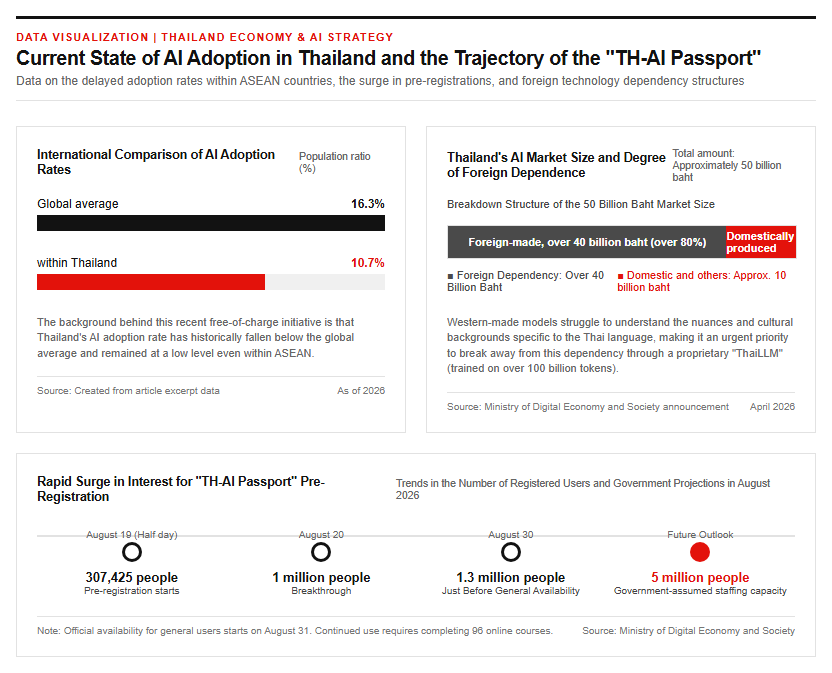
To boost the artificial intelligence literacy of its citizens and enhance its digital competitiveness, the Thai government has launched a national project called “TH-AI Passport,” which provides free access to paid generative AI services for one year. This initiative is spearheaded by the Office of the National Digital Economy and Society Commission (ONDE), operating under the Ministry of Digital Economy and Society (DES). Through a dedicated platform called “AiPASS,” the plan is to make over 30 advanced AI models provided by a total of 14 or more service providers available for free. Users can leverage professional-grade features for a variety of business and creative scenarios, including image generation, video and music production, detailed research, programming, and website building. The adoption rate of AI in Thailand has previously remained at just 10.7%, falling below the global average of 16.3% and standing at a low level even among ASEAN nations, which has been a long-standing challenge. This measure aims not simply to promote convenience, but to significantly lower the barrier to hands-on experience by making paid services free, thereby driving widespread adoption among the general public.
Registration Requirements and the Sudden Surge in Response Prior to Usage
Eligibility for the TH-AI Passport is limited to Thai nationals aged 15 and older, and proxy registration is not permitted. Registration applications are accepted via the dedicated portal site “de.aipass.net”, and require strict identity verification procedures using existing accounts from Google, Microsoft, Apple, and others, as well as official apps provided by the Thai government such as “ThaID” or “Tanrat”. Pre-registration began on August 19, 2026, with 307,425 people completing registration in just the first half of the day. The number of registrants surpassed 1 million the following day on the 20th, and reached 1.3 million by the 30th ahead of the general release, attracting exceptionally high interest from the public. An official launch ceremony was held on August 28, 2026, and the rollout to general users officially started on August 31 of the same year. This complimentary service is scheduled to run continuously for one year until August 31, 2027, with the Minister of Digital Economy and Society indicating the belief that it will reach the capacity of 5 million users.
A proprietary educational program for continued use
What sets this project apart from a mere temporary free-distribution campaign is the introduction of an educational mechanism that makes learning mandatory for continued free access. All registered users can try out the platform for free unconditionally for the first 30 days, but to continue using the AI beyond that period, they must complete a total of 96 online courses provided by the government and earn the required credits. Users who register by November 30, 2026, will be classified as “Creators” and will take these practical curricula. This ensures the project doesn’t just stop at distributing tools; it simultaneously establishes an educational environment that enables citizens to acquire proper knowledge and utilize AI continuously and proactively in their work and daily lives. This serves as a highly valuable case study, even from the perspective of talent development in corporate digital transformation, for creating an environment that readily adapts to change.
Homegrown AI Infrastructure and Roadmap Supporting the Project
The Role of Thailand’s Proprietary Language Model “ThaiLLM”
Aiming to break away from dependence on foreign technology, the Thai government built its own AI development infrastructure, “ThaiLLM,” and officially announced it on April 1, 2026. Thailand’s AI market size amounts to approximately 50 billion baht, of which over 40 billion baht relies on foreign-made technology. Because major global AI models are trained on Western data, it has been difficult to accurately understand nuances unique to the Thai language, cultural backgrounds, and regional slang. ThaiLLM is trained on over 100 billion tokens of high-quality Thai data, including Thai government official documents, papers from educational and research institutions, and legal texts. Currently, two versions are available for free: an 8-billion-parameter model with excellent processing speed and a 30-billion-parameter model capable of advanced processing. With the widespread adoption of this solution, companies will be able to incorporate AI optimized for the Thai language into their own systems at a low cost. Please refer to the figure below.
Strategies of the National AI Roadmap for Boosting Industrial Productivity
On August 28, 2026, the Thai government officially announced the “National AI Roadmap for Sustainable Productivity Enhancement” aimed at the full-scale utilization of artificial intelligence in the industrial sector. Thailand’s labor productivity growth rate has plummeted by more than half, dropping from an average of 4.8% between 2010 and 2015 to an average of 2.1% between 2015 and 2023. Against the backdrop of a rapidly aging population, improving productivity has become an urgent priority. The roadmap sets a target to achieve a 15% increase in productivity in designated priority sectors by 2030, and to spread AI adoption to 60% of large enterprises and 40% of small and medium-sized enterprises (SMEs). Furthermore, as a practical outcome, the plan aims to launch over 80 pilot projects and scale 30% of them into full-scale operations. It also includes plans to officially certify more than 50,000 industrial workers and 5,000 AI specialists, thereby integrally promoting not only the introduction of technology but also the development of human resources capable of utilizing it on the ground. Through these initiatives, Thailand is steadily solidifying its foundation as an advanced AI nation.
Controversy Surrounding Massive Budgets and Regulatory Development for Safety
Questions regarding the procurement process exceeding 1.6 billion baht and the government’s explanation
The implementation of the TH-AI Passport has drawn on a massive budget of 1.621 billion baht (approx. 7.7 billion yen) from the Digital Economy and Society Fund. In response to this huge expenditure, private sector entities and experts have raised questions such as “Could this not have been replaced by free tools available in the private sector?” Additionally, criticism has mounted regarding the lack of transparency in the procurement method—specifically, routing the contract through an intermediary called the “TH Consortium” (a joint venture between Turnkey Communication Services and Human Intelligence) rather than contracting directly with the platform developer. Opposition lawmaker Pawut Pongvitayapanu pointed out that the bidding process, which normally takes three to six months, was rushed from announcement to deadline in an extremely short span of just 34 days, escalating the situation to the point of filing a petition with the National Anti-Corruption Commission (NACC). In defense, permanent secretaries of the Ministry of Digital Economy and Society explained that the procurement procedures fully complied with government procurement laws and that there was no wrongdoing, as actual spending operates on a performance-based pay-as-you-go model tied to user volume, meaning the full amount will not be paid out if usage is low.
Ensuring Trust Through Thailand’s First Draft “Artificial Intelligence Act”
To manage the risks associated with the rapid adoption of technology, Thailand’s Electronic Transactions Development Agency (ETDA) has released a draft of the country’s first comprehensive “Artificial Intelligence Act” and is swiftly soliciting public comments. The “Draft AI Trust Framework” published by the Ministry of Digital Economy and Society establishes six key principles: transparency, accountability, copyright protection, the elimination of bias, information security, and personal data protection. Unified safety standards for AI development and use are expected to be established by 2026. High-risk areas—particularly medical diagnosis, financial scoring, recruitment screening, and critical infrastructure management—have been designated as priority oversight areas, with considerations underway to mandate human oversight and rigorous safety verification. The prompt development of regulations that serve as proper guardrails is drawing attention as a crucial turning point for ensuring trust in AI adoption across industries and transforming Thailand into an advanced digital market where numerous investors, including Japanese companies, can operate with confidence.
Reference Page
- 【Thailand Launches ThaiLLM: A Sovereign AI Foundation for the Nation – NSTDA】https://thaillm.or.th/
- 【TH-AI Passport ONDE Portal】https://de.aipass.net/
[#Thailand #GenerativeAI #DigitalPolicy #ScienceAndTechnology #TH-AIPassport #ThaiLLM #EducationProgram]


コメント