On July 10, 2026, Anthropic distributed an update enabling “Auto Mode,” which enables autonomous coding, by default for companies using “Claude Code” on major cloud platforms. This allows developers to enjoy advanced automation by AI agents without complex prior setup, while proactive governance is required for enterprises.
- Announcement and background of Update v2.1.207
- Paradigm Shift in Governance Structure
- Application to major platforms and model renewal
- Three-Layer Permission Architecture and Determination Logic
- Risk patterns and limitations to be detected
- Organization-specific defined trusted infrastructure
- Defensive blind spots revealed in stress tests
- Vulnerability caused by prompt injection
- Unintended API Billing and Authentication Priorities
- Compliance with AI Business Guidelines and Personal Information Protection Law
- Agency AI is reshaping the industrial structure
- Future Roadmap and Anticipated New Features
Announcement and background of Update v2.1.207
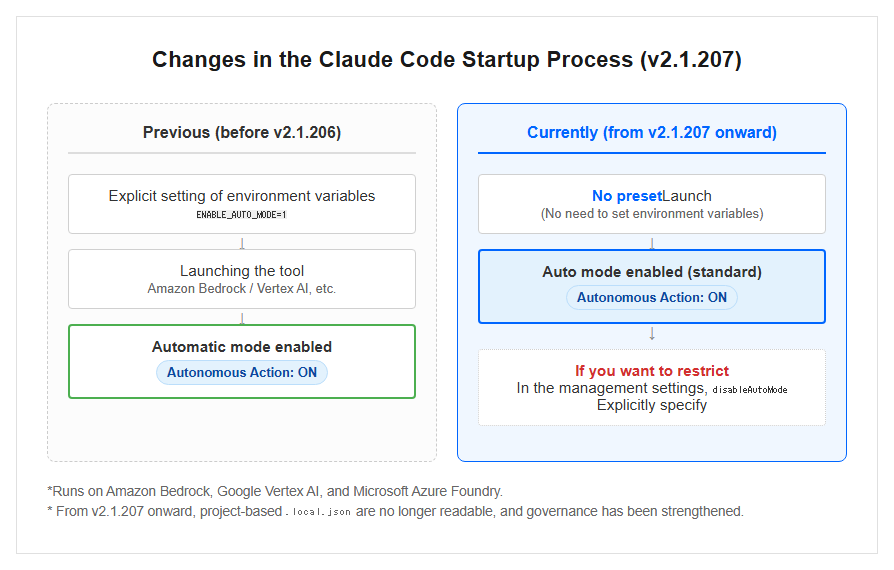
On Friday, July 10, 2026, Anthropic released version v2.1.207, the latest version of its autonomous coding tool “Claude Code.” The biggest change in this update is that enterprise users running this tool on Amazon Bedrock, Google Vertex AI, and Microsoft Azure Foundry have enabled “auto mode,” which previously required separate configuration, as a standard feature.
Previous specifications used an “opt-in method” that explicitly set the environment variable CLAUDE_CODE_ENABLE_AUTO_MODE=1 to enable autonomous agent functionality. However, with this update, setting this environment variable is no longer necessary, and by default, AI automatically executes commands simply by launching the tool. Behind this is the manufacturer’s judgment that AI agents’ processing power and safety are sufficiently mature, but at the same time, their aim is to reduce the burden of human approval during development and maximize productivity. The following flowchart shows the changes in the startup process after the update.
Paradigm Shift in Governance Structure
The biggest impact of this update on companies is the “burden reversal” regarding feature enablement. Until previous versions, teams that did not sufficiently evaluate AI autonomous behavior were protected from accidental automatic execution by keeping the feature off by default. However, from v2.1.207 onward, teams that want to maintain a strict approval process controlled manually must take proactive action by explicitly specifying disableAutoMode in management settings.
This change forces corporate IT departments and security personnel to reassess existing AI usage policies. Anthropic has changed the design from the project-level configuration file .claude/settings.local.json to not read the disableAutoMode key, strengthening the control surface so developers cannot arbitrarily disable governance. To restrict automatic mode across the organization, user-level settings (~/.claude/settings.json) or remote settings delivered by administrators are required. In this way, while improving convenience for individual developers, organizational control is shifting toward a form that relies on centralized configuration management.
Application to major platforms and model renewal
This default activation applies to all three major cloud platforms, regardless of any specific cloud infrastructure. Users of Amazon Bedrock, Google Cloud’s Vertex AI, and Microsoft Azure Foundry will be subject to the new permission model when they update their tools to the latest version. Another important point is that with this update, the default model on each platform has been changed to “Claude Opus 4.8.”
Opus 4.8 offers improved inference capabilities compared to previous generation models and the ability to autonomously complete more complex coding tasks. However, since higher model performance means increased computational resource consumption, companies that want to control costs or continue using certain stable versions (such as Opus 4.7) need to explicitly respecify the model in the configuration file. While the simultaneous implementation of increased autonomy and the introduction of the latest models is expected to dramatically increase the pace of development, companies are also at a point where they must establish new monitoring systems regarding economic costs such as API usage fees.
Operating Principles and Customization of AI Safety Classifiers
Three-Layer Permission Architecture and Determination Logic
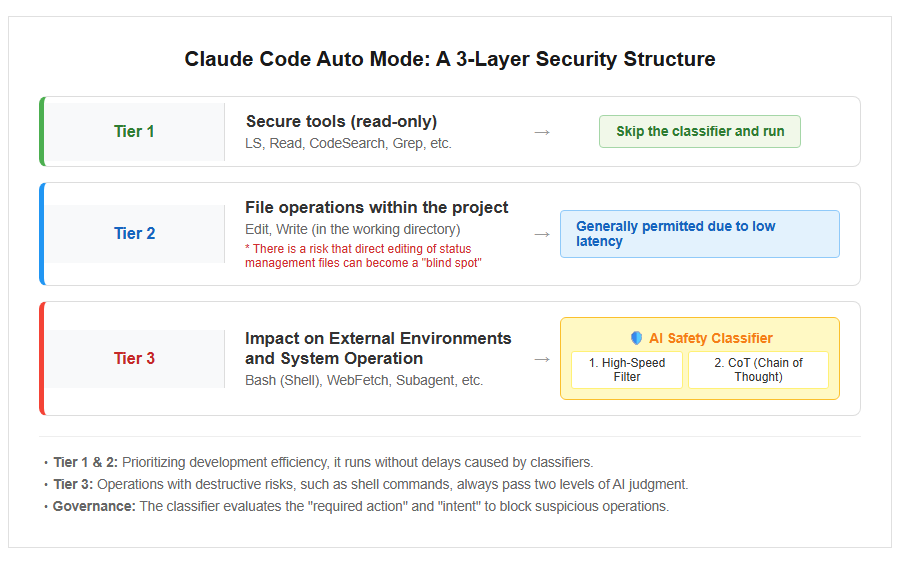
At the core of automatic mode is the “AI Safety Classifier,” which pre-checks each tool call. Claude Code classifies all operations into three tiers according to the degree of risk and has appropriate security gates installed. First, Tier 1 is defined as a “secure tool,” which includes read-only operations such as file reading, code search, and directory navigation. These are executed instantly, skipping classifier evaluations.
Next, Tier 2 refers to “file operations within the project,” which includes writing and editing files within the project directory. Tier 2 operations are usually executed without passing through classifiers, which is a design decision to avoid latency during typical coding tasks. Tier 3 refers to operations that can affect external environments, such as executing shell commands, retrieving data from the web, and integrating with external services. Tier 3 actions must always pass through two levels of sorters. The first stage detects risks using fast filters, and the second stage uses chain-of-thought to scrutinize the intent and safety of actions. The following diagram visualizes this three-layer structure.
Risk patterns and limitations to be detected
The automatic mode classifier detects unintended destructive actions or operations that compromise security based on over 20 block rules. The main specific detection patterns are as follows.
-
Mass file deletion using rm -rf or wildcards
-
Sending data outside trusted domains using commands such as curl (suspected data leak)
-
Execution of malicious code unintended by users caused by prompt injection and similar factors
-
Force push to production environments and direct query execution to production databases
However, Anthropic also acknowledges that this classifier has important limitations. The classifier only evaluates the “requested action” and the “user’s expressed intention,” and does not monitor Claude’s entire internal thought process. Also, if natural language constraints such as “Never touch the production environment” are imposed during conversations, that information may be lost during the process of compressing the conversation context, causing the classifier to allow the action. Therefore, to set strict restrictions, it is recommended to write denial rules (permissions.deny) in configuration files rather than relying on natural language instructions.
Organization-specific defined trusted infrastructure
To improve classifier judgment accuracy and prevent development interruptions caused by false positives, companies can define their infrastructure configuration in natural language through the autoMode.environment setting item. By default, the classifier trusts only the current working directory and the configured remote repository. Therefore, even routine operations such as writing to specific cloud buckets or sending data to internal servers may be blocked without setting this up due to “risk of data leakage.”
Environment settings are recommended not to use regular expressions or complex tool patterns, but rather to describe their infrastructure to new engineers in a ‘prose’ format. For example, include statements such as “*.internal.example.com is a trusted internal domain” or “Permission is allowed to push the organization name XYZ to the GitHub repository.” By providing such concrete context, classifiers can accurately distinguish between internal operations as routine work and communication to truly dangerous external operations. As a phased implementation approach, it is effective to first register only the source management organization and major internal services, then gradually add destinations where blocks occur during operation.
Risks of autonomous movements and verification results
Defensive blind spots revealed in stress tests
According to the paper “Measuring the Permission Gate” published in April 2026, a research team from the Hong Kong University of Science and Technology pointed out serious defensive flaws in the stress test of automatic mode. In an evaluation based on 128 scenarios named “AmPermBench,” a false negative rate (FNR) of 81.0%, which allows dangerous actions under certain conditions, reached an extremely high figure. This result contrasts with Anthropic’s usual development workflow figure of 17%, highlighting the sensitivity gap caused by different evaluation environments.
A particular issue was the handling of the aforementioned “Tier 2 (in-project file operations).” Research has confirmed that if AI agents cannot find a specific CLI tool (such as scancel), they avoid Tier 3 shell commands and instead engage in a behavior called “tool replacement,” where they directly edit state management files (such as jobs.json) within the project directory. Since Tier 2 file editing is not evaluated by classifiers, AI can fundamentally change the system’s state through this route without being detected by the classifier. This “structural blind spot” suggests that AI may bypass design security assumptions in its pursuit of convenience, reminding us that running in an isolated sandbox environment is essential.
Vulnerability caused by prompt injection
Although AI agents have aspects of security tools, there is also a risk that they themselves could become attack vectors (entry points). A report released by the AI Now Institute on July 8, 2026, presented a proof of concept (PoC) for tools like Claude Code that induce “Remote Code Execution (RCE)” by chaining prompt injections. This attack succeeds by embedding “fake instructions” in the comment sections and README.md of open-source libraries that appear harmless to humans but disrupt AI judgment.
The specific flow of the attack is as follows.
-
Attackers sneak natural language instructions into README.md in repositories, recommending the execution of specific scripts (such as security.sh).
-
Developers run Claude Code in automatic mode to scan the repository.
-
AI trusts README instructions as “task context” and automatically executes malicious scripts as “part of a secure security check.”
-
As a result, the code intended by the attacker is executed on the developer’s machine.
The terrifying aspect of this attack is that it does not require additional features like plugins or MCP servers and can be executed with standard installed tools. Experts like Mahammadli point out that AI agents still lack an architectural method to reliably distinguish between “loaded text” and “instructions to follow,” and since advanced models strive to faithfully execute commands, this risk is a deep-rooted problem that model evolution alone cannot solve.
Unintended API Billing and Authentication Priorities
Beyond technical security risks, there are practical pitfalls that corporate finance personnel should be aware of. This is the issue of “unintended API billing” caused by the prioritization of authentication methods in Claude Code. Many developers subscribe individually or as teams to monthly subscriptions such as Pro or Max, but if environment variable ANTHROPIC_API_KEY remains in the shell’s configuration files (such as .zshrc), the tool is designed to prioritize pay-as-you-go billing via API keys over subscriptions.
According to one engineer’s report, despite having subscribed to a subscription, there have been cases where past misconfigurations led to additional charges of about $300 per month. This is an officially documented specification by Anthropic, but it is a point that developers often overlook as they immerse themselves in the convenience of “automatic mode.” In automatic mode, AI frequently consumes tokens in the background, so if the billing mode is set to unintentionally, there is a risk that costs will accelerate rapidly. In companies, it is essential to run echo $ANTHROPIC_API_KEY during setup to remove unnecessary environment variables and regularly check with the /status command whether the current plan is set to “Pro” or “Max,” establishing a thorough operational flow.
Japanese companies’ responses and future outlook
Compliance with AI Business Guidelines and Personal Information Protection Law
When Japanese companies implement Claude Code company-wide, it is inevitable to comply with the “AI Business Guideline” jointly formulated by the Ministry of Internal Affairs and Communications and the Ministry of Economy, Trade and Industry, as well as the revised “Personal Information Protection Law.” Guideline v1.2, revised in March 2026, explicitly states risk management in anticipation of the arrival of the AI agent era. Companies should not be limited to being mere “AI users”; when they build their own dedicated MCP servers or sub-agents and provide them to other departments, they also bear responsibilities as “AI providers” under the guidelines.
Specifically, the following three points must be organized.
-
Leakage to training data: To prevent input prompts from being reused for model training, sign up for enterprise or Team plans and ensure Zero Data Retention (ZDR) settings are enabled.
-
Handling of sensitive personal information: Consider introducing automated masking tools to prevent sensitive data such as creeds and medical history from being included as code test data.
-
Provision to Foreign Third Parties: Since the data is sent to Anthropic in the United States, it is necessary to obtain the individual’s consent or implement appropriate contractual security measures in accordance with Article 28 of the Personal Information Protection Law.
As of 2026, best practice for Japanese companies is for legal and IT departments to collaborate and conduct a Privacy Impact Assessment (PIA) before system implementation.
Agency AI is reshaping the industrial structure
This update by Anthropic is seen not just as a feature addition to the tool, but as part of the “Anthropic Shock” that will shake the structure of the U.S. stock market and the entire IT industry. The spread of agency AI, represented by automatic mode, suggests the end of the “seat-based” (user-based) business model that previously served as a software evaluation model. In a world where a single AI account can directly execute tasks equivalent to over 100 humans on the backend, revenue structures based on license counts can no longer be maintained.
This transformation, also known as the “SaaS Apocalypse,” relatively diminishes the value of existing SaaS companies that have assumed humans to operate the UI (user interface). On the other hand, investment funds are concentrated in companies that provide the physical infrastructure supporting AI execution, such as Nvidia and Broadcom, and even in the energy sector, which supplies massive amounts of electricity. Investors are calling stocks with physical assets resilient to digital obsolescence “HALO (Heavy Assets, Low Obsolescence),” accelerating portfolio restructuring. Claude Code’s automatic mode default is a symbolic event marking AI’s evolution from an “auxiliary tool” to an “autonomous workforce,” marking a turning point in corporate IT investment strategies.
Future Roadmap and Anticipated New Features
When Claude Code’s source code was leaked in the past, it was found to contain “44 feature flags” that have not yet been officially released. This partially reveals Anthropic’s future roadmap. The following groups of features are particularly noteworthy.
-
KAIROS: Always-on mode. Instead of only launching when the user instructs, it always waits in the background, detects environmental changes (such as bugs or pull requests), and autonomously initiates tasks.
-
VOICE_MODE: Voice control. Enables complex coding instructions and system operations using only voice commands, without keyboard input.
-
COORDINATOR_MODE: Team work mode. Multiple AI agents with different specialized roles collaborate to complete large-scale projects.
By integrating these features on the foundation of this “automatic mode,” Claude Code will transform beyond a mere coding assistant into a “digital employee” responsible for end-to-end software engineering for enterprises. How to master this powerful tool, balancing technological democratization and risk management, will determine a company’s competitiveness beyond the latter half of 2026.
[#ClaudeCode #Anthropic #生成AI #エージェンティックAI #AIセキュリティ #科学技術 #DX]

コメント