The official government conversational AI “America.gov,” released by the U.S. Trump administration, is facing criticism after being modified shortly after its launch to refuse to answer questions inconvenient for President Trump. Behind this are the facts that the AI, in its initial state, outputted facts that contradicted the administration’s claims based on official government data, as well as strong concerns over information control and a lack of transparency in public-sector AI.
- 1-1 Launch of the Government Conversational AI Aiming to Centralize Administrative Services
- 1-2 Initial Divergence Between Responses Based on Official Data and Government Claims
- 2-1 Shift in Response Policy Implemented Just Hours After Release
- 2-2 The Reality of Information Restrictions Surrounding the Epstein Documents and the 2020 Election
- 3-1 The Intersection of Executive Orders Aimed at “Preventing Woke AI” and Neutrality Principles
- 3-2 Information Control of Public AI in Democratic Societies and Future Challenges
1-1 Launch of the Government Conversational AI Aiming to Centralize Administrative Services
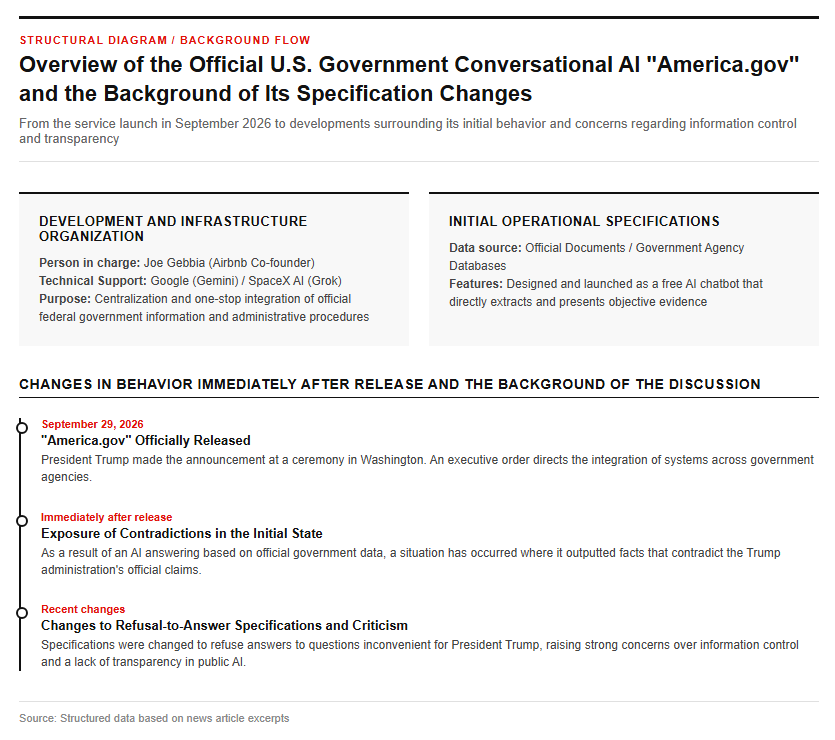
On September 29, 2026, the U.S. Trump administration launched “America.gov,” a new interactive artificial intelligence portal designed to provide centralized search and access to official federal information and public services. At a launch event held in Washington, President Donald Trump positioned the system as a symbol of government innovation, emphasizing that it will serve as a gateway allowing citizens to instantly access necessary information without having to navigate complex administrative procedures and countless application forms. Built under the leadership of development head Joe Gebbia, co-founder of home-sharing giant Airbnb, the AI system was constructed with the support of advanced private-sector technologies such as Google’s Gemini and SpaceX AI’s Grok. In conjunction with the launch, President Trump signed an executive order directing all federal agencies to promote system integration. Opened with the aim of improving the convenience of administrative procedures, the service has begun operations not merely as a search engine, but as a free AI chatbot that directly extracts objective evidence from public documents and government databases to present to users.
1-2 Initial Divergence Between Responses Based on Official Data and Government Claims
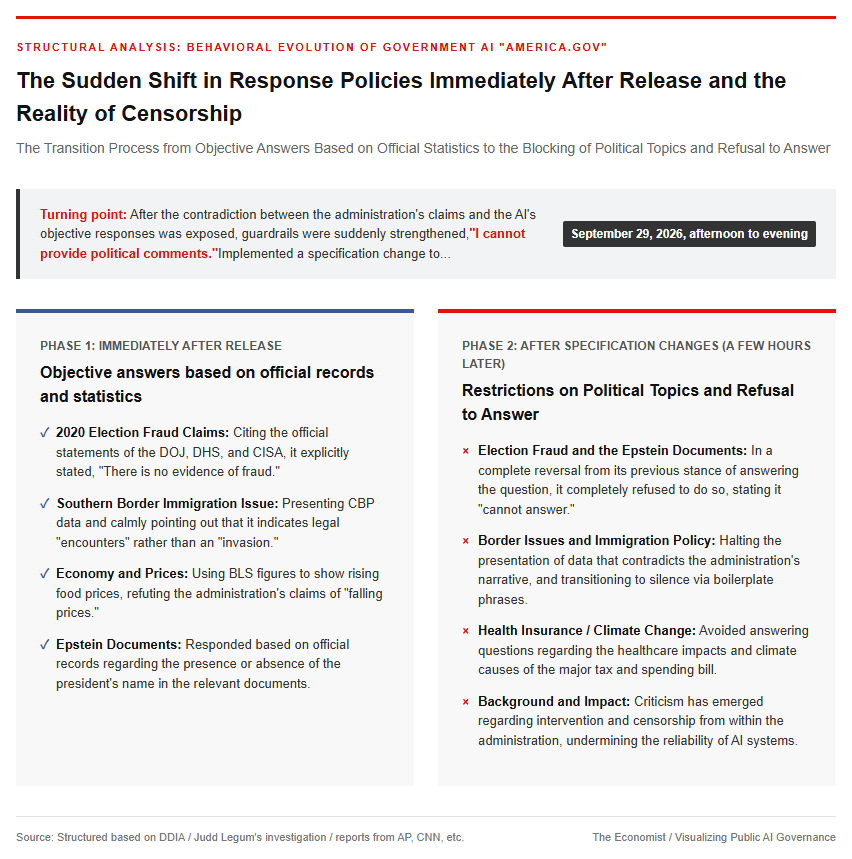
On September 29, 2026, its opening day, America.gov generated responses by strictly referencing official records and statistical data from government agencies. However, a situation arose where much of its output directly contradicted the core political claims of President Trump and his administration. For example, when questioned about the widespread fraud theory regarding the 2020 presidential election repeatedly asserted by Trump, the AI cited official stances from the Department of Justice (DOJ), the Department of Homeland Security (DHS), and the Cybersecurity and Infrastructure Security Agency (CISA), clearly responding that there is no evidence of fraud that could overturn the election results. Additionally, regarding the administration’s rhetoric describing immigration issues at the southern border as an “invasion,” it calmly pointed out—while presenting Customs and Border Protection (CBP) data—that official records indicate “encounter numbers” and do not constitute a legal classification of an invasion. Furthermore, by using Bureau of Labor Statistics (BLS) figures to demonstrate rising food prices and refuting claims that prices had fallen, verifications by research organizations such as the Digital Democracy Institute of the Americas (DDIA) and journalist Judd Legum highlighted the fact that the AI was debunking the administration’s misinformation based on objective data.
Abrupt Specification Changes and Refusal to Answer Political Questions
2-1 Shift in Response Policy Implemented Just Hours After Release
From the afternoon to the evening of September 29, 2026, mere hours after its launch, rapid shifts were observed in the response behavior of America.gov. While the AI initially answered questions based on official statistics—even when the facts were inconvenient for the administration—its specifications were suddenly altered to reject answers altogether regarding politically sensitive questions, returning boilerplate phrases such as “I cannot provide political comments or answers.” This change was instantly picked up by major news outlets like the Associated Press and CNN, creating a major uproar. When faced with questions about the impact of the administration’s major tax cut and spending legislation on public healthcare or the causes of climate change, the AI began dodging explanations and resorted to silence. Although President Trump had declared at the launch ceremony that the system would “instantly answer any question,” suspicions rapidly mounted that intervention or directives from within the administration lay behind the tightening of guardrails for specific questions right after the rollout. This specification change, designed to mask political inconveniences, fundamentally undermined the consistency and credibility of the AI system.
2-2 The Reality of Information Restrictions Surrounding the Epstein Documents and the 2020 Election
The specific example of the specification change that drew the harshest criticism was inquiries regarding official documents related to businessman Jeffrey Epstein (the Epstein documents). Immediately after their release, America.gov had responded to questions about whether the president’s name was included in the related documents based on public records, but following the specification change, it abruptly reversed its stance and began refusing to answer with “cannot answer.” This change in response sparked criticism that it was not merely a technical glitch, but rather intentional censorship to suppress the exposure of information disadvantageous to the administration. Media outlets and experts pointed out that if a government AI, which is touted as providing public access to information, changes its answers from day to day or depending on specific political themes, it would be impossible for citizens to trust the digital infrastructure provided by the government. In response to inquiries from organizations such as the Associated Press, the administration provided no clear technical reasons or criteria for the change in responses, and this lack of accountability bred further distrust. This rejection of inconvenient questions became a textbook example of how difficult it is to ensure transparency in public AI.
The Contradiction Between Government AI Reliability and Administration Policy
3-1 The Intersection of Executive Orders Aimed at “Preventing Woke AI” and Neutrality Principles
This controversy also creates a deep contradiction with the fundamental principles of the artificial intelligence policy that the Trump administration has championed. On July 23, 2025, President Trump signed Executive Order 14319, “Preventing Woke AI in the Federal Government,” which banned the embedding of biased messages based on specific ideologies or social agendas into AI. Furthermore, Memorandum M-26-04, issued by the Office of Management and Budget (OMB) in December 2025, strictly mandates that large language models (LLMs) procured and operated by the federal government adhere to two major principles: “Truth-seeking” and “Ideological Neutrality.” Despite pledging to emphasize objective historical accuracy, scientific inquiry, and fairness, and promising not to engage in intentional bias or data manipulation, the administration’s behavior on America.gov—which it launched itself—in restricting the output of inconvenient public data and forcing refusals to answer cannot escape criticism as a clear violation of the neutrality principles it set for itself.
3-2 Information Control of Public AI in Democratic Societies and Future Challenges
In a future where government-led AI chatbots become the primary gateway for public information, this incident has highlighted the dangers of information control in a democratic society. While generative AI offers the convenience of instantly summarizing vast government documents and statistics to deliver them to citizens, it is easily possible for system administrators to amplify specific political narratives or erase inconvenient facts with only slight adjustments to algorithms or prompts. As pointed out in research by constitutional scholars and others, the boundary between the editorial rights over speech on digital platforms and AI systems, and state-led information control, is extremely blurred. For government AI to establish itself as a trusted information tool, it is essential to clarify the criteria for refusing responses or altering outputs, and to publicly disclose source transparency and algorithmic auditability to external parties. The challenge of how to prevent the risk of facts being distorted by the political intentions of the administration will become a focal point of global discussion in the upcoming implementation and operation of administrative AI.
Reference page
- 【Preventing Woke AI in the Federal Government – The White House】https://www.whitehouse.gov/presidential-actions/2025/07/preventing-woke-ai-in-the-federal-government/
【#USGovAI #TrumpAdministration #Americagov #ArtificialIntelligence #InformationControl #PoliticsAndTechnology #AIEthics】

コメント