
In October 2026, Malaysia’s total trade reached a record high of 436.6 billion ringgit, with exports surging by 61.1% year-on-year. This was driven by the expansion of electrical and electronic (E&E) product exports due to the ripple effects of AI demand, along with a sharp spike in global semiconductor demand.
- Key Takeaways from the 61.1% Export Surge in October and Breaking the 400-Billion-Ringgit Total Trade Milestone
- The Overwhelming Driver: Electrical and Electronic (E&E) Products and Semiconductor Demand
- Q3 GDP Growth of 5.5% and the Virtuous Cycle of AI Data Center Investment
- U.S. Semiconductor Regulations and the Risk of Supply Chain Transshipment Trade
- Stagnation in Backend Dependency and Ripple Effects on Wages and Competitiveness
- Future Outlook and Structural Transformation through the National Semiconductor Strategy (NSS)
Key Takeaways from the 61.1% Export Surge in October and Breaking the 400-Billion-Ringgit Total Trade Milestone
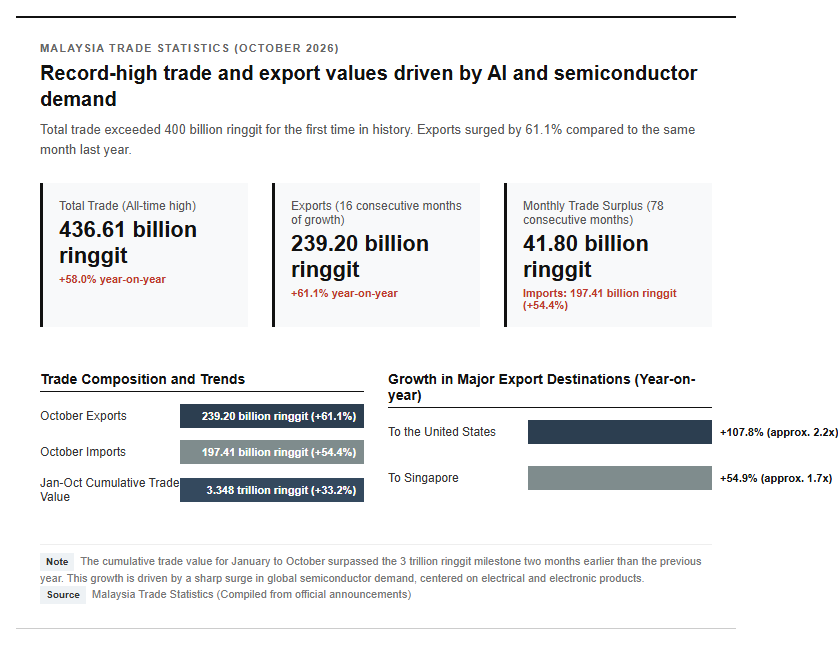
In Malaysia’s trade statistics for October 2026, total trade grew by 58.0% year-on-year to reach 436.61 billion ringgit, breaking the 400-billion-ringgit milestone for the first time in history. Exports skyrocketed by 61.1% year-on-year to 239.2 billion ringgit, maintaining a positive growth streak for the 16th consecutive month while setting a new all-time high. Meanwhile, imports expanded by 54.4% to 197.41 billion ringgit, resulting in a monthly trade surplus of 41.8 billion ringgit—the 78th consecutive month in the black. Cumulative trade from January to October 2026 increased by 33.2% year-on-year to 3.348 trillion ringgit, crossing the 3-trillion-ringgit mark two months earlier than the previous year. Among major export destinations, shipments to the United States showed record growth, soaring approximately 2.2 times (107.8% year-on-year), while those to Singapore rose about 1.7 times (54.9% year-on-year). Please refer to the figure below.
The Overwhelming Driver: Electrical and Electronic (E&E) Products and Semiconductor Demand
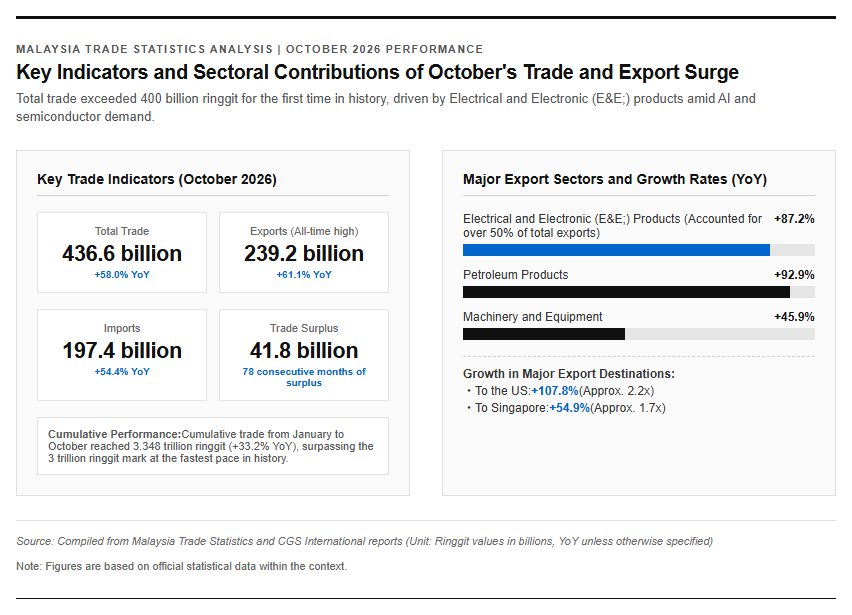
The phenomenal export surge in October was led by electrical and electronic (E&E) products, which account for over half of Malaysia’s total exports. E&E exports recorded an 87.2% year-on-year increase, surging by 58.51 billion ringgit compared to the same month last year and accounting for about two-thirds of the overall increase. Driven in particular by the rapid adoption of generative artificial intelligence (AI) and a global rush to build data centers, demand has exploded for integrated circuits (ICs) for computing and control, semiconductor memory, and solid-state drives (SSDs). According to a report by analytical firm CGS International, Malaysia’s memory-related exports in 2026 surged by 243% year-on-year in line with the expansion pace of the global market, with shipment volumes reaching approximately three times their 2023 levels. Furthermore, major categories such as petroleum products (up 92.9%) and machinery and equipment (up 45.9%) remained strong, supporting a virtuous cycle.
Ripple Effects on GDP Growth and Structural Analysis of the Economic Environment
Q3 GDP Growth of 5.5% and the Virtuous Cycle of AI Data Center Investment
The explosive expansion of trade and exports has provided a major boost to Malaysia’s macroeconomic growth. Real GDP growth for the third quarter of 2026 came in at 5.5% year-on-year, showing robust growth that exceeded the government’s flash estimate of 5.3% and market expectations. The average growth rate from January to September reached 5.6%, making it virtually certain that Malaysia will achieve high growth exceeding 5% for the full year of 2026. This is underpinned by massive inflows of investment into AI-focused data centers and digital infrastructure, centered around Penang and Johor. Cumulative data center investments from 2021 to mid-2026 are estimated at 386.6 billion ringgit, with U.S. tech giant Microsoft and other major operators successively building facilities. Bank Negara Malaysia Governor Abdul Rasheed also emphasized that strong exports and expanding investment are forming solid economic fundamentals. Please refer to the figure below.
U.S. Semiconductor Regulations and the Risk of Supply Chain Transshipment Trade
Behind the export explosion lie significant downside risks and security challenges stemming from the external environment. The U.S. government’s push to tighten export controls on advanced AI semiconductors and GPUs raises concerns over their impact on Malaysia’s data center ecosystem and high-performance computing facilities. Malaysia is a major global hub accounting for roughly 13% of the world’s backend operations (assembly, testing, and packaging: ATP) and hosts advanced manufacturing plants for companies like Intel and Infineon. However, concerns remain that its logistics structure—which includes duty-free Penang Free Trade Zones (FTZs) and over 200 bonded warehouses—could be exploited as illegal transshipment or rerouted export channels to restricted nations. If the U.S. Department of Commerce steps up monitoring or suspicions of illicit trade via third countries emerge, it poses the risk of halting advanced chip imports and driving up compliance costs.
Challenges in Industrial Structure and Mid-to-Long-Term Outlook
Stagnation in Backend Dependency and Ripple Effects on Wages and Competitiveness
While export values are hitting record highs, challenges remain regarding the spillover effects on the domestic economy and industrial competitiveness. According to CGS International’s Revealed Comparative Advantage (RCA) index analysis, Malaysia’s surge in exports is primarily driven by volume increases due to expanding global demand, and has not translated into technological market share expansion or the acquisition of pricing power. Malaysia’s strengths remain concentrated in back-end operations (ATP) with low gross profit margins, and revenues from front-end semiconductor manufacturing and high-added-value sectors tend to flow out to foreign companies. Furthermore, employee compensation in the electrical and electronics sector has remained largely flat since 2022, meaning the export boom has not immediately translated into rising wages or job growth for workers. In addition, with the manufacturing capacity utilization rate reaching a record high of 87.7%, shortages of electricity and water resources as well as a depletion of advanced IT talent have become bottlenecks to growth.
Future Outlook and Structural Transformation through the National Semiconductor Strategy (NSS)
Whether the Malaysian economy can maintain sustainable high growth and overcome the “middle-income trap” depends on shifting from mere back-end operations to front-end processes, IC design, and advanced packaging. The World Semiconductor Trade Statistics (WSTS) forecasts that the growth of global semiconductor sales in 2027 will be slower than in 2026, making industrial upgrading an urgent priority to prepare for a slowdown in the current demand cycle. The government has formulated the National Semiconductor Strategy (NSS) and “Malaysia Digital 2030” (MD2030), supporting initiatives such as local IC design firm SkyeChip’s edge AI processor development and participation in international cooperation frameworks. Additionally, through the establishment of the Johor-Singapore Special Economic Zone (JS-SEZ), the country aims to build a new high-value-added supply chain hub that integrates financial and research functions with expansive manufacturing bases, thereby solidifying its strategic position in the AI era.
Reference Pages
- [Rediscovering Malaysia (1): Growing Presence as a Strategic Hub Amid AI Demand | JETRO] https://www.jetro.go.jp/biz/areareports/special/2026/1101/be95f7fe6c18ef8e.html
- [Overseas Watcher: Looking Back at Malaysia in 2025 | Ministry of Finance] https://www.mof.go.jp/public_relations/finance/202601/202601k.html
[#MalaysianEconomy #SemiconductorExports #AIDemand #DataCenters #NationalSemiconductorStrategy]

コメント