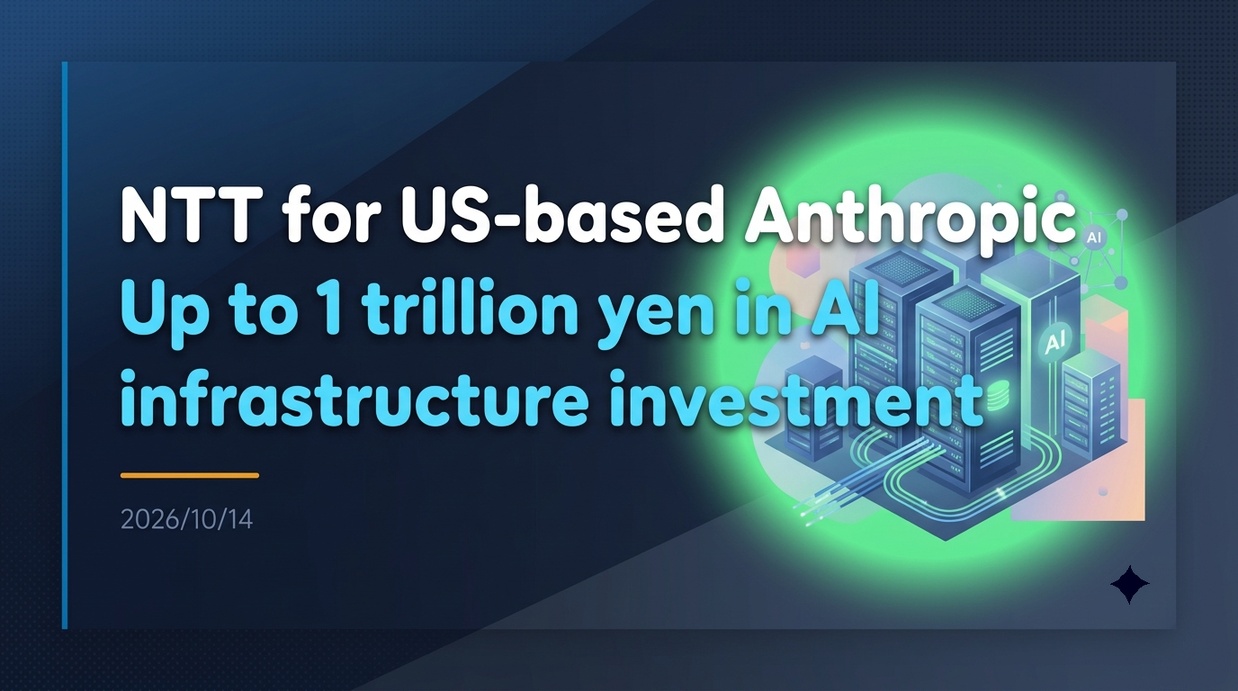
NTT DATA Group has entered final talks to build a dedicated data center in Osaka for major US AI company Anthropic. Boasting an investment of up to 1 trillion yen and a power receiving capacity of 500 megawatts, it is one of Japan’s largest AI infrastructure initiatives, set against the backdrop of a global scramble for computing resources and expanding electricity demand.
- [Key Event Summary] A massive project worth up to 1 trillion yen by NTT DATA and Anthropic
- The Strategic Background Behind US-Based Anthropic Choosing Osaka, Japan as Its Dedicated Hub
- 500MW Power Reception Wall and On-Site Generation / NTT’s IOWN/Liquid Cooling Technology
- Financial, Valuation, and Litigation Risks Lurking in Massive AI Infrastructure Investments
- Impact on Stock Prices and Market Valuation, and Strengthening the Digital Infrastructure in the Japanese Economy
- [Future Developments and Key Points] Key indicators for contract signing by the end of fiscal 2026 and the start of operations in 2028
[Key Event Summary] A massive project worth up to 1 trillion yen by NTT DATA and Anthropic
It has been revealed that NTT Data Group is making final arrangements to build a dedicated data center in Osaka Prefecture for Anthropic, a leading US AI company. The key points of this project are as follows.
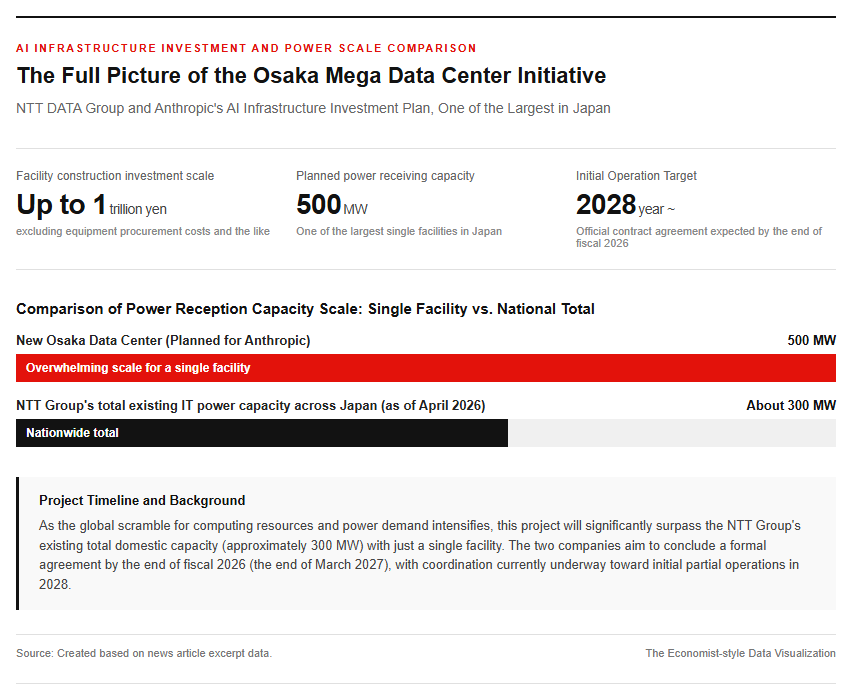
- Investment scale: Facility construction costs alone are expected to reach up to 1 trillion yen (approximately $6.3 billion), and will increase further when including the procurement of equipment such as advanced AI servers and GPUs.
- Power receiving capacity: Planned for a maximum of 500 megawatts (MW), it will be one of Japan’s largest mega data centers in terms of processing capacity.
- Operational Timeline: Both companies aim to conclude a formal contract by the end of fiscal 2026 (the end of March 2027) and intend to begin initial partial operations starting in 2028.
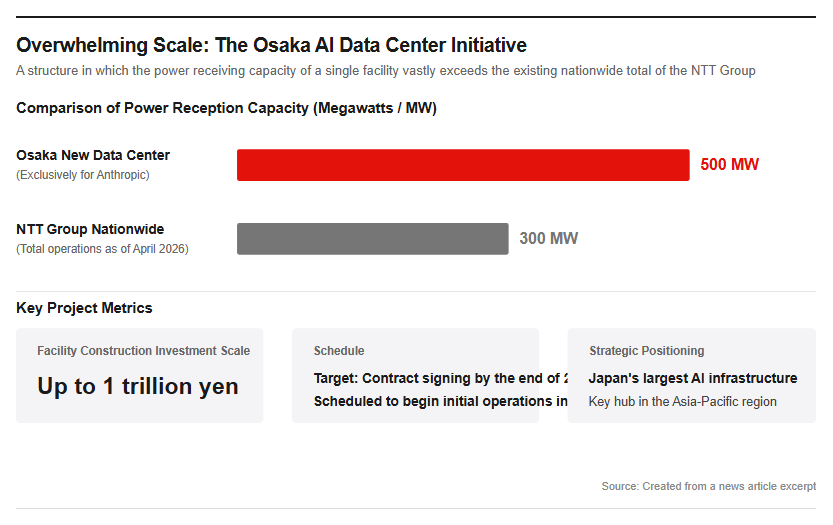
The 500-megawatt power reception capacity under this plan significantly exceeds, at a single facility, the total IT power capacity currently operated by the NTT Group across Japan (approximately 300 megawatts as of April 2026).
Leveraging its proximity to industrial land in the Osaka Bay coastal area and major urban centers, it is positioned as a key hub in the Asia-Pacific region.
The Strategic Background Behind US-Based Anthropic Choosing Osaka, Japan as Its Dedicated Hub
Behind the decision by US-based Anthropic, developer of the generative AI model “Claude”, to select Osaka, Japan as the location for its first large-scale dedicated data center outside the US mainland are surging demand in the Asian market and economic security imperatives. The status of the company’s deployment in the Japanese market and its strategic significance are as follows.
- Driving Adoption in Major Domestic Enterprises: Major Japanese companies such as Rakuten, Nomura Research Institute, and Panasonic have already introduced Claude.
- Strengthening Asia-Pacific Presence: Opened the first Asia-Pacific office in Tokyo in October 2025 and signed a memorandum of understanding with the Japanese government’s AI Safety Institute.
- Addressing domestic data processing needs: This aims to meet the demands of government agencies and enterprises that want to securely process confidential and financial data on infrastructure within Japan.
While Anthropic has previously deployed $50 billion-scale infrastructure in US states such as Texas and New York with companies like Fluidstack, this Osaka project represents an important part of the global diversification of its computing infrastructure.
The establishment of high-performance AI infrastructure within Japan is directly linked to improving the response speed of generative AI and ensuring security.
Power and Technical Challenges and the Financial and Legal Risks of AI Infrastructure Investment
500MW Power Reception Wall and On-Site Generation / NTT’s IOWN/Liquid Cooling Technology
The single greatest global bottleneck in the construction of AI data centers is securing massive amounts of power from the electrical grid. A 500-megawatt-class power capacity in Osaka is on a scale that would strain the electricity supply of an entire city, demanding responses to technical and environmental challenges.
- Alternative measures for securing power: Because arranging a power supply from the existing general power grid takes a long time, the introduction of on-site power generation facilities and fuel cells is being considered in the initial stages of the business.
- NTT Group’s AI/IOWN and Liquid Cooling Strategy: NTT is leveraging its optical-electrical convergence technology “IOWN” to triple its domestic IT capacity to approximately 1 gigawatt by fiscal 2033, while also driving the nationwide deployment of state-of-the-art liquid-cooled AI data centers.
- Cooling Efficiency and Reduction of Environmental Impact: To manage the massive amount of heat generated by high-density GPU servers, the transition from conventional air cooling to high-efficiency liquid cooling systems has become essential.
According to projections by the International Energy Agency (IEA), global data center electricity consumption in 2030 will reach approximately 945 terawatt-hours, nearly doubling from 2024 levels. Going beyond mere building construction, securing cutting-edge energy-saving technologies and dedicated power sources has become an essential prerequisite for success.
Financial, Valuation, and Litigation Risks Lurking in Massive AI Infrastructure Investments
With the surge in demand for AI infrastructure, astronomical amounts of capital are being invested worldwide, but rapid capital expenditures are sharply increasing financial and legal risks. According to specialized research institutions and legal analyses, the following concerns have been pointed out.
- Divergence between revenue and capital expenditures: While the overall AI industry revenue in 2025 is projected to remain at around $60 billion, capital expenditures are expected to reach approximately $400 billion, raising concerns about a deterioration in free cash flow.
- Depreciation and Asset Obsolescence: The useful life of GPUs and dedicated servers is as short as 2 to 4 years, and there is a risk that held assets will rapidly suffer impairment and obsolescence (becoming stranded assets) due to generational shifts in semiconductors.
- Rise in Legal Disputes and Litigation: In the United States, off-balance-sheet financing using SPVs (Special Purpose Vehicles) and complex debt collateral structures has been advancing, resulting in shareholder and creditor lawsuits against Oracle and CoreWeave.
Even for the NTT Group, which is making a 1-trillion-yen-scale investment, managing the expansion of interest-bearing debt and demand fluctuation risks during the investment recovery period will be a critically important management challenge.
Future Outlook and Impact on Markets and Investors
Impact on Stock Prices and Market Valuation, and Strengthening the Digital Infrastructure in the Japanese Economy
In NTT’s (9432) stock price and market valuation, the transformation story from a conventional “mature domestic telecommunications carrier” to a “global leader in AI data centers and next-generation IT solutions” is drawing strong attention. The main market evaluation criteria and economic ripple effects are as follows.
- Shift in Growth Drivers: In its Medium-Term Management Plan (FY2023–2027), the company has outlined a total of 8 trillion yen in new investments in growth areas over the five-year period, with expectations for the expansion of EBITDA in the data center business.
- Digital Industry Concentration in the Kansai Region: Driven by plans to develop data centers on the former site of Sharp’s Sakai plant and other initiatives, the Osaka Bay area is emerging as Asia’s new digital hub.
- Growth Forecast for the Japanese Market: The Japanese data center market size is projected to grow from $11.89 billion in 2026 to $17.66 billion in 2030, with a compound annual growth rate (CAGR) of 8.22%.
Following reports of this mega-investment initiative, expectations are growing in the stock market for the NTT Group’s AI infrastructure strategy, and it is attracting attention as a catalyst for a long-term corporate value re-rating.
[Future Developments and Key Points] Key indicators for contract signing by the end of fiscal 2026 and the start of operations in 2028
To determine whether this project will materialize and contribute to sustainable revenue growth, progress checks aligned with the future roadmap are essential. The key points that investors and industry insiders should monitor are as follows.
- Negotiations for the Definitive Agreement: Reaching a basic agreement and signing the definitive agreement by the end of fiscal 2026 (the end of March 2027) will be the first major milestone.
- Securing power infrastructure and commencement of construction: The key focus will be whether prospects for arranging 500 megawatts of power reception and procuring alternative power sources, such as on-site power generation and fuel cells, can be successfully established.
- Initial operations and monetization in 2028: It is necessary to confirm whether partial operations will begin in 2028 as planned and whether usage fee revenue from Anthropic will be steadily recorded.
In the global data center market, rapid demand expansion is accompanied by concerns over power constraints and the risk of overinvestment. Therefore, how NTT DATA manages contract conditions and power costs to secure stable returns will dictate its medium- to long-term success.
Reference Page
- 【NTT DATA INSIGHT】https://www.nttdata.com/jp/ja/trends/data-insight/2026/0512/
- 【Quinn Emanuel – Financing the AI Infrastructure Boom】https://www.quinnemanuel.com/
【#NTT #Anthropic #DataCenter #AIInfrastructure #StockInvestment #JapaneseEconomy】


コメント