
The preliminary UK Purchasing Managers’ Index (PMI) for November 2026 fell short of expectations, leading to dominant selling pressure on the pound in the foreign exchange market. This was driven by a slowdown in service sector growth, persistent labor cost burdens, and a waning expectation of additional interest rate hikes by the Bank of England.
- Key Takeaways: The Stalling of November Preliminary PMI and Market Trends
- Sector Divergence: A Slowing Service Sector and a Manufacturing Sector Supported by AI-Related Demand
- Foreign Exchange Market Reactions: Pound-Dollar Nears One-Year Lows and Pound-Yen Ranges
- Fading Monetary Policy Expectations for the Bank of England and Pressure from a Strong US Dollar
- Structural Impacts of Fiscal Debt Issues and Quantitative Tightening (QT)
- Future Developments and Key Points: Inflation Trends and Outlook for the Next MPC Meeting
Key Takeaways: The Stalling of November Preliminary PMI and Market Trends
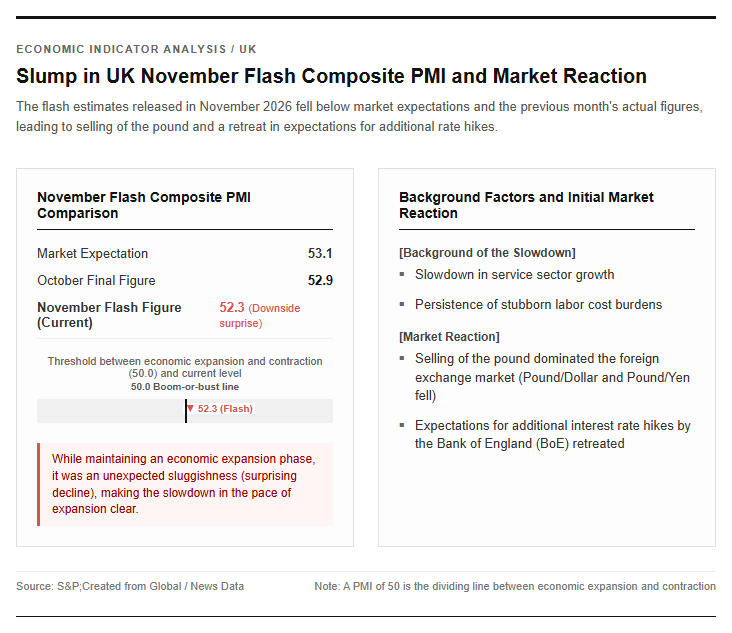
Released on November 23, 2026, S&P Global’s preliminary UK Purchasing Managers’ Index (PMI) posted a surprising decline from the previous month, defying market expectations of an improvement. The preliminary Composite PMI, which indicates overall private sector activity, came in at 52.3, slowing from October’s final figure of 52.9 and missing the market forecast of 53.1. While it remained above the 50.0 threshold that separates economic expansion from contraction—indicating that the broader UK economy remains in expansion territory—it highlighted that the pace of economic growth is losing momentum.
Following this announcement, selling pressure on the pound intensified in the foreign exchange market, causing both the pound-dollar and pound-yen exchange rates to decline and lose ground. Market participants are increasingly viewing the economic slowdown as a factor that may temper the Bank of England’s future monetary tightening stance. The figure below is an conceptual illustration showing the key movements of the November preliminary PMI and the initial market reaction.
Factors behind the current economic slowdown include high energy costs and elevated labor costs at companies, which are squeezing profit margins and driving businesses to curb hiring and cut labor expenses. Chris Williamson, Chief Business Economist at S&P Global Market Intelligence, pointed out the following points:
- The November PMI results suggest that real GDP in the fourth quarter is maintaining solid growth of around 0.6% quarter-on-quarter.
- Business confidence improved for the second consecutive month, recovering to levels seen before the escalation of Middle East geopolitical tensions in February 2026.
- Concerns over rising costs have led to a continued net reduction in employment, with companies prioritizing productivity improvements.
Thus, while overall economic activity itself maintains positive growth, a complex situation persists where a weakening employment environment coexists with high costs.
Sector Divergence: A Slowing Service Sector and a Manufacturing Sector Supported by AI-Related Demand
A closer look at the breakdown of the UK’s November PMI revealed a divergence between the service sector—a pillar of the UK economy—which is slowing down, and the manufacturing sector, which is supported by select demand. The preliminary Services PMI, which accounts for about 80% of the UK economy, fell to 52.0, delivering a disappointing result that missed both the previous month’s 52.8 and the market forecast of 53.0. Service companies, in particular, experienced very weak export demand from overseas markets, with a noticeable sluggishness in new business growth. Furthermore, to cope with increasing labor cost burdens, personnel cuts were implemented mainly in the service sector, serving as the primary factor dragging down the overall employment index.
Meanwhile, the preliminary Manufacturing PMI came in at 52.7; although it fell short of the market forecast of 53.0, it maintained strong production activity on par with October’s 52.8. The pace of increase in manufacturing production recorded its highest growth rate since August 2024, functioning as a breakwater against the overall economic slowdown. The main factors driving the manufacturing sector are as follows:
- The expansion of aggressive capital investment demand accompanying the opening of artificial intelligence (AI) data centers.
- An increase in defense-related spending driven by rising geopolitical tensions.
- A recovery in orders in certain industries linked to supply chain restructuring.
Regarding price trends, input cost inflation faced by businesses settled down to its lowest growth rate in three months, though it remains at a historically high level due to stubbornly high energy, transportation, and wage costs. Additionally, output price inflation remained at its mildest increase since July 2026, suggesting that companies are facing limitations in passing costs on to selling prices.
Background of Pound Selling Dominance and Impact on the Foreign Exchange Market
Foreign Exchange Market Reactions: Pound-Dollar Nears One-Year Lows and Pound-Yen Ranges
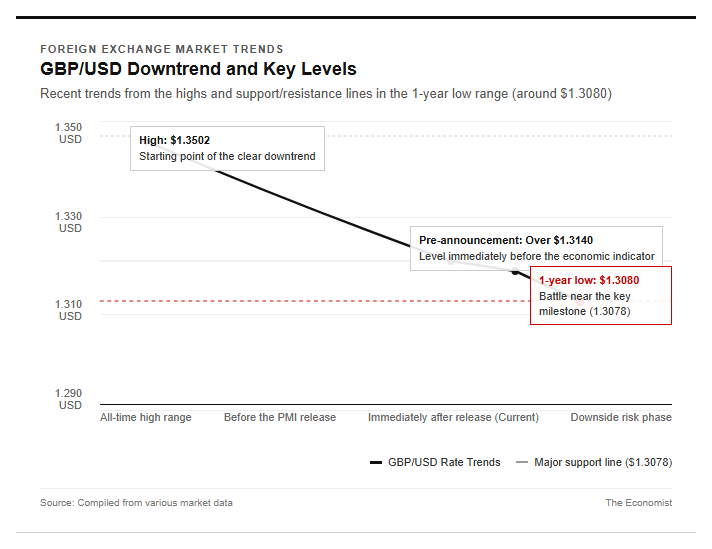
Immediately after the November preliminary PMI missed market expectations, selling pressure on the pound emerged swiftly in the foreign exchange market. Against the US dollar (GBP/USD), the rate was rapidly pushed back from above the 1.3140 level prior to the announcement to around the 1.3110–1.3118 range, interrupting a recent recovery trend. The pound-dollar pair has declined in eight of the past nine sessions, recently touching a temporary low of 1.3080 and updating to soft levels not seen in about 12 months (one year). From a technical analysis standpoint, a clear downtrend has formed from the high of 1.3502, and downside risks targeting 1.3030 and 1.2980 have been pointed out in the event that the 1.3078 support level is broken downward. The figure below is a conceptual chart showing the trajectory of key support and resistance lines for the pound-dollar pair.
Against the Japanese yen (GBP/JPY), selling pressure on the pound and buying pressure on the yen also materialized, with the pair dropping to around 208.73 yen immediately after the PMI release. After going through a short-term correction phase from a high in the upper 216 yen range in July 2026 to the upper 206 yen range in mid-September, the pound-yen has recently shown some signs of buying back, but it has not yet fully returned to a robust upward trend. Some analyses suggest that moving forward, the pair will transition into a range-bound market centered on a price range of roughly 10 yen, spanning from the upper 206 yen range to the upper 216 yen range.
Factors capping the upside for the pound include the deceleration of the UK’s September wage growth rate (excluding bonuses) to 3.5%, and the October Consumer Price Index (CPI), which rose by 3.6% year-on-year—accelerating, but still falling short of the market expectation of 3.7%.
Fading Monetary Policy Expectations for the Bank of England and Pressure from a Strong US Dollar
A major background factor behind the ongoing depreciation of the pound is the shift in market participants’ predictions regarding the policy directions of the UK and US central banks. At its September 2026 meeting, the Bank of England’s (BoE) Monetary Policy Committee (MPC) voted 6 to 3 to maintain the policy interest rate at 3.75%. Subsequently, at the November meeting, it decided to raise the policy rate to 4.00% (8 votes in favor, 1 against) to curb inflation; however, as domestic inflation rates and wage indicators have calmed down, market expectations for additional rate hikes have gradually receded.
Specifically, following the October inflation data release and the soft PMI figures this time, the implied probability of a rate hike at the upcoming December MPC meeting dropped from around 90% previously to about 80%. Although caution remains within the BoE that the timeline for inflation to sustainably return to the 2% target level could be pushed back to the third quarter of 2028, the recent slowdown in economic indicators is prompting cautious policy management.
On the other hand, on the US dollar side, the hawkish stance of the US Federal Reserve (FRB) and strong economic indicators are underpinning the dollar. Although expectations for a large-scale rate cut in December receded somewhat following cautionary remarks by US Treasury Secretary Scott Bessent against excessive tightening, the US dollar’s resilience is being maintained because the October US core PCE deflator is projected to remain high at up 3.2% year-on-year (up 0.3% month-on-month). Although the interest rate level itself has the BoE (4.00%) slightly exceeding the Fed’s target range (3.75% to 4.00%), the US dollar’s dominance and concerns over the UK’s economic slowdown are acting as downward pressure on the pound exchange rate.
Structural Vulnerabilities of the UK Economy and Key Points to Watch
Structural Impacts of Fiscal Debt Issues and Quantitative Tightening (QT)
The underlying weakness of the pound is cast with a persistent shadow not just from short-term PMI deterioration, but also from the structural vulnerabilities of UK public finances and credibility issues in the government bond market. While the UK’s total government debt is not among the highest within G7 nations, due to meager public assets, its net debt basis has reached a severe scale exceeding 90% of GDP. Compared to other countries, the UK is pointed out to lack structural strengths such as the following:
- The backbone of massive domestic personal savings, like that of Japan.
- Institutional support by the European Central Bank (ECB), like that of the Eurozone.
- The international privilege of being a reserve currency, like that of the United States.
Furthermore, because approximately one-quarter of the UK’s issued government bonds are index-linked gilts, the government’s debt servicing costs rapidly swell during phases of persistent inflation. Additionally, due to a high reliance on foreign investors for government bonds, the market possesses characteristics of extreme vulnerability to shifts in market sentiment. Since 2021, the fiscal deficit has failed to break away from high levels of 4% to 5% of GDP, and repeated postponements of austerity plans have led to a decline in market credibility.
In addition to this, the BoE is pursuing Quantitative Tightening (QT) to reduce the UK government bonds held in its Asset Purchase Facility (APF) to zero by 2034. A government bond reduction plan averaging £46 billion per year—including active sales of £20 billion annually—has been resolved, which leads to upward pressure on long-term interest rates (gilt yields) and an expansion of the term premium, further squeezing the flexibility of fiscal management.
Future Developments and Key Points: Inflation Trends and Outlook for the Next MPC Meeting
In assessing the future trajectory of the pound exchange rate and the UK economy, the progression of inflation rates, labor market trends, and monetary policy meetings of major central banks will be crucial focal points. At the upcoming MPC meeting scheduled for December 17, the BoE will be forced into a difficult steering act of managing the risks of inflation suppression and economic slowdown.
In the short term, the US October core PCE deflator figures, scheduled for release on November 25, are seen as a direct catalyst that will heighten volatility in the foreign exchange market. If persistent US inflation is demonstrated, expectations of higher-for-longer interest rates by the Fed will expose the pound-dollar pair to a risk of further decline, threatening the 1.3000 psychological level. On the other hand, if US economic indicators soften, it could present an opportunity for short-term short-covering in the pound.
As for domestic UK factors, continuous attention needs to be paid to the following developments:
- The secondary impacts of Middle Eastern affairs and energy price volatility on the Consumer Price Index (CPI).
- The risk of sticky service inflation driven by rising labor costs and labor shortages.
- Fiscal consolidation plans based on the UK Autumn Budget and the movement of the government bond (Gilt) yield curve.
Although bright spots exist in the manufacturing sector such as AI-related capital expenditure and defense demand, if the slowdown in the services sector and the trend of net job losses persist, concerns over a growth slowdown in the UK economy could intensify further. Market participants will likely scrutinize upcoming remarks by Bank of England officials and the next set of economic indicators as they carefully assess the possibility of a sustained trend reversal for the pound.
References
- [Bank of England (BoE) Monetary Policy Committee (MPC) Minutes (September 2026)] https://www.bankofengland.co.uk/monetary-policy-summary-and-minutes/2026/september-2026
- [S&P Global PMI Data Portal] https://www.markiteconomics.com/Public/Home/Index?language=en
[#UKPMI #PoundSelling #ForeignExchangeMarket #BankOfEngland #UKEconomy #MonetaryPolicy #PoundDollar]


コメント