On November 23, 2026, China’s Z.ai (Zhipu AI) launched its new AI model “GLM-5.4” without prior announcement, designed to deepen reasoning performance without increasing the number of parameters. This move is driven by a growing demand for new technical approaches that achieve advanced logical reasoning and autonomous processing while suppressing massive computational resource and power consumption.
- Key Event Summary: Overview of GLM-5.4 released by Z.ai without prior notice
- The Mechanism of Loop Transformer: Innovation through double layer execution and weight sharing
- First integration of image recognition and support for 1-million-token long context
- Evolution into general-purpose coding and a 50% increase in weekly quotas
- Practical Considerations Regarding Unreleased Benchmarks and Weights
- Future Developments and Key Points: Implications for Energy-Saving and High-Efficiency AI
Key Event Summary: Overview of GLM-5.4 released by Z.ai without prior notice
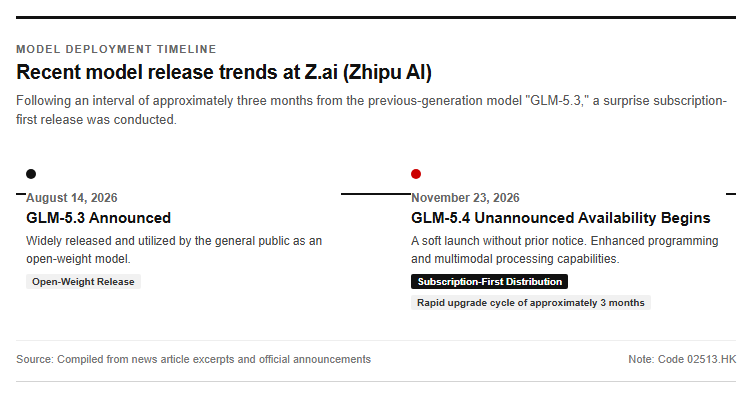
On the afternoon of November 23, 2026, Z.ai (Zhipu AI, Hong Kong Stock Exchange code 02513.HK), a Beijing-based artificial intelligence development company, began unannounced distribution of its latest large-scale AI model, “GLM-5.4,” to users of its paid subscription service, the GLM Coding Plan. Because the release occurred suddenly without prior announcements or countdowns, it has garnered significant attention and surprise across social media platforms like X and within developer communities. The previous generation model, GLM-5.3, was announced on August 14, 2026, and has been widely utilized as an open-weight model; this upgrade comes approximately three months later. This release takes the form of a subscription-first soft launch, provided to paid users ahead of API pricing updates and the release of open weights (model weights). According to Z.ai’s official announcement, GLM-5.4 features significant enhancements not only in traditional text processing but also in complex programming tasks and multimodal processing.
The Mechanism of Loop Transformer: Innovation through double layer execution and weight sharing
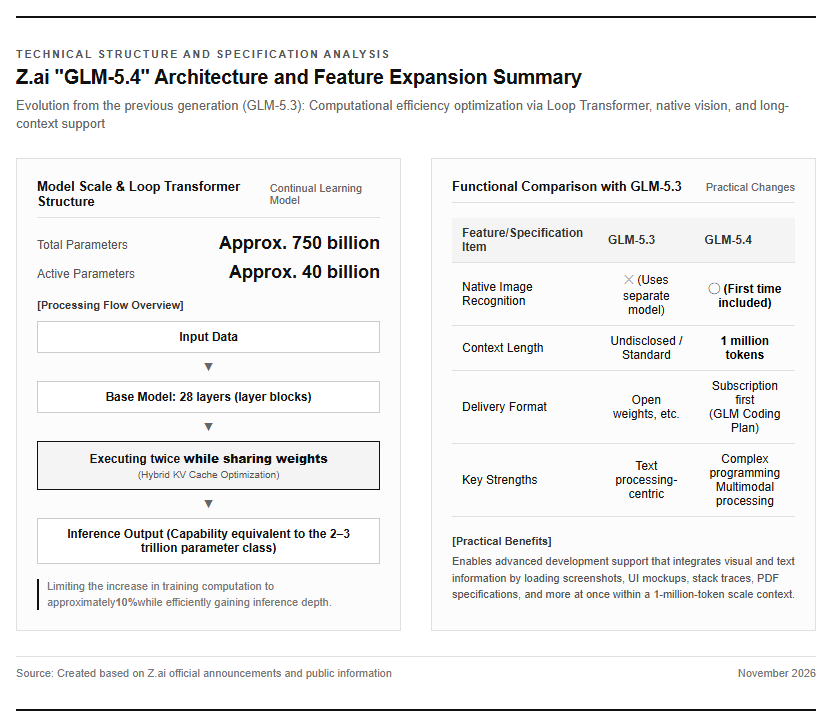
The most significant technical feature of GLM-5.4 is that it marks the first time the company has adopted the “Loop Transformer” architecture in a flagship model. While traditional Transformer models pass input data through each layer once, GLM-5.4 incorporates a design where 28 layers (layer blocks) extracted from the GLM-5 base model are executed twice while sharing parameter weights. It is reported that the total parameter count is approximately 750 billion, with approximately 40 billion active parameters, achieving computational reasoning depth without adding new parameters. Rather than training from scratch, Z.ai has adopted a method of adapting existing pre-trained base models through continual learning. They claim to have achieved reasoning capabilities comparable to massive models with 2 to 3 trillion parameters while limiting the increase in training computational load to approximately 10 percent. Furthermore, by implementing optimizations such as hybrid KV cache—which reuses sparse KV entries and attention indices obtained from the previous loop during the second iterative process—they are preventing a surge in memory consumption and deployment costs.
Key Functional Expansions from GLM-5.3 and Practical Changes
First integration of image recognition and support for 1-million-token long context
The previous generation model, GLM-5.3, was a language model supporting only text input and text output, requiring developers to use separate smaller models like GLM-5.3-Flash for image processing tasks. In contrast, GLM-5.4 integrates native vision capabilities (image recognition) for the first time as a main flagship model. This allows developers to input screenshots of error screens, complex UI design mockups, stack traces, or PDF specifications directly into the model to consult or provide correction instructions. Additionally, GLM-5.4 maintains a context window of 1 million tokens, capable of reading vast amounts of data at once. The ability to process large volumes of both textual and visual information simultaneously is a factor that significantly improves practical efficiency in software development and document analysis.
Evolution into general-purpose coding and a 50% increase in weekly quotas
With GLM-5.4, Z.ai is introducing a new concept called “Generalized Coding” that goes beyond mere program code generation. This refers to the ability of AI to autonomously write and execute code to solve complex problems—such as generating and editing video, building 3D games, 3D modeling in CAD tools, and controlling physical systems—through code description. In published demos, the company demonstrated the design of a 6-axis robot arm using FreeCAD and the creation of interactive 3D applications using custom graphics shaders. Additionally, as a substantial benefit for subscribers, the weekly usage quota for the GLM Coding Plan has been increased by 50 percent compared to when selecting GLM-5.3. For example, in the Lite plan, the quota was raised from 10,000 to 15,000 weekly credits, and in the Pro plan, it was raised from 60,000 to 90,000 credits, providing developers with an environment where they can conduct trial and error more freely.
Implementation Notes and Future Outlook
Practical Considerations Regarding Unreleased Benchmarks and Weights
While GLM-5.4 shows significant functional evolution, there are several points for companies and developers to consider when contemplating its adoption. The most critical point is that, at the time of the announcement, no specific benchmark results (evaluation scores), details on model parameter scale, timing for open-weight availability, or per-token API pricing have been disclosed. Looking at Z.ai’s past release trends, API fees and the release of weights on Hugging Face often occur approximately one to two weeks after the initial release for paid plans; however, at this stage, it is not possible to conduct self-hosted operations or objective performance comparisons. Therefore, for production systems that require a reproducible development environment or strict SLAs (Service Level Agreements), it is recommended to proceed with testing cautiously while maintaining existing models such as GLM-5.3 as a fallback.
Future Developments and Key Points: Implications for Energy-Saving and High-Efficiency AI
As a future development and key point, the architectural direction demonstrated by GLM-5.4—”deepening reasoning without increasing the number of parameters”—carries important implications for the global challenges of rising AI power consumption and costs. With the proliferation of AI agents and advanced automation tools, the demand for computational resources and electricity is increasing exponentially. Particularly in regions facing constraints in power supply or infrastructure, the traditional approach of simply scaling up model size has its limits. Highly efficient model designs, such as the Loop Transformer which utilizes iterative processing of shared layers and adaptive computation, could serve as realistic options for achieving high levels of intelligence while minimizing deployment costs and environmental impact. Z.ai has indicated a policy to move toward open-sourcing its weights following safety verifications, while simultaneously developing next-generation models with further expanded iteration counts and model scales, a move expected to create a technological ripple effect across the entire industry.
Reference Pages
- 【Z.ai Official Site】https://z.ai/
- 【Z.ai Official Developer Documentation】https://docs.z.ai/guides/llm/glm-5.3
【#GLM54 #Zai #LoopTransformer #LatestAIInfo #ImageRecognition #CodingAI #EnergySavingAI #GenerativeAI】

コメント