On October 8, 2026, Google Cloud announced “Gemini agent,” a general-purpose AI agent that completes business inquiries, content creation, and programming within a single window. This reflects a shift in the main battleground of enterprise AI from conventional conversational AI to agent-based systems that autonomously plan and execute complex tasks.
- Key Points and Background of the “Gemini Agent” General-Purpose AI Agent Announcement
- The Evolutionary Mechanism from Conventional AI Chat to “Autonomous Agents”
- “Coworker Agent” and Collaborative Structure via Independent Identity
- Enterprise-level Governance and Cost Control System
- Global deployment case studies, including Japanese companies, and specific operational reduction results
- The Intensifying Competition Over AI Agent Platforms and Future Key Points to Watch
Key Points and Background of the “Gemini Agent” General-Purpose AI Agent Announcement
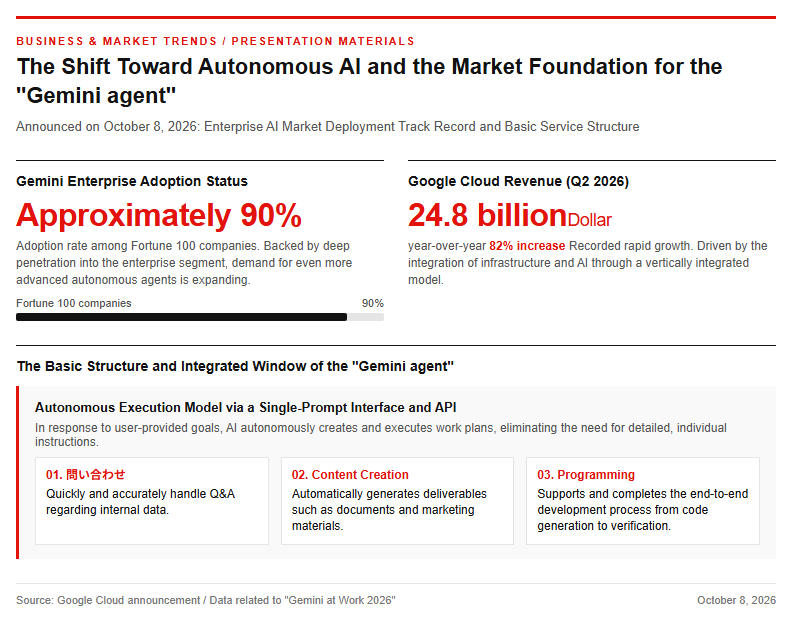
At the “Gemini at Work 2026” event held on October 8, 2026, Google Cloud officially announced “Gemini agent,” an integrated AI agent for enterprises. This service is a general-purpose work agent capable of executing tasks such as text creation, programming, and Q&A regarding internal data through a single prompt interface and API. Rather than users having to individually instruct detailed workflow steps, simply by providing the goal to be achieved, the AI autonomously formulates a work plan, coordinates with necessary tools and internal systems, and generates deliverables.
Driving this is a market trend in which corporate AI utilization is shifting dramatically from simple chat responses to autonomous execution that automates multiple processes. Already, approximately 90% of Fortune 100 companies have adopted Gemini Enterprise, and Google Cloud’s revenue in the second quarter of 2026 reached $24.8 billion, an 82% increase year-over-year. As competitors such as Microsoft and OpenAI successively launch enterprise agent platforms, Google is clearly demonstrating its stance to compete through a vertically integrated model that deeply merges its cloud infrastructure and business systems. Please refer to the image below.
The Evolutionary Mechanism from Conventional AI Chat to “Autonomous Agents”
The fundamental difference between conventional AI assistants and Gemini agents lies in their ability to autonomously execute and complete a series of workflows. Upon receiving instructions, a Gemini agent dynamically generates a group of temporary sub-agents based on the scale and complexity of the task. This makes it possible to continuously execute multi-stage tasks combining parallel and sequential processing in the cloud. Even after the user closes their PC, the processing continues in the background, carrying out long-term project workflows spanning from several hours to several days.
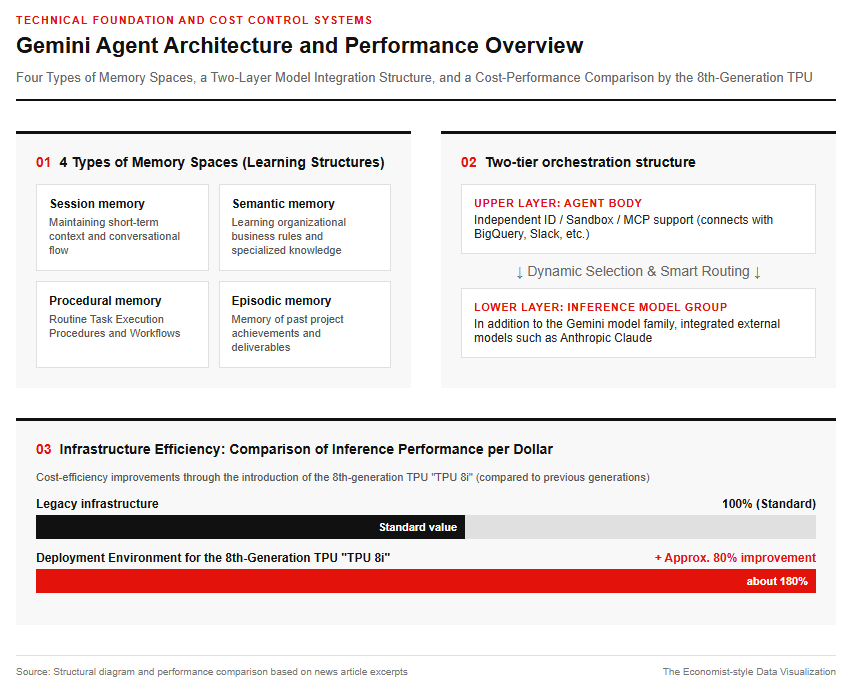
Additionally, the system features a flexible access environment: it not only functions by being embedded directly within Google Workspace (such as Gmail, Drive, Docs, and Calendar), but also integrates with third-party tools such as Microsoft 365, Slack, Confluence, Jira, and Salesforce. Furthermore, by maintaining four types of memory spaces—session memory, semantic memory, procedural memory, and episodic memory—it realizes a structure that progressively learns user preferences and organizational business rules. Its defining characteristic is that it goes far beyond mere question-and-answer interactions, functioning as a true business foundation capable of sharing the workload of actual operations.
Technical Foundations and Security Features Accelerating Enterprise Adoption
“Coworker Agent” and Collaborative Structure via Independent Identity
The Gemini agent is equipped with a “coworker agent” feature that plays a permanent role as a member of an organization. With this feature, agents are assigned a dedicated email address (@agents.company.com), an ID in the internal directory, and an independent storage space. It can be interacted with just like a human colleague, making it possible to assign tasks directly through group chat invitations and mention notifications.
In terms of technical architecture, a two-tier design is employed that separates the agent itself from the underlying reasoning model. In addition to the Gemini model family, it incorporates and orchestrates external models such as Anthropic’s Claude models. By dynamically selecting the optimal model according to the difficulty of the task, it achieves a balance between advanced reasoning and cost efficiency. Furthermore, by supporting the Model Context Protocol (MCP), it possesses the extensibility to securely connect with a wide variety of internal and external data sources and databases (such as BigQuery, Databricks, and Snowflake).
Enterprise-level Governance and Cost Control System
The biggest barriers for enterprises in fully deploying AI agents are security and the management of operational costs. With Gemini agent, every agent is provided with a verifiable least-privilege identity, and the actions taken are strictly recorded not as individual logs, but as the agent’s own audit logs. Furthermore, the execution environment is isolated within a network boundary called an “agent sandbox,” and external communications pass through an “agent gateway” equipped with network firewall functions, thereby minimizing the risk of data leakage.
In terms of cost management, “smart routing” technology has been introduced to automatically route requests to the most cost-effective model based on the nature of the requested processing. Furthermore, administrators can set real-time spending limits for each project via the Cloud Billing Console, with a mechanism that safely pauses processing if the limit is reached. As for the infrastructure foundation, by leveraging the 8th-generation TPU “TPU 8i” specialized for inference processing, performance per dollar has been improved by approximately 80% compared to conventional models, establishing a stable foundation to support large-scale operations. Please refer to the figure below.
Enterprise Adoption Outcomes and the Future Outlook of the AI Agent Market
Global deployment case studies, including Japanese companies, and specific operational reduction results
Gemini agents and Gemini Enterprise are already being adopted by leading companies worldwide, achieving exceptional results in operational efficiency. As a Japanese example, SOMPO Holdings built more than 10,000 custom agents for its 34,000 employees, shortening model development time from one week to just one day. Additionally, by utilizing data analysis agents, NTT DOCOMO reduced the time required to extract insights from two weeks to real-time, anticipating an annual reduction of approximately 450,000 work hours. Furthermore, Hitachi has deployed over 200 use cases for frontline workers, achieving significant productivity improvements.
In overseas markets, financial giant DBS Bank automated corporate credit research by linking 70 to 80 specialized agents, while manufacturing giant Tata Steel reduced customer complaint processing time by 50% through the operation of over 300 agents. These proven results clearly indicate that general-purpose AI agents have moved beyond the mere proof-of-concept stage and entered a practical phase that directly enhances corporate profitability and competitiveness.
The Intensifying Competition Over AI Agent Platforms and Future Key Points to Watch
Since the autumn of 2026, the AI industry has been transitioning from an era of competing for improvements in the accuracy of standalone foundation models to a battle for supremacy over the “control plane”—safely and efficiently controlling multiple agents within an enterprise. Google has announced a roadmap for Gemini agent that evolves and integrates its conventional customization feature, “Gems,” into a more practical “skills” feature, with plans to sequentially end support and transition for personal accounts in November 2026 and for enterprise accounts in March 2027.
Moving forward, how naturally they can be blended into existing workflows while maintaining internal data protection and permission management will determine a company’s success or failure. As competition intensifies with Microsoft’s Agent 365 and OpenAI’s Workspace agents, attention is focused on what market advantage Google’s vertically integrated ecosystem—which consistently provides everything from the cloud and its proprietary TPU chips to office tools—will establish. For every enterprise, it is essential to re-examine its AI governance framework and early on outline a strategy for transitioning to agent-based operations.
Reference Page
- [Google Cloud Official Announcement] https://cloudonair.withgoogle.com/events/2026-gemini-enterprise-roadmap
- [Google Official Blog] https://blog.google/innovation-and-ai/infrastructure-and-cloud/google-cloud/gemini-at-work/
【#Google #Gemini #AIAgent #GoogleCloud #DX #Productivity #GenerativeAI】

コメント