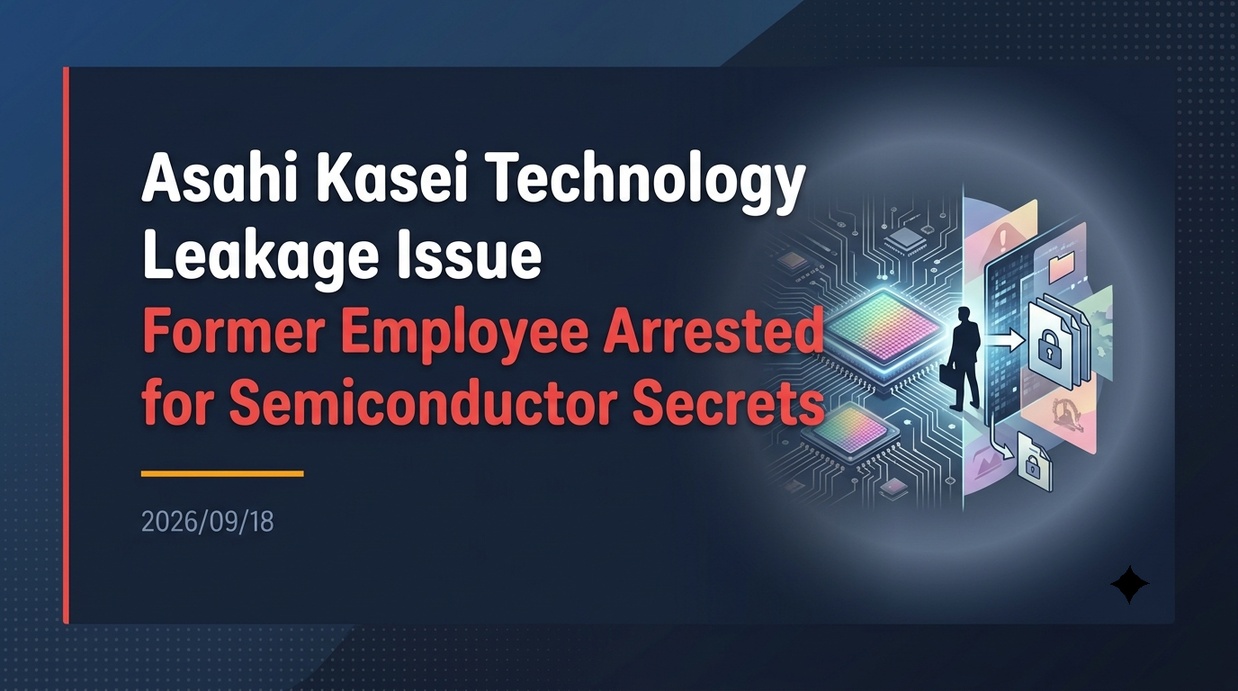
A former senior manager at Asahi Kasei has been arrested on suspicion of violating the Unfair Competition Prevention Act for illegally exfiltrating manufacturing technology for the semiconductor material “Novacure” and leaking it to a Chinese company. The incident highlights the ongoing challenges of managing access privileges for departing employees and the intensifying risks of industrial espionage in the global semiconductor competition.
- Circumstances Leading to the Arrest of Former Asahi Kasei Executive and the Leak Method
- Police Consultation from Subsequent Employer Triggered the Investigation
- Global Competition over Advanced Semiconductor Materials and Technology Defense
- Insider Threats and Security Challenges in Departing Employee Management
- Evolution of Corporate Governance and New Approaches to IP Protection
- Advances in Legal Recourse and the Economic Security Framework
Circumstances Leading to the Arrest of Former Asahi Kasei Executive and the Leak Method
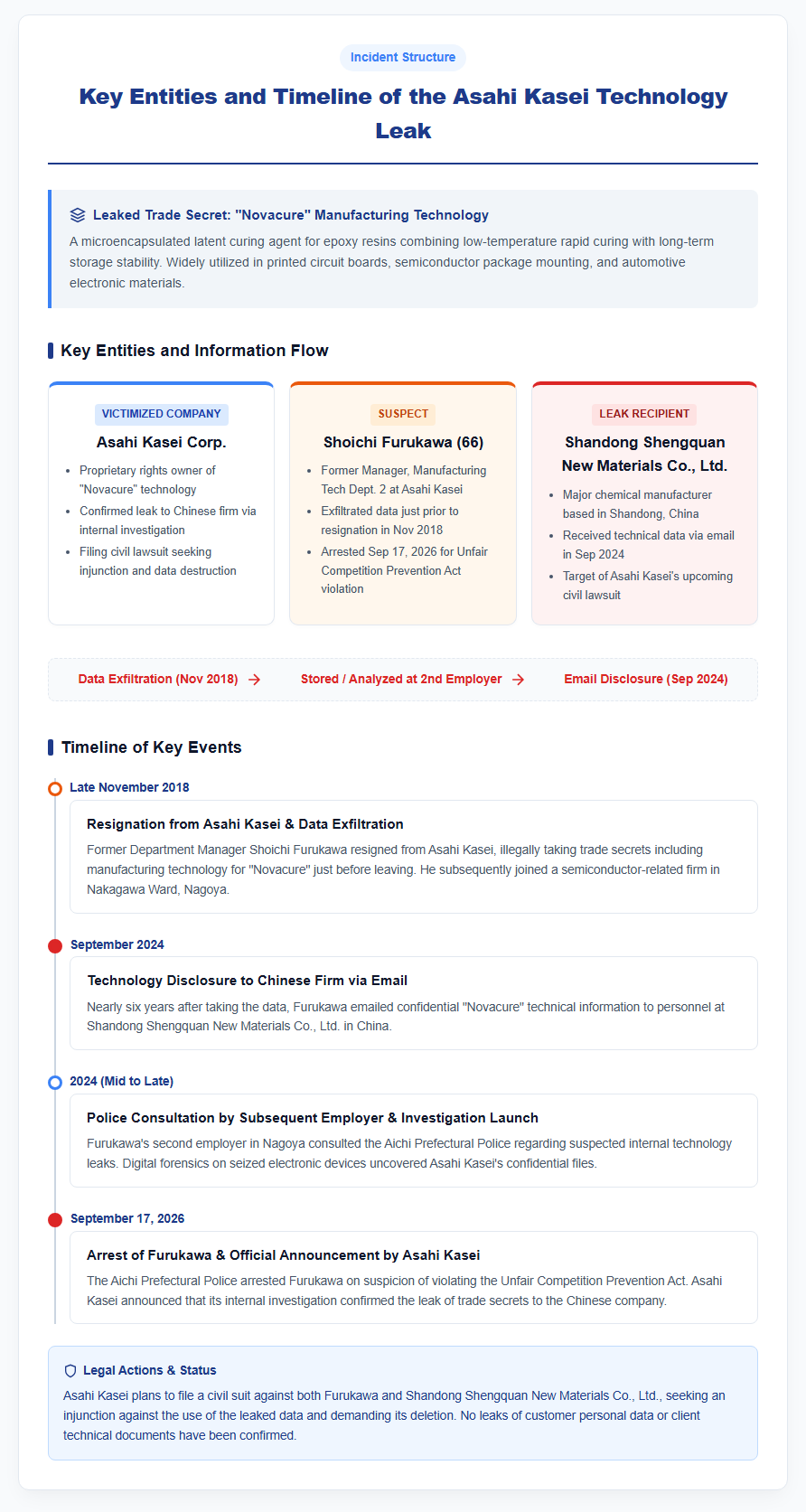
On September 17, 2026, Shoichi Furukawa (66), former Manager of Manufacturing Technology Department 2 at major chemical manufacturer Asahi Kasei Corporation, was arrested by the Aichi Prefectural Police on suspicion of violating the Unfair Competition Prevention Act (disclosure of trade secrets). Furukawa is suspected of illegally taking trade secrets related to semiconductor manufacturing materials developed by Asahi Kasei just before his resignation at the end of November 2018. The leaked information concerns manufacturing technology for “Novacure,” a microencapsulated latent curing agent for epoxy resins widely used in circuit boards, semiconductor package mounting, and automotive electronic materials. In September 2024, nearly six years after leaving the company, Furukawa allegedly disclosed this technical information by emailing it to personnel at Shandong Shengquan New Materials Co., Ltd., a major chemical manufacturer based in Shandong Province, China. Asahi Kasei announced that its internal investigation confirmed the leak of confidential information to the Chinese firm. Consequently, Asahi Kasei disclosed plans to file a civil lawsuit against both Furukawa and Shandong Shengquan New Materials Co., Ltd., seeking an injunction against the use of the information and demanding its destruction. According to the company, no leak of client technical documents or customer personal data has been confirmed. Refer to the figure below for the structure of the unauthorized leak.
Police Consultation from Subsequent Employer Triggered the Investigation
The discovery of this case did not stem from a direct report by the victimized party, Asahi Kasei, but rather from a consultation by another company where Furukawa was subsequently re-employed. After leaving Asahi Kasei in November 2018, Furukawa worked at a semiconductor-related firm in Nakagawa Ward, Nagoya City. In 2024, this subsequent employer consulted the Aichi Prefectural Police regarding suspected unauthorized external leaks of its own semiconductor technology. Initiating an investigation, the police seized electronic devices including computers and smartphones from Furukawa’s residence and related locations. Subsequent digital forensics revealed Asahi Kasei’s confidential data among the seized files. Nearly eight years elapsed between the initial exfiltration in 2018, the external transmission in 2024, and the arrest in September 2026, bringing to light the difficulty of detecting data theft upon resignation and the long-term latency risks of digital data. While the Aichi Prefectural Police have not disclosed whether Furukawa admits to the charges, they are thoroughly investigating potential additional offenses, including the alleged technology leak from his second employer.
Business Management and Industry-Wide Impact
Global Competition over Advanced Semiconductor Materials and Technology Defense
The “Novacure” technology leaked in this incident enables one-part adhesives to achieve both low-temperature rapid curing and long-term storage stability, making it a critical material in cutting-edge semiconductors where miniaturization and high-density packaging continue to advance. In recent years, competition among nations and enterprises for technological dominance in the semiconductor market has intensified amid rising US-China tensions and geopolitical risks. While Japanese companies enjoy high global acclaim for precision chemistry and advanced material expertise developed over decades, they remain vulnerable targets for overseas competitors. Although Asahi Kasei placed intellectual property management and intangible asset utilization at the core of its business and built a sophisticated IP intelligence framework, the incident exposed the inherent difficulty of defending against physical and electronic exfiltration by trusted insiders. The leakage of high-value-added material technology not only erodes a company’s market advantage but also transfers technological superiority to competing nations, severely impacting Japan’s broader industrial competitiveness. From an economic security standpoint, defending critical material technologies has become a top-priority management issue transcending individual corporate boundaries.
Insider Threats and Security Challenges in Departing Employee Management
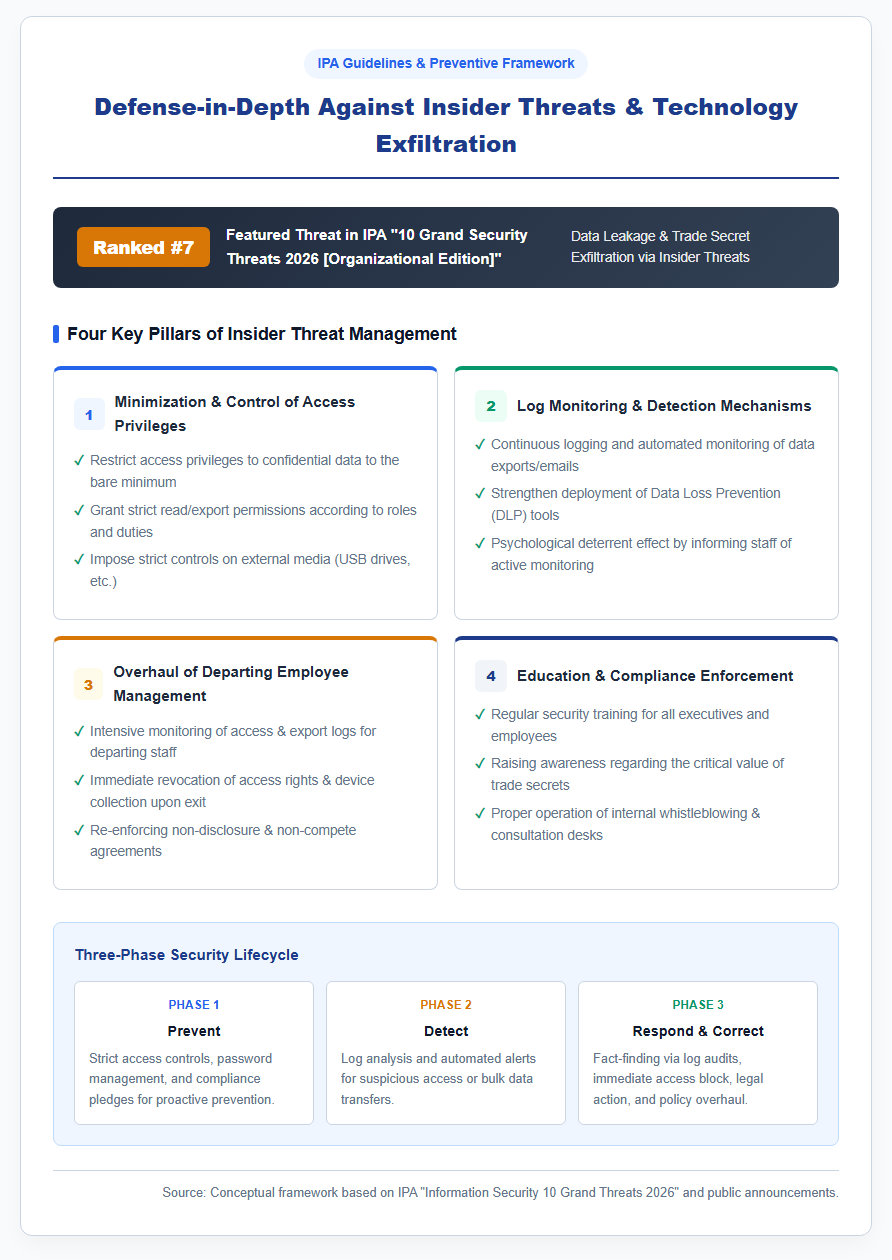
In the “Information Security 10 Grand Threats 2026” published by the Information-technology Promotion Agency, Japan (IPA), “Information Leakage via Insider Threats” ranks as a prominent danger facing organizations. Insider threats involve current employees or executives acquiring information using legitimate access privileges, making them significantly harder to detect or prevent compared to external cyberattacks. Typical exfiltration methods include abusing system permissions, using removable media such as USB drives, email, or cloud storage. As preventive measures, the IPA recommends minimizing access rights, continuously monitoring operational logs and data export histories, enhancing surveillance of departing employees, and enforcing strict non-disclosure agreements. Following the revelation, Asahi Kasei presented countermeasures such as tightening access controls to confidential data, enhancing log monitoring with new IT tools, reforming information management protocols for departing staff, and re-emphasizing compliance training for all executives and employees. Refer to the figure below for a conceptual illustration of insider threat prevention measures.
Future Outlook and Key Points of Attention
Evolution of Corporate Governance and New Approaches to IP Protection
Future industrial practices will demand not only perimeter defense against cyberattacks but also internal monitoring and protection frameworks built on Zero Trust principles. For departing R&D personnel and senior technical managers in particular, automated auditing of historical data access logs and the deployment of Data Loss Prevention (DLP) solutions are rapidly becoming standard protocol. Furthermore, reinforcing the enforceability of non-compete and confidentiality agreements upon departure, alongside regular post-employment follow-ups, is essential. Capital markets and institutional investors are also increasingly weighing the effectiveness of IP protection risk management—including trade secret safeguarding—over mere patent filing counts when evaluating ESG investments and corporate governance. For technology-driven companies such as chemical and materials manufacturers, the precision of an “Open & Close Strategy”—maintaining core technologies as strictly closed and secret while fostering external co-creation through open innovation—will serve as a decisive factor in long-term corporate valuation.
Advances in Legal Recourse and the Economic Security Framework
Beyond criminal prosecution under the Unfair Competition Prevention Act, Asahi Kasei’s planned civil litigation is drawing significant interest. Seeking injunctions against trade secret usage, data destruction, and damages from overseas entities presents complex challenges regarding international jurisdiction and judicial enforcement, making the practical execution of court rulings a key focus. Although the Japanese government has strengthened measures against critical technology leaks through amendments to the Unfair Competition Prevention Act and the enactment of the Economic Security Promotion Act, practical operational hurdles remain at the corporate level. Moving forward, public-private partnerships uniting government, law enforcement, and private enterprise are expected to accelerate information sharing and enable rapid dissemination of threat intelligence regarding technology exfiltration risks. Industry-wide, a transition is anticipated toward a comprehensive risk management paradigm that defends intellectual property not merely as a legal right, but as a critical national economic security asset.
Reference Pages
- 【Asahi Kasei Corporation Official Site】https://www.asahi-kasei.com/jp/
- 【Information-technology Promotion Agency, Japan (IPA) Information Security】https://www.ipa.go.jp/security/
【#AsahiKasei #TechnologyLeak #Semiconductors #UnfairCompetitionPreventionAct #InformationSecurity #EconomicSecurity #IPStrategy】
コメント