The Bank of Japan and Bank Negara Malaysia have signed the Third Bilateral Swap Arrangement with a maximum swap capacity of up to USD 6 billion. Against a backdrop of ongoing global financial market volatility and growing demands for currency stability, the agreement aims to deepen bilateral financial cooperation and reinforce financial stability across Asia.
- Execution of the $6 Billion Third Bilateral Swap Arrangement
- How the Currency Swap Works and Its Role in Strengthening Bilateral Ties
- Robust Domestic Demand and a 4.0–5.0% GDP Growth Outlook for 2026
- Foreign Exchange Intervention and Safety Nets for Reserve Adequacy
- Synergies Between the Chiang Mai Initiative and Bilateral Swap Networks
- Global Monetary Policy Shifts and Key Future Outlook
Execution of the $6 Billion Third Bilateral Swap Arrangement
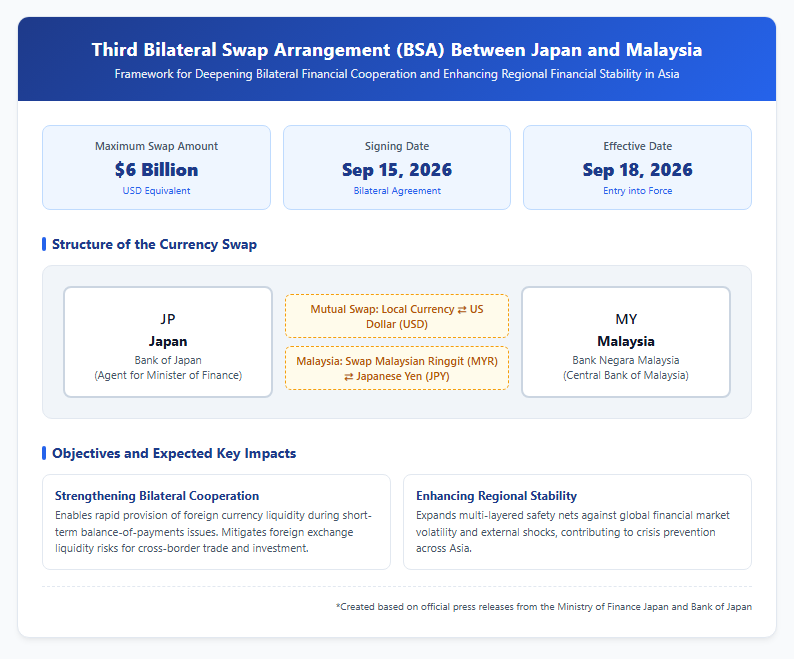
On September 15, 2026, the Bank of Japan, acting as agent for the Minister of Finance of Japan, and Bank Negara Malaysia signed the Third Bilateral Swap Arrangement (BSA), establishing a maximum exchange capacity of up to USD 6 billion or its equivalent in Japanese Yen. Scheduled to enter into force on September 18, 2026, this agreement serves to further strengthen and deepen the long-standing financial cooperation between the two nations.
Financial authorities from both countries agreed that this arrangement will not only fortify bilateral monetary cooperation but also make a substantial contribution to stabilizing the broader Asian financial system. Concluded amidst persistent uncertainty in global financial markets, the agreement has attracted significant attention as a crucial expansion of the financial safety net against external economic shocks. Please refer to the diagram below.
By establishing a mechanism for swift response during sudden capital outflows or liquidity crises, the signing of this agreement stands as a landmark demonstration of mutual trust and robust institutional coordination between Japanese and Malaysian monetary authorities.
How the Currency Swap Works and Its Role in Strengthening Bilateral Ties
The newly signed Bilateral Swap Arrangement enables the financial authorities of Japan and Malaysia to exchange their respective local currencies for US dollars. A key feature of this agreement is that it also permits Malaysian authorities to swap Malaysian Ringgit directly for Japanese Yen.
Under this framework, should short-term balance-of-payments or liquidity issues arise from global market turbulence or sudden capital flight, both nations possess a mechanism to rapidly supply necessary foreign currency liquidity. While the direct day-to-day impact on individual consumers remains modest, businesses engaged in international trade and cross-border investment gain substantial protection, as mitigated foreign exchange liquidity risks foster a far more predictable business environment.
Furthermore, by encouraging local currency settlement and facilitating foreign direct investment, the arrangement establishes a vital foundation supporting operational finance and broader economic exchange between the two countries.
Malaysian Economic Trends and Countermeasures Against Ringgit Depreciation
Robust Domestic Demand and a 4.0–5.0% GDP Growth Outlook for 2026
In its Annual Report released on March 31, 2026, Bank Negara Malaysia revised its real GDP growth forecast for 2026 upward from an initial 4.0–4.5% range to 4.0–5.0%. This growth trajectory is strongly anchored by resilient domestic demand, which is projected to expand by 5.5% year-on-year.
A closer look at individual components reveals that private consumption is expected to maintain steady growth of 5.0%, backed by stable labor market conditions and rising income levels. Private investment is also projected to expand by a solid 7.5%, driven by the steady execution of approved projects. On the trade front, exports of electrical and electronic products remain buoyant alongside accelerating global demand for artificial intelligence infrastructure, lifting total export growth forecasts to 8.6% and import growth to 9.0% for 2026.
Headline inflation is forecasted to hover between 1.5% and 2.5%, remaining close to the long-term average of around 2%. Supported by a healthy financial sector and a strong external balance position, Malaysia’s economic fundamentals remain well-positioned to weather global economic headwinds.
Foreign Exchange Intervention and Safety Nets for Reserve Adequacy
Nevertheless, the Malaysian economy has confronted ongoing pressure from the depreciation of the Malaysian Ringgit in foreign exchange markets. Influenced by monetary tightening and interest rate hikes by the U.S. Federal Reserve, the Ringgit temporarily plunged in February 2024 to its weakest level since the 1997–1998 Asian Financial Crisis.
Although Bank Negara Malaysia held foreign exchange reserves of MYR 509.79 billion as of the end of 2025, analysts point out that this level falls below the International Monetary Fund’s Assessing Reserve Adequacy (ARA) metric (100–150%), indicating a potential vulnerability to external shocks. While keeping its policy rate benchmarked at 3.00% to balance economic growth with price stability, the central bank has actively conducted currency market interventions. Please refer to the diagram below.
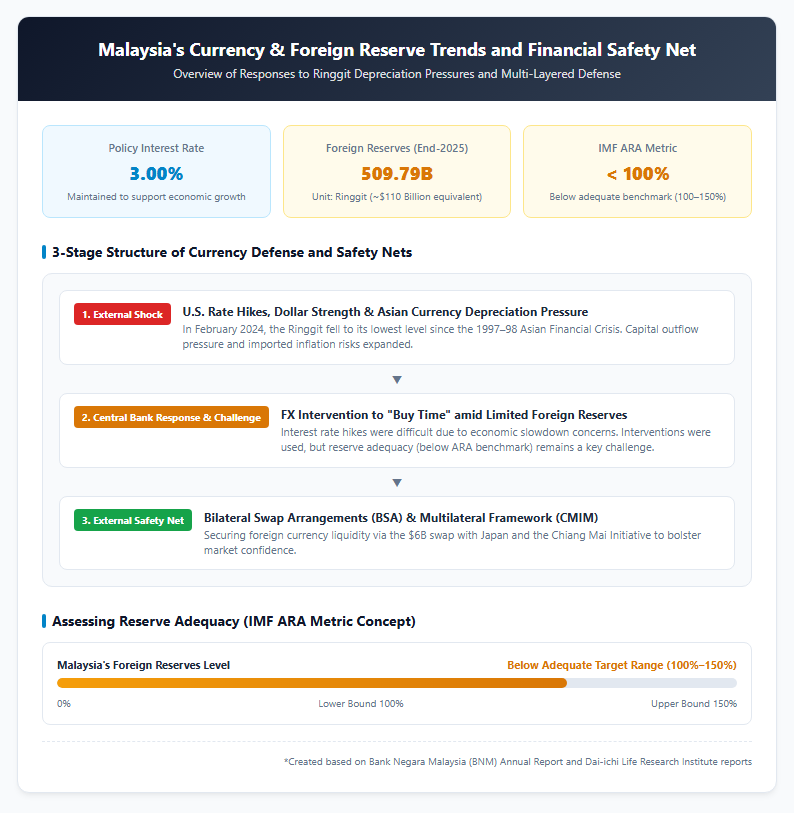
In light of these conditions, renewing and securing the \$6 billion currency swap facility with Japan represents an indispensable measure to reinforce foreign currency liquidity safety nets and bolster market confidence.
Expansion of Asian Regional Financial Networks and Key Future Watchpoints
Synergies Between the Chiang Mai Initiative and Bilateral Swap Networks
Efforts to construct a robust financial safety net across Asia have evolved through a multi-tiered approach following the 1997 financial crisis. The Chiang Mai Initiative Multilateralisation (CMIM)—a regional framework involving ASEAN members along with Japan, China, and South Korea—functions as a collective liquidity support arrangement using standardized operational procedures during financial emergencies.
In contrast, bilateral swap arrangements like the one between Japan and Malaysia play a complementary role by offering agile, flexible liquidity assistance tailored to the specific economic needs of the participating countries. Bank Negara Malaysia has actively expanded this multi-layered safety net, maintaining bilateral swap agreements not only with Japan but also with China, South Korea, Indonesia, and Thailand.
Complementing these agreements are ongoing regional initiatives aimed at reducing reliance on the US Dollar and promoting local currency settlement, thereby fortifying the overall resilience of the Asian financial architecture.
Global Monetary Policy Shifts and Key Future Outlook
Looking ahead, monetary policy decisions by major central banks—including the U.S. Federal Reserve, the European Central Bank, and the Bank of Japan—and shifting interest rate differentials will continue to exert a powerful influence on capital flows into emerging Asian markets. Furthermore, geopolitical developments, particularly in the Middle East, and commodity price volatility remain key swing factors that could trigger imported inflation or exchange rate turbulence.
For business executives and institutional investors, key areas to monitor include how the Malaysian government and central bank manage to sustain domestic demand-led growth while balancing inflation control with ongoing subsidy rationalization. Additionally, market participants will closely watch how effectively the newly established currency swap framework stabilizes foreign exchange dynamics and catalyzes bilateral trade and investment.
As Asian economies work to prevent future financial crises and maintain sustainable growth, the true strength of bilateral and multilateral financial cooperation will remain on test.
References
- 【Signing of the Third Bilateral Swap Arrangement between Japan and Malaysia】https://www.mof.go.jp/policy/international_policy/financial_cooperation_in_asia/bsa/Pressrelease/20260909115514.html
- 【What is the Chiang Mai Initiative (CMI/CMIM)?】https://www.boj.or.jp/about/education/oshiete/intl/g11.htm
- 【Bank Negara Malaysia Annual Report 2025】https://www.bnm.gov.my/ar2025
- 【Malaysia’s 2026 GDP Growth Projected at 4.0–5.0%, Driven by Domestic Demand】https://www.jetro.go.jp/biznews/2026/04/b133619b7c2288e4.html
【#CurrencySwap #BankOfJapan #BankNegaraMalaysia #MinistryOfFinance #FinancialStability #MalaysianEconomy】


コメント