On November 23, 2026, Google Cloud announced native execution integration for local large language models in AlloyDB Omni. This is driven by strong corporate demand for security concerns associated with external cloud API communication, ensuring data sovereignty, and real-time AI processing that eliminates network latency.
- Overview of Direct Local AI Model Execution Announced on November 23, 2026
- Mechanism of Local Inference via Standard SQL Queries and Native Integration
- Complete Local Retention of Data in On-Premises and Edge Environments
- AlloyDB Omni and the Features of its 100% PostgreSQL-Compatible Engine
- High-Speed Vector Search and Columnar Engine via ScaNN Indexes
- Deployment architecture leveraging Ollama and the Kubernetes Operator
- Elimination of communication latency and sub-millisecond query execution performance
- Elimination of token-based billing and stabilization of infrastructure cost forecasting
- Air-gapped and data sovereignty compliance in the financial and medical sectors
- Load Isolation of Production Transactions Using Agent-Dedicated Instances
- Zero-Trust Security via Remote MCP Servers and Model Armor
- Specific Procedures and Practical Examples in Proprietary Document Summarization and Log Analysis
- Plans to Provide Pre-Packaged Models Toward Q1 2027
- Evolution of Database Strategies in the Hybrid Cloud Era
Overview of Direct Local AI Model Execution Announced on November 23, 2026
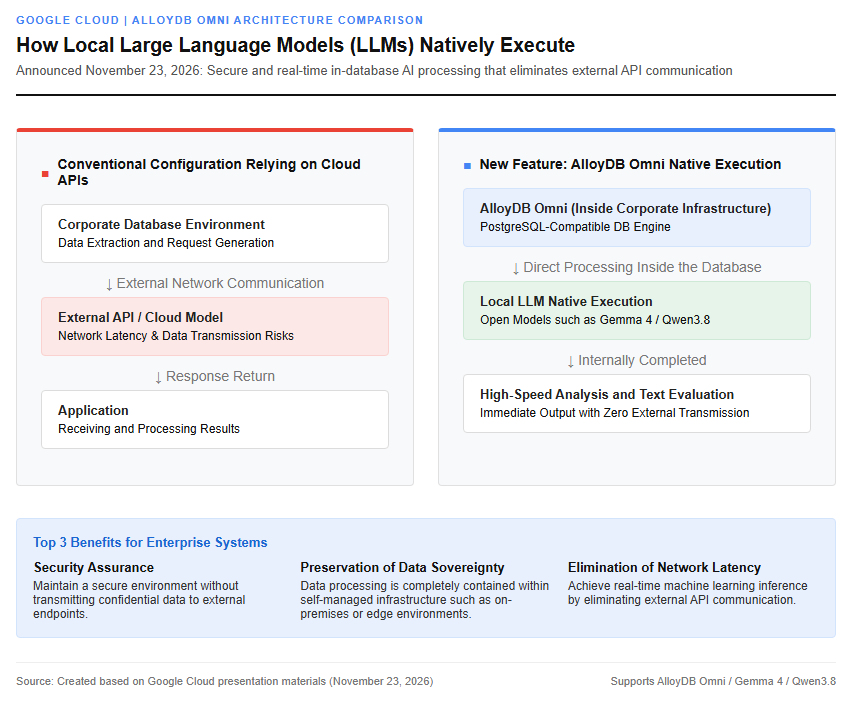
On November 23, 2026, Google Cloud announced native integration capabilities with locally hosted large language models in AlloyDB Omni, its containerized database. AlloyDB Omni is a 100% PostgreSQL-compatible database engine available for download for on-premises environments, edge devices, and self-managed cloud environments. This update makes it possible to run open-weight Transformer models directly inside the database instance, enabling machine learning inference without sending data to external endpoints. This creates an environment where companies can run not only cloud models like Gemini, but also open models such as Google DeepMind’s Gemma 4 and Qwen3.8 entirely within their own infrastructure. This feature, which completes data analysis and text evaluation inside the database, is attracting attention as an initiative that significantly transforms system architectures that previously relied on cloud APIs. The image below shows the overall picture.
Mechanism of Local Inference via Standard SQL Queries and Native Integration
The most prominent feature of this integration is that developers can invoke AI features directly from familiar standard SQL queries. The database includes a built-in google_ml_integration extension, which registers local model servers through procedures such as google_ml.create_model. Once registered, simply executing functions like ai.generate within SQL statements allows for immediate text summarization, classification, and vector embedding generation on row data. For example, when summarizing customer feedback text, the model can be invoked directly inside a SELECT statement and the results retrieved as a separate column. Input and output transformation functions are provided to adjust prompt formats and parse model responses. Because there is no need to separately build inference code on the application side and pass data back and forth, the operational burden on developers is significantly reduced.
Complete Local Retention of Data in On-Premises and Edge Environments
This feature serves as a definitive solution for organizations that cannot permit sensitive data or personally identifiable information to leave their local networks via the internet. Because prompts, input data, and generated answers are all retained within the same local environment where the database runs, governance can be maintained without relying on external AI services. Leakage risks associated with data movement can be proactively prevented, making it ideal for use cases such as internal log analysis, proprietary internal document summarization, and building localized chatbots. Furthermore, it is also possible to deploy custom model weights fine-tuned in-house, allowing organizations to leverage advanced generative AI capabilities while strictly protecting corporate intellectual property and confidentiality regulations. Because it functions even in completely isolated environments, it is expected to be utilized in settings where infrastructure independence is strongly demanded.
Technical Elements and Architecture Supporting the Integration
AlloyDB Omni and the Features of its 100% PostgreSQL-Compatible Engine
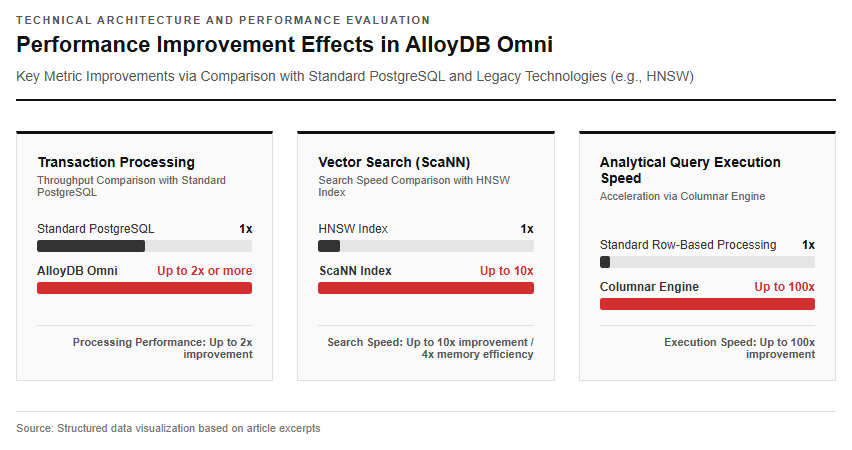
AlloyDB Omni is a product that applies database kernel optimization technologies cultivated by Google over many years while maintaining complete backward compatibility with standard PostgreSQL. Compared to standard PostgreSQL, transaction processing throughput is improved by up to twice or more, supporting operations involving massive access volumes. A major strength is that, being fully PostgreSQL-compatible, modernization can proceed by directly leveraging existing SQL assets, third-party tools, and existing data models. Additionally, it supports a wide variety of deployment forms such as bare metal, virtual machines, Docker containers, and Kubernetes environments, flexibly adapting to each company’s existing infrastructure. Integrating the machine learning inference engine directly onto this foundation has enabled the fusion of traditional transaction processing and advanced AI processing.
High-Speed Vector Search and Columnar Engine via ScaNN Indexes
AlloyDB Omni has built-in vector indexing technology based on the Scannable Nearest Neighbor (ScaNN) algorithm, which powers Google’s search services. Compared to the HNSW index used in standard PostgreSQL, it delivers up to 10x faster search speeds and 4x greater memory efficiency. It enables ultra-low-latency similarity searches even for massive vector datasets on the scale of 10 billion vectors, making it exceptionally well-suited as a backend for Retrieval-Augmented Generation (RAG) systems. Furthermore, it features a built-in intelligent columnar engine that can accelerate analytical query execution by up to 100x. This establishes an architecture capable of performing real-time transaction processing while simultaneously conducting advanced semantic analysis using local models on the same database. Please refer to the configuration diagram below.
Deployment architecture leveraging Ollama and the Kubernetes Operator
For the cooperative deployment of local AI models and AlloyDB Omni, open-source local model servers such as Ollama or the AlloyDB Omni Kubernetes Operator are commonly used. When building a database cluster in a Kubernetes environment, it is necessary to enable the googleMLExtension parameter in the configuration file. By deploying Ollama as a ClusterIP service on port 11434 and registering its endpoint URL with the database side, both communicate seamlessly via the internal network. For model inference processing, automatic hardware acceleration functions for CPU vector acceleration instruction sets and on-premise GPU cards (such as NVIDIA GPUs) operate, enabling highly efficient processing from single-machine to cluster environments.
Comparison with existing cloud API integration and deployment benefits
Elimination of communication latency and sub-millisecond query execution performance
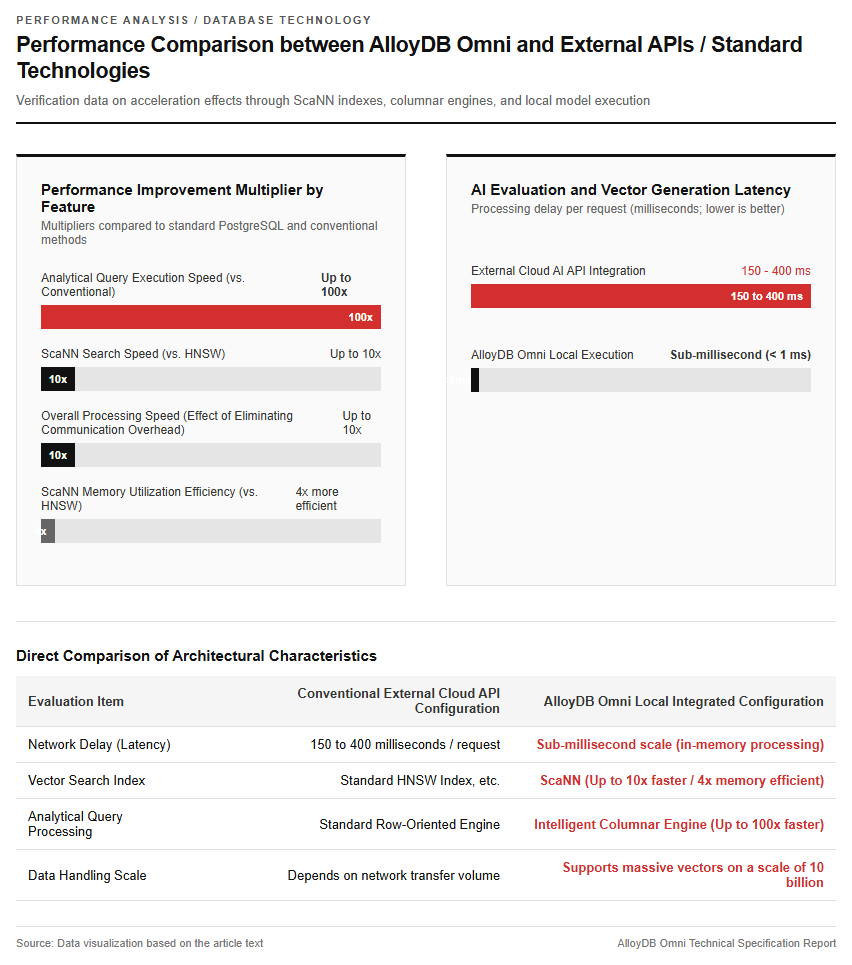
In conventional database architectures, vector embedding of row data in tables or generative AI evaluations required sending HTTP requests to external cloud AI APIs. This method introduced network latency of about 150 milliseconds to 400 milliseconds per request, creating a bottleneck in large-scale data batch processing and real-time transactions. In contrast, local model execution with AlloyDB Omni completes processing in-memory and within the same process, enabling low-latency processing on the order of sub-milliseconds. By completely eliminating network communication round trips, overall processing speed is improved by up to 10x, realizing high-performance applications that instantly generate vectors simultaneously with write processing. Please also refer to the comparison table below.
Elimination of token-based billing and stabilization of infrastructure cost forecasting
When using public cloud AI APIs, variable usage-based billing is incurred according to the number of tokens sent and received, carrying the risk of operational costs surging as traffic increases. Particularly for companies that routinely perform large-scale log analysis or massive document processing, the challenge of making monthly cost estimations has existed. By migrating to a local execution model using AlloyDB Omni, operations become possible based on fixed hardware resource allocation, avoiding unexpected expenditures from token-based billing. Even in high-traffic enterprise operations, AI processing can be continued scalably at a constant infrastructure cost, drastically improving the predictability and cost-effectiveness of medium-to-long-term IT budgets.
Air-gapped and data sovereignty compliance in the financial and medical sectors
In heavily regulated industries such as finance, healthcare, defense, and the public sector, regulations like Europe’s DORA (Digital Operational Resilience Act), HIPAA, and GDPR often prohibit sending customer data or medical records to external public clouds. AlloyDB Omni fully supports operation in completely air-gapped (offline) environments with no external internet connection whatsoever, perfectly meeting strict data sovereignty requirements. It becomes possible to apply advanced AI innovations while completely maintaining security standards even for mission-critical operations that demand the highest levels of compliance, such as financial transaction fraud detection, customer credit risk evaluation, and local analysis of patient data.
Secure AI integration and workload isolation in enterprise operations
Load Isolation of Production Transactions Using Agent-Dedicated Instances
In environments where large-scale AI agents and inference loops operate, bursty query traffic poses the risk of overloading production OLTP databases. To address this challenge, Google Cloud provides PostgreSQL for Agents in AlloyDB. This technology automatically provisions read-only, sandboxed serverless instances (agent pools) against up-to-date data synchronized within seconds. Even when agents generate intensive access spikes, compute resources and the read path on Colossus storage are completely isolated from the production cluster, ensuring scalability of over 3 million queries per second without ever degrading the performance of mission-critical production workloads.
Zero-Trust Security via Remote MCP Servers and Model Armor
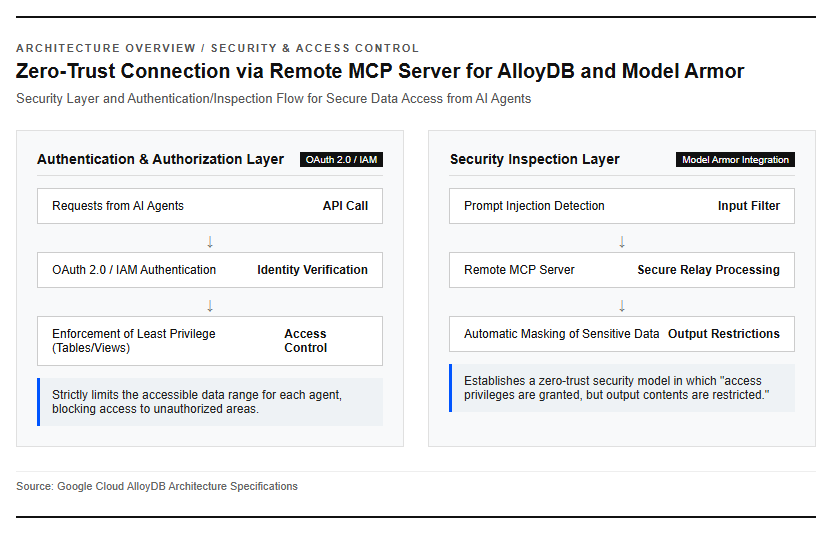
As a secure means of connecting AI agents and databases, Google Cloud has announced the General Availability (GA) of the remote MCP (Model Context Protocol) server for AlloyDB. Deeply integrated with OAuth 2.0 authentication and IAM (Identity and Access Management), it allows granular, least-privilege control over access permissions to specific tables and views for each agent. Furthermore, by integrating with the security infrastructure Model Armor, it provides functions such as prompt injection attack detection and automated filtering of sensitive data (such as credit card numbers). This realizes an advanced zero-trust security model that ensures “access permissions are granted, but output content is restricted,” achieving a balance between governance and automation. The connection topology can be seen in the conceptual diagram below.
Specific Procedures and Practical Examples in Proprietary Document Summarization and Log Analysis
When implementing local LLM integration in a real-world environment, first use a Kubernetes Operator to create a DBCluster with googleMLExtension enabled. Next, start Gemma 4 or Qwen 3.8 in a container such as Ollama, and call google_ml.create_model from the psql client to register the model’s endpoint information. Once registration is complete, executing an SQL query like the one below allows for the automated aggregation of internal inquiry texts and system logs.
SELECT customer_name, ai.generate(‘要約指示: ‘ || comment, model_id => ‘gemma4_llm’) AS summary FROM customer_feedback;
Input data is processed and results are returned within seconds without being sent externally, dramatically reducing manual data processing work.
Future Outlook and Key Highlights of Local AI Databases
Plans to Provide Pre-Packaged Models Toward Q1 2027
Starting with the release of this local LLM integration feature, Google Cloud plans further ecosystem and feature expansions. Over the course of the first quarter of 2027, the company plans to sequentially release pre-packaged model templates specialized for Retrieval-Augmented Generation (RAG) and fraud detection workflows. This will enable engineers to immediately build advanced AI solutions simply by applying standardized templates, without having to write complex prompt engineering or model transformation functions themselves. Improved development speed and lowered barriers to adoption are expected to accelerate the deployment of in-database AI processing across enterprises of all sizes.
Evolution of Database Strategies in the Hybrid Cloud Era
Database strategies in the AI era are evolving from dependence on a single public cloud to a hybrid model that flexibly combines cloud, on-premises, and edge environments. A hybrid operation model is becoming standard: utilizing fully managed cloud services for cutting-edge, ultra-large-scale models and large-scale analytics, while deploying local model integration via AlloyDB Omni for real-time processing that requires high confidentiality and low latency. By leveraging PostgreSQL as a common open-standard protocol foundation, portability across environments can be guaranteed while avoiding vendor lock-in. As companies advance their digital transformations, this architecture—capable of executing AI safely and rapidly right where the data resides—will remain a core option.
Reference Page
- [Google Cloud Blog: Data + AI Anywhere: AlloyDB Omni integration with local models] https://cloud.google.com/blog/products/databases/alloydb-omni-integration-with-local-models
- [Google Cloud Documentation: Install AlloyDB Omni on Kubernetes] https://docs.cloud.google.com/alloydb/omni/kubernetes/current/docs/deploy-kubernetes?hl=ja
- [Google Cloud: AlloyDB Omni Overview] https://cloud.google.com/alloydb/omni
[#Google #AlloyDB #LocalLLM #PostgreSQL #GenerativeAI #Database #Security #Cloud]
コメント